Elevaya journal
Hydraulic Lift Problems in Dubai: Oil Leaks, Sinking, Slow Rides and Summer Heat
Hydraulic lift problems in Dubai villas: oil leaks, sinking cars, slow or jerky rides, summer overheating and noise. Causes, safe checks and fixes.
Published · Updated · Elevaya Lifts
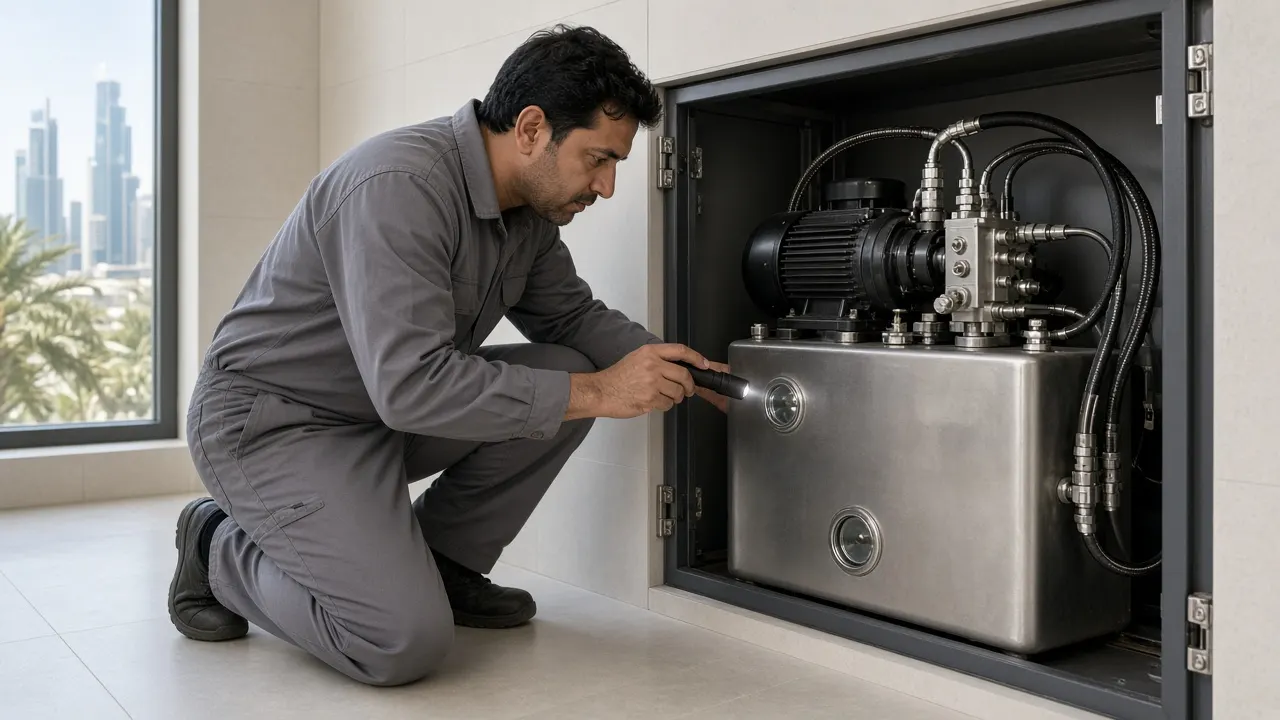
Quick answer: The most common hydraulic lift problems in Dubai villas and low-rise buildings are oil leaks, a car that slowly sinks or keeps re-levelling at a floor, slow or sluggish upward travel, jerky starts, stops and poor levelling, oil overheating in summer, a noisy pump, and a lift that goes down but will not go up. Most of these trace back to a handful of parts: the oil and its temperature, the seals and the cylinder (jack), the hoses and pipe fittings, the valve block, and the pump and motor in the power unit. Owners can safely note symptoms, check that the house has power, keep the power unit room cool and report oil they can see. Anything inside the power unit, the pit or the valve block, including emergency lowering, is work for a trained lift technician. In Dubai, villa lifts follow the same standards family as larger buildings under the Dubai Building Code, and repairs to safety devices, drives or controls can affect the next third-party inspection.
Hydraulic lifts are popular in UAE villas for good reasons. They suit low travel heights, they usually need a modest pit, and the power unit can sit in a small room or cabinet near the shaft. They also have their own way of failing. A traction lift that is wearing out tends to get noisy or rough. A hydraulic lift often tells you through oil: a damp patch in the pit, a car that sits a little lower each morning, a ride that feels different on a hot August afternoon than in January.
This guide is for villa owners, family offices, facility managers and building owners in Dubai and across the UAE who have a hydraulic lift and want to understand what is going wrong, what is safe to check themselves, and what a technician should look at. For the wider picture of lift faults, including doors, alarms and trapped passengers, read our guide to common lift problems in Dubai. This post stays with problems that are specific to hydraulic drives.
Elevaya Lifts has worked in the UAE since 2019 on more than 200 projects, covering design, supply, installation and annual maintenance contracts (AMC). We service all lift brands, including hydraulic lifts we did not install ourselves.
How does a hydraulic lift work, and where do problems start?
A hydraulic lift moves the car with oil: a pump pushes oil from a tank into a cylinder to lift the car, and a valve lets the oil flow back to the tank to lower it. Because the whole system depends on oil under pressure, most hydraulic lift problems start with the oil itself or with the parts that hold, move and control it.
The main parts are:
- The power unit. A tank of hydraulic oil, an electric motor and pump, and a valve block that controls flow up and down. In villas it usually sits in a small machine room or a cabinet next to the shaft. Our hydraulic lifts page explains how the drive arrangement varies between projects.
- The cylinder (jack) and ram. The cylinder holds the oil that raises the car. The ram slides in and out through a seal at the cylinder head. Some installations push the car directly, others use ropes and a pulley (an indirect or roped arrangement).
- Hoses and pipework. They connect the power unit to the cylinder. Each fitting is a possible leak point.
- Safety and control devices. These include a rupture valve on the cylinder that stops the car if a hose or pipe fails, an emergency lowering arrangement to bring the car down during a fault or power cut, oil temperature monitoring, and a re-levelling function that brings the car back to floor level if it drifts.
- The controller. As on any lift, it runs the motor and valves, reads the door locks and safety circuit and decides when the lift may move.
Going up takes energy, because the pump has to push oil. Going down mostly uses gravity, with the valve controlling the speed. That simple fact explains a common symptom: a hydraulic lift that will still go down but will not go up usually has a problem on the pump, motor, power supply or "up" side of the control system.
Hydraulic lift problems at a glance
Use this table to match what you see to the likely cause, what you can safely do and who should fix it. It is a guide for a conversation with your lift company, not a repair manual.
| What you notice | Likely causes a technician checks | Safe owner checks | Who fixes it |
|---|---|---|---|
| Oil in the pit, on the cylinder or around the power unit | Worn cylinder head seal, loose or damaged hose or pipe fitting, valve block seal, tank or pump seal | Note where you see it and how much; keep people away; do not wipe inside the pit | Lift technician |
| Car sinks below the floor when parked, or re-levels often | Internal valve leakage, cylinder seal wear, external leak, oil temperature effects | Note how far and how often, and whether it is worse after a hot day or a long idle period | Lift technician |
| Slow or weak upward travel | Low oil level, pump or motor wear, valve adjustment, low or unbalanced supply voltage, very hot oil, overload | Check that the load is normal and that other appliances on the same supply work | Lift technician (with the electrician for supply issues) |
| Jerky start, hard stop or uneven levelling | Valve settings, oil temperature and viscosity, air in the oil, guide shoes or rollers | Note whether it happens on every trip or only when the lift is cold or hot; warn users about any step at the door | Lift technician |
| Lift stops in summer and restarts later | Oil temperature protection, a hot or poorly ventilated power unit room, heavy use | Check the room is not sealed, blocked or used for storage; check any cooling or ventilation is running | Lift technician (and AC contractor if the room cooling has failed) |
| Whining, groaning or knocking from the power unit or shaft | Low oil or aerated oil, pump wear, motor mounts, valve noise, ram or guide contact | Note when it happens (up, down, start, stop) | Lift technician |
| Goes down but will not go up | Pump or motor fault, thermal or phase protection, contactor, overload, up-direction valve | Check that the house has power and the lift's supply has not tripped; do not reset breakers inside the lift panels | Lift technician |
| Lift will not move at all | Door lock or safety circuit open, controller fault, power supply, protection trip | Check every landing door is fully closed and the house has power | Lift technician |
If someone is trapped in the car, follow the steps in the trapped-passenger section of our common lift problems guide and call your lift company's emergency line. In a medical emergency, fire or smoke, call the emergency services first. The UAE government's handling emergencies page lists 999 for police, 998 for ambulance and 997 for the fire department.
Hydraulic lift oil leaks: where they come from
Most hydraulic lift oil leaks come from four places: the seal at the cylinder head, the hose and pipe fittings, the valve block and the power unit itself. A small leak is usually a maintenance item. A growing leak, oil on the pit floor or oil near electrical parts needs attention quickly.
What a technician will look for:
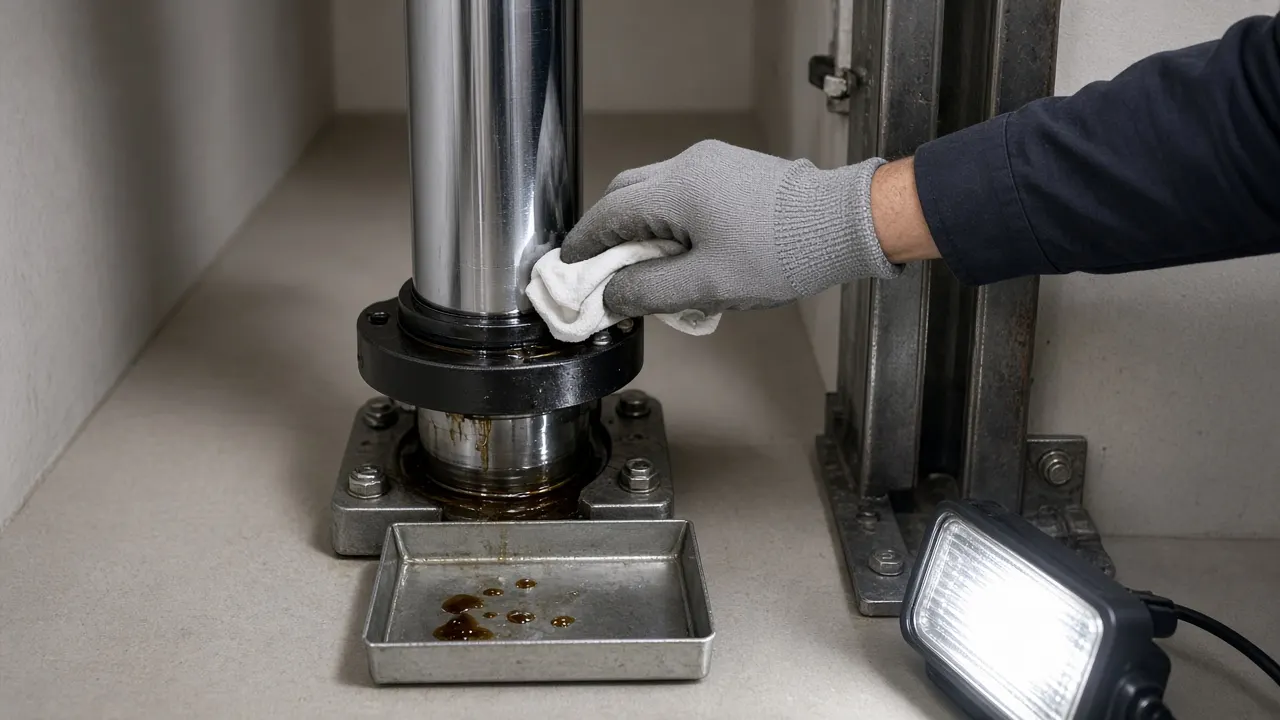
- Cylinder head seal. The ram slides through a seal at the top of the cylinder. As it wears, a thin film of oil appears on the ram and drips into a tray or the pit. Dust and sand on the ram speed up the wear, which is one reason pits and rams should be kept clean.
- Hoses and fittings. Flexible hoses age, especially in hot rooms. Fittings can loosen with vibration. Weeping at a fitting is often fixed by tightening or replacing a seal; a cracked or swollen hose should be replaced.
- Valve block. Seals inside and outside the valve block can leak. An internal leak does not show as oil on the floor. It shows as a car that drifts down when parked (see the next section).
- Tank and pump. Seals on the pump, the tank lid and pipe entries can weep, and a tank that is overfilled can push oil out of its breather.
Things owners should not do: do not climb into the pit to look, do not try to tighten fittings, and do not top up oil yourself. The right oil type and level are part of the lift's technical data, and the level reading depends on where the car is parked. Oily cloths and waste oil should be removed by the technician and disposed of through a proper waste route, not general household waste.
Why does a hydraulic lift sink or keep re-levelling?
A hydraulic car sinks when oil escapes from the cylinder faster than it should, either out of the system as a visible leak or back to the tank through a valve that does not seal fully. The lift's re-levelling function then runs the pump to bring the car back to the floor. Occasional re-levelling is normal behaviour. Frequent re-levelling, or a car that sits visibly below the floor, is a sign that something needs checking.
Common causes:
- Internal valve leakage. A worn or dirty valve seat lets oil seep back to the tank. There is no oil on the floor, but the car drifts.
- Cylinder seal wear or a leak in the pipework. Oil leaves the system and usually shows up somewhere.
- Temperature. Oil contracts as it cools. A car parked after heavy use on a hot afternoon can settle slightly overnight as the oil cools, even without a leak. A technician can tell the difference between normal settling and leakage by testing under controlled conditions.
- Idle periods. Villas that stand empty for weeks during travel can show more settling and stiffer seals when the lift is first used again.
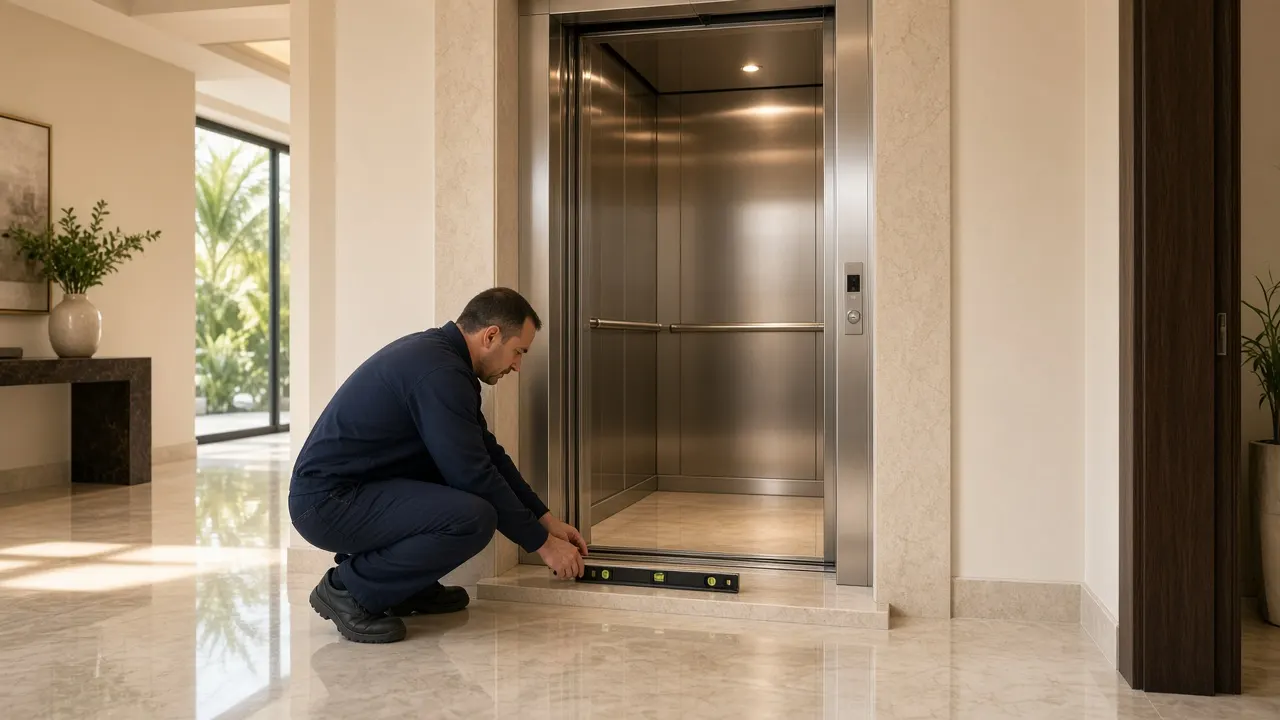
Why it matters: a car that stops or sits below floor level creates a trip step at the door. Our lift COP and LOP panels guide and common lift problems guide explain the wider door and levelling issues. Tell your maintenance company how far the car has dropped, how quickly, and whether it happens after hot days or idle periods, because that pattern helps them find the cause faster.
Slow, weak or jerky rides on a hydraulic lift
A hydraulic lift that is slow going up, starts with a jolt, stops hard or stops unevenly usually has a problem with oil condition and temperature, valve adjustment, the pump and motor, or the power supply. These problems often creep in gradually, so families notice them as "the lift feels different" rather than as a breakdown.
- Slow upward travel. Low oil, a worn pump, a slipping motor coupling, a valve that is out of adjustment or low supply voltage can all reduce the flow of oil. A heavily loaded car on an older unit can also feel slower.
- Jerky starts and hard stops. The valve controls acceleration and deceleration. Settings that were right when the lift was installed can drift, and oil viscosity changes with temperature, so a lift that rides smoothly in winter may feel rougher in summer if the settings and oil are not right.
- Uneven levelling. The car stops above or below the floor because the valve and controller are not stopping it accurately, often linked to temperature or valve wear.
- Air in the oil. Aerated oil compresses, which can make the ride spongy and noisy. It can follow low oil levels, leaks on the suction side or recent work on the system.
A technician will usually check the oil level and condition, the temperature, the valve settings and the pump and motor, then test the ride across several trips. If the problem keeps returning, the valve block or the power unit may be due for an upgrade rather than another adjustment. Our post on lift upgrades in Dubai covers targeted upgrades in more detail.
Hydraulic lifts in UAE summer heat
Heat is the UAE-specific problem for hydraulic lifts: hot oil gets thinner, ride quality and levelling change, and oil temperature protection may stop the lift until it cools. The power unit itself adds heat every time the pump runs, so a small, sealed room with no ventilation can get much hotter than the rest of the villa.
What helps:
- Keep the power unit room or cabinet ventilated or cooled. If the design included an extract fan, a cooling unit or a louvred door, make sure it works and is not blocked. Do not use the room for storage.
- Ask about oil temperature. Your lift company can tell you whether the unit has an oil cooler or heater, what the temperature protection does, and whether the oil grade suits the conditions.
- Plan for heavy-use days. Parties and moving days mean many trips in a short time. If the lift has stopped on hot, busy days before, mention it to your technician.
- Keep sand and dust out. Sand on the ram and in the pit wears the cylinder seal and contaminates the oil. Keep pit areas dry and clean, and report water in the pit after rain or washing.
Glass and outdoor lifts face the same issue with more sun on the shaft. Our glass villa lift guide explains cooling for glass shafts and power units at the design stage.
Power cuts and emergency lowering
Hydraulic lifts have an emergency lowering arrangement that lets the car be brought down to a landing so passengers can get out, but on most installations it should only be operated by a trained person. Some units use a battery-powered lowering device that does this automatically during a power cut. Others rely on a manual lowering valve in the power unit, used by a technician or trained person following the manufacturer's procedure.
For owners:
- If the power fails and someone is in the car, keep them calm, tell them help is coming and call your lift company. Do not try to open the doors or reach the power unit valves yourself unless you have been trained on that specific lift.
- If the lift has an automatic lowering device, ask your technician how to tell whether its battery is healthy, and have it tested as part of routine maintenance.
- After a power cut, check that the lift returns to normal service. If it does not, call your lift company rather than switching breakers on and off.
Our lift upgrades guide covers rescue devices for power cuts on both traction and hydraulic lifts.
Noise from a hydraulic lift
Noise usually comes from the power unit (pump, motor and valves), from oil that is low or aerated, or from the car and ram running against their guides. A useful report to your technician says where the noise is (power unit room, shaft, car) and when it happens (going up, going down, starting, stopping).
- Whining or screaming from the pump can point to low oil, aeration or pump wear.
- Knocking or banging at start or stop can point to valve adjustment or worn mounts.
- Groaning or rubbing in the shaft can come from guide shoes, rollers or the ram.
- A new noise after hot weather or a long idle period is worth reporting even if the lift still works.
What owners can safely check, and what to leave to a technician
Owners can observe, record and keep the area safe; anything inside the power unit, the pit, the controller or the valve block is work for a trained lift technician. Hydraulic systems hold oil under pressure, and the car and ram can move.
Safe to do:
- Note the symptom, the time, the weather and how often it happens.
- Check the house has power and the lift's supply has not tripped.
- Check every landing door is fully closed.
- Look from outside for oil you can see without entering the pit or opening panels.
- Keep the power unit room clear, ventilated and locked.
- Take the lift out of use if it sinks noticeably, leaks visibly or behaves unpredictably, and call your lift company.
Never do:
- Enter the pit, climb on the car or open the power unit or controller.
- Operate the manual lowering valve or hand pump unless you are trained on that lift.
- Top up or change the oil yourself.
- Reset breakers or protection devices inside the lift's own panels.
- Keep using a lift that is leaking heavily or stopping below floor level.
Hydraulic lift maintenance: what a service visit should cover
A good hydraulic lift service visit checks the oil, the leaks, the cylinder and hoses, the valves, the power unit, the temperature protection, the emergency lowering arrangement and the ride, as well as the doors and safety circuit that every lift has. Our lift maintenance checklist for Dubai sets out the full monthly visit for all lift types. For hydraulic lifts, ask that the visit and the log book include:
- Oil level and visible condition, and any top-up made.
- Leak check at the cylinder head, hoses, fittings, valve block and power unit, with the drip tray emptied and cleaned.
- Ram and cylinder condition, including dirt or scoring that could damage the seal.
- Hose condition: cracking, swelling, rubbing or loose clamps.
- Re-levelling and drift: how far the car settles and how often it re-levels.
- Ride and levelling at each floor, going up and down.
- Power unit room temperature and ventilation, and oil temperature behaviour.
- Emergency lowering and any battery lowering device tested as the manufacturer recommends.
- Pump and motor noise, mounts and electrical connections.
- Rupture valve and other safety devices tested at the intervals the manufacturer and the inspection body require.
Oil changes, hose replacement and seal kits follow the manufacturer's instructions and the condition of the equipment rather than a single fixed rule. Ask your maintenance company to write down when they expect these to be due, so the cost is planned rather than a surprise.
Under Dubai Building Code clause K.5.5.4, where elevators are provided in villas, their design shall conform to sections D.5 and D.6. Clause D.5 says vertical transportation is designed, installed, tested, commissioned and maintained to one suite of standards, ASME A17 or BS EN 81, and the two are not used interchangeably. So a villa hydraulic lift should be maintained against the same standards family it was built to. As a side note on energy, clause D.6.1 requires variable voltage, variable frequency (VVVF) drives on non-hydraulic elevators in new buildings, which is one of the comparisons people make when they weigh hydraulic against traction and MRL lifts.
Repairs, certification and inspection in Dubai
Confirm the applicable examination and certification programme for the hydraulic lift with the appointed inspection body. Dubai Municipality guideline DM-HSD-GU48-ECLA2 addresses lifting equipment in its stated scope, including workplaces; do not infer a blanket annual certification rule for every private villa from that workplace guidance alone.
Within its stated scope, Dubai Municipality guideline DM-HSD-GU48-ECLA2 (version 5, 2025) says:
- Lifts shall be tested and certified by a third party accredited by the Emirates International Accreditation Centre (EIAC) once every 12 months (requirement 1).
- The certificate of safety is issued after due examination and test, and only after any repairs have been carried out (requirement 4).
- Repairs identified by the accredited third party shall be carried out by the owner or occupier immediately (requirement 5).
- If the accredited third party considers the equipment unsafe, the owner must be advised to cease use, and a report goes immediately to the Health and Safety Department (requirement 6).
- The compliance certificate shall be kept at the site (requirement 9).
EIAC's requirements for lifting-equipment inspection bodies, EIAC-RQ-IB-002, are useful when a hydraulic repair is larger than a seal or hose:
- Clause 2.6 treats repair or alteration as restoring equipment by rebuilding or exchanging parts or units, and includes alterations to safety devices and to driving mechanisms and controls. A new power unit, valve block or controller falls into that territory.
- Clause 2.21 describes a periodic inspection as a thorough inspection, including visual, functional and load testing where applicable, of equipment that is operational or has been repaired or altered.
- Clause 2.22 lists cases for a major inspection, including after a major repair or alteration and for equipment that was upgraded or modified.
In practice: before replacing a cylinder, power unit, valve block or controller, ask your lift company and the inspection body what inspection will be needed afterwards. Our annual lift inspection certificate guide and inspection preparation service explain how to prepare.
Repair, upgrade or modernize a hydraulic lift?
Repair the fault when the lift is basically sound and parts are available; upgrade one system when it keeps failing; consider modernization when several systems are worn, parts are hard to find or the lift no longer suits how the home is used.
| Situation | Usually the right step |
|---|---|
| A weeping fitting, a worn hose or a single seal | Repair under the AMC; parts charged as needed |
| Frequent re-levelling caused by valve wear | Valve repair or valve block replacement |
| Repeated summer stops | Check room cooling and oil temperature; consider an oil cooler or improved ventilation |
| Cylinder scoring or recurring head seal leaks | Cylinder or ram repair or replacement, followed by the inspection the inspection body requires |
| Old power unit and controller, parts hard to source | Power unit and controller upgrade, or modernization |
| Several systems failing, lift no longer suits the home | Full modernization or replacement; compare hydraulic with MRL traction |
Our guides to elevator modernization in Dubai and the lift modernization guide explain scope and planning. If parts are the issue, our elevator spare parts guide explains compatibility.
Can one company repair any hydraulic lift brand?
Yes. A multi-brand lift company can maintain and repair most hydraulic lifts regardless of who installed them, provided it can identify the equipment, get the technical information it needs and source compatible parts. Elevaya services all lift brands, including hydraulic villa lifts we did not install.
The first visit on an unfamiliar hydraulic lift is a survey. We confirm the make and model of the power unit, valve block, cylinder and controller, check the oil and the leak points, review the service history and test the ride. Then we give a written repair scope. Our guide to multi-brand lift maintenance explains how this works, and our villa and home lift maintenance page sets out the service.
How an AMC prevents hydraulic lift problems
Monthly maintenance catches small leaks, oil and temperature issues, drift and worn hoses before they turn into breakdowns, and an AMC makes the response to breakdowns predictable.
In Dubai, Elevaya's non-comprehensive AMC for a G+1 villa lift starts from AED 2,500 a year. It includes 12 visits a year (one each month), fixes for issues found and free 24-hour emergency callouts; only replacement parts are charged, and only when they need changing. The elevator AMC cost guide explains what that covers, and lift repairs explains how we handle breakdowns.
Related Elevaya guides
Continue planning with these related Elevaya guides:
- Common lift problems in Dubai: causes and fixes: stuck lifts, doors not closing, jerky rides, noise and summer heat trips, safe owner checks and repairs.
- Lift maintenance checklist for Dubai: monthly service visit: what each monthly visit should check on doors, ride, machine and brake, alarm, car top and pit, the log book, maintenance vs inspection, villa lifts and an escalator checklist.
- Glass villa lift in Dubai: footprint, heat and cost factors: shaft vs shaftless, laminated glass, cabin cooling, hydraulic vs MRL vs platform.
- Escalator installation in the UAE: step-by-step process: survey and selection, pit and truss supports, rigging, alignment, controller, safety devices, testing, EIAC inspection and handover.
- Lift installation in Dubai: step-by-step process: survey, shaft, pit and headroom prep, supply and delivery, installation sequence, testing, EIAC certification and handover.
- Escalator modernization in the UAE: signs it is due, modernize vs replace, drive, step and handrail upgrades, phased mall works and Dubai compliance.
- Escalator design and maintenance for UAE malls: layout, balustrades, dust and heat, AMC and modernization.
- Escalator faults and repairs in Dubai: why escalators stop, safety-device trips, handrail and step chain wear, sand and heat, repair vs modernization.
- Elevator and escalator speeds in UAE buildings: rated lift speed by travel height and 0.5 vs 0.65 m/s escalators.
- Lift and elevator supply in the UAE: buyer's guide: supply-only vs supply and installation, what to specify, what a supply quote must include, BS EN 81 / ASME A17, EIAC certification, escalator supply and red flags.
- Dubai annual lift inspection certificate: who issues it, 12-month and 6-month inspection rules and how to prepare.
- Lift installation in Ras Al Khaimah and Fujairah: local rules, the design study, the annual certificate and installation steps.
- How to choose the best lift company in Dubai: buyer's checklist: licences, AMC terms, written response times, parts, references and red flags.
- Elevator modernization in Dubai: signs, scope and standards: when to modernize, controller and door upgrades, EN 81-20/80, downtime and cost factors.
- Lift upgrades in Dubai: what to upgrade first: rescue devices for power cuts, door light curtains, VVVF and energy saving, cabin refresh, alarms, upgrade vs modernization.
- Elevator AMC cost in Dubai: villa owners' guide: non-comprehensive from AED 2,500 for G+1, visits, callouts and parts rules.
- Lift out of service in a UAE building: who to report it to: who is responsible, the RERA route in Dubai, municipality contacts by emirate, and what owners and tenants can ask for.
- Export lifts and elevator spare parts from the UAE: export documents, HS codes, certificate of origin and the steps from enquiry to shipment.
- Lift COP and LOP panels in Dubai: what is on each panel, DBC button heights, Braille and intercom rules, common faults, repair vs replacement.
- Lift speed by building height in Dubai towers: DBC travel-time formula, worked m/s examples, waiting times, DHA hospital and Trakhees rules.
- Glass and panoramic villa lifts in Dubai: 2026 planning guide: placement, glazing, heat control, approvals and AMC care.
- Elevator cabin design trends in the UAE for 2026: finishes, COP/LOP panels, LED lighting and glass cabins.
- Luxury elevator interiors in the UAE: marble, bronze and wood: weight, fire performance and cleaning of premium cabin finishes.
- Bespoke luxury home lifts in Dubai: gold, gems and rare marble: what can be customised, how gold, platinum, diamonds, crystal and rare marble are specified, weight and load, Dubai safety rules, the design process and care of precious finishes.
- Swarovski crystal lift cabins in Dubai: crystal, onyx and light: crystal ceilings and walls, backlit onyx, mirrors, cabin lighting levels, and how to keep crystal secure and serviceable in a moving cabin.
- Gold lift doors and luxury lift panels in Dubai: gold and platinum landing doors and frames, engraved or monogrammed COP and LOP panels, jewelled push buttons, handrails, and how to make them last.
- Bespoke luxury lift design process in Dubai: from brief and mood board to material samples, 3D renders, a full-scale mock-up, fabrication, installation, handover and AMC care of precious finishes.
- Luxury marble and onyx lift interiors in Dubai: rare stones beyond Calacatta, from Statuario, Arabescato, Nero Marquina, Emperador and Taj Mahal quartzite to blue and green onyx, malachite, lapis lazuli and backlit agate, and how each is handled for weight and wear.
- Luxury lift cabin upgrade in Dubai: metals and finishes: re-dressing an existing lift with rose gold and champagne PVD, brass, bronze, copper, hammered and etched metal, black titanium, Macassar ebony and burl walnut veneers, leather, shagreen and gold leaf, and how weight, fire rules and downtime are handled.
- Luxury lift modernization ideas in the UAE: pairing a modernization with smart glass, fibre-optic starry ceilings, antiqued mirror, mother-of-pearl, marquetry, Murano-style glass, mashrabiya and Arabic calligraphy, touchless, fingerprint and touchscreen controls, cabin music, scent, filtered air and near-silent doors.
- What is the best luxury home elevator brand for a Palm Jumeirah or Emirates Hills villa?: how to compare brands neutrally by drive type, local service and parts, BS EN 81 or ASME A17 compliance, warranty, AMC, design flexibility and heat suitability.
- How much does a bespoke glass panoramic villa lift cost in Dubai?: what an installed AED quote should cover, the choices that move the price, confirmed Elevaya price points and the yearly cost of ownership.
- Can you install a luxury elevator in an already built Dubai villa without a concrete shaft or deep pit?: self-supporting structures, shallow-pit and pitless options, EN 81-21 and EN 81-41, positions in finished villas, approvals and cost.
- Which is quieter and smoother for a luxury villa: screw-driven, hydraulic or gearless traction?: how each drive sounds and rides in a Dubai villa, where noise really comes from, heat effects and how to test a lift before you buy.
Related Elevaya services and guides: Hydraulic lifts, Villa and home lift maintenance, Lift repairs, Elevator problems and troubleshooting guide, Home lift for an existing villa, Elevator AMC, Lift modernization, Contact Elevaya.
FAQ
What are the most common hydraulic lift problems?
The most common hydraulic lift problems are oil leaks, a car that sinks or keeps re-levelling at a floor, slow upward travel, jerky starts and stops, poor levelling, oil overheating in hot weather, a noisy pump and a lift that goes down but will not go up. Most trace back to the oil and its temperature, the seals and cylinder, the hoses and fittings, the valve block, or the pump and motor.
Why is my hydraulic lift sinking or dropping below the floor?
A hydraulic lift sinks when oil escapes from the cylinder, either as a visible leak or back to the tank through a valve that does not seal fully. Oil also contracts as it cools, so a little settling after heavy use can be normal. Frequent re-levelling or a car that sits visibly below the floor should be checked by a lift technician, and the lift should be taken out of use if the step is a trip hazard.
Is a hydraulic lift oil leak dangerous?
A small weep at a fitting or seal is usually a maintenance item, but it should not be ignored. A growing leak, oil on the pit floor, oil near electrical parts or a car that keeps sinking needs prompt attention. Do not enter the pit or top up the oil yourself; report it to your lift company.
Why does my hydraulic lift stop working in summer?
Hydraulic oil heats up with use and in hot rooms. When it gets too hot, ride quality and levelling change and the lift's oil temperature protection may stop it until it cools. Keeping the power unit room ventilated or cooled, and asking your technician about oil temperature and cooling options, usually helps.
Can I lower a hydraulic lift by hand during a power cut?
Hydraulic lifts have an emergency lowering arrangement, sometimes automatic and battery powered, sometimes a manual valve in the power unit. Unless you have been trained on that specific lift, do not operate it yourself. Reassure anyone in the car and call your lift company's emergency line.
Can Elevaya repair a hydraulic lift installed by another company?
Yes. Elevaya services all lift brands, including hydraulic villa lifts we did not install. The first visit is a survey of the power unit, valves, cylinder, oil and controller, followed by a written repair scope.
Get your hydraulic lift checked by Elevaya
Is your hydraulic lift leaking, sinking, slow or stopping on hot days? Elevaya has worked on more than 200 projects in the UAE since 2019, from design and supply to installation and AMC, and we service all lift brands. Call or WhatsApp +971 58 584 4685 or contact Elevaya to book a survey.