
Elevaya journal
Escalator Faults and Repairs in Dubai: Why Escalators Stop and What Fixes Them
Understand escalator stops, handrail faults, unusual noise and controller trips. Record the symptoms and arrange a technical repair assessment in Dubai.
Published · Updated · Elevaya Lifts
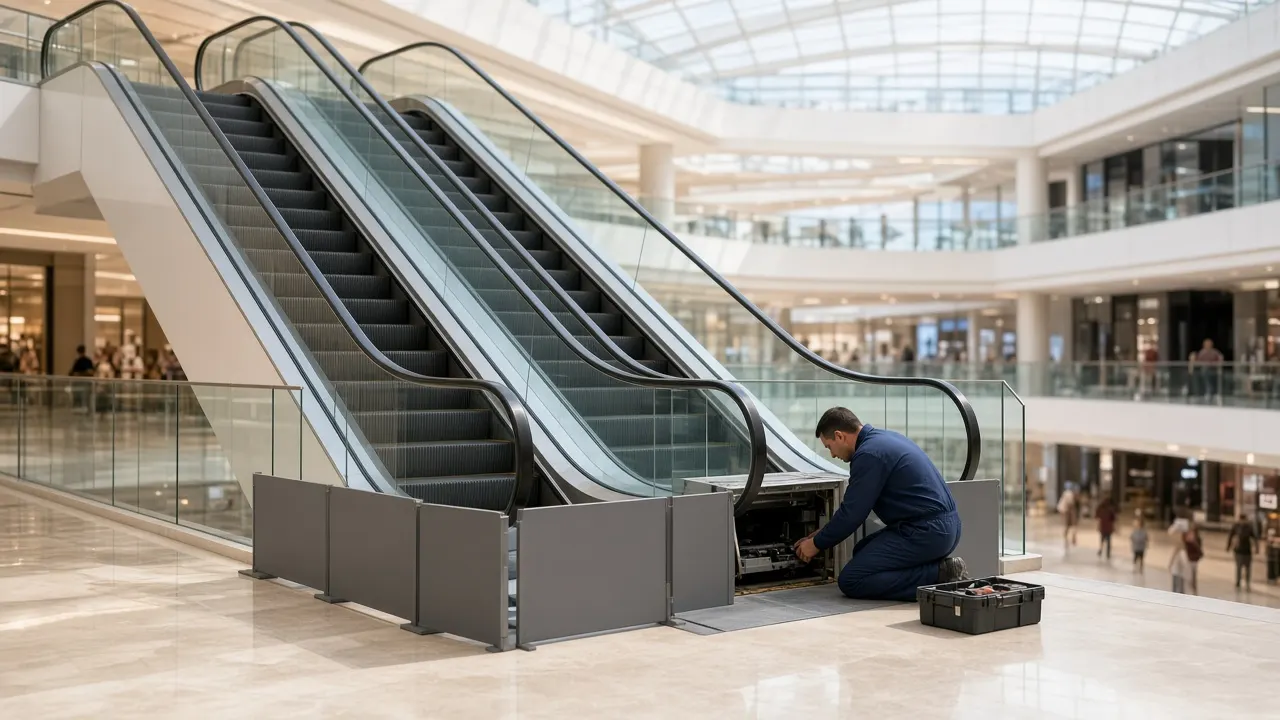
Quick answer: Most escalators in Dubai stop because a safety switch has done its job, not because the machine has failed. Comb plate, handrail entry, skirt, missing-step, overspeed and reversal devices cut power the moment they sense something wrong, and a pressed emergency stop button does the same. The lasting fix is to find why the device tripped: worn or debris-filled comb teeth, a handrail stretching or slipping out of speed, step chain and roller wear, a brake or drive fault, sand and heat in outdoor units, or water in the pit. Newer escalators may also slow down or pause on their own when nobody is using them, which is an energy-saving feature, not a fault. Repeated trips on an older unit are the signal to compare a targeted repair with escalator modernization.
An escalator that stands still in a mall atrium or metro link is one of the most visible faults a building can have. Shoppers notice it, tenants complain about it, and the facility manager is under pressure to get it moving again quickly. The temptation is to reset it and hope. That is usually the wrong move.
This guide covers escalator faults and repairs in Dubai from a diagnostic point of view: what makes an escalator stop, what each kind of trip is telling you, which wear parts are behind most repeat faults, how the UAE climate changes the picture, what a facility team should record, and when escalator repair stops making sense and modernization should be costed. If you are planning a new installation or an AMC for a mall, start with our escalator design and maintenance guide for UAE malls. If your problem is a lift rather than an escalator, see the elevator problems and troubleshooting guide.
Elevaya Lifts has worked in the UAE since 2019 on more than 200 projects, covering design, supply, installation and annual maintenance contracts (AMC). We service all major brands, including units we did not install, so the advice below is written for mixed, multi-brand portfolios rather than one manufacturer's equipment.
Why do escalators stop working in Dubai?
An escalator usually stops because one of its safety circuits has opened, and the controller will not restart it until the cause is cleared and the unit is reset by a competent person. Escalators built to the standards the Dubai Building Code points to are full of monitoring switches. Part D of the Dubai Building Code 2021 requires vertical transportation, which it defines as including escalators and moving walks, to be designed, installed, tested, commissioned and maintained to either the ASME A17 suite or the BS EN 81 suite, and it lists BS EN 115-1 (safety of escalators and moving walks) among its references.
In practice, the stops we see fall into five groups:
- Safety-device trips: a comb plate, handrail entry, skirt, step or speed device has sensed a hazard.
- Emergency stop activations: someone pressed the red button, by need, by accident or for fun.
- Mechanical wear: handrails, step chains, rollers, sprockets and drive components that have drifted out of tolerance and start tripping the devices above.
- Drive, brake and controller faults: the motor, gearbox, brake or VVVF drive reports a fault and the controller locks out.
- Environmental damage: sand, heat and water, which are the UAE's particular contribution to escalator failure.
The first two are symptoms. The last three are usually the cause. A good repair visit works backwards from the trip to the part.
Is the escalator broken, or just in energy-saving mode?
A modern escalator that slows down or stops when no one is near it may be working exactly as designed, because the Dubai Building Code requires energy-saving controls on escalators and moving walks in new buildings. Clause D.6.2 of the Code calls for reduced speed control when no activity has been detected for a maximum of 3 minutes, and "use on demand" shutdown when no activity has been detected for a maximum of 15 minutes, with photocell detectors at the top and bottom landing areas and soft-start technology on on-demand units.
That has two practical consequences for facility teams:
- An escalator found standing still in a quiet corridor early in the morning is not necessarily faulty. Walk towards the landing and see whether it starts.
- If an on-demand escalator fails to wake up, the fault may be in the photocell detectors, their alignment or their wiring rather than in the drive. Dust and cleaning chemicals on the lenses are common culprits.
Note that an escalator restarting from standstill as a passenger approaches is different from one that stops while someone is on it. The second is never an energy feature and should be treated as a fault.
Which safety devices trip an escalator, and what does each trip mean?
Each safety device protects one specific hazard, so the device that tripped tells the technician where to start looking. The exact set of switches varies by brand, age and the standard the unit was built to, but most escalators in UAE malls and towers carry the devices in the table below. The fault code or indicator on the controller usually names the circuit.
| Device that tripped | What it protects against | Typical root causes we find | Usual fix |
|---|---|---|---|
| Comb plate switch | Objects or shoes being drawn into the gap where steps enter the landing | Broken comb teeth, debris or sand packed in the comb, comb plate out of alignment, step height drifting | Clean, replace broken comb segments, realign comb plate, check step level and step chain wear |
| Handrail entry device | Hands and fingers being drawn in where the handrail returns into the balustrade | Child's hand or object at the inlet, worn inlet guard, handrail rubbing the inlet because of stretch or misalignment | Inspect and replace the inlet guard, realign the handrail, correct tension |
| Skirt (deflector) switch | Shoes or clothing trapped between the moving step and the fixed side skirt | Step-to-skirt clearance opened up by worn step guides or rollers, a bent skirt panel, debris | Restore clearances, replace worn step guides, repair skirt panels, check skirt brushes |
| Missing step / step sag device | A broken, missing or sagging step reaching the landing | A cracked step, a failed step roller, a step that has dropped on its track | Do not restart. Replace the damaged step or roller and inspect the track and chain |
| Overspeed or unintended reversal device | The escalator running faster than rated, or reversing direction under load | Drive or brake faults, a loose drive chain or belt, encoder or sensor faults | Treat as serious. Inspect drive, main drive chain, brake and sensors before any restart |
| Handrail speed monitoring | The handrail running out of step with the steps | Handrail slipping on the drive wheel, wear, stretch, contamination on the drive surface | Clean and adjust the handrail drive, check tension and pressure rollers, replace the handrail if worn |
| Emergency stop button | A passenger or staff member stopping the unit in an emergency | Genuine incidents, accidental presses, misuse by children | Check the escalator and the area before reset; record every activation |
Two points matter more than the table itself.
First, a trip that clears and returns is a symptom of wear, not a one-off. A comb plate switch that trips once after a trolley wheel hits it is an incident. One that trips three times a week is telling you the steps are no longer running at the height and line they were set to, usually because chain and roller wear has accumulated.
Second, missing-step, overspeed and reversal trips should never be "reset and watch". These devices exist to prevent the most serious escalator accidents. The unit should stay out of service until a competent technician has found and fixed the cause.
What about emergency stop misuse?
Emergency stop buttons are meant to be easy to reach, which also makes them easy to misuse. In family malls, children pressing the button is a frequent cause of nuisance stops. The answer is not to make the buttons harder to find. It is to log each activation, review the CCTV angle on persistent problem units, and ask your maintenance contractor whether guard covers or local alarms suitable for that model are available. Every restart after an emergency stop should follow a quick visual check of the steps, combs and landing.
Why does the escalator handrail run slower than the steps?
A handrail that lags behind the steps is almost always slipping on its drive, and the usual reasons are wear, stretch, contamination or incorrect tension. Passengers feel the mismatch as their hand being pulled backwards, and on many escalators a handrail speed monitor will stop the unit when the difference grows too large.
The handrail is a reinforced rubber or polymer belt that is driven by friction. Over time it:
- Stretches, so the tension device runs out of adjustment and the handrail sags or slips.
- Glazes or gets contaminated, especially where cleaning products, sunscreen or food residue reach the drive surface, and loses grip on the drive wheel.
- Wears at the lips and inner slider, which increases friction in the guides and slows it further.
- Cracks or hardens, particularly on escalators exposed to direct sun, where surface cracking is also a hygiene and appearance problem.
Typical escalator handrail repair work includes cleaning the drive and the handrail inner surface, adjusting tension and pressure rollers, replacing worn guides, and in the end replacing the handrail itself when it has stretched beyond adjustment or is cracking. Handrail replacement is a planned job that needs the correct profile for the escalator model, so it is worth checking stock or lead times before the old one fails completely. Our spare parts service can help confirm compatibility for older and multi-brand units.
The Dubai Building Code also requires enhanced handrail protection at the entry to escalators and moving walks (Part D, clause D.5, Figure D.1), so a damaged or missing inlet guard is a compliance issue as well as a safety one.
What do step chain, step roller and sprocket wear look like?
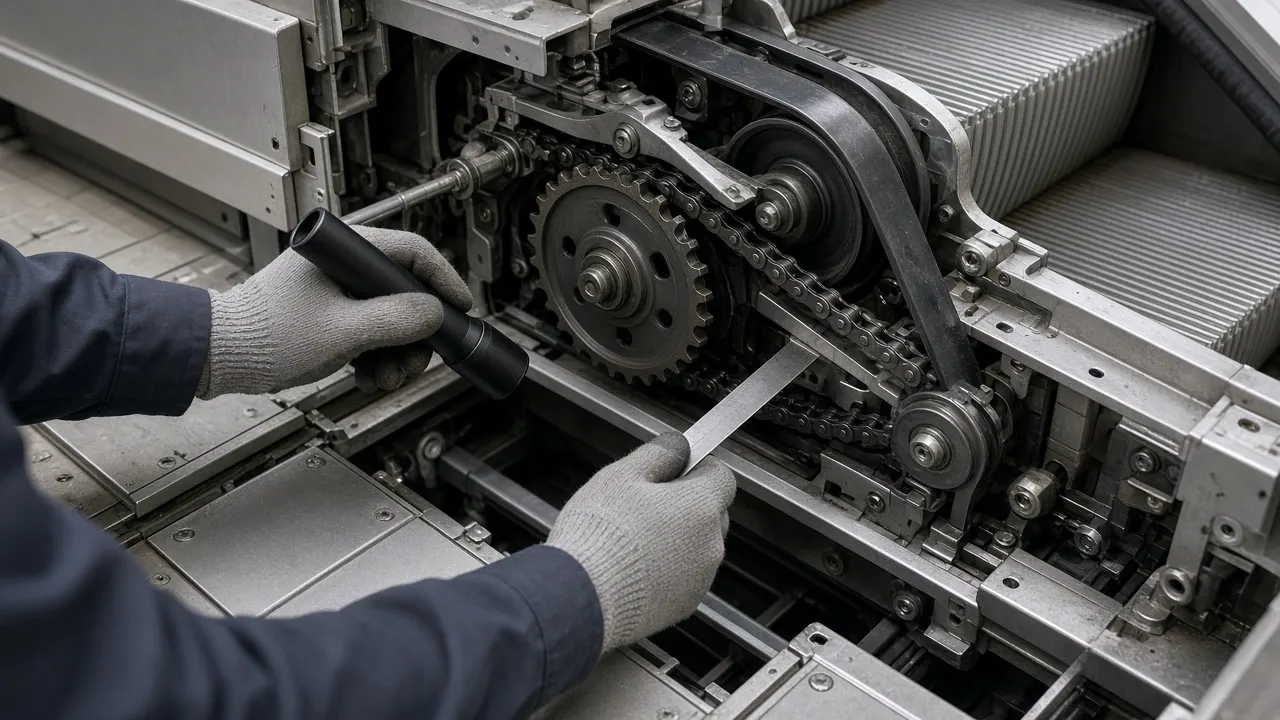
Step chain and roller wear shows up first as noise, vibration and uneven steps, and later as comb and skirt trips, so it is one of the most important things a maintenance visit measures. The step chain links every step together and runs over sprockets at the top and bottom of the truss. Each step also runs on rollers along tracks. As pins, bushes and rollers wear, the chain lengthens, steps start to rise, drop or shift sideways, and clearances that the safety devices monitor begin to close up.
Signs worth reporting:
- A rhythmic clunk or knock that repeats at a steady interval as the steps pass a point.
- Steps that rock, sit unevenly or touch the comb plate.
- Visible gaps opening between adjacent steps.
- Flat spots, cracked tyres or debonded material on step rollers found during cleaning.
- Hooked or sharpened teeth on drive and step chain sprockets.
On a well-maintained escalator, chain elongation and roller condition are measured at intervals against the manufacturer's limits, which is why the technician in the photo is carrying a ruler and not just a torch. When elongation approaches the limit, escalator step chain replacement should be planned, ideally together with rollers and an inspection of the sprockets, because a new chain running on worn sprockets wears out quickly. This is a major job that takes the unit out of service, so it is best scheduled for a quiet period rather than forced by a breakdown.
Drive, brake and controller faults: why won't the escalator restart?
When an escalator refuses to restart after a reset, the cause is usually in the drive train, the brake or the controller, and the fault log is the first place to look. Common causes include:
- Brake problems: worn linings, incorrect air gap or a sticking brake can cause the controller to block the start, or produce excessive stopping distances that the technician must correct before return to service.
- Drive chain or belt issues: a stretched main drive chain or worn drive belt can cause jerky starts, noise and, in severe cases, speed monitoring trips.
- Gearbox and motor: oil leaks, bearing noise and overheating, often made worse by poor machine-space ventilation.
- Controller and VVVF faults: escalators with variable-frequency drives can lock out on overcurrent, overvoltage, overheating, encoder faults or communication errors. Many are triggered by heat and dust inside the controller cabinet rather than by a failed board.
- Power quality: supply dips and phase problems can trip the controller even when the escalator itself is healthy.
The fix may be as simple as cleaning filters and fans in the controller space or as large as replacing the drive. A competent technician will read and record the stored fault codes before clearing them, because the history of codes is often more useful than the last one alone.
How do sand, heat and water damage escalators in the UAE?
The UAE climate shortens the life of escalator parts in ways that maintenance plans written for temperate climates do not always allow for. Three factors stand out.
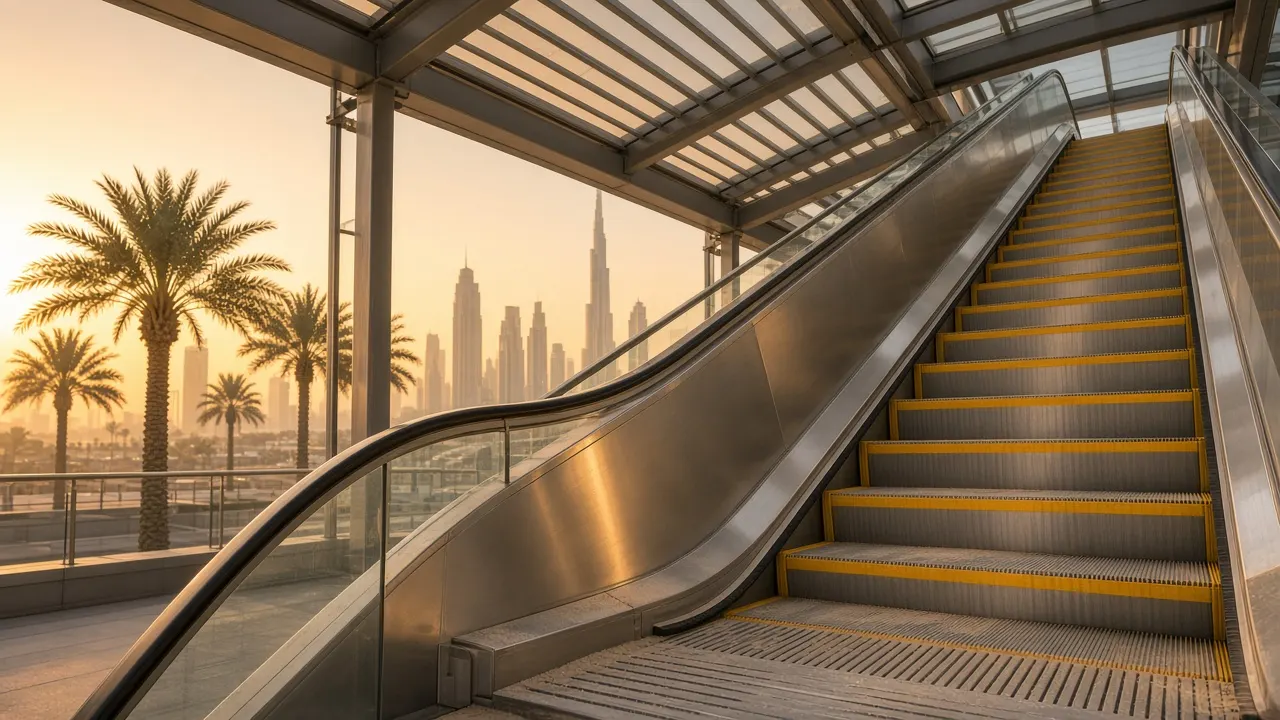
Sand and dust. Fine sand is carried in on shoes and by wind, especially on outdoor and semi-outdoor escalators at stations, bridges and mall entrances. It packs into comb teeth, works its way into step rollers and chains, mixes with lubricant into an abrasive paste, and coats sensors. More frequent cleaning of combs, step treads and the pit, and checking lubrication condition rather than only quantity, make a visible difference.
Heat and sun. Direct sun degrades handrails and plastic parts, and heat in machine spaces and controller cabinets is a leading driver of electronic faults. On outdoor units, handrails can harden and crack, and the controller can trip on overtemperature on summer afternoons. Shade, ventilation and handrail materials suited to outdoor use help, as does checking cooling fans and filters on every visit.
Water. Rain is rare but heavy, and cleaning water, irrigation overspray and blocked drains are more common sources. Water in the lower pit can reach the bottom sprockets, step chain and electrical components and cause corrosion or earth faults. Outdoor escalators need working pit drainage, and indoor ones should not be wet-mopped in a way that floods the comb area.
The Code's accessibility rules add another visible maintenance item: escalators must have yellow horizontal and vertical edges on the tread nosing of all steps, colour-contrast dots or similar on handrails, and at least four horizontal treads at each end of the flight (clause C.5.9.5.2). Faded yellow step edges on sun-exposed units are worth including in the repair list.
What does that escalator noise or vibration tell you?
Where and when a noise happens narrows down its source faster than describing what it sounds like. Before calling for repair, note whether the noise is constant or rhythmic, whether it is loudest at the top, middle or bottom of the flight, and whether it changes with load or direction.
| What you notice | Where | Likely area to inspect |
|---|---|---|
| Rhythmic clunk as each step passes | At a landing | Step rollers, step chain, sprockets, step-to-comb engagement |
| Grinding or scraping | Along the incline | Step rubbing the skirt, worn step guides, debris in the track |
| Squealing or whine | Top machine space | Drive chain or belt, gearbox or motor bearings, lubrication |
| Vibration felt through the steps | Throughout | Step chain elongation, roller condition, track alignment |
| Handrail judder or pulling | Whole length | Handrail drive, tension, guide wear, contamination |
| Clicking at start or stop | Top machine space | Brake operation and adjustment |
Never open landing plates or reach inside the balustrade to investigate. Isolating, opening and working inside an escalator is a job for trained technicians with the correct lockout procedure.
What should mall and building FMs log when an escalator stops?
A short, consistent fault log turns a series of "escalator stopped again" calls into a pattern that a technician can act on. For each stop, record:
- The escalator's identifier, location and direction of travel.
- Date and time of the stop and of the return to service.
- How it was found: stopped with passengers, stopped empty, slowed down, would not start.
- Any fault code or indicator shown on the controller or display, before anyone clears it.
- Whether an emergency stop was pressed, and by whom if known.
- Noises, smells, vibration or visible damage reported.
- Weather and conditions: sandstorm, rain, cleaning activity, peak footfall.
- Who reset it and what they checked.
Review the log monthly with your maintenance contractor. Repeat trips on the same device, clusters after cleaning shifts or after sandy days, and units that need more resets than others are the best evidence for targeted repairs, and later for a modernization budget. Our guide to commercial lift and escalator maintenance in the UAE covers how this feeds into service planning.
What does Dubai require after an escalator repair or inspection?
In Dubai, escalators are lifting equipment that must be periodically examined and certified by a third party accredited by the Emirates International Accreditation Centre (EIAC), and major repairs trigger a further inspection. Dubai Municipality's technical guideline DM-HSD-GU48-ECLA2 requires lifts and other lifting equipment to be tested and certified by an EIAC-accredited third party at least once every 12 months, says repairs identified by the inspector must be carried out immediately, and says that if the equipment is found unsafe the owner must be advised to stop using it. The compliance certificate must be kept on site.
EIAC's own accreditation requirements for lifting equipment inspection bodies (EIAC-RQ-IB-002) go further for equipment that carries people: its Annex B lists escalators and passenger conveyors for periodic inspection every six months in the Emirate of Dubai, and clause 5.5 requires equipment that has been majorly repaired to undergo a major inspection. Confirm the interval that applies to your escalators with your accredited inspection body, and plan the inspection into any large repair such as a step chain or drive replacement.
Repair, overhaul or escalator modernization: how do you decide?
Repair is right when faults trace back to specific worn parts on a sound escalator; modernization is worth costing when trips keep coming back across several systems, parts are hard to source, or the controller and drive are outdated. Use these questions:
- Is the fault isolated or spreading? One worn handrail is a repair. Handrail, chain, rollers and controller faults all rising together point to an overhaul or modernization.
- Are parts still available? Escalators from discontinued product lines can be kept running, but lead times for steps, handrails and boards grow. A parts compatibility check helps you see the risk early.
- How old is the control system? Older relay or early electronic controllers without proper fault logging make diagnosis slow. A new controller with a variable-frequency drive can add the reduced-speed and on-demand features that the Dubai Building Code requires on escalators in new buildings, plus far better fault records.
- What does downtime cost? In a mall or transport hub, a planned modernization in a quiet season often costs less in lost footfall than repeated unplanned stoppages.
- What has the inspection body flagged? Repeated findings on the same unit are a strong signal to budget for a larger scope.
Partial modernization, such as replacing the controller and drive, the handrail system, or steps and chains, can be done without replacing the whole truss. Our escalator modernization service covers these options, and the escalator parts and safety components guide explains what each component does.
How does preventive maintenance reduce escalator breakdowns?
Preventive maintenance under an AMC catches wear before it trips a safety device. For escalator maintenance in UAE malls, a good plan includes regular cleaning of combs, steps and pits; lubrication checks; testing of every safety switch; measuring chain and roller wear; checking handrail tension and condition; inspecting the brake; and cleaning controller filters and fans. See escalator maintenance and repair for what Elevaya includes.
Related Elevaya guides
Continue planning with these related Elevaya guides:
- Escalator design and maintenance for UAE malls: layout, balustrades, dust and heat, AMC and modernization.
- Elevator and escalator speeds in UAE buildings: rated lift speed by travel height and 0.5 vs 0.65 m/s escalators.
- Elevator modernization in Dubai: signs, scope and standards: when to modernize, controller and door upgrades, EN 81-20/80, downtime and cost factors.
- How to choose the best lift company in Dubai: buyer's checklist: licences, AMC terms, written response times, parts, references and red flags.
- Elevator AMC cost in Dubai: villa owners' guide: non-comprehensive from AED 2,500 for G+1, visits, callouts and parts rules.
- Lift speed by building height in Dubai towers: DBC travel-time formula, worked m/s examples, waiting times, DHA hospital and Trakhees rules.
- Elevator cabin design trends in the UAE for 2026: finishes, COP/LOP panels, LED lighting and glass cabins.
- Luxury elevator interiors in the UAE: marble, bronze and wood: weight, fire performance and cleaning of premium cabin finishes.
- Glass and panoramic villa lifts in Dubai: 2026 planning guide: placement, glazing, heat control, approvals and AMC care.
- Glass villa lift in Dubai: footprint, heat and cost factors: shaft vs shaftless, laminated glass, cabin cooling, hydraulic vs MRL vs platform.
- Lift installation in Dubai: step-by-step process: survey, shaft, pit and headroom prep, supply and delivery, installation sequence, testing, EIAC certification and handover.
- Lift and elevator supply in the UAE: buyer's guide: supply-only vs supply and installation, what to specify, what a supply quote must include, BS EN 81 / ASME A17, EIAC certification, escalator supply and red flags.
- Lift maintenance checklist for Dubai: monthly service visit: what each monthly visit should check on doors, ride, machine and brake, alarm, car top and pit, the log book, maintenance vs inspection, villa lifts and an escalator checklist.
- Lift COP and LOP panels in Dubai: what is on each panel, DBC button heights, Braille and intercom rules, common faults, repair vs replacement.
- Lift upgrades in Dubai: what to upgrade first: rescue devices for power cuts, door light curtains, VVVF and energy saving, cabin refresh, alarms, EN 81-80, upgrade vs modernization.
- Common lift problems in Dubai: causes and fixes: stuck lifts, doors not closing, jerky rides, noise and summer heat trips, safe owner checks, trapped-passenger steps, repairs and certification.
- Escalator modernization in the UAE: signs, scope and compliance: when to modernize, modernize vs replace, controller and drive, steps, chain and handrail, energy features, phased mall works and the EIAC major inspection.
- Escalator installation in the UAE: step-by-step process: survey and selection, pit and truss supports, rigging, alignment, controller, safety devices, testing, EIAC inspection and handover.
Related Elevaya services: Escalators, Moving walkways, Escalator maintenance and repair, Escalator modernization, Spare parts.
FAQ
Why does an escalator keep stopping by itself?
Repeated stops are usually a safety device tripping because of wear or debris: comb plates packed with sand, handrails slipping, or steps drifting out of line as the step chain and rollers wear. Newer escalators may also slow or pause when idle as an energy-saving feature. A fault log helps pinpoint which.
Is it safe to reset a tripped escalator and keep it running?
Only after a competent person has checked the cause. A one-off emergency stop press can be cleared after a visual check, but missing-step, overspeed and reversal trips should keep the escalator out of service until a technician has inspected and fixed it.
Why is the escalator handrail moving slower than the steps?
The handrail is friction-driven, so stretch, worn guides, contamination on the drive surface or wrong tension make it slip and lag. Cleaning and adjustment often help; a stretched or cracked handrail needs replacing with the correct profile for that model.
How often must escalators be inspected in Dubai?
Dubai Municipality's guideline DM-HSD-GU48-ECLA2 requires lifting equipment to be certified by an EIAC-accredited third party at least every 12 months, and EIAC's requirements for inspection bodies list escalators at six-monthly periodic inspection in Dubai. Confirm the interval with your inspection body.
What causes escalator faults in UAE malls and outdoor stations?
Sand and dust packing combs and wearing chains and rollers, heat hardening handrails and overheating controllers, water reaching the pit, wear from heavy footfall and trolleys, and emergency stop misuse are the most common causes we see.
When should an escalator be modernized instead of repaired?
Consider modernization when faults recur across several systems, spare parts are getting hard to source, the controller lacks fault logging or energy features, or downtime costs more than a planned upgrade. Partial modernization of the controller, drive, handrails or steps is often possible.
Get a faulty escalator in Dubai assessed
If an escalator in your mall, tower or station keeps stopping, Elevaya can inspect it, read the fault history, and give you a clear repair or modernization recommendation, for any brand. Call or WhatsApp +971 58 584 4685 or contact Elevaya for escalator repair in Dubai and across the UAE.