Elevaya journal
Elevator and Escalator Speeds in UAE Buildings: What m/s Is Right?
Understand elevator and escalator speeds in UAE buildings, including traffic, acceleration, door timing and when a performance review is useful.
Published · Updated · Elevaya Lifts
Quick answer: There is no single "correct" elevator speed in the UAE: the right rated speed depends on how far the lift travels. Indicative design values used by Dubai authorities pair roughly 0.63 m/s with an 18 m travel, 1.0 m/s with 30 m, 1.6 m/s with 48 m, 2.5 m/s with 75 m, 3.5 m/s with 100 m and 5.0 m/s with 150 m. Escalators are much slower: most run at 0.5 m/s, with 0.65 m/s common where crowds are heavy, and EN 115-1 caps speed by incline (0.75 m/s up to 30°, 0.5 m/s at steeper angles up to 35°).
Ask ten people in a Dubai lobby whether their lift is "fast" and you will get ten answers, mostly based on how long they waited, not how fast the car moved. Speed is only one part of the experience. Acceleration, door timing, dispatching and how cleanly the car stops at the floor all shape how quick a lift feels. This guide to elevator speed in UAE buildings explains what the numbers mean and how they apply to villas, towers and malls across the Emirates.
Elevaya Lifts has worked on lifts and escalators in the UAE since 2019, with more than 200 completed projects across design, supply, installation and AMC (annual maintenance contracts).
What does m/s mean for a lift?
m/s (metres per second) is the rated speed: how fast the car travels once it is at full speed between floors. A lift rated at 1.0 m/s covers about one metre every second, so a 30 m journey takes around 30 seconds of travel plus acceleration, deceleration and door time.
Two things follow from that:
- Short trips rarely reach rated speed. On a one- or two-floor hop the car spends most of the trip speeding up and slowing down, so a 2.5 m/s lift and a 1.6 m/s lift can feel almost identical.
- Rated speed matters most for long, express runs, where the car can cruise for many floors without stopping.
You will also see older or imperial-origin figures such as 0.63 m/s, 1.75 m/s or 2.5 m/s. These are simply standard steps in manufacturers' speed ranges.
How fast should a lift be for each building type?
A useful rule of thumb hidden inside the official tables: lift speed is chosen so the car can travel the full building height in roughly 30 seconds at rated speed. 18 m at 0.63 m/s, 48 m at 1.6 m/s and 150 m at 5.0 m/s all land close to that figure.
The travel-height values below come from the Dubai Health Authority's Health Facility Guidelines on vertical transportation, which publish suggested rated speeds by travel height. Building categories are our plain-language grouping; your consultant's traffic analysis always has the final say.
| Building type (typical UAE example) | Approx. travel height | Indicative rated speed |
|---|---|---|
| Private villa (G+1 / G+2) | 3–10 m | Home lifts usually run well below 1.0 m/s |
| Low-rise residential or office (around G+4) | up to ~18 m | ~0.63–1.0 m/s |
| Mid-rise (around G+8 to G+15) | ~30–48 m | ~1.0–1.6 m/s |
| High-rise tower (around 25–40 floors) | ~75–120 m | ~2.5–4.0 m/s |
| Tall tower (around 40–50 floors) | ~150 m | ~5.0 m/s |
| Super-tall (300 m+) | zoned, with sky lobbies | 6 m/s and above on express shuttles |
In super-tall buildings, lifts are almost never asked to run from ground to the top in one shot. The building is split into zones, express shuttles carry people to sky lobbies, and local lifts serve the floors above. That design does far more for journey time than chasing a higher top speed.
The Dubai Building Code sets out vertical transportation requirements in Part D, with a simplified tabulated design method for simpler buildings and a consultant-led method for complex ones. Designs must follow either the ASME or the BS EN suite of standards.
Villas: speed is rarely the point
In a Dubai or Abu Dhabi villa, a lift typically travels two or three floors. Smoothness, quiet operation, safe levelling at each landing and a cabin that suits the interior matter far more than speed. See our home lifts page for the types that fit villas, and our guide to panoramic glass villa lifts in Dubai if the lift will be a design feature.
Acceleration and ride comfort: why "fast" can feel wrong
Acceleration (m/s²) and jerk (the rate of change of acceleration, m/s³) decide whether a ride feels smooth or abrupt. A lift can have a high rated speed and still feel calm if it ramps up and down gently.
- In hospital and clinical areas, the DHA guideline limits acceleration to 0.6 m/s² and jerk to 1.0 m/s³ to protect vulnerable patients.
- Commercial and residential lifts typically use higher values, tuned by the manufacturer for each speed and drive.
- In tall towers, pressure change in the ears and rope or car vibration become comfort factors too, which is why high-speed lifts use careful profile tuning, guide-rail alignment and aerodynamic car design.
Ride quality is not set once and forgotten. Worn guide shoes or rollers, out-of-alignment rails, tired door operators and drift in drive settings all show up as bumps, noise and stops that are slightly above or below the floor.
Escalator speeds: 0.5 vs 0.65 m/s
Most escalators in UAE malls run at 0.5 m/s; 0.65 m/s is used where large crowds must be cleared quickly, such as metro stations and busy mall entrances. The European escalator standard EN 115-1 (published by CEN, the European Committee for Standardization) sets maximum nominal speeds by angle:
- Inclination up to 30°: up to 0.75 m/s.
- Inclination above 30° up to 35°: up to 0.50 m/s, and 35° is only allowed for limited rises (up to 6 m).
So a steeper 35° escalator saves floor space but must run slower, while a 30° unit gives more flexibility on speed. The trade-off between 0.5 and 0.65 m/s comes down to comfort versus capacity:
- 0.5 m/s feels relaxed and suits malls with families, children, shopping bags and tourists unfamiliar with the layout.
- 0.65 m/s moves more people per hour but asks more of passengers when stepping on and off, so longer flat steps at the landings and clear signage matter.
Many modern escalators also slow down or stop when idle and restart when a passenger approaches. That saves energy, but the transition must be smooth and correctly set up.
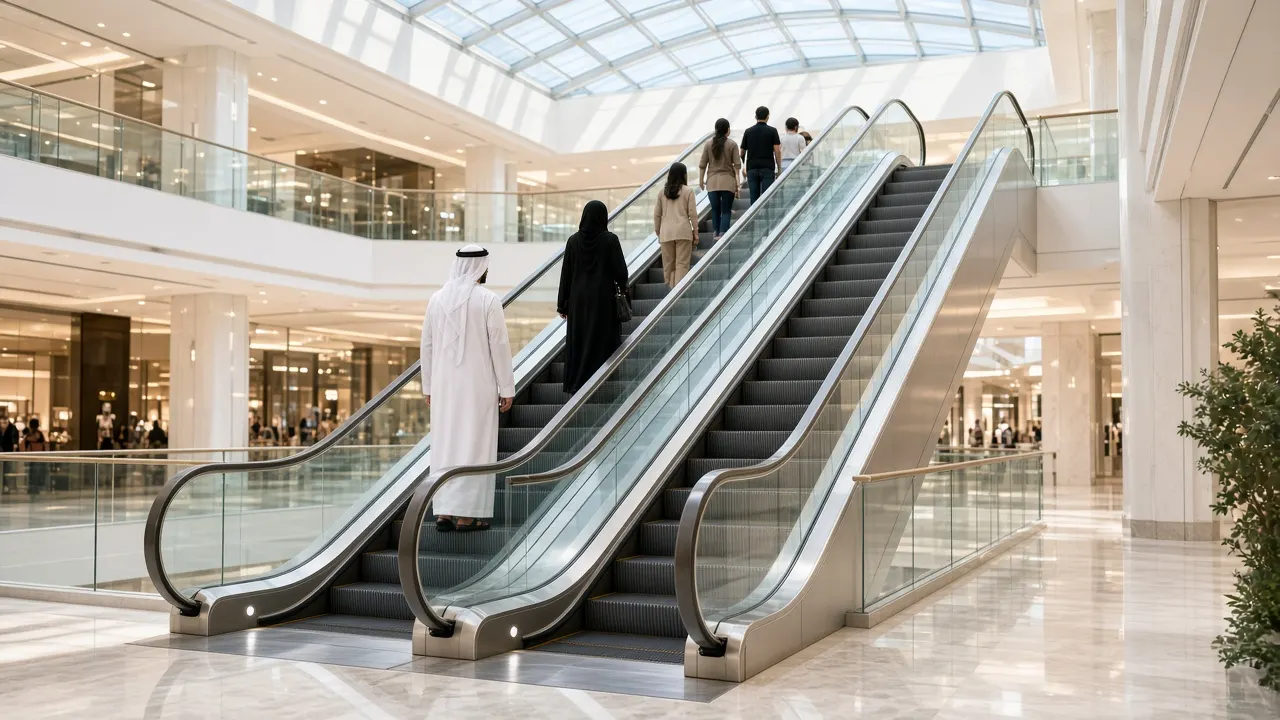
For mall layouts, balustrades and maintenance in heat and dust, read our escalator design and maintenance guide for UAE malls or see our escalators page.
When does a lift speed upgrade or modernization make sense?
A speed upgrade is worth considering when waiting and journey times no longer match how the building is used, not simply because the lift is old. Common triggers in UAE buildings:
- Change of use or more occupants, for example an office floor turned into a co-working space or a residential tower that has filled up.
- Old relay or early microprocessor controls with slow door cycles and poor dispatching. A new controller and destination or group control often cuts waiting time more than extra m/s.
- Obsolete drives (for example older geared machines) that cannot hold smooth acceleration or accurate levelling.
- Frequent breakdowns and parts that are hard to source.
Raising the rated speed is a significant engineering change. It affects the machine, drive, safety gear, governor, buffers, rails and sometimes the shaft headroom and pit, and it has to be checked against the applicable standard and approved. Often the better answer is modernization at the same speed with modern controls and drives. Our lift modernization team can survey the installation and explain the options.
How maintenance (AMC) affects speed and levelling
A well-maintained lift keeps its designed speed profile and stops level with the floor; a neglected one drifts. Typical symptoms of missing maintenance:
- Stops a few millimetres to centimetres above or below the landing, a trip hazard for wheelchairs, trolleys and older people.
- Jerky starts and stops as drive settings drift and brakes or guide shoes wear.
- Doors reopening or slowing, adding seconds to every stop.
- Escalator handrails running out of step with the steps, which feels unsafe.
In UAE conditions, dust and heat speed up that wear, especially on door tracks, sensors and machine rooms. A structured lift maintenance (AMC) plan checks levelling accuracy, door timing, brakes, ropes and controller settings so the lift keeps performing as designed.
2026 update: lift speed by travel time under the Dubai Building Code
Updated 22 October 2026. The table earlier in this guide uses the DHA's suggested speeds by travel height, which come from healthcare design. For other buildings, the Dubai Building Code (Part D, clause D.8.6) works the other way round: rated speed equals the travel distance between the lowest and highest stops divided by a minimum travel time that depends on the building type (Table D.4). That is why the "about 30 seconds to the top" rule of thumb fits offices, hospitals and malls (25 to 30 s) but not apartments (40 to 45 s) or 4- and 5-star hotels (20 to 25 s).
Updated speed table, calculated with the DBC formula (our arithmetic; the final speed comes from the project's traffic analysis and the supplier's standard speed steps):
| Travel distance | Apartments (40 to 45 s) | Regular office (25 to 30 s) | 4- and 5-star hotel (20 to 25 s) |
|---|---|---|---|
| 30 m | about 0.7 to 0.75 m/s | 1.0 to 1.2 m/s | 1.2 to 1.5 m/s |
| 60 m | about 1.3 to 1.5 m/s | 2.0 to 2.4 m/s | 2.4 to 3.0 m/s |
| 90 m | 2.0 to 2.25 m/s | 3.0 to 3.6 m/s | 3.6 to 4.5 m/s |
| 120 m | about 2.7 to 3.0 m/s | 4.0 to 4.8 m/s | 4.8 to 6.0 m/s |
| 150 m | about 3.3 to 3.75 m/s | 5.0 to 6.0 m/s | 6.0 to 7.5 m/s |
For waiting-time and handling-capacity targets, zoning in super high-rise towers, the full DHA hospital rules and Trakhees lift requirements, read our new guide, Lift speed by building height in Dubai towers.
Related Elevaya guides
Continue planning with these related Elevaya guides:
- Elevator cabin design trends in the UAE for 2026: finishes, COP/LOP panels, LED lighting and glass cabins.
- Glass and panoramic villa lifts in Dubai: 2026 planning guide: placement, glazing, heat control, approvals and AMC care.
- Luxury elevator interiors in the UAE: marble, bronze and wood: weight, fire performance and cleaning of premium cabin finishes.
- Escalator design and maintenance for UAE malls: layout, balustrades, dust and heat, AMC and modernization.
- Elevator AMC cost in Dubai: villa owners' guide: non-comprehensive from AED 2,500 for G+1, visits, callouts and parts rules.
- How to choose the best lift company in Dubai: buyer's checklist: licences, AMC terms, written response times, parts, references and red flags.
- Elevator modernization in Dubai: signs, scope and standards: when to modernize, controller and door upgrades, EN 81-20/80, downtime and cost factors.
- Glass villa lift in Dubai: footprint, heat and cost factors: shaft vs shaftless, laminated glass, cabin cooling, hydraulic vs MRL vs platform.
- Lift speed by building height in Dubai towers: DBC travel-time formula, worked m/s examples, waiting times, DHA hospital and Trakhees rules.
- Escalator faults and repairs in Dubai: why escalators stop, safety-device trips, handrail and step chain wear, sand and heat, repair vs modernization.
- Lift installation in Dubai: step-by-step process: survey, shaft, pit and headroom prep, supply and delivery, installation sequence, testing, EIAC certification and handover.
- Lift and elevator supply in the UAE: buyer's guide: supply-only vs supply and installation, what to specify, what a supply quote must include, BS EN 81 / ASME A17, EIAC certification, escalator supply and red flags.
- Lift maintenance checklist for Dubai: monthly service visit: what each monthly visit should check on doors, ride, machine and brake, alarm, car top and pit, the log book, maintenance vs inspection, villa lifts and an escalator checklist.
- Lift COP and LOP panels in Dubai: what is on each panel, DBC button heights, Braille and intercom rules, common faults, repair vs replacement.
- Lift upgrades in Dubai: what to upgrade first: rescue devices for power cuts, door light curtains, VVVF and energy saving, cabin refresh, alarms, EN 81-80, upgrade vs modernization.
- Common lift problems in Dubai: causes and fixes: stuck lifts, doors not closing, jerky rides, noise and summer heat trips, safe owner checks, trapped-passenger steps, repairs and certification.
- Escalator modernization in the UAE: signs, scope and compliance: when to modernize, modernize vs replace, controller and drive, steps, chain and handrail, energy features, phased mall works and the EIAC major inspection.
- Escalator installation in the UAE: step-by-step process: survey and selection, pit and truss supports, rigging, alignment, controller, safety devices, testing, EIAC inspection and handover.
Related Elevaya services: Passenger lifts, Escalators, Lift modernization, Lift maintenance and AMC, Escalator maintenance and repair.
FAQ
What is a normal elevator speed in the UAE?
It depends on travel height. Low-rise buildings commonly use about 0.63–1.0 m/s, mid-rise around 1.0–1.6 m/s, and high-rise towers 2.5–5.0 m/s, with faster express lifts in super-tall buildings.
How fast should a lift be in a Dubai tower?
As a guide, a lift serving about 75 m of travel is typically around 2.5 m/s, 100 m around 3.5 m/s and 150 m around 5.0 m/s. A vertical transportation traffic analysis confirms the final choice.
What is the standard escalator speed in m/s?
Most escalators run at 0.5 m/s. 0.65 m/s is common in high-traffic places such as metro stations. EN 115-1 allows up to 0.75 m/s at 30° and limits 35° escalators to 0.5 m/s.
Can I upgrade my lift to a higher speed in Dubai?
Sometimes, but it is a major change affecting the machine, drive, safety components and possibly the shaft, and it needs engineering checks and approval. Modernizing controls at the same speed often improves waiting time more.
Why does my lift stop slightly above or below the floor?
Levelling errors usually come from worn components, brake or drive adjustment drift, or sensor problems. Regular maintenance under an AMC should identify and correct them.
Talk to Elevaya about lift and escalator performance
Whether you are planning a new tower, choosing a villa lift or trying to fix slow, uneven lifts in an existing building, Elevaya can help with design, supply, installation and AMC. Call or WhatsApp +971 58 584 4685 or request a site survey.