Elevaya journal
Bespoke Luxury Lift Design Process in Dubai: From Mood Board and Mock-Up to Handover and AMC Care
How a bespoke luxury lift is made for a Dubai villa, palace or penthouse: mood board, samples, renders, mock-up, fabrication, handover and AMC care.
Published · Updated · Elevaya Lifts
Quick answer: The bespoke luxury lift design process for a Dubai palace, villa or penthouse runs in eight stages: brief and mood board, site survey, material sampling, 3D renders and shop drawings, a full-scale mock-up, fabrication, installation with testing, and handover into an AMC. Each stage ends with a decision you sign off, so nothing precious is cut, plated or set until you have seen it, touched it and approved it. Elevaya designs, supplies, installs and maintains these lifts, and the five design directions on our bespoke luxury villa lifts page are where many commissions begin.
A bespoke lift is not bought from a catalogue. It is made, in the same way a piece of jewellery or a set of joinery is made, and the order in which decisions are taken matters more than any single material.
Get the order right and the gold, marble and crystal arrive on site already proven. Get it wrong and you find out at handover that a slab is too heavy, a plated panel is the wrong warmth under the cabin lights, or a door cannot open past a beautiful frame.
Elevaya has worked on lifts in the UAE since 2019, on more than 200 projects across design, supply, installation and annual maintenance. Our overview of bespoke luxury home lifts in Dubai sets out the materials, our guide to Swarovski crystal lift cabins covers crystal and light, and our piece on gold lift doors and luxury lift panels covers the details you touch. This guide is about the journey: how a one-off lift moves from an idea to a working, certified lift in your home, and who decides what along the way.
What happens at the concept and mood board stage?
The concept stage turns a feeling into a written brief: who will use the lift, which floors it serves, how it should look and feel, and what the building can physically accept. It is the cheapest stage to change your mind, so it is worth taking slowly.
We start with the people. A lift that carries grandparents, children, staff and luggage has a different brief from one that mainly serves a roof terrace for guests. Then the house. A palace with a formal majlis, a contemporary villa on the Palm and a penthouse at the top of a tower all ask for different proportions and a different level of ornament.
The mood board brings this together. It usually holds:
- images of rooms, materials and objects you love, including from your own home,
- the main palette: metal tone, stone family, timber or leather, and how much sparkle you want,
- a design direction, such as Royal Gold, Platinum & Onyx, Titanium Atelier, Diamond Detail or Crystal Signature, used as a starting point rather than a package,
- the landings, because the doors and surrounds on every floor are part of the design.
In parallel, the building sets the limits. For a new villa or palace, we work with your architect and interior designer on the shaft, pit, headroom, door openings and cabin size while the drawings are still flexible. For an existing lift, we survey what is there: cabin size, door type, the load allowance and the condition of the equipment. In a penthouse, the building's owner or management usually has a say in work on a lift, so their approval goes into the programme from the start.
The concept stage ends with a brief everyone has agreed. It names the design direction, the lift type and the materials to be sampled. It does not yet name a price, because a fair price depends on the material schedule that comes next.
How are precious materials sampled and approved?
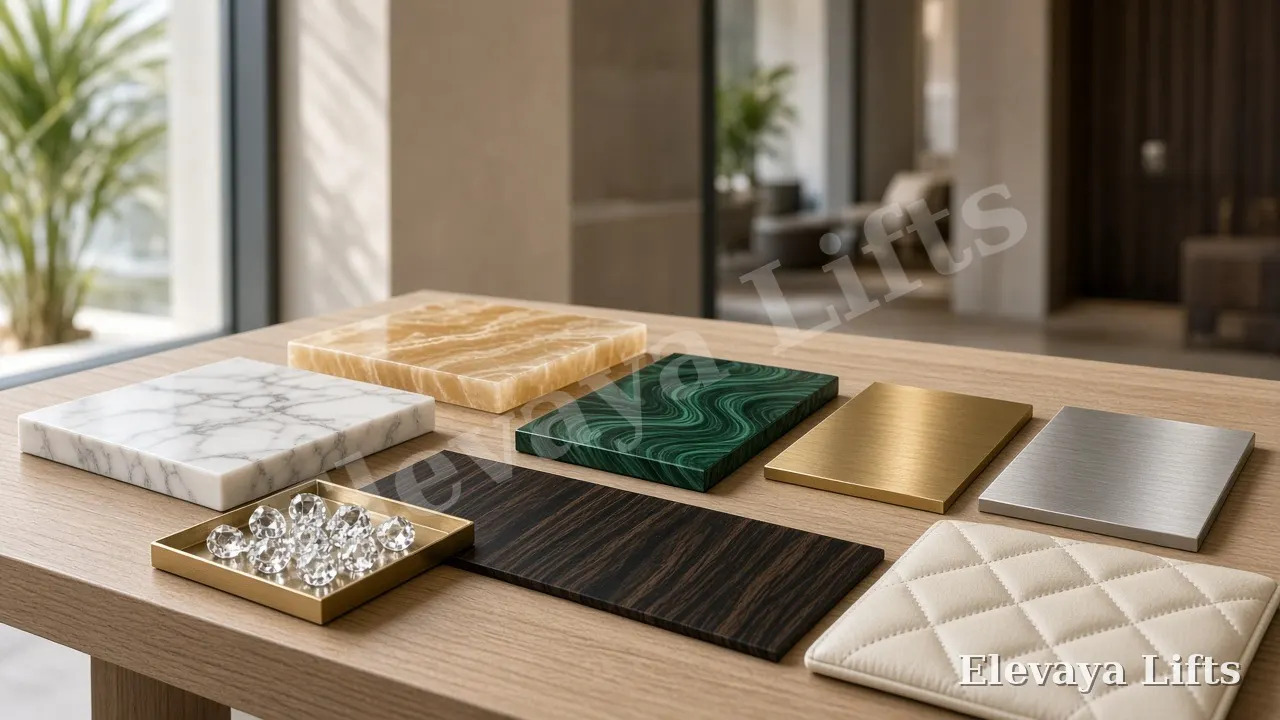
Every precious finish is approved as a physical sample, seen under the light it will live in, and the approved sample then becomes the standard the finished lift is checked against. A colour name on a drawing is not enough. "Gold" can mean genuine plating or a gold-tone PVD coating, and "Calacatta" covers slabs that look nothing alike.
How we sample each family of material:
- Metals. Gold, platinum, rose gold and titanium tones are sampled on the actual base metal, in the actual finish: mirror, brushed, hammered or relief. The sample states whether it is precious-metal plating or a colour coating, because the two wear and cost very differently.
- Stone. For a feature wall or floor, the slab is chosen, not the stone name. You see the actual slab, or clear photographs of it, and agree the vein direction and bookmatch before it is cut. Thickness, backing and weight per panel are recorded at the same time.
- Crystal and gems. Crystal is agreed by product reference and size. Diamonds and other stones are agreed as natural or laboratory-grown, with size, quantity, setting style and the paperwork you expect.
- Leather, timber and fabric. Sampled for colour and grain, and also checked for how the material will behave in a closed cabin, including any fire-performance information the project needs.
We look at samples together under warm cabin-style light, not just daylight at a window. Gold reads warmer, marble greener and crystal livelier under a ceiling light a metre above your head. Once approved, a set of samples is labelled, signed and kept. One stays with you and one with the workshop. That small step settles most arguments before they start.
What do 3D renders and shop drawings show, and what can they not?
Renders show composition, proportion and mood; shop drawings show how every panel is made, fixed, removed and serviced; and you need both before anything is fabricated. They answer different questions, so a beautiful render on its own is never a sign-off.
A good set of renders lets you see the cabin from the landing with the doors open, from inside facing the doors, and from inside facing the rear wall. It shows how the marble veining flows across panels, where the gold meets the stone, how the ceiling light falls and whether the composition feels calm or crowded. It is the right time to move a border, change the ceiling pattern or reduce the sparkle.
Renders cannot show some things honestly. They cannot show the true warmth of a plated finish, the way crystal flashes as the cabin moves, or the exact veins of a slab that has not been photographed. That is why samples come first and renders second.
The shop drawings carry the engineering. They set out each panel with its size, thickness, backing and weight, the fixings, the joints and reveals, the access panels for the ceiling lights and the car top, the handrail fixings, the position of the car operating panel and the landing door surrounds on every floor. They also produce the finished cabin weight, which goes back to the lift design. On a traction lift the counterweight is balanced to the finished car, and on any lift the decorative weight has to sit within what the lift was designed to carry. If the numbers do not work, this is the moment to change a slab for a lighter backed panel, not after it has been cut.
The design must also follow the rules for lifts in homes. The Dubai Building Code says in clause K.5.5.4 that where elevators are provided in a villa, their design shall conform to sections D.5 and D.6. Decoration is designed around those requirements, never the other way round.
Why build a full-scale mock-up before fabrication?
A full-scale mock-up is a real corner or wall of the cabin, built in the workshop from the approved materials, so you can stand in it, touch it and judge it before the whole lift is made. For a palace or a very personal villa lift, it is often the most valuable day in the whole process.
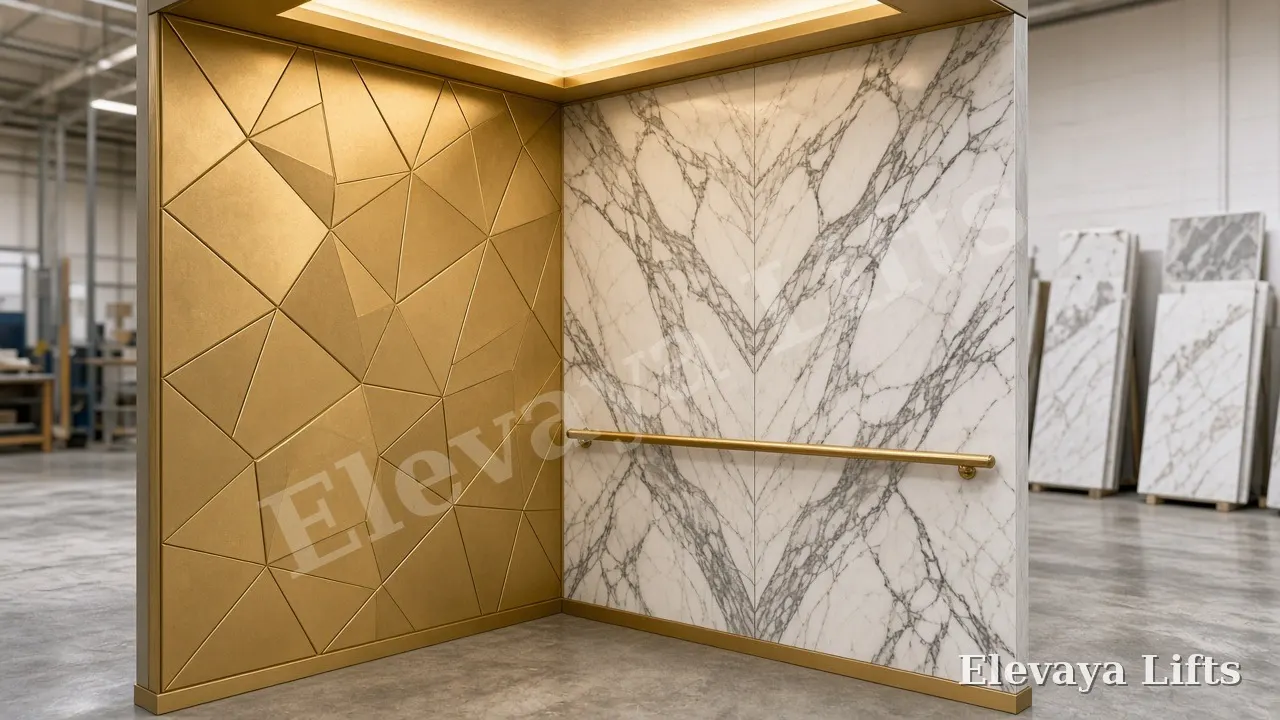
A mock-up usually shows where two materials meet, because that is where the risk is. A gold relief wall meeting a bookmatched marble return. A crystal ceiling border meeting a mirror. A handrail crossing a stone joint. At this scale you can check things no drawing reveals:
- whether the joints and reveals are as fine as you hoped,
- whether the handrail sits comfortably under the hand and clears the wall,
- glare and reflections from the ceiling light on polished metal and stone,
- how fingerprints show on the metal, and how easily they wipe off,
- whether the overall effect is the right level of richness, or a touch too much.
The table below shows how the main design tools differ and when each is used.
| Design tool | When it is used | What it proves | What it cannot prove | Who signs off |
|---|---|---|---|---|
| Mood board | Concept stage | The feeling, palette and design direction | Sizes, weight, real colour under cabin light | Owner, with the architect or interior designer |
| Physical samples | Before renders are finalised | True colour, texture, finish and the actual stone slab | How materials work together at full size | Owner and designer; signed samples kept |
| 3D renders | After samples | Composition, proportion, vein flow, lighting mood | True metal warmth, crystal sparkle, unseen slab veins | Owner and designer |
| Shop drawings | Before fabrication | Panel sizes, fixings, access, finished weight, door and panel positions | How it feels to stand inside | Elevaya engineering, then owner and designer |
| Full-scale mock-up | Before full fabrication | Joints, touch, glare, reflections, scale and richness | Ride quality and performance of the finished lift | Owner, on site at the workshop |
| Factory check | Before packing | Every panel matches the signed samples and drawings | Fit in the actual shaft and cabin | Elevaya, with the owner's team if wanted |
Not every lift needs a full cabin mock-up. A simpler scheme can be judged from samples and a single test panel. But when a cabin combines several precious materials, building one corner first is far cheaper than remaking a finished wall.
Fabrication and installation: when the craft meets the shaft
Fabrication is the stage where specialist craftsmen make each approved element, and installation is where those elements are fitted to a lift that has already been installed, tested and protected. The two run as one programme so the finishes arrive at the right moment, not the first available one.
During fabrication, each trade works to the signed samples and shop drawings: the metal workshop, the plating or coating finisher, the stone workshop, the gem setters and the lighting maker. Panels are numbered to the drawings, checked against the samples and, where it helps, pre-assembled in the workshop. Lead times are set once the material schedule is final, because precious finishes depend on the specialists who make them.
On site, the order protects the finishes:
- The lift itself goes in first. Guide rails, machine, car frame, doors and safety devices are installed and set up by our team, as in a standard lift installation.
- Precious finishes arrive late. Gold panels, marble and crystal are delivered when dusty trades nearby are finished, and stay wrapped until they are fitted.
- Fitting follows the drawings. Panels go in numbered order, joints are checked, lights are connected through their access panels, and the finished weight is confirmed against the design.
- Testing and certification. The lift is adjusted and tested with its finished cabin. Dubai Municipality's guideline DM-HSD-GU48-ECLA2 requires lifts to be tested and certified by a third party accredited by the Emirates International Accreditation Center (EIAC) once every 12 months.
- Protection until the house is ready. Floors, doors and handrails stay covered while the rest of the home is finished, so the first scratch is not made by another contractor.
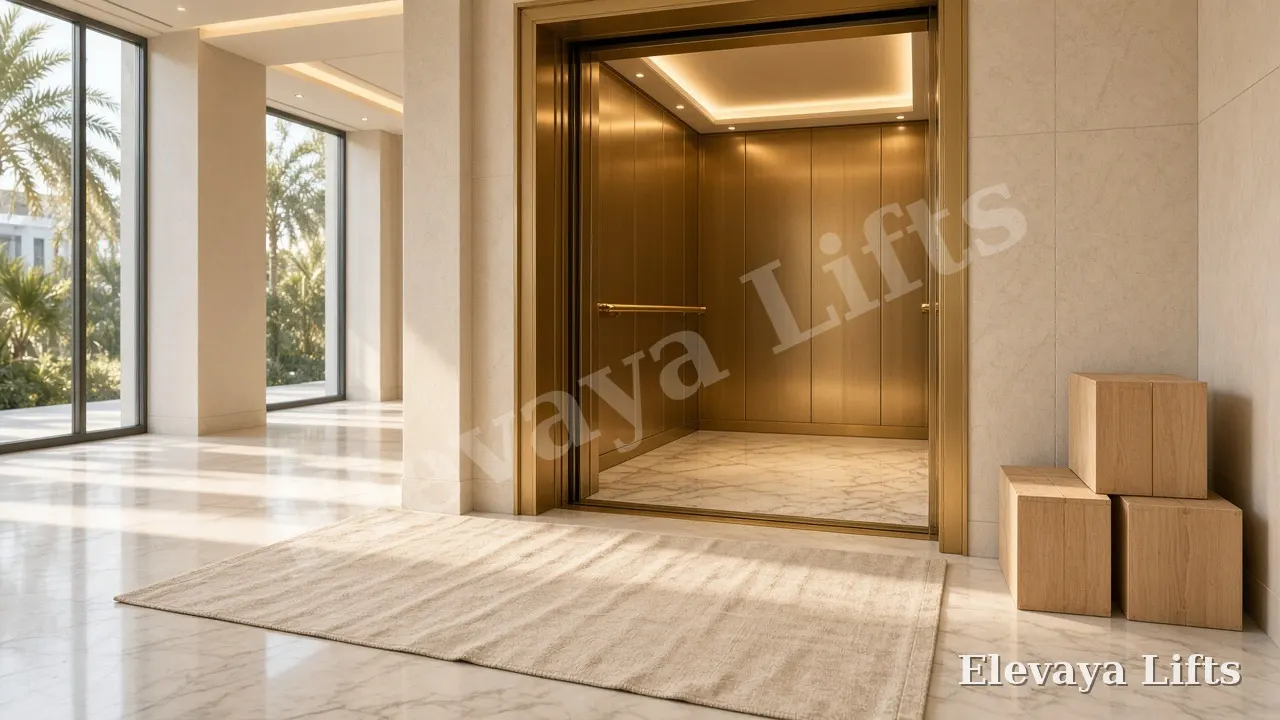
Our step-by-step guide to the lift installation process in Dubai explains the technical sequence in more detail. For an existing lift, the decorative work can run alongside lift modernization or cabin refurbishment, with the practical and decorative scope kept clearly separate.
Handover, and caring for precious finishes under an AMC
A good handover gives you the lift, the paperwork and the knowledge to keep it beautiful, and an AMC then keeps both the machinery and the finishes in order. This is where a bespoke lift is either looked after properly or slowly allowed to drift from the samples you approved.
At handover we walk the cabin and every landing with you under the lift's own lights, comparing each finish with the signed samples. Small marks are snagged and put right before the protection comes off for good. You then receive a handover pack, which for a bespoke lift should include:
- the as-built drawings and the final material schedule, naming every metal finish, stone, crystal reference and gem,
- a care sheet for each material, written for the people who will actually clean the lift,
- the signed sample set, or a record of where it is kept,
- spare material where it makes sense, such as an extra stone panel from the same slab, spare crystals or a spare jewelled button,
- the test and certification documents, and the AMC contact details.
The spare material matters more than people expect. A replacement marble panel cut years later from a different block will never quite match. A panel kept from the original slab will.
After handover, the AMC keeps everything working and looking right. In Dubai, Elevaya's non-comprehensive AMC for a G+1 villa lift starts from AED 2,500 a year, with monthly visits, fixes for issues and free 24-hour emergency callouts; only replacement parts are charged, and only when they need changing. On a bespoke lift, our technicians add the finishes to each visit: loose or moving panels, settings in crystal and gem details, failing lights behind onyx or crystal, door alignment against decorative frames, and wear on handrails and plated surfaces. Elevaya services all lift brands, so we can look after a lift we did not install. See our villa and home lift maintenance page and the elevator AMC cost guide.
Elevaya designs and installs some of the world's most expensive bespoke home lifts, customised with diamonds, Swarovski crystal, gold, platinum and precious metals, and finished in the world's most expensive marbles. The process above is how that work stays calm and predictable, however rare the materials. Explore the design directions on our bespoke luxury villa lifts page.
Related Elevaya guides
Continue planning with these related Elevaya guides:
- Gold lift doors and luxury lift panels in Dubai: gold and platinum landing doors and frames, engraved or monogrammed COP and LOP panels, jewelled push buttons, handrails, and how to make them last.
- Swarovski crystal lift cabins in Dubai: crystal, onyx and light: crystal ceilings and walls, backlit onyx, mirrors, cabin lighting levels, and how to keep crystal secure and serviceable in a moving cabin.
- Bespoke luxury home lifts in Dubai: gold, gems and rare marble: what can be customised, how gold, platinum, diamonds, crystal and rare marble are specified, weight, safety and care.
- Luxury elevator interiors in the UAE: marble, bronze and wood: weight, fire performance and cleaning of premium cabin finishes.
- Elevator cabin design trends in the UAE for 2026: finishes, COP/LOP panels, LED lighting and glass cabins.
- Lift installation in Dubai: step-by-step process: survey, shaft, pit and headroom prep, supply and delivery, installation sequence, testing, EIAC certification and handover.
- Dubai villa lift permit: which NOC and authority you need: the developer NOC, which authority approves (DM, DDA or Trakhees), the steps and the documents.
- Glass and panoramic villa lifts in Dubai: 2026 planning guide: placement, glazing, heat control, approvals and AMC care.
- Glass villa lift in Dubai: footprint, heat and cost factors: shaft vs shaftless, laminated glass, cabin cooling, hydraulic vs MRL vs platform.
- Lift COP and LOP panels in Dubai: what is on each panel, DBC button heights, Braille and intercom rules, common faults, repair vs replacement.
- Lift upgrades in Dubai: what to upgrade first: rescue devices for power cuts, door light curtains, VVVF and energy saving, cabin refresh, alarms, upgrade vs modernization.
- Elevator modernization in Dubai: signs, scope and standards: when to modernize, controller and door upgrades, EN 81-20/80, downtime and cost factors.
- Dubai annual lift inspection certificate: who issues it, 12-month and 6-month inspection rules and how to prepare.
- Elevator AMC cost in Dubai: villa owners' guide: non-comprehensive from AED 2,500 for G+1, visits, callouts and parts rules.
- Lift maintenance checklist for Dubai: monthly service visit: what each monthly visit should check on doors, ride, machine and brake, alarm, car top and pit, the log book and villa lifts.
- How to choose the best lift company in Dubai: buyer's checklist: licences, AMC terms, written response times, parts, references and red flags.
- Hydraulic lift problems in Dubai: leaks, sinking and heat: oil leaks, a car that sinks or re-levels, slow or jerky rides, summer overheating, noise and safe owner checks.
- Lift and elevator supply in the UAE: buyer's guide: supply-only vs supply and installation, what to specify, what a supply quote must include and red flags.
- Export lifts and elevator spare parts from the UAE: export documents, HS codes, certificate of origin and the steps from enquiry to shipment.
- Luxury marble and onyx lift interiors in Dubai: rare stones beyond Calacatta, from Statuario, Arabescato, Nero Marquina, Emperador and Taj Mahal quartzite to blue and green onyx, malachite, lapis lazuli and backlit agate, and how each is handled for weight and wear.
- Luxury lift cabin upgrade in Dubai: metals and finishes: re-dressing an existing lift with rose gold and champagne PVD, brass, bronze, copper, hammered and etched metal, black titanium, Macassar ebony and burl walnut veneers, leather, shagreen and gold leaf, and how weight, fire rules and downtime are handled.
- Luxury lift modernization ideas in the UAE: pairing a modernization with smart glass, fibre-optic starry ceilings, antiqued mirror, mother-of-pearl, marquetry, Murano-style glass, mashrabiya and Arabic calligraphy, touchless, fingerprint and touchscreen controls, cabin music, scent, filtered air and near-silent doors.
- What is the best luxury home elevator brand for a Palm Jumeirah or Emirates Hills villa?: how to compare brands neutrally by drive type, local service and parts, BS EN 81 or ASME A17 compliance, warranty, AMC, design flexibility and heat suitability.
- How much does a bespoke glass panoramic villa lift cost in Dubai?: what an installed AED quote should cover, the choices that move the price, confirmed Elevaya price points and the yearly cost of ownership.
- Can you install a luxury elevator in an already built Dubai villa without a concrete shaft or deep pit?: self-supporting structures, shallow-pit and pitless options, EN 81-21 and EN 81-41, positions in finished villas, approvals and cost.
- Which is quieter and smoother for a luxury villa: screw-driven, hydraulic or gearless traction?: how each drive sounds and rides in a Dubai villa, where noise really comes from, heat effects and how to test a lift before you buy.
Related Elevaya services and guides: Bespoke luxury villa lifts, Luxury lift design, Home lifts, Lift cabin wall panels, Elevator ceiling lighting, Villa lift dimensions and planning, Home lift for an existing villa, Lift installation, Cabin refurbishment, Lift modernization, Villa and home lift maintenance, Projects, Contact Elevaya.
FAQ
How long does it take to design and build a bespoke luxury lift?
There is no honest fixed answer before the survey and the material schedule. The time depends on the lift type, whether the building is new or existing, how many approval rounds you want, and the lead times of the specialists making the metalwork, stone, plating and gem settings. We set a programme once the materials are approved, rather than promising a date up front.
Do I need a full-scale mock-up for my villa lift?
Not always. A simple scheme can be judged from signed samples and one test panel. A mock-up earns its place when a cabin combines several precious materials, such as gold relief, bookmatched marble and crystal, because it shows joints, glare and touch at full size before the whole lift is made.
Can my architect or interior designer lead the design?
Yes, and many of our commissions work that way. The designer leads the look and the mood board, and we turn it into a lift that fits the shaft, carries its finished weight and stays serviceable. Samples, renders and the mock-up are signed off by the owner and the designer together.
Can I change a material after fabrication has started?
Sometimes, but it costs time and money, and the closer to installation the harder it gets. Cut stone, plated panels and set gems usually have to be remade. That is why the process puts samples, renders, shop drawings and the mock-up before fabrication: they are the cheap places to change your mind.
What should I receive when a bespoke lift is handed over?
You should receive the as-built drawings, a material schedule naming every finish, stone and crystal reference, a care sheet for each material, the signed samples or a record of where they are kept, any spare material such as a panel from the same slab, and the test and certification documents with your AMC contact details.
Start your bespoke lift with Elevaya
If you are planning a lift for a palace, villa or penthouse and want a calm, step-by-step route from first idea to handover, we would be glad to begin with your brief and mood board. Call or WhatsApp +971 58 584 4685, explore our bespoke luxury villa lifts or contact Elevaya to arrange a private design consultation.