Elevaya journal
Escalator Design and Maintenance for UAE Malls: A Practical Guide
Plan mall escalator supply, maintenance and inspection in the UAE: layout, operating duty, service records, faults and modernization decisions.
Published · Updated · Elevaya Lifts
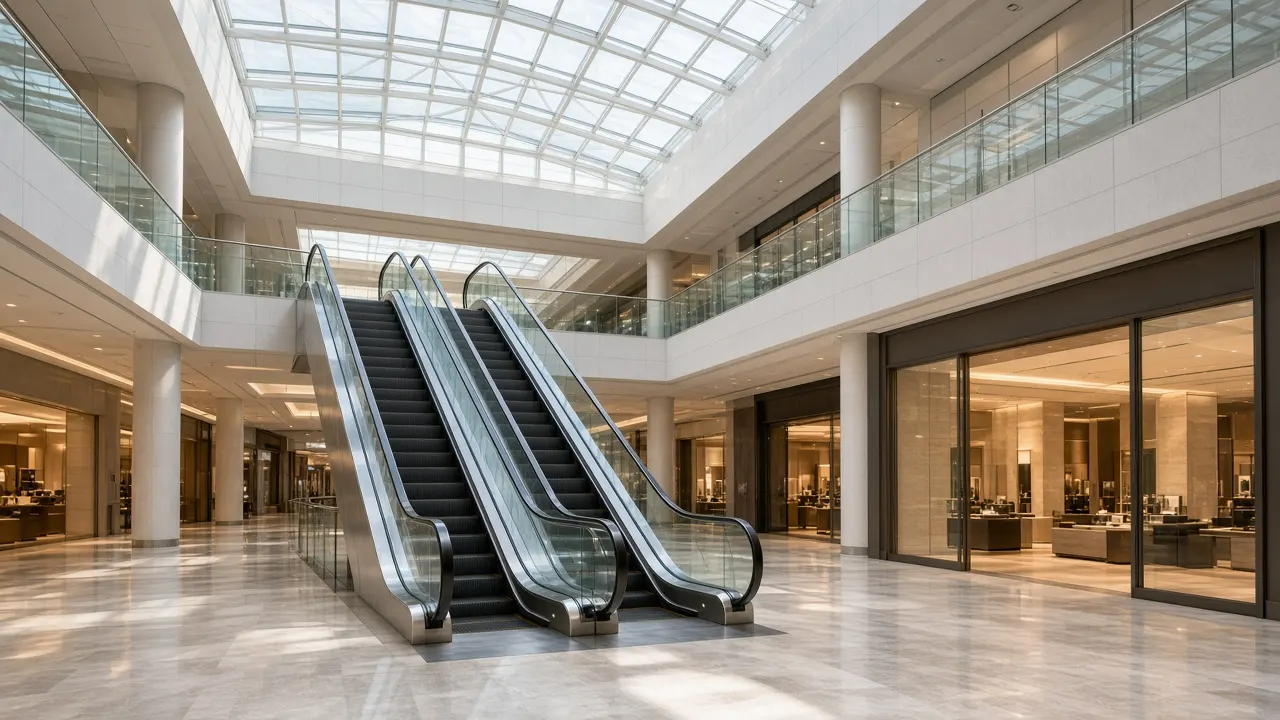
Quick answer: Good mall escalators in the UAE start with planning (where people enter, how crowds move between levels, and whether escalators sit in an open atrium or under a feature ceiling), then a specification that matches the traffic: step width, inclination, speed, glass or metal balustrades and energy-saving modes. After handover, safety and appearance depend on a structured maintenance contract (AMC) covering combs, steps, handrails, brakes and safety switches, with extra attention to dust, sand and heat. Older units can often be modernized instead of replaced.
Escalators are the circulation backbone of every UAE mall. In peak periods, during school holidays, Eid and festival seasons, they carry continuous crowds of shoppers, families with strollers, tourists with luggage and staff. When one stops, the whole floor feels it.
Elevaya has worked on lifts and escalators across the UAE since 2019, with more than 200 projects in design, supply, installation and AMC. This guide covers what mall owners, facility managers and consultants should consider in escalator design and how to keep escalators safe and running. For product types, see our escalators and moving walkways pages.
Part 1: Escalator Design for Malls
Start with people flow
Escalator position is a planning decision before it is a product decision. Ask:
- Where do the main entrances, car parks and metro or bus links deliver people?
- Which levels hold anchors, food courts and cinemas that draw crowds?
- Will escalators be in a criss-cross or parallel arrangement, and does the layout encourage people to circulate past shops?
- Where do people queue at the top and bottom, and is there enough clear space?
Run-off space at the landings is critical. A crowded landing with a shop entrance or kiosk too close creates congestion and safety risks.
Key specification choices
- Step width. Wider steps carry families, strollers and shopping bags more comfortably and increase practical capacity.
- Inclination. Common angles are 30° and 35°. A shallower angle feels more comfortable and is generally preferred for public, high-traffic settings; steeper units save space.
- Speed. Mall escalators run at moderate speeds for comfort and safety; higher speeds are rarely beneficial with mixed crowds.
- Flat steps at landings. More flat steps at entry and exit help passengers, particularly older people and children, step on and off steadily.
- Indoor vs outdoor duty. Escalators exposed to weather, sand or entrances need heavier-duty specifications.
Balustrades: glass vs metal
Glass balustrades are the standard look in UAE malls: they keep atriums open and let light through. Use toughened or laminated safety glass, protect the edges, and plan for cleaning, as fingerprints and dust show immediately.
Metal (solid) balustrades are more robust and suit transport hubs, car-park links and heavy-duty areas. They also hide more of the structure.
Whichever you choose, the handrail colour, balustrade lighting and cladding should be coordinated with the mall interior.
Escalators under feature ceilings and in atriums
UAE malls increasingly use design features around escalators: wood-slat or timber-look ceilings, sculptural cladding, LED lines and planting. These look superb but bring practical questions:
- Access for maintenance and step removal must not be blocked by ceilings or planters.
- Ceiling materials must meet fire requirements, as escalator voids connect floors.
- Lighting should not cause glare on steps, and step edges must remain clearly visible.
Applicable fire and life-safety and building requirements in Dubai fall within the framework of the Dubai Building Code and the relevant civil defence regulations. Your consultant should confirm how they apply to atrium and void design.
Energy efficiency
Escalators run long hours in malls. Variable-speed drives, standby or slow-speed modes when no one is riding, and LED lighting reduce energy use. Sensors at entry points trigger the escalator to resume full speed when a passenger approaches.
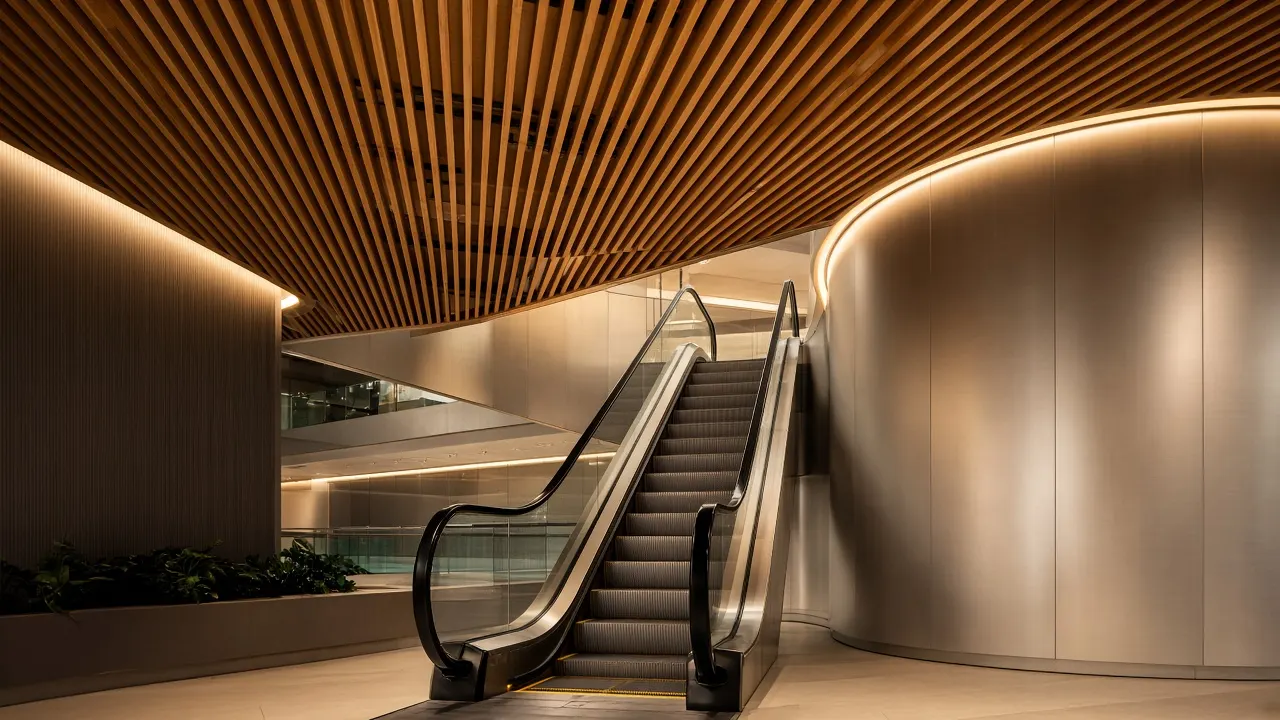
Feature ceilings must still leave access for maintenance.
Part 2: Escalator Maintenance in UAE Conditions
Why UAE malls are demanding
- Long operating hours, often from morning to late at night, and longer in festival periods.
- Dust and fine sand carried in on shoes, which collects in comb plates, step tracks and the truss.
- Heat at entrances and in outdoor or semi-outdoor units, which affects lubrication, drives and controllers.
- Mixed passengers, including strollers, trolleys and luggage that should ideally use lifts.
What a good escalator AMC covers
A structured escalator maintenance and repair contract should include, at minimum:
- Comb plates and teeth: inspect for broken teeth and correct meshing with steps; replace damaged combs promptly, as they protect against entrapment.
- Steps and step chain: check for damage, gaps, wear and correct chain tension.
- Handrails: check speed synchronisation with the steps, surface condition and tension.
- Brakes and drive: inspect and test brakes, check gearbox and motor condition, and lubrication.
- Safety devices: test emergency stop buttons, skirt switches, handrail inlet switches, missing-step detection and other safety circuits.
- Cleaning: remove dust and debris from the truss, pit and tracks, which is especially important in UAE conditions.
- Records: keep a maintenance log and reports the facility team can share during inspections.
Our commercial lift and escalator maintenance guide and escalator parts and safety components guide go into more depth.
Inspections and testing
Escalators in public buildings are subject to periodic inspection and testing by approved parties. Keep certificates current and display them where required. See our elevator inspection and testing guide for how inspections generally work in the UAE.
Planned vs reactive maintenance
Reactive maintenance (waiting for a breakdown) is expensive in a mall: lost footfall, frustrated tenants and safety exposure. Planned maintenance:
- Schedules work during low-traffic hours or overnight.
- Replaces wear parts such as combs and handrails before they fail.
- Tracks recurring faults and fixes root causes.
Daily checks by mall operations teams
Facility staff can support the AMC with simple daily walk-arounds:
- Check that emergency stop buttons are visible and unobstructed.
- Look for broken comb teeth, loose skirt panels or debris.
- Check that handrails move in sync with steps.
- Report unusual noise or vibration.
- Make sure safety signage (hold handrail, supervise children, no strollers or trolleys where required) is in place.
Staff should never attempt repairs themselves; they should isolate the unit and call the maintenance contractor.
Spare parts and response times
A mall cannot wait weeks for a comb plate or handrail. Agree in the AMC which critical wear parts are held in stock, how quickly technicians respond to a stopped unit, and how breakdowns during peak hours are prioritised. Multi-brand portfolios add complexity, because each manufacturer uses different parts and diagnostic tools. Our guides on elevator spare parts in the UAE and multi-brand maintenance explain what to ask before signing. Clear reporting also helps: a monthly summary of callouts, downtime and recurring faults lets the facility team see whether reliability is improving or whether a unit is becoming a candidate for modernization.
Part 3: Modernization vs Replacement
As escalators age, breakdowns and spare-part delays become more frequent. Options include:
- Partial modernization: new controller, drive or handrails, while keeping the truss and steps.
- Full modernization: replacing major components within the existing truss, often faster and less disruptive than full replacement.
- Full replacement: removing the unit and installing a new escalator, sometimes needed when the truss or layout no longer works.
A condition survey identifies the best option. Our escalator modernization service covers survey, phasing and execution with minimal disruption to operations.
Key Takeaways
- Plan escalators around people flow, landings and crowd peaks.
- Specify step width, angle, speed and balustrades for heavy, mixed traffic.
- Coordinate feature ceilings and atrium designs with maintenance access and fire requirements.
- Choose an AMC that addresses UAE dust, heat and long hours.
- Use condition surveys to decide between modernization and replacement.
Malls also rely on lifts for strollers, wheelchairs and luggage. For premium lift interiors in commercial and residential projects, read our guide to luxury elevator interiors in marble, bronze and wood, and for glass lifts in atriums and villas see panoramic villa lifts in Dubai. Design trends for cabins are covered in our 2026 cabin trends guide. To discuss an escalator project or AMC, contact Elevaya.
Wondering whether your escalators should run at 0.5 or 0.65 m/s, or how fast the lifts beside them should travel? See our guide to elevator and escalator speeds in UAE buildings.
Related Elevaya guides
Continue planning with these related Elevaya guides:
- Elevator cabin design trends in the UAE for 2026: finishes, COP/LOP panels, LED lighting and glass cabins.
- Glass and panoramic villa lifts in Dubai: 2026 planning guide: placement, glazing, heat control, approvals and AMC care.
- Luxury elevator interiors in the UAE: marble, bronze and wood: weight, fire performance and cleaning of premium cabin finishes.
- Elevator and escalator speeds in UAE buildings: rated lift speed by travel height and 0.5 vs 0.65 m/s escalators.
- Elevator AMC cost in Dubai: villa owners' guide: non-comprehensive from AED 2,500 for G+1, visits, callouts and parts rules.
- How to choose the best lift company in Dubai: buyer's checklist: licences, AMC terms, written response times, parts, references and red flags.
- Elevator modernization in Dubai: signs, scope and standards: when to modernize, controller and door upgrades, EN 81-20/80, downtime and cost factors.
- Glass villa lift in Dubai: footprint, heat and cost factors: shaft vs shaftless, laminated glass, cabin cooling, hydraulic vs MRL vs platform.
- Lift speed by building height in Dubai towers: DBC travel-time formula, worked m/s examples, waiting times, DHA hospital and Trakhees rules.
- Escalator faults and repairs in Dubai: why escalators stop, safety-device trips, handrail and step chain wear, sand and heat, repair vs modernization.
- Lift installation in Dubai: step-by-step process: survey, shaft, pit and headroom prep, supply and delivery, installation sequence, testing, EIAC certification and handover.
- Lift and elevator supply in the UAE: buyer's guide: supply-only vs supply and installation, what to specify, what a supply quote must include, BS EN 81 / ASME A17, EIAC certification, escalator supply and red flags.
- Lift maintenance checklist for Dubai: monthly service visit: what each monthly visit should check on doors, ride, machine and brake, alarm, car top and pit, the log book, maintenance vs inspection, villa lifts and an escalator checklist.
- Lift COP and LOP panels in Dubai: what is on each panel, DBC button heights, Braille and intercom rules, common faults, repair vs replacement.
- Lift upgrades in Dubai: what to upgrade first: rescue devices for power cuts, door light curtains, VVVF and energy saving, cabin refresh, alarms, EN 81-80, upgrade vs modernization.
- Common lift problems in Dubai: causes and fixes: stuck lifts, doors not closing, jerky rides, noise and summer heat trips, safe owner checks, trapped-passenger steps, repairs and certification.
- Escalator modernization in the UAE: signs, scope and compliance: when to modernize, modernize vs replace, controller and drive, steps, chain and handrail, energy features, phased mall works and the EIAC major inspection.
- Escalator installation in the UAE: step-by-step process: survey and selection, pit and truss supports, rigging, alignment, controller, safety devices, testing, EIAC inspection and handover.
Related Elevaya services: Escalators, Escalator maintenance and repair, Escalator modernization.
FAQ
How often should mall escalators be maintained in the UAE?
Mall escalators should follow a planned schedule set by the manufacturer and the AMC, typically with regular routine visits plus periodic in-depth inspections. High-traffic and dusty locations may need more frequent cleaning.
What are the most common escalator problems in UAE malls?
Common issues include broken comb teeth, handrail wear or speed mismatch, dust build-up in tracks, step damage from trolleys, and safety switch trips. Most can be reduced with planned maintenance.
Are glass balustrades safe on escalators?
Yes, when made of safety glass, properly fixed and maintained. Edges should be protected and panels inspected for chips or cracks.
Should strollers and trolleys use escalators?
Many malls direct strollers, wheelchairs and trolleys to lifts, as they increase the risk of falls and step damage. Follow your mall's signage and policies.
When should an escalator be modernized rather than replaced?
If the truss and layout are sound but controllers, drives or handrails are outdated or unreliable, modernization is often more efficient. A condition survey confirms the right option.
How often should mall escalator checks be performed?
Separate routine operating observations by trained site staff, planned technical maintenance and independent thorough examination. The manufacturer’s instructions, operating duty, equipment condition and applicable authority requirements determine the programme. An opening check does not replace maintenance or the independent examination schedule.
EIAC’s lifting-equipment requirements, Annex B lists escalators and passenger conveyors on a six-month examination interval, excluding the load test in that listed frequency. Ask the appointed inspection body to confirm the precise scope and due dates for the site. Keep reports and defect closure records against the same asset number.
After a trip or an unusual noise, isolate and report the equipment using the site’s procedure; repeated resets are not a diagnosis. See escalator faults and repair, maintenance and repair scope and escalator modernization.