Elevaya journal
Luxury Lift Modernization Ideas in the UAE: Smart Glass, Starry Ceilings, Mashrabiya, Touchless Controls and Near-Silent Doors
Luxury lift modernization ideas for UAE homes: smart glass, starry ceilings, mashrabiya, mother-of-pearl, touchless controls, cabin scent and quiet doors.
Published · Updated · Elevaya Lifts
Quick answer: Luxury lift modernization ideas in the UAE work best when technology and craft are planned as one job. Renewing the controller, door operator and car wiring makes room for smart glass, fibre-optic starry ceilings, touchless or fingerprint controls, cabin music, filtered air and quieter doors, finished in antiqued mirror, mother-of-pearl, marquetry, Murano-style glass, mashrabiya or calligraphy.
Most people think of modernization as the dull part of owning a lift. A new controller, a new drive, a new door operator, perhaps new buttons. Nobody frames a photo of a controller.
But in a luxury villa, palace or penthouse, modernization is the one moment when the lift is opened up properly. New cables run to the car. The door equipment comes off. The control panel is replaced anyway. That is exactly when you can add the things that make a cabin feel extraordinary: a night sky in the ceiling, glass that frosts for privacy, a lattice of mashrabiya over soft light, a fingerprint reader that knows which floors you are allowed to visit.
Elevaya Lifts is a UAE lift company with its office in Al Barsha 1, Dubai. We have worked on lifts in the UAE since 2019, on more than 200 projects, and our team of 40+ designs, supplies, installs, modernizes and maintains lifts in all seven Emirates. Our bespoke luxury villa lifts page shows the design directions many owners start from, and our overview of bespoke luxury home lifts covers gold, platinum, diamonds and rare marble. This guide is different. It is about what you can add to an existing luxury lift when it is modernized, and how the new technology and the hand-made finishes have to be designed around each other.
What makes a luxury modernization different from a cabin upgrade?
A cabin upgrade changes what you see; a modernization changes how the lift works. A luxury modernization does both at once, and that is what makes the bigger ideas possible. Our guide to a luxury lift cabin upgrade covers re-dressing a car in new metals, veneers and leather while the machinery stays as it is. That is the right answer when the lift itself is healthy.
Modernization goes further. Depending on the lift's age and condition, it can replace the controller, the drive, the door operator, the car and landing panels, the travelling cable that feeds power and signals to the car, and sometimes the machine. Our guide to elevator modernization in Dubai explains when that makes sense and which standards apply.
For a luxury lift, the important part is the wiring and the controls. Almost every idea in this article needs one of three things:
- Power at the car for smart glass, light engines, speakers, diffusers and fans.
- Signals between the car and the controller for touchless calls, fingerprint access, touchscreens and announcements.
- Space on the car roof for equipment that has to be reached for service without taking the ceiling down.
An older lift often has none of these to spare. A modernized one can be designed with all three from the start. That is why we say "plan it once": the craft decisions decide what the technology has to deliver, and the technology decides where the craft can go.
Can smart glass be used on lift doors and cabin walls?
Yes. Switchable smart glass can turn a glass lift door or cabin wall from clear to frosted at the touch of a button, and it is one of the most useful privacy ideas for panoramic and glass villa lifts. It needs careful design, because a lift door is a moving, safety-critical part and the glass has to be the right kind.
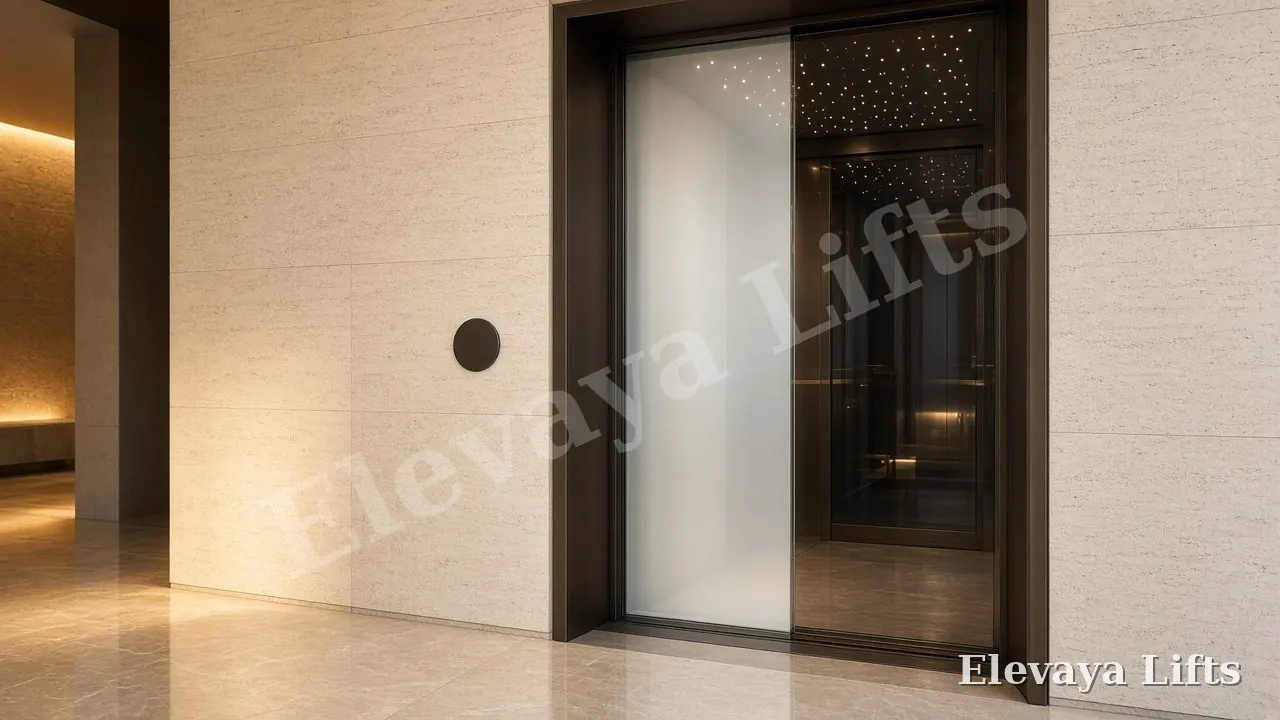
Most switchable glass used in interiors is a laminated glass with a liquid-crystal film inside. With power on, the film lines up and the glass is clear. With power off, it scatters light and looks frosted. On a lift, that gives you some lovely options:
- Privacy on demand. A glass lift in a double-height hall can be clear when it is empty and frost when someone steps in, or frost only on the side that faces a guest suite.
- A cleaner landing. The doors can stay frosted at rest, so the landing reads as a pale glass panel rather than a view into the shaft.
- A reveal. Doors that clear as the car arrives can show a lit cabin behind them, like the landing above.
What has to be checked first:
- The glass itself. Glass in lift doors and car walls is covered by the lift standards, so it must be the laminated safety glass specified for that use, with the right fixings. Smart glass is only an option if the product can meet that requirement. Ask for the test data before anything else.
- Power to moving doors. Car doors move with the car, and landing doors sit at each floor. Feeding power to a door leaf is not the same as wiring a window, so the detail is designed with the door supplier, not added afterwards.
- What happens when power is off. Most liquid-crystal glass goes frosted without power. Decide whether that suits you during a power cut or a long holiday.
- Heat and sun. In a glass lift in the UAE, the cabin can get warm. Smart glass is not a sun-control product on its own, so cooling and solar glazing still need to be planned. Our guide to glass and panoramic villa lifts in Dubai covers heat control.
The Dubai Building Code also recommends, in its accessible lift requirements (C.5.9.3.2 u), a full-height opaque wall or corner section 800 mm wide in panoramic lifts. Smart glass that frosts can help a glass cabin feel calmer for nervous passengers, but where that clause applies, treat it as a design question to settle with your consultant and the authority rather than a box ticked by the glass.
How are fibre-optic starry ceilings and antiqued mirror fitted in a lift?
A fibre-optic starry ceiling uses hundreds of fine glass or plastic fibres, all lit from one light source, so the ceiling panel itself carries light but no electrics or heat at each "star". That makes it a good fit for a lift, where a thin ceiling has to be light, cool and easy to take down.
How we plan one:
- Put the light source where a technician can reach it. The light engine usually sits on the car roof or in a ventilated void above the ceiling. If it fails, it should be replaced from the car top, not by taking the starry panel apart.
- Make the ceiling a removable panel. The fibres are threaded through the panel and trimmed flush. The whole panel lifts out as one piece, with enough slack in the fibre bundle to move it.
- Keep the working light. A night sky is beautiful, but a cabin also needs proper light for people to see the buttons, the floor and each other. For lifts in buildings, the Dubai Building Code asks for uniform lighting of at least 100 lux (C.5.9.3.2 t). In practice, we pair the stars with a dimmable cove or downlight that is bright when the doors open and can soften during the ride.
- Choose a calm setting. Twinkle effects and colour changes look great in a showroom and can feel busy in a small box. Most owners settle on a slow, warm white shimmer.
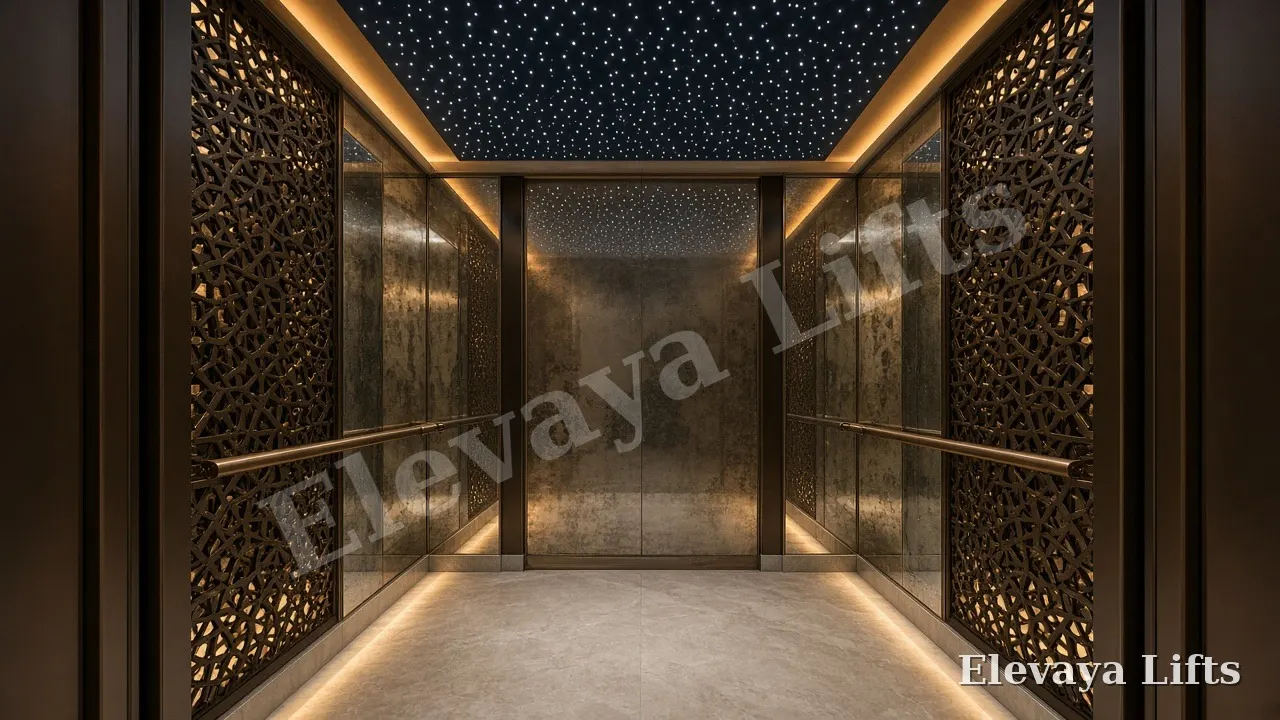
Antiqued mirror is the natural partner to a starry ceiling. It is real mirror glass whose silvering has been deliberately clouded, veined or speckled, so it reflects light and the stars without the hard, bright mirror of a hotel lift. It also makes a small cabin feel deeper, as the hero image shows.
Because it is mirror glass, it is handled like any mirror in a moving car: a safety backing so it holds together if it breaks, a fixing system designed for vibration, and frames or trims that protect the edges. Our elevator ceiling lighting guide has more on light levels and glare.
Where do mother-of-pearl, marquetry and Murano glass belong in a cabin?
Mother-of-pearl, wood marquetry and Murano-style glass are display finishes. They belong above the handrail and in panels that can be taken out whole, never as a floor or a surface people lean on. Used that way, they are what turns a beautifully engineered lift into something that looks hand-made.
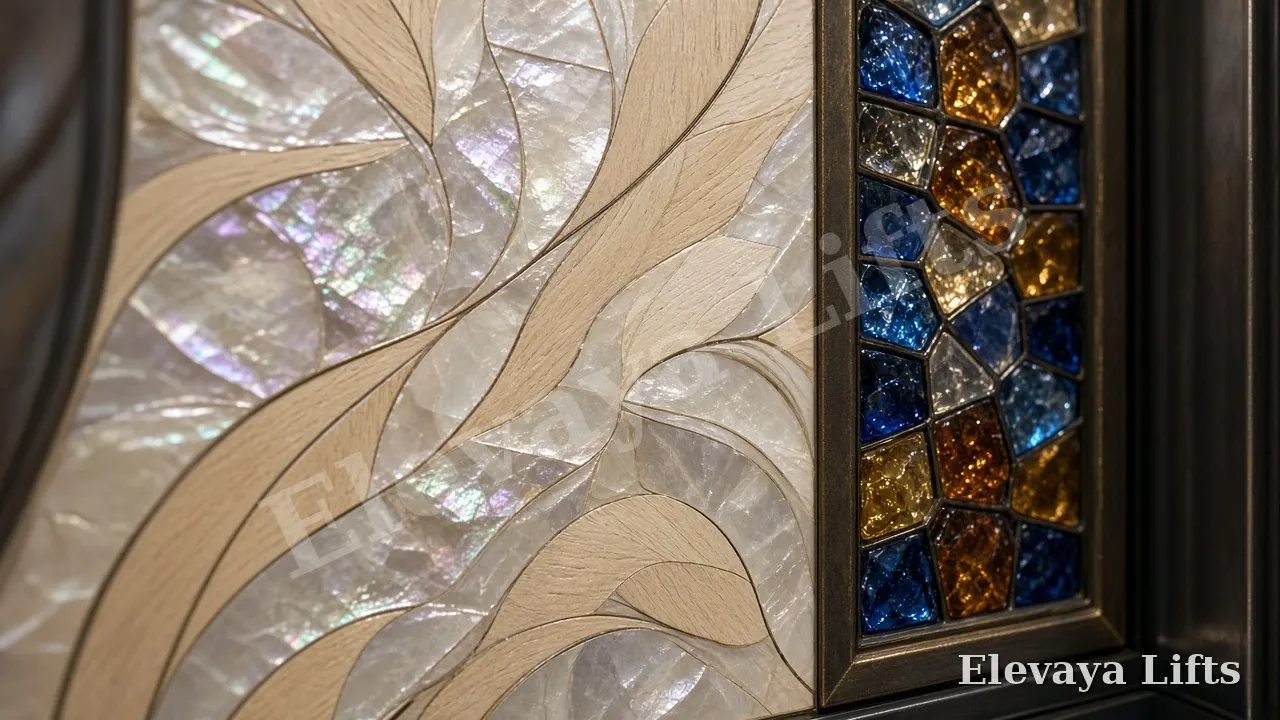
- Mother-of-pearl is cut from shell into thin pieces and laid as a mosaic or inlay on a stable backing. It shimmers as you move, which suits a lift better than almost any other room. It is thin, so it is light. It is also brittle, so it is sealed and framed, and kept to the upper walls or small feature panels.
- Marquetry is a picture or pattern made from pieces of different veneers. In a lift it is built on a fire-rated core, like any veneer, and sealed on both sides so it does not move in air-conditioning. Floral and geometric patterns both work. The panel above mixes pale wood with mother-of-pearl, a pairing with a long history in Levantine inlaid furniture.
- Murano or crystal glass inlays add colour and depth. "Murano" strictly means glass made on the island of Murano in Venice, so ask whether you are getting genuine Murano glass or a Murano-style piece, and get it in writing. Either way, each piece sits in a metal frame, bonded and mechanically held, so it cannot work loose with the movement of the car. Backlighting turns it into a small stained-glass window.
One practical habit for all three: order a spare panel or a spare set of pieces at the same time. Shell, wood and hand-made glass vary from batch to batch, and a matching repair in five years is much easier with a spare in the store room. Our guide to Swarovski crystal lift cabins covers how crystal is secured in a moving car, and the same thinking applies here.
How can Arabic calligraphy and mashrabiya patterns be used in a lift?
Mashrabiya and Arabic calligraphy bring a sense of place to a UAE lift that imported finishes cannot, and modern cutting and engraving make them practical in a cabin. They do need more thought than most finishes, for reasons of both maintenance and respect.
Mashrabiya in a lift is usually a laser- or water-jet-cut metal screen, often bronze or bronze-coloured steel, set a few centimetres in front of a lit panel, a mirror or a mother-of-pearl mosaic. The light behind it does the work. A few points we design for:
- Dust. A deep lattice collects dust. Screens should lift off for cleaning, and the depth of the pattern should suit how often the household wants to clean it.
- Fingers and bags. At hand height, openings are kept small or backed with glass so nothing catches.
- Hidden services. A mashrabiya screen is a neat way to hide ventilation openings, speakers or a camera, as long as air and sound can pass through.
Arabic calligraphy can be engraved into metal door faces, inlaid in brass into stone or wood, or cut as a screen. Our advice is simple:
- Have the text set by a calligrapher, not a font. Then have it checked by someone who reads it well before anything is cut. A mistake engraved in bronze is hard to undo.
- Agree the words with the family, and think about placement. If the text is a verse or carries religious meaning, many families prefer it at eye level or above, never on the floor or where it may be leant on, and away from a lower door area that gets scuffed.
- Keep it apart from the safety signage. Floor indicators, alarm signs and any required tactile or Braille markings stay clear and readable, not woven into the decoration.
Our guide to gold lift doors and luxury lift panels covers engraving and monograms on doors and control panels in more detail.
Are touchless, fingerprint and touchscreen lift controls allowed in Dubai?
Yes, all three can be used, but a touchscreen or touch-sensitive panel in a lift that must meet the Dubai accessibility rules also needs a physical tactile button that switches on an alternative for blind or visually impaired passengers. That requirement is in the Dubai Building Code, C.5.9.3.2 o.
Here is how each option tends to work in a luxury modernization:
- Touchless call buttons. A proximity sensor reads a hand a few centimetres away, so nobody has to touch the panel. They suit landings with polished stone and pale walls, like the blank round plate in the smart glass image above. We still fit a physical button or keep one available, because sensors can be confused by bright sun on a glass landing.
- Fingerprint and card access. A reader on the landing or in the car can limit which floors each person can reach: staff to service floors, guests to the reception level, family everywhere. It needs to be built into the lift's controller logic, not wired around it, and there must always be a reliable override, such as a key switch or code, for emergencies and maintenance.
- Touchscreen COPs. A glass screen can show floor names, the time, a welcome message or a calm animation of the house. For buildings, the code also asks for buttons between 900 mm and 1,200 mm from the floor with high-embossed numerals and Braille (C.5.9.3.2 k), so a screen usually sits alongside a slim tactile button column rather than replacing it. In a private villa, we still recommend keeping a physical button set; touchscreens in the UAE can get hot in glass lifts and can be hard to use with wet hands.
Whatever the controls look like, the emergency alarm and intercom stay simple, visible and reachable. Our guide to lift COP and LOP panels in Dubai covers button heights, Braille and intercom rules in more detail. If you are unsure which accessibility clauses apply to your building, confirm with Dubai Municipality or your consultant before the panel is ordered.
Can a lift cabin have music, scent and air purification?
Yes. Modern cabins can have a small sound system, a scent diffuser and a filtered fan, but each one has to fit around the lift's safety equipment and the comfort of every passenger, not just the owner.
Music. Slim speakers can sit behind a ceiling panel, a mashrabiya screen or a perforated metal strip. A few rules we follow:
- Keep the volume low and capped. A lift ride is short, and music should be background, not a performance.
- The lift's own floor announcements and alarm sounds always come first. For buildings, the Dubai Building Code asks for audible signals or voice announcements at each floor (C.5.9.3.2 r), and the hands-free intercom must work at all times (C.5.9.3.2 q). The music system is designed to mute for those, not to compete.
- Speakers and the amplifier are serviced like the rest of the car equipment, so they are placed where they can be reached.
Scent. A gentle fragrance can make a lift feel like part of a hotel-grade home. It is also a small, closed space. The US Environmental Protection Agency lists air fresheners among the household products that release volatile organic compounds into indoor air. So we keep scent subtle: a diffuser on a timer or linked to the ride, fed from outside the cabin where possible, at a low setting, with a fragrance the household is happy for guests, staff and children to breathe. Many owners simply scent the lobby instead.
Air purification. A quiet fan with a proper particle filter on the car roof can keep air fresh in a closed cabin, which matters in a busy villa during dusty months. One firm piece of advice: avoid devices that work by making ozone. The EPA explains that relatively low amounts of ozone can cause chest pain, coughing, shortness of breath and throat irritation. A filter you can change is a better choice in a small space.
How quiet can the doors be after a modernization?
Very quiet. A new door operator with smooth, controlled motion, combined with new door rollers, tracks and well-adjusted sills, can make door movement close to silent, and it is one of the upgrades owners notice most. In a home where the lift opens onto a living room or a bedroom corridor, door noise is often the loudest thing the lift does.
Where the noise comes from, and what we change:
- The door operator. Older operators can thump at the end of travel. Modern operators control the door speed all the way through, slowing gently at the end of opening and closing.
- Rollers, tracks and guide shoes. Worn rollers rumble, and a dirty or worn sill makes the door shoes scrape. These are replaced or adjusted together.
- The car itself. Rattling panels, a loose ceiling or a noisy fan can be mistaken for door noise. Heavy luxury finishes need fixings that stay tight.
Quiet does not mean weak. Door force and the safety devices that stop a closing door, such as a light curtain, are set by the lift standards, and a modernized door still has to react to a hand or a bag in the gap. Our guide to lift upgrades in Dubai explains light curtains and door operators in more detail.
Which modernization idea suits which home?
The best ideas are the ones that suit how the lift is used, so it helps to see them side by side. This table is a starting point for a conversation, not a rule book.
| Idea | What the lift needs | Works best in | Care note |
|---|---|---|---|
| Smart glass doors or walls | Laminated safety glass, power to the door or wall, controller logic | Glass and panoramic villa lifts | Frosts when unpowered; check heat and sun |
| Fibre-optic starry ceiling | Light engine on car roof, removable ceiling panel | Penthouses, palaces, cinema-style homes | Keep a bright working light alongside |
| Antiqued mirror | Safety backing, vibration-proof fixing | Small cabins that need to feel bigger | Wipe dry; avoid harsh sprays |
| Mother-of-pearl and marquetry | Fire-rated core, sealed panels, frames | Upper walls, feature panels | Spare pieces for future repairs |
| Murano-style glass inlay | Metal frame, mechanical fixing, backlight | Rear wall, beside the COP | Ask genuine Murano or Murano-style |
| Mashrabiya screen | Lift-off fixing, space for light behind | Side walls, landing surrounds | Regular dusting of the lattice |
| Arabic calligraphy | Proofed artwork, engraving or inlay | Door faces, upper panels, lintels | Placement agreed with the family |
| Touchless call buttons | Sensor plate, wiring to controller | Polished landings, wellness homes | Keep a physical button too |
| Fingerprint or card access | Access logic in the controller, override | Homes with staff and guest floors | Plan the emergency override |
| Touchscreen COP | New controller interface, tactile backup | Modern villas and penthouses | Watch heat in glass lifts |
| Music, scent and filtered air | Power, speakers, fan and filter space | Family homes with frequent use | Mute for alarms; no ozone devices |
| Near-silent door operator | New operator, rollers, tracks, sills | Lifts opening onto living spaces | Regular door adjustment under AMC |
How do you plan technology and craft together in one modernization?
Start with a survey of the lift as it stands, decide which parts are being modernized, and only then design the finishes, so the wiring, weight and access are settled before anything is made. That order is what keeps a luxury modernization to a single shutdown rather than a series of disruptions.
The way we usually run it:
- Survey the lift and the house. Lift data, condition, rated load and current car weight, available power, and how the household uses the lift.
- Fix the technical scope. Controller, drive, door operator, travelling cable, car top equipment. This is where the spare wires and power for the luxury features are added.
- Choose the ideas. From the table above, or from your own designer's brief. Our bespoke luxury villa lifts team can work with your architect or interior designer.
- Weigh everything. Every panel, screen, light engine and fan is added up against the lift's limits. Mother-of-pearl and fibre-optics are light; stone, solid bronze and thick glass are not.
- Sample and mock up. Real mirror, shell, glass and a section of mashrabiya under the actual cabin light. A small mock-up of a starry ceiling shows the density of stars far better than a render.
- Fabricate off site, then install. The lift is taken out of service when the parts are ready. Mechanical and cabin work are done in the same window.
- Test, hand over and maintain. The lift is tested and certified, and the cabin's care sheet joins the lift records. Your AMC visits then cover both the machinery and the luxury features.
On cost, every project is priced after a site survey, because the scope varies so much. For context, Elevaya's basic home lifts are from AED 69,999, and some basic models start as low as AED 60,000. Some of our bespoke luxury lifts, with handcrafted Italian marbles and precious metals such as gold, are in the range of AED 2 million to 5 million, and a few go up to AED 20 million to 25 million. A modernization with luxury features sits wherever its scope puts it, and the survey is how we find that out.
For more on doing this in a home that is already built, see our guide to a home lift for an existing villa and our lift modernization service.
Related Elevaya guides
Continue planning with these related Elevaya guides:
- Luxury lift cabin upgrade in Dubai: metals and finishes: re-dressing an existing lift with rose gold and champagne PVD, brass, bronze, copper, hammered and etched metal, black titanium, Macassar ebony and burl walnut veneers, leather, shagreen and gold leaf, and how weight, fire rules and downtime are handled.
- Luxury marble and onyx lift interiors in Dubai: rare stones beyond Calacatta, from Statuario, Arabescato, Nero Marquina, Emperador and Taj Mahal quartzite to blue and green onyx, malachite, lapis lazuli and backlit agate, and how each is handled for weight and wear.
- Bespoke luxury lift design process in Dubai: from brief and mood board to material samples, 3D renders, a full-scale mock-up, fabrication, installation, handover and AMC care of precious finishes.
- Gold lift doors and luxury lift panels in Dubai: gold and platinum landing doors and frames, engraved or monogrammed COP and LOP panels, jewelled push buttons, handrails, and how to make them last.
- Swarovski crystal lift cabins in Dubai: crystal, onyx and light: crystal ceilings and walls, backlit onyx, mirrors, cabin lighting levels, and how to keep crystal secure and serviceable in a moving cabin.
- Bespoke luxury home lifts in Dubai: gold, gems and rare marble: what can be customised, how gold, platinum, diamonds, crystal and rare marble are specified, weight, safety and care.
- Luxury elevator interiors in the UAE: marble, bronze and wood: weight, fire performance and cleaning of premium cabin finishes.
- Elevator cabin design trends in the UAE for 2026: finishes, COP/LOP panels, LED lighting and glass cabins.
- Lift upgrades in Dubai: what to upgrade first: rescue devices for power cuts, door light curtains, VVVF and energy saving, cabin refresh, alarms, upgrade vs modernization.
- Elevator modernization in Dubai: signs, scope and standards: when to modernize, controller and door upgrades, EN 81-20/80, downtime and cost factors.
- Lift COP and LOP panels in Dubai: what is on each panel, DBC button heights, Braille and intercom rules, common faults, repair vs replacement.
- Lift installation in Dubai: step-by-step process: survey, shaft, pit and headroom prep, supply and delivery, installation sequence, testing, EIAC certification and handover.
- Dubai villa lift permit: which NOC and authority you need: the developer NOC, which authority approves (DM, DDA or Trakhees), the steps and the documents.
- Glass and panoramic villa lifts in Dubai: 2026 planning guide: placement, glazing, heat control, approvals and AMC care.
- Glass villa lift in Dubai: footprint, heat and cost factors: shaft vs shaftless, laminated glass, cabin cooling, hydraulic vs MRL vs platform.
- Dubai annual lift inspection certificate: who issues it, 12-month and 6-month inspection rules and how to prepare.
- Elevator AMC cost in Dubai: villa owners' guide: non-comprehensive from AED 2,500 for G+1, visits, callouts and parts rules.
- Lift maintenance checklist for Dubai: monthly service visit: what each monthly visit should check on doors, ride, machine and brake, alarm, car top and pit, the log book and villa lifts.
- How to choose the best lift company in Dubai: buyer's checklist: licences, AMC terms, written response times, parts, references and red flags.
- Hydraulic lift problems in Dubai: leaks, sinking and heat: oil leaks, a car that sinks or re-levels, slow or jerky rides, summer overheating, noise and safe owner checks.
- Lift and elevator supply in the UAE: buyer's guide: supply-only vs supply and installation, what to specify, what a supply quote must include and red flags.
- Export lifts and elevator spare parts from the UAE: export documents, HS codes, certificate of origin and the steps from enquiry to shipment.
- What is the best luxury home elevator brand for a Palm Jumeirah or Emirates Hills villa?: how to compare brands neutrally by drive type, local service and parts, BS EN 81 or ASME A17 compliance, warranty, AMC, design flexibility and heat suitability.
- How much does a bespoke glass panoramic villa lift cost in Dubai?: what an installed AED quote should cover, the choices that move the price, confirmed Elevaya price points and the yearly cost of ownership.
- Can you install a luxury elevator in an already built Dubai villa without a concrete shaft or deep pit?: self-supporting structures, shallow-pit and pitless options, EN 81-21 and EN 81-41, positions in finished villas, approvals and cost.
- Which is quieter and smoother for a luxury villa: screw-driven, hydraulic or gearless traction?: how each drive sounds and rides in a Dubai villa, where noise really comes from, heat effects and how to test a lift before you buy.
Related Elevaya services and guides: Bespoke luxury villa lifts, Luxury lift design, Home lifts, Lift cabin wall panels, Elevator ceiling lighting, Home lift for an existing villa, Lift modernization, Cabin refurbishment, Villa and home lift maintenance, Projects, Contact Elevaya.
FAQ
Can I add a fibre-optic starry ceiling to my existing lift?
Usually, yes. The starry effect comes from fine fibres threaded through a new ceiling panel and lit by one light source, normally placed on the car roof. The lift needs a spare power supply at the car and a ceiling that can be removed as one panel. If the lift is being modernized anyway, that is the easiest time to add it.
Do smart glass lift doors stay clear during a power cut?
Most switchable glass turns frosted when it loses power, so expect privacy rather than a view during an outage. The doors themselves are moved by the door operator, not the glass, so the glass does not decide whether they open. How the lift behaves in a power cut depends on its rescue equipment.
Can a fingerprint reader decide which floors each person can reach?
Yes. A fingerprint or card reader can be linked to the lift's controller so that family, guests and staff each see only the floors they are allowed to visit. It has to be built into the control logic, with a reliable override such as a key switch or code for emergencies and maintenance.
Is it safe to use a scent diffuser or air purifier inside a lift?
It can be, if it is gentle and well chosen. Keep fragrance subtle, on a timer and acceptable to everyone who rides the lift, because air fresheners release chemicals into indoor air. For purification, choose a quiet fan with a changeable particle filter and avoid devices that produce ozone.
Can Arabic calligraphy be engraved on lift doors?
Yes. Calligraphy can be engraved into metal door faces, inlaid in brass, or cut as a screen. Have it written by a calligrapher, proofread before cutting, and agree the words and placement with the family, keeping meaningful text at eye level or above and away from scuffed lower door areas.
Modernize your luxury lift with Elevaya
If your lift is due for modernization and you want it to come back as the most remarkable room in the house, we would be glad to help you plan the technology and the craft together. Call or WhatsApp +971 58 584 4685, explore our bespoke luxury villa lifts or contact Elevaya to arrange a site survey.