Elevaya journal
Lift Upgrades in Dubai: What to Upgrade First on an Existing Lift, and When to Modernize Instead
Lift upgrades in Dubai for existing lifts: rescue devices for power cuts, door light curtains, VVVF drives, LED cabins, alarms, and when to modernize.
Published · Updated · Elevaya Lifts
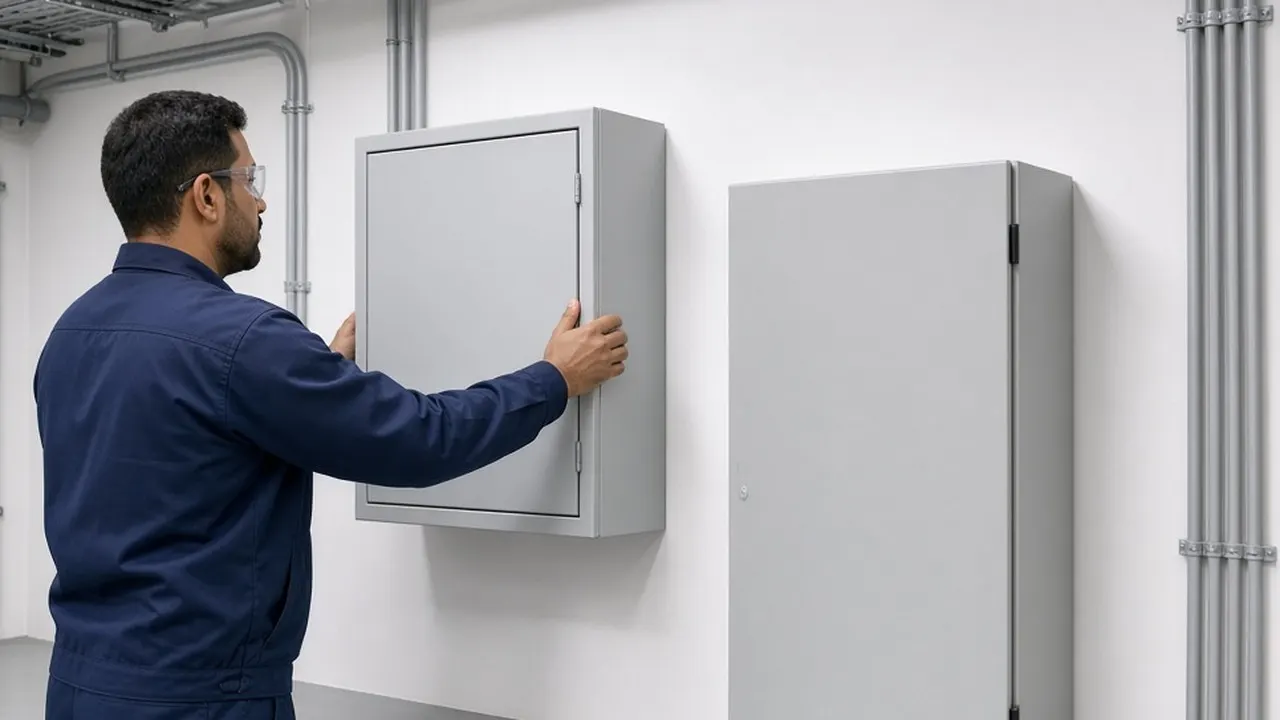
Quick answer: A lift upgrade is a targeted improvement to one part of an existing lift, such as adding an automatic rescue device (ARD) for power cuts, fitting door light curtains, installing a VVVF drive or LED lighting, refreshing the cabin, or replacing the alarm intercom, without replacing the whole lift system. In Dubai and the wider UAE, prioritise upgrades in this order: safety first (door protection, emergency alarm and communication, rescue during power cuts), then reliability (drive, door operator, worn components), then comfort and energy (ride quality, standby modes, LED lighting) and looks last (ceilings, wall panels, flooring). Use BS EN 81-80 as the reference for improving the safety of an existing lift and BS EN 81-82 for accessibility; both are listed in the Dubai Building Code. If the controller is obsolete or several systems are failing at once, a full modernization usually makes more sense than a string of separate upgrades. After any work that alters safety devices, drives or controls, plan for inspection and certification by an EIAC-accredited third party.
A lift that still runs is not necessarily a lift that is safe, efficient or pleasant to use. Many villas and buildings in Dubai have lifts that work every day but have no rescue function when the power drops, doors that close on people's bags, a cabin light that never switches off, or an alarm button that nobody has tested in years. None of these on their own justify replacing the lift. Each of them can usually be fixed with a focused upgrade.
This guide explains lift upgrades in Dubai for existing lifts: the upgrades that are worth considering, what each one solves, how to rank them, where the Dubai Building Code and the BS EN 81 standards come in, how upgrades compare with full elevator modernization, and what happens with inspection, certification and maintenance afterwards. It also covers escalator upgrades briefly at the end.
Elevaya Lifts has worked in the UAE since 2019 on more than 200 projects, covering lift design, supply, installation and annual maintenance contracts (AMC). We service all lift brands, including Otis, KONE and Schindler, and lifts we did not install, so the advice below applies to whichever make you have.
What counts as a lift upgrade, and how is it different from modernization?
A lift upgrade changes or adds one system or component to an existing lift to fix a specific weakness, while a modernization replaces the main systems (usually the controller, drive and often the doors and fixtures) as one coordinated project. The line between the two is not fixed, but the difference in scope matters for planning, downtime and certification.
| Targeted lift upgrade | Partial or full modernization | |
|---|---|---|
| Typical scope | One system: rescue device, door protection, alarm intercom, drive, lighting, cabin finishes, panels | Several major systems together: controller, drive, machine, door equipment, fixtures, wiring |
| When it fits | The lift is basically sound and supported, but one area is weak or out of date | The controller is obsolete, parts are hard to find, or several systems are failing at once |
| Planning | Survey of the specific system and its interface with the existing controller | Full survey, design, approvals and phased programme |
| Compatibility question | Will the new part work with the existing controller and safety circuit? | Usually designed as one matched system |
| After the work | Testing of the changed system and certification as required | Full testing, commissioning and certification |
A practical way to think about it: an upgrade fixes a problem, a modernization resets the lift. If a survey finds that the same lift needs a new drive, new door operators, new panels and a rescue device, you are effectively describing a modernization and should price it as one. Our lift modernization service and the longer lift modernization guide cover that route.
Which lift upgrades should you do first?
Rank lift upgrades by risk: safety first, then reliability, then comfort and energy, then appearance. This order protects passengers, reduces breakdowns and avoids spending on a beautiful cabin inside a lift that still traps people during a power cut.
- Safety: door protection (light curtains), the emergency alarm and two-way communication, rescue during power failure, and any gaps a survey against BS EN 81-80 identifies.
- Reliability: the door operator, the drive, worn components and anything behind repeat callouts.
- Comfort and energy: smoother starts and stops, accurate levelling, standby modes, LED lighting with automatic switch-off.
- Accessibility: button and signal upgrades, audible announcements and door timing, using BS EN 81-82 as the reference.
- Appearance: ceilings, wall panels, flooring, handrails and mirrors.
Accessibility can move up the list. In a building where an elderly resident or a wheelchair user depends on the lift, missing announcements or short door-open times are a safety and dignity issue, not a cosmetic one.
The best evidence for ranking is your own lift's history. A maintenance log showing repeated door faults points to door equipment first. Repeated trapped-passenger calls during outages point to a rescue device. A survey by your maintenance company should turn this history into a written, prioritised list rather than a single headline quotation.
Automatic rescue device (ARD): what happens when the power goes off?
An automatic rescue device (ARD) lets a lift bring passengers to a landing and open the doors when the mains supply fails, instead of leaving them trapped between floors until power returns or a technician arrives. It is a common upgrade for villas and smaller buildings that have no standby generator supply for the lift.
When the ARD detects a power failure, it uses a battery or other stored energy to move the car slowly to a suitable floor, levels it and opens the doors, then parks the lift until normal power is back. On traction lifts it works through the drive and brake; hydraulic lifts use a different arrangement, typically lowering the car to the floor below. The details depend on the lift type and the controller.
Things to check before fitting an ARD:
- Compatibility with the existing controller, drive and brake, including whether the controller supports a rescue mode.
- Battery condition and testing: the batteries need checking and replacing during their life, and the rescue function should be tested on maintenance visits, not only when the power fails.
- Which floors it can stop at, how the doors behave and what passengers hear or see during the rescue.
- How it sits with any generator in the building, so the two do not conflict.
An ARD does not replace the alarm and intercom. A passenger still needs to be able to call for help if the rescue does not complete or the fault is not a power failure.
Door upgrades: light curtains and door operators
Door upgrades are usually the highest-value reliability and safety improvements on an older lift, because doors are involved in most lift trips and many lift faults. The two common upgrades are door protection (light curtains) and the door operator.
Light curtains
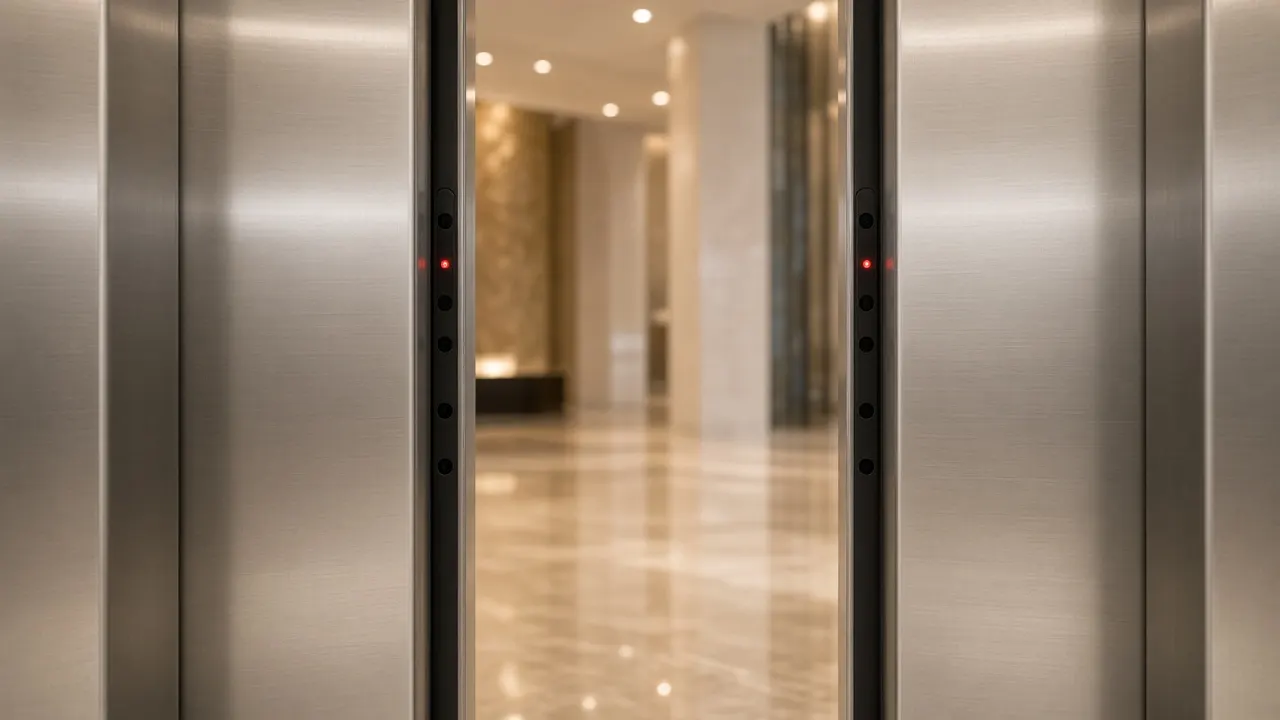
A light curtain is a pair of vertical strips on the car door edges that projects many infrared beams across the opening. If any beam is broken, the doors stop and reopen. Older lifts often rely on a mechanical safety edge, which only reacts after it touches someone, or a single photocell that covers one height and can miss a child, a pet, a suitcase or a pushchair wheel.
For accessible lifts, clause C.5.9.3.2 of the Dubai Building Code asks for automatic doors that stay open for at least 3 seconds (item f) and that automatically reopen when a user is in the doorway without producing a force greater than 135 N, with sensors recommended at two levels so that lower items can be detected (item g). A multi-beam light curtain is the usual way to meet that intent on an existing lift.
Door operators
The door operator is the motor and control unit that opens and closes the car door and couples to the landing doors. Worn or older operators cause slamming, slow or noisy doors, doors that stop halfway and repeat callouts. A modern operator with its own controller gives smoother, more consistent movement and adjustable timings. Landing door rollers, locks, sills and guides should be inspected at the same time, because a new operator cannot compensate for worn landing door equipment. Our guide to elevator landing doors explains those parts.
In the UAE, sand and dust in door sills are a common cause of door faults, especially at ground-floor and car-park landings. A door upgrade is a good time to improve sill cleaning routines in the AMC.
Drive and energy-saving upgrades: VVVF, standby mode and LED lighting
Drive and energy upgrades make an existing lift smoother and cheaper to run: a VVVF drive controls motor speed precisely, a standby mode powers down equipment when the lift is idle, and LED lighting with automatic switch-off cuts the lighting load. The Dubai Building Code sets these features for new lifts, and they are a sensible benchmark for upgrading older ones.
Clause D.6.1 of the Dubai Building Code 2021 says elevators in new buildings shall include controls to conserve energy, and that traction drive elevators shall incorporate:
- a) AC variable voltage and variable frequency (VVVF) drives on non-hydraulic elevators;
- b) energy-efficient lighting, including controls that turn off the lights when the elevator has been inactive for a maximum of 5 minutes, with an average luminous efficacy greater than 70 lumens per circuit watt inside the elevator; and
- c) a standby condition for off-peak periods.
A note to the same clause says regenerative drives should be used where they are shown to save energy. A regenerative drive feeds energy generated during certain movements, such as a heavily loaded car travelling down, back into the building supply instead of burning it off as heat. Whether it is worthwhile depends on the lift's traffic, travel and load pattern, so it should be assessed for each lift rather than assumed.
These clauses apply to new buildings, so they are not automatically a legal requirement for an older lift. They are still a clear, local definition of what an efficient lift looks like, and they make a practical checklist for an energy upgrade:
- Older drive types (for example two-speed motors or older control systems) can be replaced with a VVVF drive, which also improves levelling accuracy and ride comfort.
- Cabin lights that stay on all day can be replaced with LED fittings and an automatic switch-off after a period of inactivity.
- Fans and displays can be included in the standby logic where the controller allows.
- Regeneration can be considered on busy traction lifts once the traffic pattern is known.
A drive change affects the lift's driving mechanism and controls, which matters for certification (see below). It also needs careful matching to the motor, brake and controller, so it is often bundled with a controller upgrade.
Cabin refresh upgrades: LED ceiling, wall panels and flooring
A cabin refresh upgrades what passengers see and touch, including ceiling and lighting, wall panels, flooring, handrails and mirrors, and it is most worthwhile once safety and reliability are in order. It can transform an older villa lift or a residential tower lobby lift without touching the machinery.
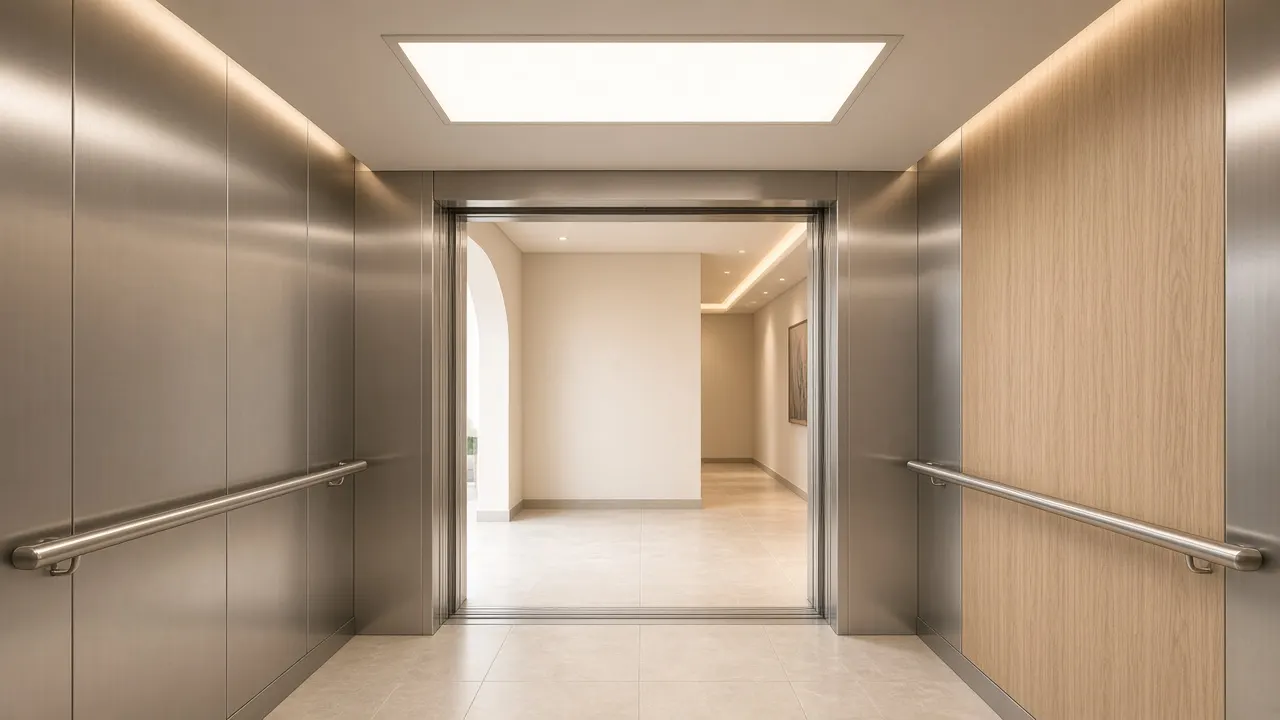
Common cabin upgrades include:
- LED ceilings with even, glare-free light and automatic switch-off. Clause C.5.9.3.2 t) of the Dubai Building Code recommends uniform illumination of at least 100 lux in accessible lifts. Our elevator ceiling lighting guide covers options.
- Wall panels in hairline or patterned stainless steel, laminates, glass or timber-effect finishes. See our lift cabin wall panels guide.
- Flooring that suits the traffic: stone, vinyl or rubber in busy buildings, lighter finishes in villas.
- Handrails and mirrors. Clause C.5.9.3.2 d) says that where a wheelchair user cannot turn around inside the cabin, a mirror shall be installed to help them reverse out.
The key technical point is weight. Heavier finishes, especially stone floors and thick decorative panels, add to the car's own weight and can affect balancing, the rated load and the safety equipment. Any cabin refresh should be checked by a lift engineer before finishes are ordered, and materials should meet the project's fire performance requirements. Our cabin renovation guide and the post on luxury elevator interiors go into more detail.
COP, LOP and emergency alarm upgrades (BS EN 81-28)
Panel and alarm upgrades replace worn or obsolete buttons, indicators and the emergency communication system, and they are where safety, accessibility and appearance meet. New car and landing panels must be compatible with the existing controller, or be installed together with a controller upgrade.
The emergency alarm deserves its own line in any upgrade plan. BS EN 81-28 covers remote alarms on passenger and goods passenger lifts and is listed in the Dubai Building Code's Part D references. For accessible lifts, clause C.5.9.3.2 q) requires a hands-free intercom with two-way communication between passengers and a rescue service, with a graphic and tactile sign showing the alarm centre's number, and item s) requires an audio and visual intercom or an emergency SMS option for passengers with hearing impairment.
On older lifts, typical alarm upgrades include:
- Replacing a bell-only alarm or a handset with a hands-free two-way unit that connects to a manned service.
- Moving an alarm line from an old fixed line to a mobile or IP connection where the old line is no longer reliable.
- Adding backup batteries so the intercom works during a power cut.
- Adding a visual confirmation that the alarm has been received, and a text or visual option for hearing-impaired passengers.
- Putting a live test call on the maintenance checklist.
Our full guide to lift COP and LOP panels in Dubai explains panel layouts, button heights, Braille and common faults, and our control-panel upgrade service covers the work itself.
Accessibility upgrades for existing lifts (BS EN 81-70 and BS EN 81-82)
BS EN 81-70 sets accessibility rules for lifts, and BS EN 81-82 gives rules for improving the accessibility of existing lifts, so BS EN 81-82 is the natural reference when upgrading an older lift for elderly or disabled users. Both standards are listed in the Dubai Building Code's Part D references.
Clause C.5.9.3.2 of the Code gives the local brief for accessible lifts. The items most often addressed in an upgrade are:
- Doors: automatic doors that stay open for at least 3 seconds and reopen when someone is in the doorway (items f and g).
- Buttons: between 900 mm and 1,200 mm above the floor, with high-embossed numerals and Braille (item k), and a raised, green-ringed exit-floor button (item m).
- Floor indicators: between 1,800 mm and 2,000 mm (item i).
- Announcements: an audible signal or voice announcement at each floor (item r).
- Communication: the hands-free intercom and an option for hearing-impaired passengers (items q and s).
Some items, such as the cabin size in Table C.15, cannot realistically be changed by an upgrade. Where a building needs step-free access that the existing lift cannot provide, a platform or accessibility lift may be the better answer.
Improving the safety of existing lifts (BS EN 81-80)
BS EN 81-80 sets out rules for improving the safety of existing passenger and goods passenger lifts, and it is the most useful framework for deciding which safety upgrades an older lift needs. The standard is often referred to as SNEL ("safety norm for existing lifts"), and it is listed in the Dubai Building Code's Part D references alongside BS EN 81-20 for new lifts and BS EN 81-21 for new lifts in existing buildings.
The approach is a structured risk assessment. A competent person compares the existing lift with a list of known hazards (for example around doors, the car and landing door locks, the levelling accuracy, the alarm and communication, the brake and the protection of people working on the lift) and ranks each finding by risk. The result is a prioritised action list, which fits the "safety first" ranking above.
Clause D.5 of the Dubai Building Code says vertical transportation shall be designed, installed, tested, commissioned and maintained to either the ASME A17 suite or the BS EN 81 suite, with one suite selected per project, and the suites must not be used interchangeably. For villas, clause K.5.5.4 says that where elevators are provided, their design shall conform to D.5 and D.6. In practice, that means an upgrade should follow the same standards family as the original lift, and anything that cannot be brought fully up to current standards should be recorded and explained.
Remote monitoring and smarter maintenance
Remote monitoring connects the lift controller to a monitoring service so that faults, trapped-passenger alarms and unusual behaviour can be seen without waiting for a phone call. It is a useful upgrade for buildings with several lifts, for villas whose owners travel, and for lifts where breakdowns are hard to diagnose.
Depending on the controller and the system chosen, monitoring can report the lift's status, fault codes, door cycles and alarm activations. Its value comes from what the maintenance company does with the data: planning visits around recurring faults, spotting a door that is starting to struggle, and arriving with the right part. Ask any provider which data the system reads, who watches it, how alerts reach the technician, and whether it works with your lift's make and controller. Because Elevaya maintains lifts from multiple brands, compatibility is checked lift by lift.
Villa lift upgrades vs building lift upgrades
In villas the most common upgrades are rescue devices for power cuts, door protection, quieter and smoother drives and cabin refreshes; in towers and commercial buildings they are door equipment, alarm communication, energy saving and remote monitoring across a group of lifts. The priorities follow how the lift is used.
- Villa lifts are often used by elderly family members, children and domestic staff, and may be idle for long periods. An ARD, reliable door protection, a working intercom or alarm, and comfortable, quiet travel matter most. Hydraulic and machine-room-less villa lifts each have their own upgrade options. See our villa and home lift maintenance page.
- Residential towers and offices need door reliability and alarm communication across many lifts, plus energy saving because the lifts run all day.
- Hotels, malls and clinics add accessibility, passenger experience and, in many cases, fire service and access-control integration.
How to plan a lift upgrade in Dubai
A good lift upgrade starts with a survey and ends with testing, certification and an updated maintenance plan. The steps are similar for villas and larger buildings.
- Survey: record the lift make, model, age, controller, drive, door equipment, alarm system and fault history. Photographs and the maintenance log help.
- Prioritise: list the upgrades by safety, reliability, comfort and appearance, with a BS EN 81-80 style risk view for safety items.
- Check compatibility: confirm each new component works with the existing controller and safety circuit, or decide that the controller should be upgraded too.
- Decide upgrade or modernization: if the list covers most major systems, compare it with a modernization quotation.
- Plan the works: agree access, lift downtime and how residents or users will be informed.
- Test: test every changed function, including rescue operation, door reopening, alarm calls and announcements.
- Certify: arrange third-party inspection where required (see below) and keep the certificate on site.
- Update the AMC: add the new equipment to the maintenance checklist.
Certification after a lift upgrade (DM-HSD-GU48 and EIAC)
In Dubai, lifts must be tested and certified by an EIAC-accredited third party, and upgrades that alter safety devices, drives or controls may call for a wider inspection before the lift returns to normal service. Plan the inspection as part of the upgrade, not as an afterthought.
Dubai Municipality guideline DM-HSD-GU48-ECLA2 (version 5, 2025) requires lifts to be tested and certified by a third party accredited by the Emirates International Accreditation Centre (EIAC) once every 12 months (requirement 1). The certificate of safety is issued after due examination and test, and only after any repairs have been carried out (requirement 4), and the compliance certificate shall be kept at the site (requirement 9).
EIAC's accreditation requirements for lifting-equipment inspection bodies, EIAC-RQ-IB-002, are also relevant to upgrades:
- Clause 2.6 describes repair or alteration as including alteration of current or voltage, alteration to safety devices, alteration to driving mechanisms and controls, and alteration of guiding rails.
- Clause 2.5 describes major repair or alteration as work that changes the load lifting capacity, function or methods of control, such as an increase in safe working load or rated speed.
- Clause 2.22 lists situations for a major inspection, including after a major repair or alteration and for equipment that was upgraded or modified. Clause 5.5.2 says a major inspection includes a design review to the extent of the repair, a repair inspection, a visual inspection, a functional test and a proof load test.
In plain terms: a new ARD, drive, door operator or controller changes how the lift's safety devices or controls work, so ask your lift company and the inspection body before the works start what inspection will be needed afterwards. Our inspection preparation service helps buildings get ready.
Escalator upgrades in brief
Escalators also benefit from targeted upgrades, especially energy-saving controls, handrail renewal, comb plate and step safety improvements and better safety-device monitoring. For new escalators, clause D.6.2 of the Dubai Building Code requires reduced speed control after a maximum of 3 minutes without activity, use on demand with shutdown after a maximum of 15 minutes and soft-start, with photocell detectors at the top and bottom landing areas. Those features are a good benchmark when upgrading an older escalator.
Other common escalator upgrades include new handrails, replacement comb plates and comb teeth, step and skirt safety improvements and drive or controller upgrades. Clause D.5 also requires enhanced handrail protection at the entry to escalators and moving walks. Our posts on escalator faults and repairs in Dubai and escalator design and maintenance for UAE malls go deeper, and our escalator modernization service covers larger projects.
How does an AMC look after an upgraded lift?
After an upgrade, the new equipment needs to be added to the maintenance routine so it keeps working: rescue devices need battery checks and test runs, light curtains and door operators need adjustment, and alarm lines need regular test calls. An upgrade without maintenance tends to slide back to the problem it was meant to fix.
In Dubai, Elevaya's non-comprehensive AMC for a G+1 villa lift starts from AED 2,500 a year. It includes 12 visits a year (one each month), fixes for issues found and free 24-hour emergency callouts at no extra cost; only replacement parts are charged, and only when they need changing. The elevator AMC cost guide explains what that covers, and lift maintenance and AMC sets out the service for larger buildings.
Related Elevaya guides
Continue planning with these related Elevaya guides:
- Elevator modernization in Dubai: signs, scope and standards: when to modernize, controller and door upgrades, EN 81-20/80, downtime and cost factors.
- Lift COP and LOP panels in Dubai: what is on each panel, DBC button heights, Braille and intercom rules, common faults, repair vs replacement.
- Elevator AMC cost in Dubai: villa owners' guide: non-comprehensive from AED 2,500 for G+1, visits, callouts and parts rules.
- Lift installation in Dubai: step-by-step process: survey, shaft, pit and headroom prep, supply and delivery, installation sequence, testing, EIAC certification and handover.
- Lift and elevator supply in the UAE: buyer's guide: supply-only vs supply and installation, what to specify, what a supply quote must include, BS EN 81 / ASME A17, EIAC certification, escalator supply and red flags.
- Lift maintenance checklist for Dubai: monthly service visit: what each monthly visit should check on doors, ride, machine and brake, alarm, car top and pit, the log book, maintenance vs inspection, villa lifts and an escalator checklist.
- How to choose the best lift company in Dubai: buyer's checklist: licences, AMC terms, written response times, parts, references and red flags.
- Elevator cabin design trends in the UAE for 2026: finishes, COP/LOP panels, LED lighting and glass cabins.
- Luxury elevator interiors in the UAE: marble, bronze and wood: weight, fire performance and cleaning of premium cabin finishes.
- Glass villa lift in Dubai: footprint, heat and cost factors: shaft vs shaftless, laminated glass, cabin cooling, hydraulic vs MRL vs platform.
- Glass and panoramic villa lifts in Dubai: 2026 planning guide: placement, glazing, heat control, approvals and AMC care.
- Lift speed by building height in Dubai towers: DBC travel-time formula, worked m/s examples, waiting times, DHA hospital and Trakhees rules.
- Elevator and escalator speeds in UAE buildings: rated lift speed by travel height and 0.5 vs 0.65 m/s escalators.
- Escalator design and maintenance for UAE malls: layout, balustrades, dust and heat, AMC and modernization.
- Escalator faults and repairs in Dubai: why escalators stop, safety-device trips, handrail and step chain wear, sand and heat, repair vs modernization.
- Common lift problems in Dubai: causes and fixes: stuck lifts, doors not closing, jerky rides, noise and summer heat trips, safe owner checks, trapped-passenger steps, repairs and certification.
- Escalator modernization in the UAE: signs, scope and compliance: when to modernize, modernize vs replace, controller and drive, steps, chain and handrail, energy features, phased mall works and the EIAC major inspection.
- Escalator installation in the UAE: step-by-step process: survey and selection, pit and truss supports, rigging, alignment, controller, safety devices, testing, EIAC inspection and handover.
Related Elevaya services and guides: Lift modernization, Control-panel upgrades, Lift repairs, Lift maintenance and AMC, Inspection preparation, Lift cabin renovation, Lift modernization guide.
FAQ
What is the difference between a lift upgrade and lift modernization?
A lift upgrade improves one system, such as adding a rescue device, door light curtains, a new drive or a cabin refresh. Modernization replaces the main systems, usually the controller, drive, door equipment and fixtures, as one project. If most major systems need work, modernization is usually the better option.
What is an automatic rescue device (ARD) on a lift?
An ARD is a battery-backed unit that, during a power cut, moves the lift car to a floor and opens the doors so passengers are not trapped. It must be compatible with the lift's controller, drive and brake, and its batteries and rescue function should be tested during maintenance.
Which lift upgrade should I do first?
Start with safety: door protection, the emergency alarm and communication, and rescue during power cuts. Then fix reliability issues such as the door operator or drive, then comfort and energy saving, and leave cabin finishes until last. A survey based on BS EN 81-80 helps rank the safety items.
Do lift upgrades save energy in Dubai?
They can. The Dubai Building Code requires new traction lifts to have VVVF drives, energy-efficient lighting that turns off after up to 5 minutes of inactivity and a standby condition, and says regenerative drives should be used where they are shown to save energy. The same features can be added to many existing lifts.
Does a lift need inspection after an upgrade in Dubai?
Lifts in Dubai must be tested and certified by an EIAC-accredited third party every 12 months, and the certificate is issued only after any repairs are done. EIAC requirements list upgraded or modified equipment among cases for a major inspection, so agree the inspection before the works start.
Can Elevaya upgrade a lift installed by another company?
Yes. Elevaya services all lift brands, including Otis, KONE and Schindler, and lifts it did not install. A survey confirms which upgrades are compatible with the existing controller and equipment before anything is quoted.
Plan your lift upgrade with Elevaya
Whether you want a rescue device for power cuts, safer doors, a quieter and more efficient drive, a working emergency intercom or a fresh cabin, Elevaya can survey your lift, rank the upgrades by risk and value, and tell you honestly when a full modernization makes more sense. Call or WhatsApp +971 58 584 4685 or contact Elevaya to arrange a visit anywhere in the UAE.