Elevaya journal
Gold Lift Doors and Luxury Lift Panels in Dubai: Landing Doors, Engraved COPs, Jewelled Buttons and Handrails
Gold and platinum lift doors, engraved COP and LOP panels, jewelled buttons and handrails for Dubai villas, and how to keep each detail looking new.
Published · Updated · Elevaya Lifts
Quick answer: Gold lift doors and luxury lift panels are the details people touch and remember: gold- or platinum-finished landing doors and frames, an engraved or monogrammed car operating panel (COP) and landing panels (LOPs), jewelled push buttons and a handrail made to match. They last when each finish is chosen for how often it is touched, the buttons stay real, legible switches with embossed numerals and Braille, and the door set keeps the construction, weight and fire performance it was designed and tested with. Elevaya designs, supplies and installs these details for new villa and penthouse lifts and for existing lifts. See the Royal Gold and Diamond Detail directions on our bespoke luxury villa lifts page.
Most visitors never see the inside of a villa lift shaft. They see the landing doors in the hall, the panel they press and the rail they rest a hand on. Those three things do more to make a lift feel personal than anything else in it.
They also take the hardest life. Doors open and close all day. Buttons are pressed with rings, keys and wet fingers. Handrails are gripped, leaned on and polished by hands every day. A finish that looks perfect on a sample board can look tired in two summers if it was put in the wrong place.
Elevaya has worked on lifts in the UAE since 2019, on more than 200 projects across design, supply, installation and annual maintenance. Our overview of bespoke luxury home lifts in Dubai sets out the full palette, and our guide to Swarovski crystal lift cabins covers crystal, onyx and light. This guide is about the signature details: the doors, frames, panels, buttons and handrails. What each can be, how to specify it, and how to make it last.
Gold and platinum landing doors and frames
The landing doors are the face of the lift on every floor, so they are usually where a gold or platinum finish earns its place first. In a villa they often open onto the main hall or a majlis. A guest sees them long before they step inside.
There are a few ways to get the look, and they behave very differently:
- Genuine gold or platinum plating. A real precious-metal layer applied by a specialist finisher over a prepared base metal. It has a depth and warmth that is hard to copy. It is also thin and softer than most people expect, so it suits surfaces that are admired more than handled.
- Gold-tone or platinum-tone PVD on stainless steel. A hard, thin coating bonded to the steel in a vacuum process. It resists scratches and fingerprints far better than soft plating, which is why it is often the sensible choice for door leaves that are pushed, bumped and wiped.
- Solid or clad brass and bronze, lacquered or left to age. Warm and heavy, with a different character from plating. Unlacquered metal will change colour over time, which some owners love and others do not.
- Relief, etched or engraved patterns. Chevron, geometric star, Greek key or a pattern taken from the home's own joinery. Pattern also helps hide the small marks every door collects.
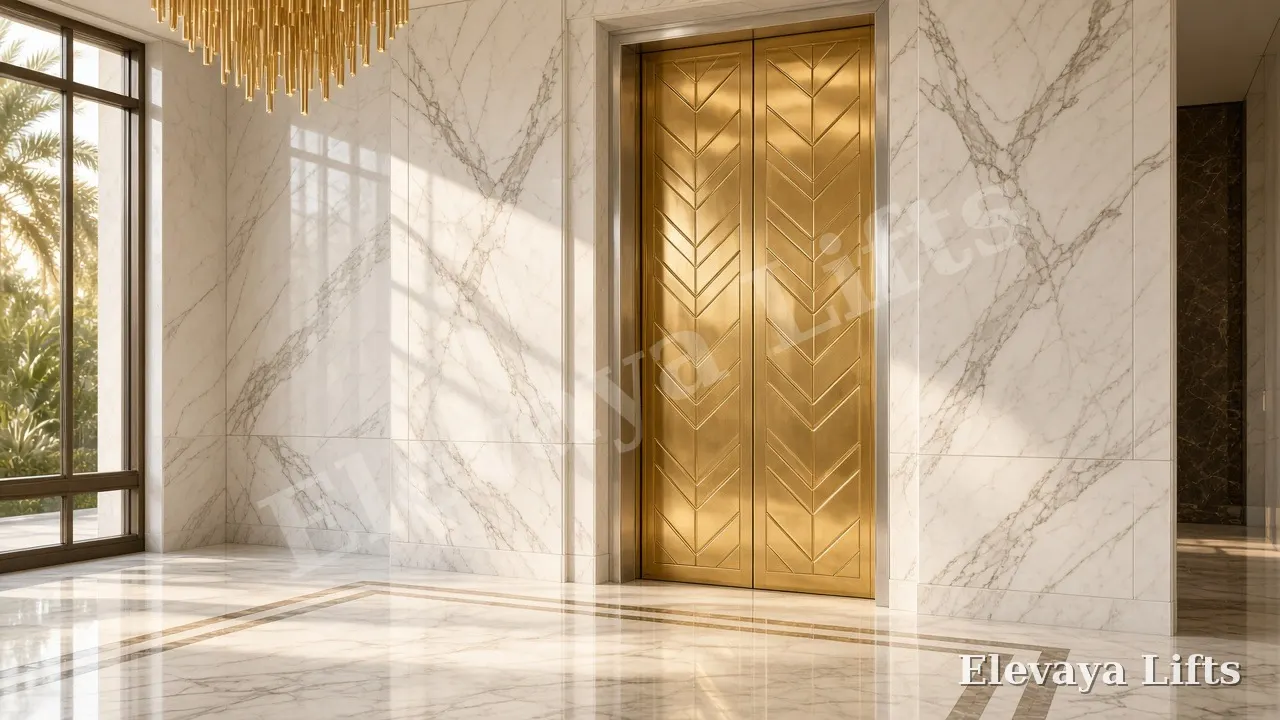
The frame matters as much as the leaves. A slim platinum-tone frame around gold doors, as in the image above, makes the doors look deliberate rather than loud. A wide stone or metal architrave turns the lift into part of the wall. We agree the frame, the leaves and the surround on every floor as one drawing, so the ground floor and the roof terrace match.
What does not change is the door itself. Landing doors are a safety component. Their locks, gaps, guidance and closing force are set by the lift's design and the standard it is built to. Where landing doors form part of a fire-separated shaft, they are a tested door set, and the fire-resistance test for lift landing doors is set out in BS EN 81-58. Any decorative finish or added cladding should be checked with the door supplier's test evidence and the project's fire consultant before anything is applied, and the added weight has to suit the door operator. Our guide to elevator landing doors explains the components.
Engraved and monogrammed COP and LOP panels
An engraved panel is one of the quietest ways to make a lift unmistakably yours: a family monogram, a crest, a calligraphy line or a pattern from the house, cut into the faceplate around the controls rather than onto them. The car operating panel (COP) is the panel inside the cabin. The landing operating panels (LOPs) are the call stations on each floor. Both can carry the same signature.
How it is done shapes how it looks and wears:
- Laser or CNC engraving gives crisp, repeatable lines and suits monograms and fine geometric borders.
- Hand engraving has a softer, slightly irregular line that reads as craft. It takes longer and is usually kept to a small motif.
- Chemical etching suits larger areas of pattern across a faceplate.
- Colour or enamel infill makes an engraved monogram readable from a distance and keeps grime out of the cut.
Placement is where design and function meet. The monogram usually sits above the buttons, at the top of the faceplate or on a separate plate beside the panel, so it never crowds the controls. The faceplate is often a single piece of gold-tone or platinum-tone metal with the buttons set into it. We make it removable on standard fixings, so a technician can open the panel without marring the engraving.
The controls themselves stay readable. The Dubai Building Code, in its accessible elevator clause C.5.9.3.2, asks for buttons between 900 mm and 1,200 mm above the floor with high-embossed numerals and Braille numerals on the left lower side of each button (item k), an exit-floor button raised at least 3 mm and circled with a green line (item m), and Braille and tactile signage on the door jamb at 1,500 mm (item p). Even where a private villa lift is not formally an accessible lift, those items are a good brief. A monogram can be as ornate as you like. The floor numbers should never be harder to read because of it. Our guide to lift COP and LOP panels in Dubai covers what each panel must carry.
Jewelled push buttons: beautiful, but still a switch
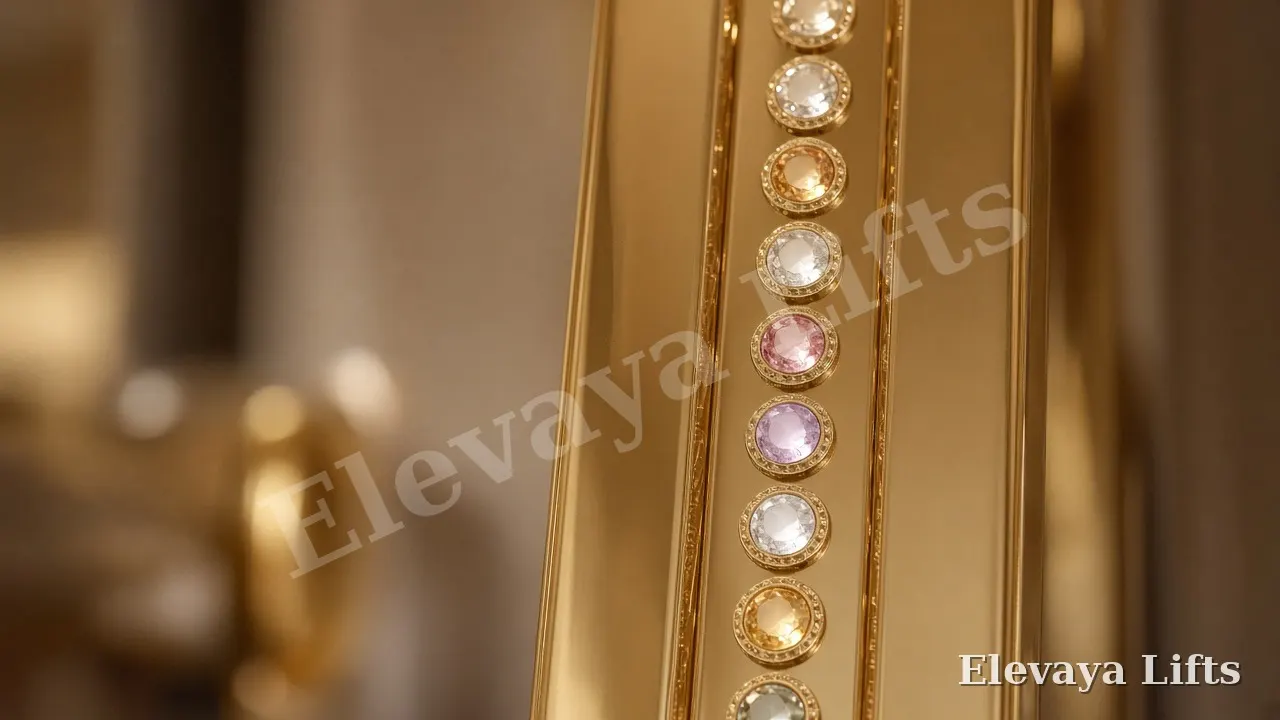
A jewelled button is a gemstone or crystal set into the face of a real lift push button, and it only works if it still presses, lights and reads like a lift button. The image above is a design study for the stone colours and bezels. On a working panel each button also carries its embossed numeral and Braille, and a light ring or indicator that shows the call has registered.
A few things decide whether jewelled buttons age well:
- Hardness of the stone. On the Mohs scale, diamond sits at 10 and sapphire and ruby at 9, while crystal glass is much softer. Rings and keys will mark a soft stone on a button pressed many times a day. We put the hardest stones on the most-used buttons and keep softer or more delicate stones for decorative accents nearby.
- Cabochon or faceted. A smooth, domed cabochon is comfortable under a fingertip and hides wear. A faceted stone sparkles more but can feel sharp if it stands proud of the bezel.
- The setting. The stone should sit in a closed metal bezel or setting, flush or slightly domed, with no claws to catch skin or clothing. Glue alone is not a setting.
- The switch behind it. The stone is mounted on a proper push-button mechanism with a clear press and a long rated life. The jewel is the cap, not the switch.
- Records and spares. The material schedule lists each stone, whether it is natural or laboratory-grown, its size and the setting. Keeping one or two spare buttons on day one saves a long wait if one is ever damaged.
Colour can also do a job. A family might use one stone colour for the main floors and a different stone for the roof or basement. The numerals still do the real work, but the colour helps people find their floor at a glance.
Handrails and the small metal details
The handrail is the most-touched decorative item in the cabin, so it should be the hardest-wearing finish you can live with, in a profile people can actually grip. Clause C.5.9.3.2 of the Dubai Building Code asks for handrails on the side walls of an accessible lift (item j). In a villa it is simply good sense, especially for older parents and children.
What works best in practice:
- Solid metal or PVD over stainless steel for the rail itself. Soft gold plating on a handrail can wear through where hands rest.
- A round or softly oval profile that a hand closes around, with returns at the ends so sleeves and bags do not catch.
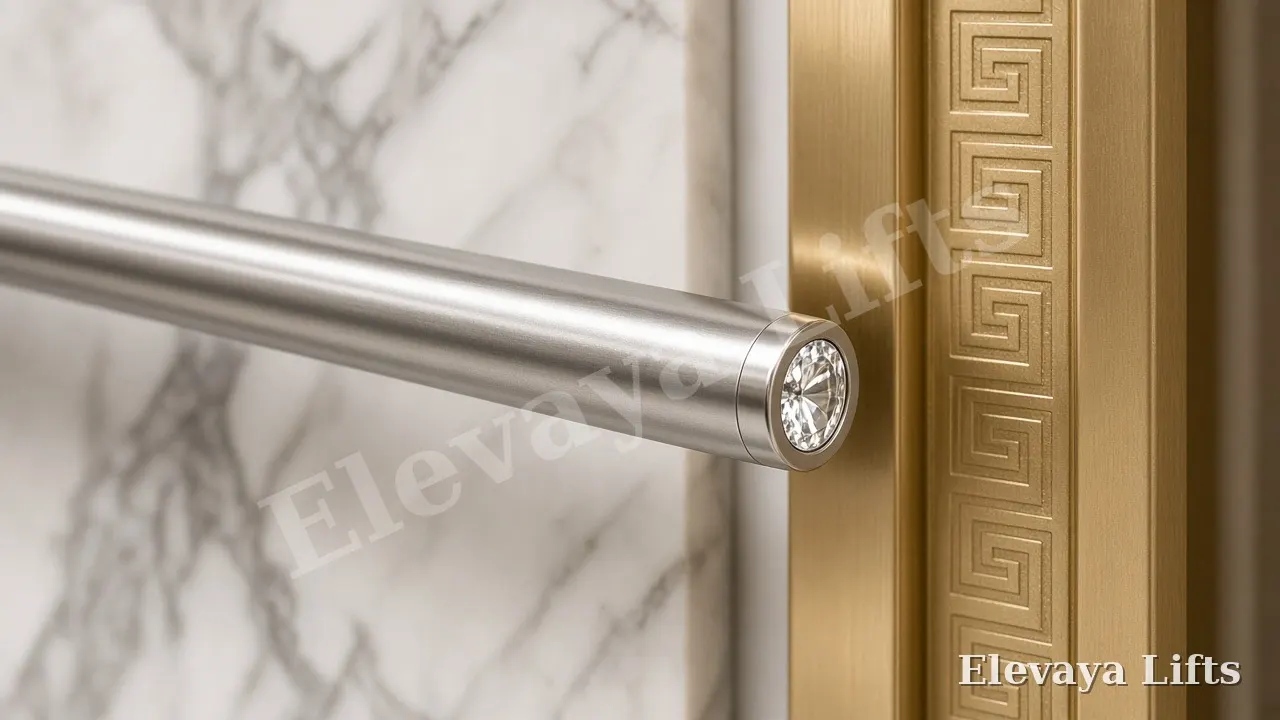
- Jewels at the end caps, not along the grip. A flush-set stone in a brushed-platinum end cap, as in the image below, gives the detail without putting a stone under anyone's palm.
- Matching small hardware. Kick plates, door-jamb trims, indicator surrounds and the fixings you can see, all in the same finish family so nothing looks like an afterthought.
Our guide to lift handrails and flooring covers the practical side in more detail.
How to make signature details last
Signature details stay beautiful when the finish is matched to how hard each surface works, and when they are protected during construction and checked on every maintenance visit. This is where most of the long-term value is won or lost. The table below is how we usually match finishes to wear.
| Detail | How hard it works | Finish that usually lasts best | Weak point to plan for | How to keep it looking new |
|---|---|---|---|---|
| Landing door leaves | Pushed, bumped by trolleys and luggage, wiped often | Gold- or platinum-tone PVD on stainless steel, relief or brushed pattern | Scratches at hand and trolley height; fire-tested door construction | Kick plate or lower band in a tougher finish; soft microfibre only; no abrasive pads |
| Door frames and architraves | Touched lightly, mostly admired | Genuine gold or platinum plating, polished or brushed PVD, stone | Cleaning chemicals at the joint with stone or plaster | Clean metal and stone separately; pH-neutral cleaner on stone |
| COP and LOP faceplates | Touched around the buttons all day | PVD or solid metal faceplate; engraving with infill | Fingerprints around buttons; worn infill | Removable faceplate on standard fixings; re-fill engraving if it dulls |
| Jewelled push buttons | Pressed many times a day, often with rings | Hard stones (sapphire, ruby, diamond) on most-used buttons, flush bezels | Soft stones scratching; loose settings | Spare buttons on record; settings checked on maintenance visits |
| Handrail | Gripped and leaned on constantly | Solid metal or PVD; jewels only at end caps | Plating wear where hands rest | Wipe dry after cleaning; keep stones out of the grip zone |
| Small trims and kick plates | Kicked, knocked and mopped | Brushed PVD or solid metal | Mop chemicals and sand grit | Good mats at each landing; brush sand away before wiping |
A few habits make a real difference:
- Protect everything until handover. Doors and panels should arrive wrapped and stay covered while other trades finish the house. A surprising amount of damage to new gold doors happens before the family has even moved in.
- Snag with the finisher's sample in hand. At handover, compare every door, frame and plate against the approved sample under the same light.
- Agree a cleaning routine with the household. Soft, dry or barely damp microfibre on metal. No metal polish on plating. Nothing abrasive on engraving.
- Plan for refinishing, not replacement. Plated frames can be re-plated and engraved infill renewed. That is much easier when parts were designed to come off.
Adding signature details to an existing lift, and the rules that stay
Many existing villa lifts can take new door finishes, engraved panels, jewelled buttons and a new handrail, but each change is checked against the lift before it is made. We survey the door type and condition, the door operator, the panel layout and wiring, and the load allowance, then decide which details are cosmetic and which touch safety components.
Faceplates, handrails and trims are usually cosmetic changes. New push buttons mean new electrical components in the panel, so they are wired and tested like any panel work. Re-cladding or replacing landing doors touches a safety component and, in a fire-separated shaft, a tested door set, so it is planned with the door supplier and, where relevant, the fire consultant. Our cabin refurbishment service covers interiors and details on their own. If the lift underneath is tired, it is often wiser to combine the work with lift modernization. Elevaya services all lift brands, so the lift does not need to be one we installed.
The decoration does not change the engineering rules. The Dubai Building Code says in clause K.5.5.4 that if elevators are provided in a villa, their design shall conform to sections D.5 and D.6. Dubai Municipality's guideline DM-HSD-GU48-ECLA2 requires lifts to be tested and certified by a third party accredited by the Emirates International Accreditation Center (EIAC) once every 12 months. Where work goes beyond decoration and changes safety devices, doors or controls, the inspection body's rules on repair and alteration apply; EIAC-RQ-IB-002 defines repair or alteration in clause 2.6. Our guide to the Dubai annual lift inspection certificate explains the yearly cycle.
Once the details are in, regular care keeps them right. In Dubai, Elevaya's non-comprehensive AMC for a G+1 villa lift starts from AED 2,500 a year, with monthly visits, fixes for issues and free 24-hour emergency callouts; only replacement parts are charged, and only when they need changing. On those visits our technicians check the lift as usual, then the details: door alignment and gaps, button presses and lights, loose settings or faceplates, and wear on the handrail. See our villa and home lift maintenance page and the elevator AMC cost guide.
Elevaya designs and installs bespoke home lifts with specified precious-metal finishes, diamonds, crystal and selected marble, with materials, settings and engineering requirements agreed for each project. The signature details are where that work is closest to the hand. Explore the five design directions on our bespoke luxury villa lifts page; Royal Gold and Diamond Detail are the natural starting points for doors, panels and buttons.
Related Elevaya guides
Continue planning with these related Elevaya guides:
- Swarovski crystal lift cabins in Dubai: crystal, onyx and light: crystal ceilings and walls, backlit onyx, mirrors, cabin lighting levels, and how to keep crystal secure and serviceable in a moving cabin.
- Bespoke luxury home lifts in Dubai: gold, gems and rare marble: what can be customised, how gold, platinum, diamonds, crystal and rare marble are specified, weight, safety and care.
- Lift COP and LOP panels in Dubai: what is on each panel, DBC button heights, Braille and intercom rules, common faults, repair vs replacement.
- Luxury elevator interiors in the UAE: marble, bronze and wood: weight, fire performance and cleaning of premium cabin finishes.
- Elevator cabin design trends in the UAE for 2026: finishes, COP/LOP panels, LED lighting and glass cabins.
- Lift interior designs for UAE villas, schools and hospitals: modern, gold and bronze lift interiors and how finishes differ by building type.
- Lift upgrades in Dubai: what to upgrade first: rescue devices for power cuts, door light curtains, VVVF and energy saving, cabin refresh, alarms, upgrade vs modernization.
- Elevator modernization in Dubai: signs, scope and standards: when to modernize, controller and door upgrades, EN 81-20/80, downtime and cost factors.
- Glass and panoramic villa lifts in Dubai: 2026 planning guide: placement, glazing, heat control, approvals and AMC care.
- Glass villa lift in Dubai: footprint, heat and cost factors: shaft vs shaftless, laminated glass, cabin cooling, hydraulic vs MRL vs platform.
- Dubai villa lift permit: which NOC and authority you need: the developer NOC, which authority approves (DM, DDA or Trakhees), the steps and the documents.
- Lift installation in Dubai: step-by-step process: survey, shaft, pit and headroom prep, supply and delivery, installation sequence, testing, EIAC certification and handover.
- Dubai annual lift inspection certificate: who issues it, 12-month and 6-month inspection rules and how to prepare.
- Elevator AMC cost in Dubai: villa owners' guide: non-comprehensive from AED 2,500 for G+1, visits, callouts and parts rules.
- Lift maintenance checklist for Dubai: monthly service visit: what each monthly visit should check on doors, ride, machine and brake, alarm, car top and pit, the log book and villa lifts.
- How to choose the best lift company in Dubai: buyer's checklist: licences, AMC terms, written response times, parts, references and red flags.
- Common lift problems in Dubai: causes and fixes: stuck lifts, doors not closing, jerky rides, noise and summer heat trips, safe owner checks and repairs.
- Hydraulic lift problems in Dubai: leaks, sinking and heat: oil leaks, a car that sinks or re-levels, slow or jerky rides, summer overheating, noise and safe owner checks.
- Lift and elevator supply in the UAE: buyer's guide: supply-only vs supply and installation, what to specify, what a supply quote must include and red flags.
- Export lifts and elevator spare parts from the UAE: export documents, HS codes, certificate of origin and the steps from enquiry to shipment.
- Bespoke luxury lift design process in Dubai: from brief and mood board to material samples, 3D renders, a full-scale mock-up, fabrication, installation, handover and AMC care of precious finishes.
- Luxury marble and onyx lift interiors in Dubai: rare stones beyond Calacatta, from Statuario, Arabescato, Nero Marquina, Emperador and Taj Mahal quartzite to blue and green onyx, malachite, lapis lazuli and backlit agate, and how each is handled for weight and wear.
- Luxury lift cabin upgrade in Dubai: metals and finishes: re-dressing an existing lift with rose gold and champagne PVD, brass, bronze, copper, hammered and etched metal, black titanium, Macassar ebony and burl walnut veneers, leather, shagreen and gold leaf, and how weight, fire rules and downtime are handled.
- Luxury lift modernization ideas in the UAE: pairing a modernization with smart glass, fibre-optic starry ceilings, antiqued mirror, mother-of-pearl, marquetry, Murano-style glass, mashrabiya and Arabic calligraphy, touchless, fingerprint and touchscreen controls, cabin music, scent, filtered air and near-silent doors.
- What is the best luxury home elevator brand for a Palm Jumeirah or Emirates Hills villa?: how to compare brands neutrally by drive type, local service and parts, BS EN 81 or ASME A17 compliance, warranty, AMC, design flexibility and heat suitability.
- How much does a bespoke glass panoramic villa lift cost in Dubai?: what an installed AED quote should cover, the choices that move the price, confirmed Elevaya price points and the yearly cost of ownership.
- Can you install a luxury elevator in an already built Dubai villa without a concrete shaft or deep pit?: self-supporting structures, shallow-pit and pitless options, EN 81-21 and EN 81-41, positions in finished villas, approvals and cost.
- Which is quieter and smoother for a luxury villa: screw-driven, hydraulic or gearless traction?: how each drive sounds and rides in a Dubai villa, where noise really comes from, heat effects and how to test a lift before you buy.
Related Elevaya services and guides: Bespoke luxury villa lifts, Home lifts, Elevator landing doors, Elevator control panels, Handrails and flooring, Cabin refurbishment, Lift modernization, Lift installation, Home lift for an existing villa, Villa and home lift maintenance, Projects, Contact Elevaya.
FAQ
Will gold lift doors scratch or fade?
Any metal finish on a door will collect marks, but how much depends on the finish. Gold-tone PVD on stainless steel is hard and resists scratches and fingerprints well, which is why it suits door leaves. Genuine gold plating is softer and is best kept to frames and surfaces that are admired more than touched. A brushed or patterned finish hides wear better than a mirror polish.
Can a lift control panel be engraved with a family monogram?
Yes. A monogram, crest or calligraphy line can be laser, CNC or hand engraved into the COP or LOP faceplate, often with colour or enamel infill. It is placed above or beside the buttons, never on them, so the floor numerals, Braille and the exit-floor button stay clear and easy to read.
Are jewelled lift buttons practical for everyday use?
They are, if each stone is set flush in a closed bezel on a proper push-button switch, and the harder stones such as sapphire, ruby or diamond go on the most-pressed buttons. Each button still needs its embossed numeral, Braille and a light that shows the call has registered. Keeping a spare button or two on record makes any repair quick.
Do decorative landing doors affect the lift's fire rating or inspection?
They can. Where landing doors form part of a fire-separated shaft they are a tested door set, so any finish or added cladding should be checked against the door supplier's test evidence with the fire consultant. Changes to doors or controls can also bring repair or alteration rules from the third-party inspection body, so they are planned before work starts.
Which signature detail should I spend on first?
Start with what guests see and hands touch most: the ground-floor landing doors and frame, then the COP faceplate and buttons, then the handrail. Put the hardest-wearing finish where wear is highest and the most delicate finish where it will be admired, and the whole lift will still look right years later.
Talk to Elevaya about gold doors and luxury panels
If you are picturing gold landing doors in the hall, a panel carrying your family monogram or buttons set with your favourite stones, we would be glad to help you shape them into details that are safe, practical and built to last. Call or WhatsApp +971 58 584 4685, explore our bespoke luxury villa lifts or contact Elevaya to arrange a private design consultation.