
Elevaya journal
Common Lift Problems in Dubai: Causes, Safe Checks and Fixes for Owners and Facility Managers
Common lift problems in Dubai: stuck lifts, doors not closing, jerky rides, noise and summer trips, with likely causes, safe checks and who fixes them.
Published · Updated · Elevaya Lifts
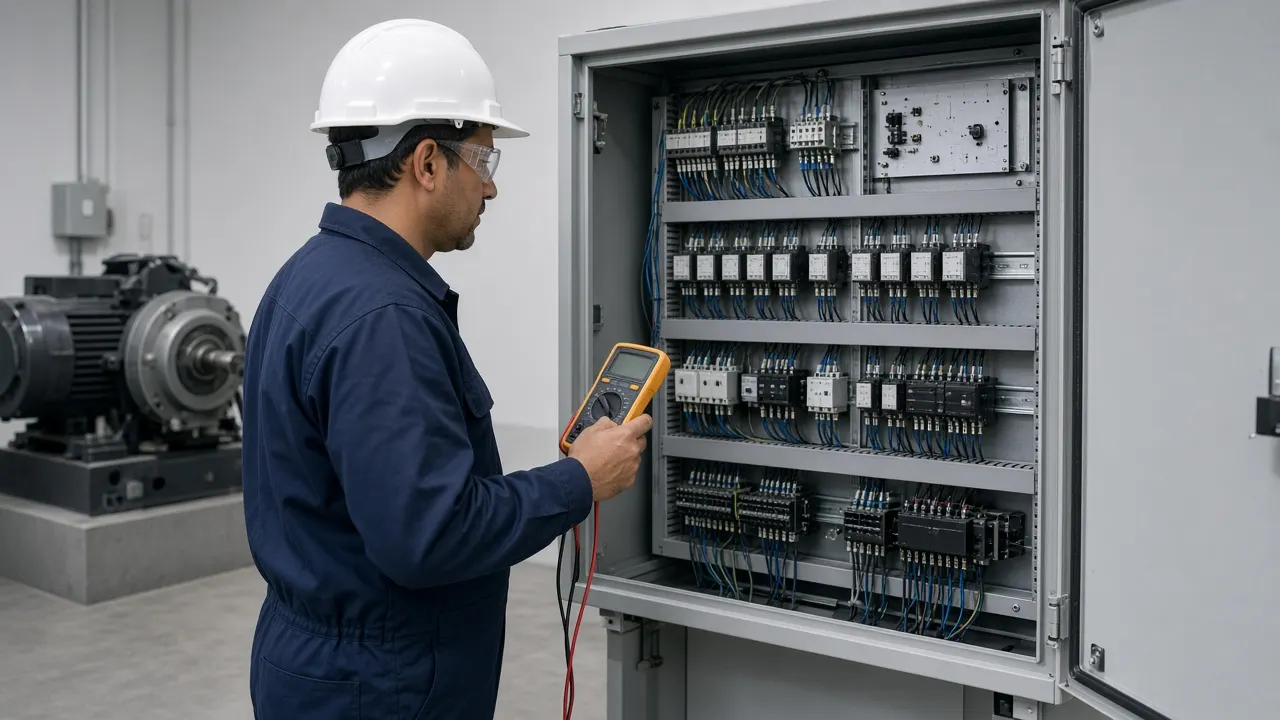
Quick answer: The most common lift problems in Dubai are a lift that stops and will not restart, a lift stuck between floors, doors that will not close or keep reopening, jerky starts and stops or poor levelling, unusual noise or vibration, faulty buttons and indicators, a dead alarm or intercom, and lifts that trip in the summer heat. In the UAE, many of these trace back to the same few conditions: fine sand and dust in door sills and on sensors, high temperatures in machine rooms and lift shafts, humidity and water ingress, power cuts and voltage dips, and gaps in maintenance. Owners and facility managers can safely check for a building-wide power cut, an obstruction or open landing door, an overloaded car and the lift's service status, and they can log the fault in detail. Anything involving the controller, safety circuit, brakes, ropes, door locks or the lift shaft is work for a qualified lift technician. If someone is trapped, press the alarm, stay calm, never force the doors, and call the building's lift service number; for a medical emergency, fire or smoke, call 998, 997 or 999.
A lift that misbehaves rarely fails without warning. Doors start to hesitate, the car stops a few millimetres off the floor, a new noise appears on one landing, or the lift trips on hot afternoons and works again in the evening. Spotting these early signs, and knowing which ones you can deal with and which need a technician, is the difference between a quick repair and a lift that is out of service for days.
This guide explains common lift problems in Dubai and across the UAE: what each problem usually looks like, the causes a technician will typically investigate, what owners and facility managers can safely check, and who should fix it. It also covers what to do if someone is trapped, why the local climate matters, and what Dubai requires after repairs. For escalators, see our separate guide to escalator faults and repairs in Dubai.
Elevaya Lifts has worked in the UAE since 2019 on more than 200 projects, covering lift design, supply, installation and annual maintenance contracts (AMC). We service all lift brands, including Otis, KONE and Schindler, and lifts we did not install, so the advice below applies to whichever make you have.
Which lift problems are most common in Dubai and the UAE?
The lift problems building owners in Dubai report most often are door faults, lifts that stop or will not restart, passengers trapped between floors, rough or uneven travel, noise and vibration, panel and indicator faults, alarm failures and heat-related trips. Door problems come up most because the doors open and close on every single trip and sit right where sand, dust and knocks from trolleys and luggage end up.
The table below is a starting point, not a diagnosis. The same symptom can have several causes, and only an inspection of the actual lift can confirm which one applies.
| Symptom | Causes a technician will usually check | What an owner or FM can safely check | Who fixes it |
|---|---|---|---|
| Lift not working at all | Power supply or tripped protection, an open safety circuit, controller or drive fault, a lift switched to inspection or maintenance mode | Is there a building-wide power cut? Is a landing door on any floor visibly not closed? Is an out-of-service status shown or a maintenance visit under way? | Lift technician |
| Lift stuck between floors | Power failure, a safety device trip, loss of a door lock contact, controller or drive fault | Keep passengers calm and in contact; check for a power cut; call the lift service number | Trained rescue staff or lift technician |
| Doors not closing or reopening repeatedly | Sand or debris in the sill, a dirty or misaligned door sensor or light curtain, worn door operator or rollers, a landing door lock problem, overload | Is anything blocking the doorway or sill? Is someone holding the door button? Is the car overloaded? | Lift technician |
| Doors slamming, slow or noisy | Door operator wear or adjustment, worn hangers, rollers or gibs, damaged sill | Note which floor and which door (car or landing) | Lift technician |
| Jerky starts and stops, poor levelling | Drive or controller adjustment, brake condition, guide shoe or roller wear, rope condition, hydraulic oil temperature or valve settings on hydraulic lifts | Note whether it happens on every trip, at one floor or only at certain times; warn users about any step at the door | Lift technician |
| Unusual noise or vibration | Guide shoes or rollers, bearings, door equipment, fans, loose fittings, machine or pulley wear | Note where and when the sound occurs; do not open panels to find it | Lift technician |
| Buttons or indicators not working | Worn push buttons, wiring or connector faults, display failure, communication fault with the controller | Note the exact button, floor and display behaviour | Lift technician |
| Alarm or intercom not working | Failed alarm unit, battery, telephone or mobile line, wiring | Report it immediately as a safety fault | Lift technician |
| Lift stops on hot days | High temperature in the machine room, controller cabinet or MRL shaft head, failed cooling or ventilation, overheating motor or drive | Is the machine room air conditioning or ventilation working (from outside the room)? | Lift technician and the building's MEP team |
| Water in the pit or on the car roof | Leaks, cleaning water, condensate, flooding in basements | Keep people out of the lift and report it | Lift technician, with the building team fixing the water source |
Two of these problems need extra emphasis. A dead alarm or intercom is a safety fault, not an inconvenience, because it is how a trapped passenger calls for help. And a lift that stops even a few centimetres off the floor is a trip hazard, so treat poor levelling as a reason to call for service, not something to live with.
What should owners and facility managers check before calling a technician?
Owners and facility managers should check only what they can see and do without touching lift equipment: whether there is a power cut, whether a landing door is open or blocked, whether the car is overloaded, and whether the lift is already in maintenance mode. These checks often explain a stopped lift and make the technician's job faster when they are not the cause.
Safe checks:
- Power: are other lights and services in the building off too? If the whole building has lost power, the lift will not run until it returns, unless it has a rescue device or generator supply.
- Doors: walk the landings and look for a landing door that is not fully closed, or for an object such as a door wedge, a trolley wheel or debris in the sill. Do not push, pull or try to close landing doors by hand.
- Load: if an overload warning is showing, ask passengers to step out or remove heavy items.
- Status: is there a maintenance sign, a technician on site or a message on the display? Note it down exactly.
- Recent events: was there a power cut, a storm, cleaning with water, building works or a move-in with heavy items in the past day?
Things owners and facility managers should never do:
- Reset, bridge or bypass anything in the controller or safety circuit, or switch the lift back on after a trip.
- Open the machine room, controller cabinet, car roof or pit, or enter the lift shaft.
- Use emergency unlocking keys or force car or landing doors, unless you have been trained and authorised for rescue on that lift.
- Lubricate, adjust or "test" the lift repeatedly to see whether the fault comes back.
Safety circuits exist to stop the lift when something is wrong. Bypassing one hides the fault and removes the protection. Our elevator problems and troubleshooting guide explains how to record an issue and protect users while you wait for an assessment.
What should you do if you are trapped in a lift in the UAE?
If you are trapped in a lift, press and hold the alarm button or use the intercom, stay calm and inside the car, and wait for trained help; never try to force the doors or climb out. Modern lifts are designed so that a stopped car is a safe place to wait.
If you are inside the lift:
- Press the alarm button and hold it for a few seconds, or use the intercom if the lift has one. Speak clearly and give the building name and lift number if you know them.
- Call for help by phone if you have signal: the building's security, reception or lift service number, usually shown in the car or lobby.
- Stay calm and away from the doors. Do not try to prise the doors open or climb through a gap, even if the car seems close to a floor. The car can move once the fault clears or the rescue starts.
- Wait for trained help. Rescues should only be done by trained staff or lift technicians who know the lift.
If you are outside the lift, keep talking to the passengers, reassure them that help is on the way and call the lift company. Do not try to open the landing doors or move the car yourself.
Call emergency services when there is a medical emergency, fire or smoke, or another immediate danger. The UAE government's handling emergencies page lists 999 for police, 998 for ambulance and 997 for the fire department (Civil Defence), callable from anywhere in the UAE. The same page advises people not to use lifts in case of a fire.
For accessible lifts, clause C.5.9.3.2 q) of the Dubai Building Code 2021 requires a hands-free intercom that allows two-way communication, enabling permanent contact between passengers in the lift and a rescue service, with a graphic and tactile sign showing the phone number of the alarm centre and the number to report an emergency. Item s) requires an audio/visual intercom or an emergency SMS option so that users with hearing impairment can communicate in an emergency. If your lift's alarm only rings a bell nobody hears, or the number on the sign is out of date, fix that before anyone gets trapped. Our post on lift upgrades in Dubai covers alarm and intercom upgrades.
Why does a lift stop or get stuck between floors?
A lift usually stops between floors because a safety device has opened the safety circuit, the power has failed, a door lock contact has been lost or the controller or drive has detected a fault. Stopping is the lift doing its job: when any safety condition is not met, the car is brought to rest.
The safety circuit is a chain of switches and contacts, including the car and landing door locks and other protective devices. If any one of them opens, the lift stops. Common reasons in practice include a landing door that is knocked or pulled while the car is moving, a door lock contact that is worn or dirty, a passenger jumping or rocking the car, an overload, a voltage dip, or a fault code from the drive.
A lift that stops once after a power cut and then runs normally may simply need checking at the next visit. A lift that stops repeatedly, especially between floors, needs a technician to find the cause before it is put back into normal use. Repeated stops are also exactly what an automatic rescue device (ARD) is designed to soften during power cuts: it brings the car to a floor and opens the doors.
Why won't the lift doors close, or why do they keep reopening?
Lift doors that will not close or keep reopening are usually reacting to an obstruction, a dirty or misaligned door sensor, sand or debris in the sill, a worn door operator, a landing door lock problem or an overload. Door faults are the most frequent lift problem in many UAE buildings, and the cause is often found at one particular floor.
Sensors and light curtains
Most modern lifts use a light curtain, a pair of strips on the car door edges that projects infrared beams across the opening. If a beam is blocked, the doors reopen. Dust on the lenses, a knocked strip or a loose cable can make the curtain "see" an obstruction that is not there. For accessible lifts, Dubai Building Code clause C.5.9.3.2 f) requires automatic doors that remain open for at least 3 seconds, and item g) requires doors to reopen automatically when a user is in the doorway without producing a force greater than 135 N, with sensors recommended at two levels to detect lower items. A door that closes on people is a safety fault to report straight away.
Sills, rollers and the door operator
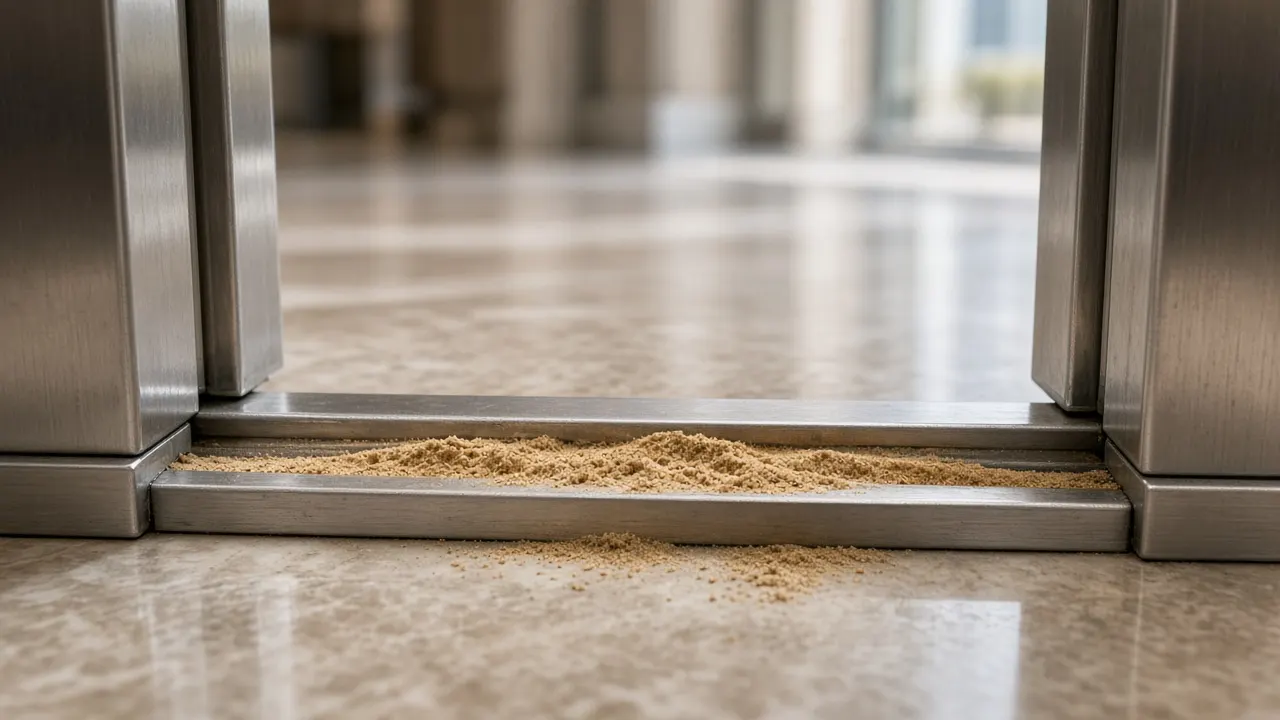
The door panels run in a sill at the bottom and hang from rollers at the top. Sand, small stones, cleaning grit and broken tiles in the sill stop the doors from closing fully, and the lift will not leave the floor until the door lock is made. Ground floors, car-park levels and landings near the main entrance collect the most sand in Dubai, especially after windy days. Worn rollers and hangers, a misaligned landing door or a door operator that needs adjustment produce slow, noisy or slamming doors. Our guide to elevator landing doors explains these parts.
What helps: regular sill cleaning by the building team (vacuuming the visible sill with the lift parked, never reaching into gaps), clearing sand from lobbies, and asking the maintenance technician to check the doors at every monthly visit.
Why is the lift jerky, noisy or not stopping level?
Jerky starts and stops, vibration and uneven levelling usually point to the drive or controller adjustment, the brake, guide shoes or rollers, rope condition, or, on hydraulic lifts, oil temperature and valve settings. These problems tend to build slowly, so the first sign is often a passenger remarking that the ride "feels different".
- Rough starts and stops can come from drive settings, brake wear or adjustment, or wear in the machine. Older lifts with older drive types are often rougher by design, which is one reason drive upgrades are popular.
- Vibration and humming during travel often trace to guide shoes or rollers, guide rail alignment or fixings, or the ropes.
- Uneven levelling, where the car stops above or below the floor, is a trip hazard. On traction lifts it can involve the drive, brake or positioning system; on hydraulic villa lifts it can be linked to oil temperature and valves, which is why heat matters (see below).
- Clicks, bangs and scraping at one floor often point to the door equipment or the landing door at that floor.
When you report one of these, note whether it happens on every trip, only at a certain floor, only when the car is full or empty, or only at certain times of day. That detail saves diagnostic time. Our lift repairs service explains how Elevaya investigates and repairs these faults.
How do heat, sand, humidity and power cuts affect lifts in the UAE?
The UAE climate puts four specific stresses on lifts: summer heat in machine rooms and shafts, fine sand and dust, humidity and occasional water ingress, and power interruptions. Each one creates its own pattern of faults, so a maintenance plan written for a cooler, cleaner climate will miss some of them.
Heat: why lifts trip in summer
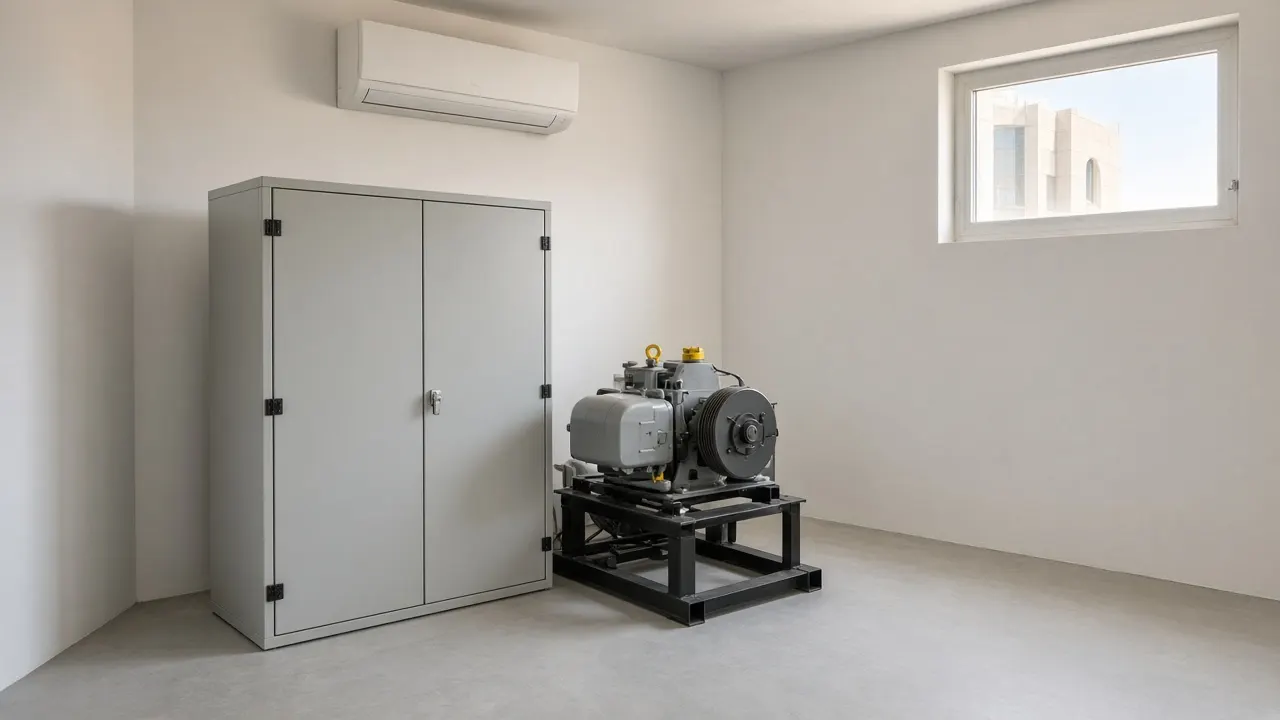
Controllers, drives and motors produce heat, and electronics are sensitive to high temperatures. When a machine room's air conditioning fails, or an MRL (machine-room-less) lift's controller sits in a hot shaft head or a sun-facing wall, equipment may protect itself by stopping. The typical pattern is a lift that trips on summer afternoons and runs again once things cool down. Glass and panoramic lifts in direct sun add cabin heat on top of that; our glass villa lift guide covers cooling. Ask your maintenance company to check machine room temperatures and ventilation before summer, and treat machine room air conditioning as part of the lift, not an afterthought.
Sand and dust
Fine sand gets into door sills, onto light curtain lenses and push buttons, into controller cabinets and onto guide rails. It causes door faults, sticky buttons and extra wear. Keeping lobbies swept, machine room doors closed and filters clean reduces the problem.
Humidity and water
Coastal humidity, condensation from air conditioning and water from cleaning or leaks can corrode contacts and electrical connections, and water in a lift pit is a serious fault. Never wash lift lobbies or car floors with so much water that it runs into the sill or shaft.
Power cuts and voltage dips
A power cut stops a lift wherever it is, which is why trapped-passenger calls often follow outages. An automatic rescue device can bring the car to a floor and open the doors. Voltage dips and surges can also trip drives and damage electronics. If your lift often faults after power disturbances, tell your technician and the building's electrical team so both sides can be checked.
Villa lift problems: what is different at home?
Villa lifts in Dubai often fail for different reasons than tower lifts: they may stand idle for weeks while the family travels, they rely on the home's power supply, and they are often hydraulic or compact machine-room-less designs with their own weak points. Their users, often elderly family members, children and domestic staff, also make reliability and a working alarm especially important.
Typical villa lift issues include:
- Lifts left idle for long periods, which can lead to door and battery problems when the family returns. Monthly maintenance visits keep the lift exercised and checked.
- Rescue and alarm batteries that run down unnoticed and fail during the first power cut.
- Hydraulic lifts whose ride and levelling change with oil temperature, and whose oil, hoses and valves need checking.
- Heat in a roof-level machine space or a sun-facing glass shaft.
- Domestic wiring and power shared with the rest of the house, so tripped breakers elsewhere can affect the lift supply.
If the villa lift will not run, check whether the house has power and whether a landing door is open, then call your maintenance company. Do not reset breakers inside the lift's own panels. Our villa and home lift maintenance page explains the service. Under Dubai Building Code clause K.5.5.4, where lifts are provided in villas, their design shall conform to D.5 and D.6, and clause D.5 says lifts shall be designed, installed, tested, commissioned and maintained to one suite of standards (ASME A17 or BS EN 81), so villa lifts follow the same standards family as larger buildings.
How should a facility manager log and escalate lift faults?
A good fault log records the lift, time, floor, symptom, what the display showed, who attended and what was done, so repeat problems become visible instead of being treated as new each time. It also gives the technician the pattern they need and gives the building evidence when discussing maintenance quality or modernization.
Record for every event:
- Lift or asset number and location.
- Date and time, starting floor, destination and direction of travel.
- What users saw or heard: door behaviour, noise, stop position, display message, alarm activation.
- Whether anyone was trapped, how long for and who released them.
- Who attended, what they found, what they did and whether parts were ordered.
- Whether the lift returned to service and whether the fault came back.
Escalate when the same fault returns several times, when the lift traps passengers, when the alarm or intercom fails, or when a technician recommends taking the lift out of service. Agree in the AMC how quickly the maintenance company must respond to a trapped passenger and to a breakdown, and keep those terms with the log. Our buyer's checklist for choosing a lift company explains what to ask for in writing.
What does Dubai require after a lift repair? (DM-HSD-GU48 and EIAC)
In Dubai, lifts must be tested and certified by an EIAC-accredited third party once every 12 months, repairs identified by the inspector must be carried out immediately, and the certificate of safety is issued only after any repairs are done. Some repairs also call for a wider inspection before the lift returns to normal service.
Dubai Municipality guideline DM-HSD-GU48-ECLA2 (version 5, 2025) sets these rules:
- Lifts shall be tested and certified by a third party accredited by the Emirates International Accreditation Centre (EIAC) once every 12 months (requirement 1).
- The accredited third party issues a certificate of safety after due examination and test, and only after any repairs have been carried out (requirement 4).
- The repairs identified by the accredited third party shall be carried out by the owner or occupier immediately (requirement 5).
- If the accredited third party considers the equipment unsafe, the owner must be advised to cease use of the equipment, and a report must be sent immediately to the Health and Safety Department (requirement 6).
- The compliance certificate shall be kept at the site (requirement 9).
The guideline's purpose statement also notes that accidents in lifting operations result from causes including improper maintenance, which is a reminder that the inspection regime and the maintenance regime work together.
EIAC's requirements for lifting-equipment inspection bodies, EIAC-RQ-IB-002, add useful definitions:
- Clause 2.6 describes repair or alteration as restoring the original state of equipment by rebuilding or exchanging parts or units, and includes alterations to safety devices and to driving mechanisms and controls.
- Clause 2.21 describes a periodic inspection as a thorough inspection, including visual, functional and load testing where applicable, of equipment that is installed and operational, or after being repaired or altered.
- Clause 2.22 lists cases for a major inspection, including after a major repair or alteration and for equipment that was upgraded or modified.
- Clause 2.16 describes the inspection report issued when equipment does not comply, with a full description of why it failed.
In practice: if a repair replaces safety devices, door locks, the drive or the controller, ask your lift company and the inspection body before the work what inspection will be needed afterwards. Our inspection preparation service and elevator inspection and testing guide explain the process.
Repair, upgrade or modernize: when is a fault a sign of something bigger?
Repair the fault when the lift is basically sound and parts are available; consider a targeted upgrade when one system keeps failing; and consider modernization when the controller is obsolete, parts are hard to find or several systems are failing at once. One breakdown does not mean a new lift. A pattern of breakdowns across doors, drive and controls often does.
Signs that a recurring problem may need more than a repair:
- The same fault returns after each repair.
- Parts are discontinued or take a long time to source. Our spare parts guide explains compatibility.
- The controller or drive is an older generation that technicians struggle to support.
- The lift lacks a rescue device, modern door protection or a reliable alarm.
Our posts on lift upgrades in Dubai and elevator modernization in Dubai explain both routes, and our lift modernization guide goes into scope and planning.
Can one company repair any lift brand?
Yes, an independent multi-brand lift company can repair most lifts regardless of who installed them, as long as it can identify the equipment, access the technical information it needs and source compatible parts. Elevaya services all lift brands, including Otis, KONE and Schindler, and lifts we did not install.
The first visit on an unfamiliar lift is a survey: confirming the make, model, controller and drive, reviewing the service history and checking the condition. That is followed by a defined repair scope. Our guide to multi-brand lift maintenance explains how this works.
How does preventive maintenance prevent common lift problems?
Preventive maintenance stops many common lift problems before they become breakdowns: monthly visits catch dirty sills and sensors, worn door rollers, low batteries, heat and ventilation issues and early signs of wear, and a good AMC makes the response to breakdowns predictable.
In Dubai, Elevaya's non-comprehensive AMC for a G+1 villa lift starts from AED 2,500 a year. It includes 12 visits a year (one each month), fixes for issues found and free 24-hour emergency callouts at no extra cost; only replacement parts are charged, and only when they need changing. The elevator AMC cost guide explains what that covers, and lift maintenance and AMC sets out the service for larger buildings.
Related Elevaya guides
Continue planning with these related Elevaya guides:
- Escalator faults and repairs in Dubai: why escalators stop, safety-device trips, handrail and step chain wear, sand and heat, repair vs modernization.
- Lift upgrades in Dubai: what to upgrade first: rescue devices for power cuts, door light curtains, VVVF and energy saving, cabin refresh, alarms, EN 81-80, upgrade vs modernization.
- Elevator AMC cost in Dubai: villa owners' guide: non-comprehensive from AED 2,500 for G+1, visits, callouts and parts rules.
- Elevator modernization in Dubai: signs, scope and standards: when to modernize, controller and door upgrades, EN 81-20/80, downtime and cost factors.
- Lift COP and LOP panels in Dubai: what is on each panel, DBC button heights, Braille and intercom rules, common faults, repair vs replacement.
- How to choose the best lift company in Dubai: buyer's checklist: licences, AMC terms, written response times, parts, references and red flags.
- Lift installation in Dubai: step-by-step process: survey, shaft, pit and headroom prep, supply and delivery, installation sequence, testing, EIAC certification and handover.
- Lift and elevator supply in the UAE: buyer's guide: supply-only vs supply and installation, what to specify, what a supply quote must include, BS EN 81 / ASME A17, EIAC certification, escalator supply and red flags.
- Lift maintenance checklist for Dubai: monthly service visit: what each monthly visit should check on doors, ride, machine and brake, alarm, car top and pit, the log book, maintenance vs inspection, villa lifts and an escalator checklist.
- Glass villa lift in Dubai: footprint, heat and cost factors: shaft vs shaftless, laminated glass, cabin cooling, hydraulic vs MRL vs platform.
- Glass and panoramic villa lifts in Dubai: 2026 planning guide: placement, glazing, heat control, approvals and AMC care.
- Lift speed by building height in Dubai towers: DBC travel-time formula, worked m/s examples, waiting times, DHA hospital and Trakhees rules.
- Elevator and escalator speeds in UAE buildings: rated lift speed by travel height and 0.5 vs 0.65 m/s escalators.
- Escalator design and maintenance for UAE malls: layout, balustrades, dust and heat, AMC and modernization.
- Elevator cabin design trends in the UAE for 2026: finishes, COP/LOP panels, LED lighting and glass cabins.
- Luxury elevator interiors in the UAE: marble, bronze and wood: weight, fire performance and cleaning of premium cabin finishes.
- Lift out of service in a UAE building: who to report it to: who is responsible, the 14-day RERA route in Dubai, municipality contacts by emirate, and what owners and tenants can ask for.
- Escalator modernization in the UAE: signs, scope and compliance: when to modernize, modernize vs replace, controller and drive, steps, chain and handrail, energy features, phased mall works and the EIAC major inspection.
- Escalator installation in the UAE: step-by-step process: survey and selection, pit and truss supports, rigging, alignment, controller, safety devices, testing, EIAC inspection and handover.
Related Elevaya services and guides: Lift repairs, Elevator problems and troubleshooting guide, Lift maintenance and AMC, Elevator AMC, Villa and home lift maintenance, Inspection preparation, Lift modernization, Elevator spare parts guide.
FAQ
What are the most common lift problems in Dubai?
The most common lift problems in Dubai are door faults, lifts that stop or will not restart, passengers trapped between floors, jerky rides and poor levelling, noise and vibration, faulty buttons or indicators, dead alarms and heat-related trips in summer. Sand, heat, humidity, power cuts and gaps in maintenance are frequent contributing factors.
What should I do if I am stuck in a lift in the UAE?
Press and hold the alarm button or use the intercom, stay calm and inside the car, and call the building's lift service or security number if you have signal. Never force the doors or climb out. For a medical emergency, fire or smoke, call 998 for ambulance, 997 for Civil Defence or 999 for police.
Why do my lift doors keep opening and closing?
Doors that keep reopening are usually detecting an obstruction, real or false: sand or debris in the sill, a dirty or misaligned light curtain, a worn door operator, a landing door lock issue or an overload. Check that the doorway is clear and the car is not overloaded, then call a technician.
Why does my lift stop working in the summer?
Lift controllers, drives and motors are sensitive to heat. If machine room air conditioning or shaft ventilation fails, or an MRL controller sits in a hot shaft head, the equipment may stop to protect itself. Have cooling and ventilation checked before summer and report any lift that trips on hot afternoons.
Can I reset my lift myself after it stops?
No. Do not reset, bypass or switch anything in the lift's controller or safety circuit. A stop usually means a safety device has detected a problem, and resetting it can hide a dangerous fault. Check for a power cut or open landing door, then call a qualified lift technician.
Does Elevaya repair lifts installed by other companies?
Yes. Elevaya services all lift brands, including Otis, KONE and Schindler, and lifts it did not install. The first visit confirms the equipment, controller and service history so the repair scope and any parts are clearly defined.
Get a lift problem in Dubai fixed with Elevaya
Whether your lift will not restart, the doors keep reopening, the ride has become rough or the alarm no longer works, Elevaya can inspect the lift, explain the cause in plain language and fix it, whatever the brand. Call or WhatsApp +971 58 584 4685 or contact Elevaya to arrange a visit anywhere in the UAE.