Elevaya journal
Can I Install a Luxury Elevator in an Already Built Dubai Villa Without a Concrete Shaft or Deep Pit?
Yes, a finished Dubai villa can take a luxury lift without a concrete shaft or deep pit. The options, pit depths, approvals, ride limits and cost.
Published · Elevaya Lifts
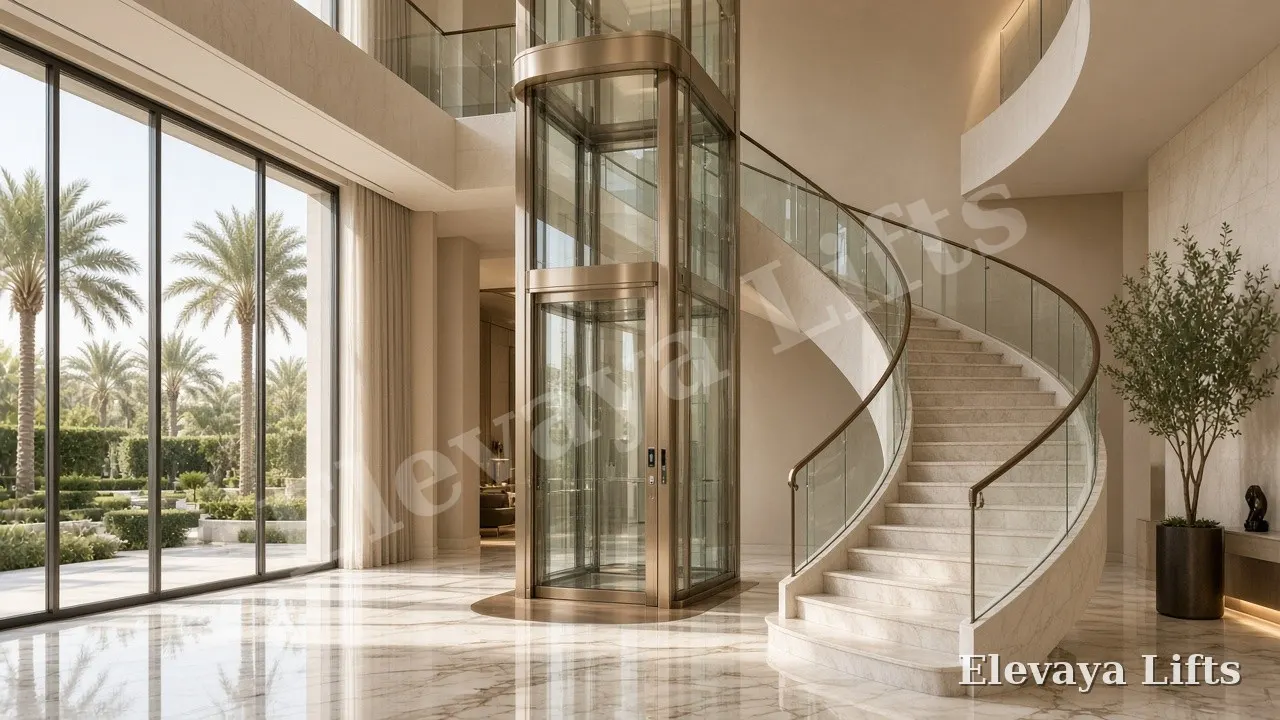
Quick answer: Yes, in most cases. A finished Dubai villa can take a luxury elevator without a poured concrete shaft or a deep pit, by using a self-supporting steel or glass structure and a drive built for a shallow pit or none at all. A site survey, a structural engineer's check and your community and authority approvals decide which route fits.
Most villa owners who ask us this have already been told the opposite. Someone walked through the house, looked at the stairs and said a lift would mean breaking slabs, digging a metre into the ground floor and pouring a concrete box through three levels. Sometimes that is true. Often, installing a luxury elevator in an existing villa needs far less.
The concrete shaft and the deep pit belong to one type of lift: a full passenger elevator designed for a new building. A villa that is already built, finished and lived in can usually be served by a different kind of system, one that brings its own structure and asks very little of the floor beneath it. The question is not "can it be done?" so much as "which compromise do you accept, and is it the right one for a luxury home?"
Elevaya Lifts is a lift company based in Al Barsha 1, Dubai. Since 2019 our team of 40+ has delivered more than 200 projects across all seven Emirates, covering design, supply, installation, maintenance (AMC) and modernization, including bespoke luxury villa lifts for finished homes. Every recommendation below starts with a site survey, never a catalogue.
What can stand in for a concrete shaft in a finished villa?
A lift needs a protected, rigid path to travel in, but that path does not have to be concrete. In an existing Dubai villa there are three common alternatives, and each suits a different house.
A self-supporting steel or aluminium structure
The lift arrives with its own frame: columns, guide rails and panels that stand on the ground floor and are tied back to the slabs at each level. The panels can be glass, which turns the structure into a feature, or solid metal or composite panels, which hide it. This is the route most luxury retrofits take, because it can sit in a stairwell void, a double-height entrance or the corner of a living room without demolishing walls around it.
A lightweight built enclosure
Where you want the lift hidden, a contractor can build a non-concrete enclosure around the lift's own frame, using blockwork or a board system. It looks like a wall, takes the same paint or stone cladding as the rest of the house and keeps noise in. If the enclosure has to meet a fire rating, the design must show how. That is a question for your consultant and, where it applies, Dubai Civil Defence, not something to assume.
A platform-style home lift with an integrated enclosure
Vertical lifting platforms are built as a complete package with their own cabin walls or enclosure panels. They need the least building work of all and are common in two- and three-stop villas. They also come with the clearest limits, covered below.
How shallow can the pit actually be?
Shallower than most people expect. Some platform-style and screw-driven home lifts sit directly on the finished floor and use a small threshold ramp at the lowest landing. Others need only a shallow recess cut into the screed, so the cabin floor lines up with your marble. A full passenger lift usually needs a deeper pit, because the safety space below the car is set by the standard.
There is a middle route. The Dubai Building Code lists BS EN 81-21 among the lift standards it references, and that part of EN 81 is written specifically for new passenger lifts installed in existing buildings, where the full pit or headroom cannot be provided. It allows reduced spaces only when extra safety measures make up for them. Whether it can be used for your villa, and with which measures, is for the lift designer, your consultant and the approving authority to confirm on the drawings.
What you should never do is accept a pit depth from a brochure. The pit, the headroom at the top floor, the slab thickness and the cabin size are one coordinated decision. Our villa lift dimensions guide shows what to measure before anyone quotes.
Will a luxury cabin still feel luxurious on a retrofit lift?
It can, but this is where the honest conversation happens. The three things that change are speed, size and weight.
- Speed. Vertical lifting platforms built to EN 81-41 are limited to a low rated speed of 0.15 m/s. For a G+1 villa that is a calm, unhurried ride. For a G+3 villa with a basement, it can feel long, and many owners then prefer a traction or hydraulic passenger lift with a shallow-pit design instead.
- Cabin size. The structure, guide rails and door packages take space out of the opening you have. A wide stairwell void in an Emirates Hills villa might take a generous cabin; a narrow one in a Jumeirah Park townhouse may limit it to one wheelchair user and a companion.
- Weight. Handcrafted marble floors, onyx walls and gold-finished panels are heavy. Every kilogram of finish comes out of the lift's rated load, and on a lighter platform system that matters quickly. Our article on luxury marble and onyx lift interiors explains how stone can be thinned and backed to save weight.
A luxury retrofit is usually a balance: a lighter structure, a slightly smaller cabin than a new build would get, and finishes chosen for their look per kilogram.
Where does a lift usually go in an already built Dubai villa?
In finished Dubai villas, the same handful of positions come up again and again.
| Position | Why it works | What to check |
|---|---|---|
| The stairwell void | The opening already runs through every floor, so little or no slab is cut | Whether the void is wide enough once the stair width rules are kept |
| A double-height entrance or majlis | Room for a glass structure that becomes a feature | Heat from large windows; how the top landing connects to the upper floor |
| Stacked rooms or cupboards | Hidden lift, matching walls | Slab openings at each level, which need a structural engineer's design |
| Outside, against the façade or in a courtyard | No internal demolition; the house stays in use | Outdoor-rated equipment, sun, sand and the community's view on external changes |
In an Arabian Ranches or Dubai Hills Estate villa, the stair void is often the first candidate. On Palm Jumeirah, an external glass structure on the garden side is common, but salt air means everything outside must be designed for it from the start. See our outdoor lifts page for what that involves.
Who has to approve cutting into a finished villa?
Two layers, and both come before any drilling. First your community or master developer NOC, then the building approval from Dubai Municipality, the Dubai Development Authority or Trakhees, depending on your plot, with Dubai Civil Defence involved where required. Our villa lift permit and NOC guide sets out which authority usually applies in each community.
Under Table A.1 of the Dubai Building Code, the code applies to changes to existing buildings, including a change to a service system or building element. Its villa section (K.5.5.4) says that where elevators are provided, their design must conform to D.5 and D.6. D.5 means one suite of lift standards for the whole project, either ASME A17 or BS EN 81, never a mix of the two.
Slab openings deserve special care. A structural engineer has to check the slab, design any trimming steel and confirm the route for any cuts. If the slab is post-tensioned, the tendons must be located before anyone cuts, and that check alone can decide where the lift goes. When a rule's application to your particular villa is unclear, ask the approving authority to confirm it. We do the same.
The lift is then tested before it goes into use. Dubai Municipality's technical guideline for the examination and certification of lifts and lifting equipment requires lifts in workplaces to be tested and certified by an EIAC-accredited third party every 12 months. For a private villa, confirm with Dubai Municipality or your consultant which inspection regime applies to your lift.
What does the work look like while the family lives there?
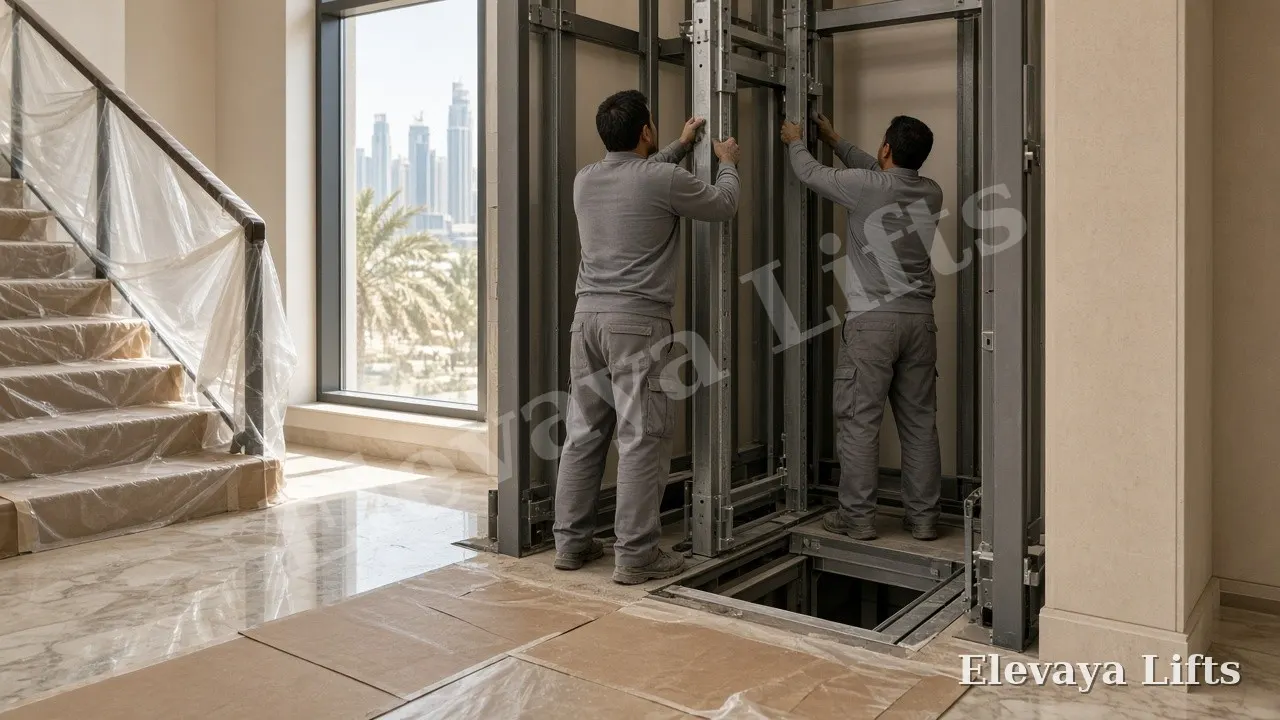
A retrofit in an occupied villa is a different job from a new build, and a good proposal says how it will be run. Expect a sealed work zone, protection over finished floors and the staircase, an agreed route for bringing in steel and glass, and set working hours inside the community's rules. Gated communities usually need contractor access passes arranged in advance.
Dubai adds its own conditions. In summer, steel and glass delivered at midday are hot to handle, so deliveries move to early mornings. Dust from cutting gets into air-conditioning returns unless they are sealed off. On an external lift, sand blown into guide rails during installation has to be cleaned out before commissioning, or it shortens the life of rollers and seals. Our lift installation process guide walks through the stages from survey to handover.
Which retrofit option fits your villa?
Start from the house, then pick the lift. As a rough guide:
- G+1, a stairwell void, mainly for accessibility or comfort: a platform-style or screw-driven home lift on the finished floor or a shallow recess.
- G+2 or G+3, a luxury cabin, a smoother and faster ride wanted: a machine-room-less traction or hydraulic passenger lift on a self-supporting structure, with a shallow-pit design where the standards and the authority allow it.
- No usable internal position: an external glass structure against the façade, designed as an outdoor lift.
- Heavy stone and metal finishes: a passenger-lift drive sized for the weight, even if the pit has to be slightly deeper.
If ride quality is your main worry, read our companion piece on which drive is quieter and smoother for a luxury villa. For how to compare brands once the system type is fixed, see the best luxury home elevator brand for a Dubai villa.
How much does a lift for an existing villa cost?
Our basic home lifts are from AED 69,999, and some basic models start as low as AED 60,000. A retrofit in a finished luxury villa is rarely a basic lift, though, because the structure, the cabin and the building works are designed around your house, so we price it after a site survey. At the top of our bespoke range, some lifts with handcrafted Italian marble and precious metals such as gold cost AED 2 million to 5 million, and a few AED 20 million to 25 million.
What moves a retrofit price most: the type of structure (glass costs more than solid panels), the number of stops, slab openings and trimming steel, the pit solution, the cabin finishes and how hard it is to get materials into the house. Our bespoke glass panoramic villa lift cost guide breaks these down in AED terms, and our home lift for an existing villa guide covers the planning side.
After handover, Elevaya's non-comprehensive AMC for a G+1 Dubai villa lift starts from AED 2,500 a year: 12 visits, fixes for faults found on those visits and free 24-hour emergency callouts, with parts charged only when they need replacing. We also maintain lifts we did not install, from Otis, KONE, Schindler and other brands.
Related Elevaya guides
Continue planning with these related Elevaya guides:
- Which is quieter and smoother for a luxury villa: screw-driven, hydraulic or gearless traction?: how each drive sounds and rides in a Dubai villa, where noise really comes from, heat effects and how to test a lift before you buy.
- What is the best luxury home elevator brand for a Palm Jumeirah or Emirates Hills villa?: how to compare brands neutrally by drive type, local service and parts, standards, warranty, AMC, design flexibility and heat suitability.
- How much does a bespoke glass panoramic villa lift cost in Dubai?: what an installed AED quote should cover, the choices that move the price, confirmed Elevaya price points and the yearly cost of ownership.
- Glass villa lift in Dubai: footprint, heat and cost factors: shaft vs shaftless, laminated glass, cabin cooling, hydraulic vs MRL vs platform.
- Dubai villa lift permit: which NOC and authority you need: the developer NOC, which authority approves (DM, DDA or Trakhees), the steps and the documents.
- Lift installation in Dubai: step-by-step process: survey, shaft, pit and headroom prep, supply and delivery, installation sequence, testing, EIAC certification and handover.
- Luxury marble and onyx lift interiors in Dubai: rare stones beyond Calacatta, from Statuario and Nero Marquina to onyx, malachite and backlit agate, and how each is handled for weight and wear.
- Bespoke luxury home lifts in Dubai: gold, gems and rare marble: what can be customised, how gold, platinum, diamonds, crystal and rare marble are specified, weight, safety and care.
- Glass and panoramic villa lifts in Dubai: 2026 planning guide: placement, glazing, heat control, approvals and AMC care.
- Elevator AMC cost in Dubai: villa owners' guide: non-comprehensive from AED 2,500 for G+1, visits, callouts and parts rules.
- Dubai annual lift inspection certificate: who issues it, 12-month and 6-month inspection rules and how to prepare.
Related Elevaya services and guides: Bespoke luxury villa lifts, Home lift for an existing villa, Villa lift dimensions, Elevator shaft and MRL planning, Home lifts, Platform and accessibility lifts, Outdoor lifts, Villa lift prices, Lift installation, Villa and home lift maintenance, Contact Elevaya.
FAQ
Can a lift be added to a Dubai villa without breaking the slabs?
Sometimes. If the lift goes in the stairwell void, a double-height space or outside the house, little or no slab may need cutting. Elsewhere, slab openings are needed and must be designed by a structural engineer and approved before work starts.
Do I need a pit for a home lift in an existing villa?
Not always. Some platform-style and screw-driven home lifts sit on the finished floor with a small ramp, and others need only a shallow recess. Full passenger lifts usually need a deeper pit unless a reduced-pit design is accepted by the authority.
Is a lift without a concrete shaft safe?
Yes, when the lift and its structure are designed, installed, tested and maintained to one recognised suite of standards, which the Dubai Building Code sets as ASME A17 or BS EN 81. The structure is part of the lift design, not an afterthought.
Can I have a marble and gold cabin on a retrofit lift?
Often, yes, but the finish weight reduces the lift's usable load. Stone can be thinned and backed, and the drive can be sized for the extra weight. A survey and an early materials list let us design for it.
Does Elevaya service lifts installed by other companies?
Yes. We maintain and repair lifts from Otis, KONE, Schindler and other brands, including lifts we did not install, as well as the lifts we supply and install ourselves.
Plan a lift for your finished villa with Elevaya
If your villa is already built and you want a lift that looks as if it was always meant to be there, start with a site survey. Call or WhatsApp +971 58 584 4685, see our bespoke luxury villa lifts, or contact Elevaya to book a visit anywhere in the UAE.