Elevaya journal
Lift Maintenance Checklist for Dubai: What a Monthly Lift Service Visit Should Cover
Lift maintenance checklist for Dubai: what a monthly service visit should check, from doors, brake and alarm to pit and log book, plus escalator care.
Published · Updated · Elevaya Lifts
Quick answer: A monthly lift service visit in Dubai should follow a written lift maintenance checklist, not just a quick "the lift is running" check. On each visit, a qualified technician should review the fault log, ride the lift to check starts, stops, levelling and noise, clean and check the car and landing doors (sills, rollers, locks, light curtain and reopening), test the alarm, intercom and car lighting, inspect the machine, brake, ropes or belts and controller (or the power unit and oil on a hydraulic lift), check the car top and pit, check the rescue device and its battery, and then record the work, findings and any parts needed in the lift log book. The Dubai Building Code requires lifts to be maintained to one suite of standards (ASME A17 or BS EN 81), and the manufacturer's maintenance instructions set the detailed tasks; monthly visits are the usual rhythm for an annual maintenance contract (AMC). Maintenance is separate from the yearly third-party test and certification by an EIAC-accredited inspection body that Dubai Municipality requires for lifts in workplaces, hotels and other establishments.
Most lift owners in Dubai pay for maintenance every month, but very few know what the technician actually did during the visit. A signature on a service sheet does not tell you whether the door sills were cleaned, the brake was checked or the alarm was tested. That is how small problems, like sand in a door track or a weak alarm battery, turn into a trapped passenger or a failed inspection.
This guide is a practical lift maintenance checklist for Dubai: what a monthly lift service visit should cover, step by step, what the log book should record, how often a lift should be serviced, what changes for villa lifts, and a short escalator maintenance checklist for malls and public buildings. It is written for villa owners, building owners and facility managers who want to check the work, not do it. Lift maintenance is work for trained lift technicians only.
If you are comparing maintenance contracts rather than visits, read our lift maintenance contract checklist, and for prices see our villa lift AMC cost guide. This post stays on the visit itself.
Elevaya Lifts has worked in the UAE since 2019 on more than 200 projects, covering lift design, supply, installation and annual maintenance contracts. We service all lift brands, including Otis, KONE and Schindler, and lifts we did not install, so we regularly take over lifts with gaps in their maintenance history.
How often should a lift be serviced in Dubai?
For most passenger lifts and villa lifts in Dubai, a planned maintenance visit once a month is the usual rhythm, with the exact tasks and intervals set by the manufacturer's maintenance instructions, how heavily the lift is used and its condition. There is no single number in the Dubai Building Code that fixes the visit frequency for every lift. What the code does say, in section D.5 of the Dubai Building Code 2021, is that vertical transportation "shall be designed, installed, tested, commissioned and maintained" in accordance with one suite of standards, either ASME A17 or BS EN 81, and that one suite is selected for a project and not used interchangeably. Section K.5.5.4 applies D.5 and D.6 to elevators in villas too.
Monthly visits make sense in the UAE for practical reasons:
- Doors are the busiest moving part of any lift, and fine sand and dust collect in sills and door tracks quickly.
- Heat in machine rooms and shafts, especially in summer, stresses drives, controllers and batteries.
- Alarm and rescue batteries run down quietly and are only noticed when they fail.
- A regular visit gives the technician a chance to spot a trend, such as a door that reopens more often or a lift that stops slightly off the floor, before it becomes a breakdown.
Busy buildings, hospitals, hotels and malls may need more frequent attention, agreed in the maintenance contract. A villa lift that is used lightly still needs regular visits, because idle lifts have their own problems (see the villa section below).
Separately, Dubai Municipality guideline DM-HSD-GU48-ECLA2 (version 5, 2025) requires lifts used in factories, construction sites, hotels and other workplaces to be tested and certified by a third party accredited by the Emirates International Accreditation Centre (EIAC) once every 12 months. That yearly inspection checks the lift; it does not replace the monthly maintenance that keeps it in good condition between inspections.
The monthly lift maintenance checklist
Use this table to check what your technician covers. Not every item applies to every lift (a hydraulic villa lift has no ropes or counterweight, for example), and the manufacturer's instructions may add tasks or schedule some of them less often. The point is that each area is looked at on a planned basis and the result is written down.
| Area | What the technician should check | Why it matters in the UAE |
|---|---|---|
| Log book and fault history | Faults, callouts and complaints since the last visit; open recommendations | Repeat faults point to the real cause |
| Ride test | Smooth start and stop, levelling at each floor, unusual noise or vibration | Poor levelling is a trip hazard |
| Landing doors | Sills and tracks cleaned, rollers and guides, door locks and contacts, alignment, damage | Sand and dust jam sills; locks are safety-critical |
| Car door and reopening | Light curtain or safety edge working, door opening time, reopening when the doorway is blocked, door closing force | Doors that close on people are a safety fault |
| Car interior | Buttons, displays, car lighting, fan, handrail, mirror and panels secure | Faulty buttons and dark cars are common complaints |
| Alarm and intercom | Alarm button and two-way intercom tested through to whoever answers; emergency lighting | A dead alarm is the most serious "small" fault |
| Machine and brake | Machine noise, temperature, oil or grease leaks, brake operation and wear | Summer heat and load stress the machine |
| Ropes or belts, sheave | Visible wear, damage, tension, cleanliness | Wear builds slowly and needs a trend |
| Controller and drive | Fault codes, connections, cooling fans and filters, cabinet cleanliness | Dust and heat cause controller trips |
| Hydraulic power unit (hydraulic lifts) | Oil level and condition, leaks at the pump, valve and cylinder, oil temperature | Heat and leaks affect levelling and ride |
| Car top | Inspection controls, stop switch, car top cleanliness, guide shoes or rollers | Safe access for the technician |
| Pit | Cleanliness, water or oil in the pit, buffers, pit stop switch, lowest-level switches | Water and debris collect in pits |
| Machine room or machinery space | Temperature and ventilation, lighting, access and lock, no stored items | Heat and storage are common problems |
| Rescue device and batteries | Automatic rescue device (where fitted) and alarm battery condition | Power cuts reveal weak batteries |
| Signs and documents | Safe working load shown in the car, emergency number on the intercom sign, current certificate kept on site | Required by Dubai rules and expected by inspectors |
| Report and return to service | Work done, findings, parts needed, next action, lift tested before return to service | Owners need a record they can act on |
Two of these rows deserve extra emphasis. The alarm and intercom should be tested on every visit, because they are how a trapped passenger gets help. And door faults should never be "reset and left": if doors reopen, stick or close hard, the cause should be found and recorded.
What happens on a monthly lift service visit, step by step
A good monthly visit follows a set order, so nothing is skipped and the lift is made safe before anyone works on it. The exact order depends on the lift and the manufacturer, but a typical visit looks like this.
- Arrive and check in. The technician reports to the building manager, security or villa owner, checks the log book for complaints since the last visit, and asks whether anything unusual has happened.
- Make the area safe. A "lift under maintenance" notice and barrier go up at the landing, and the lift is taken out of normal service before any work in the shaft, pit or machinery space.
- Ride and observe. The technician rides the lift to every floor, watching starts, stops, levelling, door timing and noise, and listens for anything that has changed.
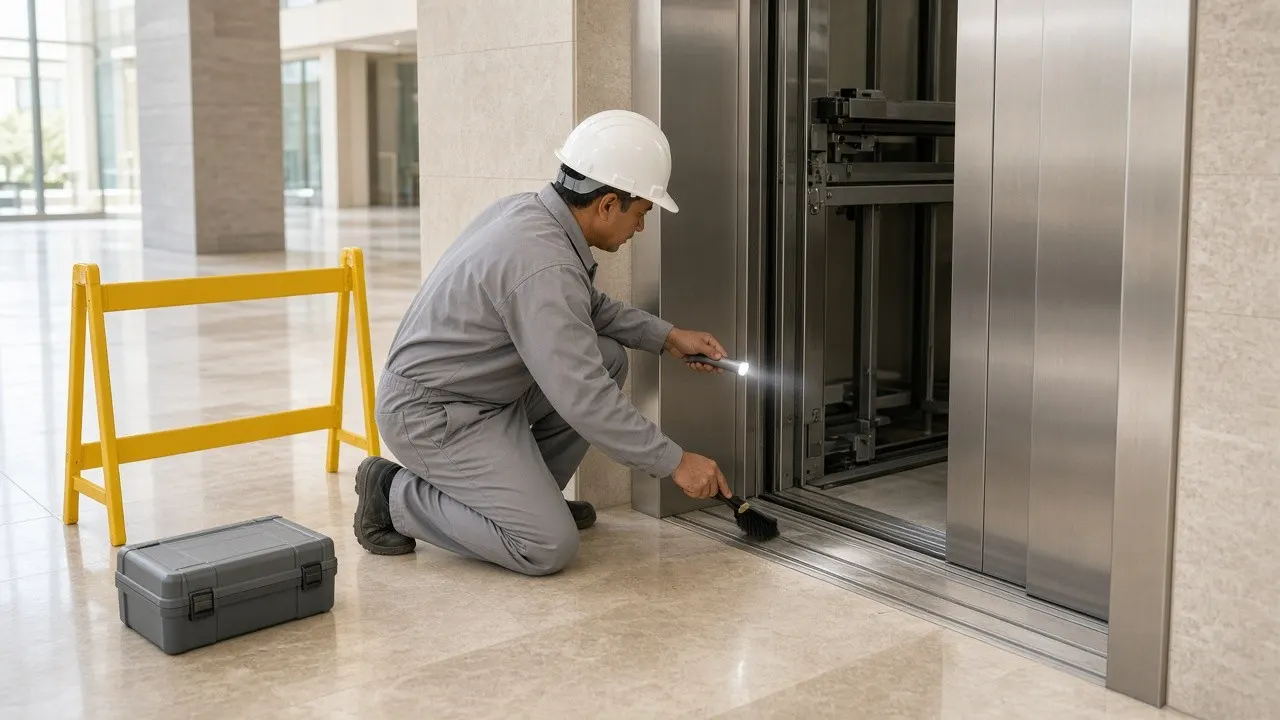
- Doors. Landing and car doors are checked at each floor: sills and tracks cleaned of sand and debris, rollers and guides checked, door locks and contacts checked, and the light curtain or safety edge tested so the doors reopen when the doorway is blocked.
- Car interior. Buttons, indicators, lighting, fan, panels and the alarm are checked. The alarm and intercom call is tested through to the number it is meant to reach.
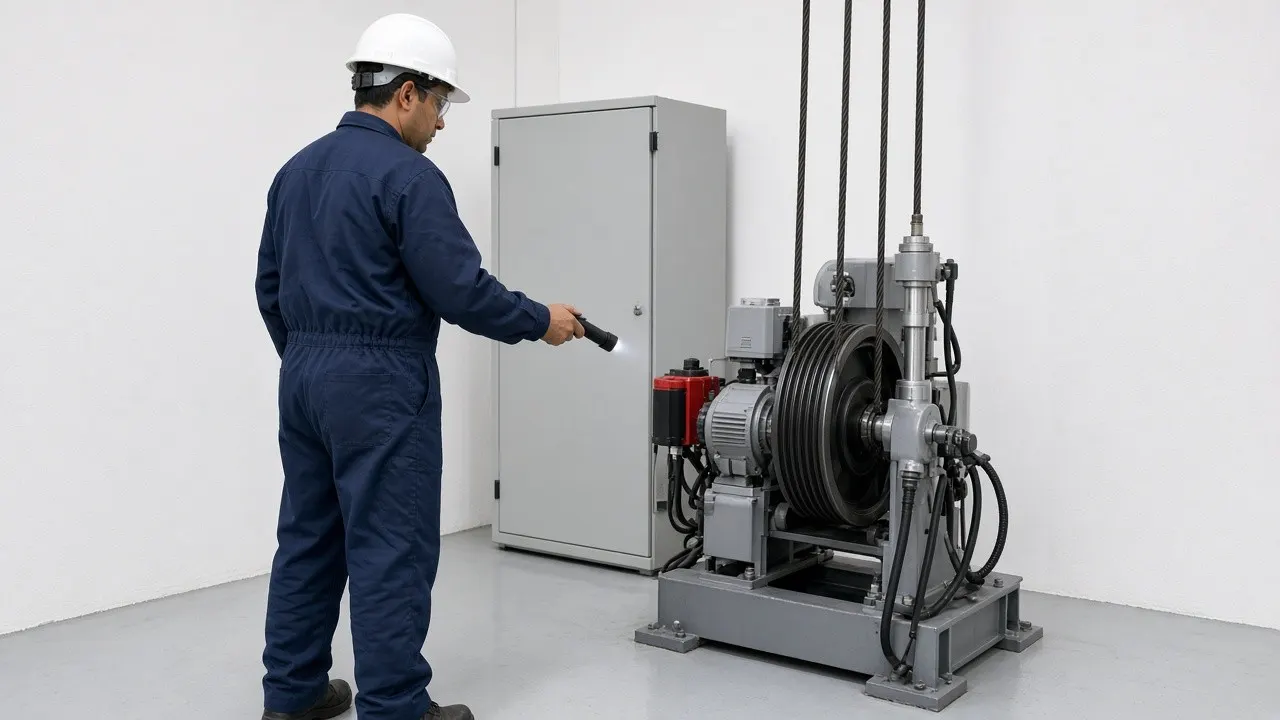
- Machine room or machinery space. The machine, brake, sheave, ropes or belts, controller and drive are inspected, fault codes are read, and the room's temperature and ventilation are checked. On a hydraulic lift, the power unit, oil and valves are checked for level, condition and leaks.
- Car top. Using the inspection controls, the technician checks the car top equipment, guide shoes or rollers, door operator and the shaft as the car moves.
- Pit. The pit is checked and cleaned, including buffers, switches and any water or oil.
- Rescue device and batteries. Where an automatic rescue device is fitted, it is checked along with the alarm battery.
- Return to service and report. The lift is tested again before going back into normal service, the notice and barrier are removed, and the log book is filled in with the work done, findings and any parts or repairs needed, so the owner can approve them.
Checks that are not needed every month
Some tasks are scheduled less often than monthly, or are done as part of testing rather than routine service. Depending on the lift and the manufacturer's instructions, these can include detailed rope or belt measurements, functional tests of the overspeed governor and safety gear, brake tests, buffer tests, insulation and earth checks on the electrical installation, and lubrication or replacement of parts at set intervals. Ask your maintenance company for its annual plan, so you can see when each of these is due and that it is recorded when done.
What should the lift maintenance log book record?
The lift log book (or digital service record) is the owner's evidence that maintenance is being done. Every visit, callout and repair should appear in it, linked to the same lift. A useful record shows:
| Field | What to record |
|---|---|
| Lift identity | Building, lift number or name, brand and model, serial number where known |
| Date and visit type | Planned monthly visit, callout, repair, test or inspection |
| Technician | Name of the person who attended and the company |
| Work done | Tasks carried out from the checklist, not just "service done" |
| Findings | Defects, wear and observations, including small ones |
| Parts | Parts replaced, or parts recommended and awaiting approval |
| Lift status | In service, in service with restrictions, or out of service |
| Open actions | Recommendations still open from earlier visits, and who must approve them |
| Inspection and certificate | Date of the last third-party inspection, certificate or report reference, findings to close |
Keep the log book with the lift, or make sure the building manager can open the digital version quickly. Dubai Municipality's guideline DM-HSD-GU48 requires that the compliance certificate "shall be kept at the site" and that safe working loads "shall be displayed on the equipment". When an inspector visits, the maintenance record is one of the first things they will want to see.
If you are taking over a lift from another maintenance company, ask for the previous log book and service reports at handover. Our guide to multi-brand lift maintenance in the UAE explains what to collect.
Maintenance, repair and inspection: what is the difference?
Maintenance keeps the lift in good condition, a repair fixes a fault, and a third-party inspection independently checks that the lift is safe and compliant. Owners sometimes mix them up, which leads to gaps.
| Monthly maintenance | Repair | Third-party inspection | |
|---|---|---|---|
| Who does it | Your lift maintenance company | Your lift maintenance company or repair contractor | An EIAC-accredited inspection body |
| When | Planned, usually monthly | When a fault is found or reported | Periodically (once every 12 months under DM-HSD-GU48 for lifts in workplaces, hotels and other establishments), and after major repairs |
| Purpose | Prevent faults, keep the lift safe and reliable | Restore the lift after a fault | Confirm the lift complies and is fit for use |
| Output | Log book entry and service report | Repair report, parts record | Inspection certificate, or an inspection report with reasons if it fails |
The EIAC-RQ-IB-002 requirements for inspection bodies define a periodic inspection as a thorough inspection with visual, functional and, where applicable, load testing, and note that factors such as the environment, frequency and type of usage and quality of maintenance are taken into account when setting the inspection period. If a lift fails, the inspection body issues an inspection report explaining why, rather than a certificate. Under DM-HSD-GU48, repairs identified by the accredited third party must be carried out by the owner or occupier immediately, and the certificate of safety is issued only after any repairs have been carried out. A lift that has been well maintained month by month is much easier to get through this process.
Elevaya can prepare your lift for its inspection and close out findings; see inspection preparation and our guide to elevator inspection and testing in the UAE. For an active fault, go to lift repairs.
Villa lift maintenance in the UAE: what is different?
Villa lifts often run fewer trips than building lifts, but they still need regular visits, because long idle periods, power cuts and heat cause their own problems. Things a villa lift maintenance visit should pay extra attention to:
- Idle periods. Many families travel in summer. A lift that stands unused for weeks can have stiff doors, flat batteries or, on hydraulic lifts, settling and levelling issues when it is used again. Tell your maintenance company before and after long trips.
- Rescue device and alarm batteries. Villa lifts depend on the home's power supply. If an automatic rescue device is fitted, its battery should be checked so the car can reach a floor and open its doors in a power cut.
- Hydraulic power units. Many villas have hydraulic lifts. Oil level, oil condition, leaks and the temperature of the power unit room matter, especially in summer. See hydraulic lifts.
- Glass and panoramic lifts. Sun-exposed glass shafts get hot; cabin ventilation, door seals and glass cleaning around the door tracks need attention. Our glass villa lift guide covers the design side.
- Who uses the lift. Elderly family members, children and domestic staff often rely on the villa lift most, so a working alarm that someone will actually hear or answer is essential.
For villa-specific service, see home lift maintenance.
What owners and facility managers can check between visits
Owners should observe and report, not repair. These checks are safe for anyone and help your technician find faults early:
- Does the lift stop level with every floor, or is there a step?
- Do the doors open and close smoothly, without banging, sticking or reopening for no reason?
- Is the car lit, is the fan working, and do all buttons and displays light up?
- Is the emergency number on the intercom sign current, and does someone answer when the alarm is used during an agreed test?
- Is the safe working load shown in the car, and is the current inspection certificate kept on site?
- Is sand or rubbish building up at the landing sills? Keep the landing area clean and report build-up; do not push tools or keys into the door gap.
- Is anything stored in the machine room or near the controller? It should not be.
Never open the controller, enter the shaft or pit, use emergency door keys, or try to reset a lift yourself. If the same fault returns, write it down with the date, time, floor and what you saw, and send it to your maintenance company. For common faults and what causes them, see common lift problems in Dubai and our elevator troubleshooting guide.
For accessible lifts, Dubai Building Code clause C.5.9.3.2 adds requirements that are worth checking during maintenance: item f) requires automatic doors that remain open for a minimum of 3 seconds, item g) requires the door to reopen automatically when a user is in the doorway without producing a force greater than 135 N, item q) requires a hands-free intercom allowing two-way communication with a rescue service, with a graphic and tactile sign showing the phone number of the alarm centre, and item t) recommends lighting with uniform illumination of at least 100 lux.
Escalator maintenance checklist for UAE malls and buildings
Escalators and moving walks need their own maintenance checklist, because their wear points (steps, comb plates, handrails and safety switches) are different from a lift's. A routine escalator service visit should typically cover:
| Area | What should be checked |
|---|---|
| Comb plates and teeth | Broken or missing teeth, alignment with the steps, sand and debris |
| Steps and gaps | Damaged steps, step-to-skirt and step-to-step gaps, step rollers |
| Handrails | Condition, tension, and handrail speed matching the steps |
| Skirt deflectors and brushes | Secure, undamaged, in place along both sides |
| Safety devices | Emergency stop buttons, comb plate, handrail entry and other safety switches tested |
| Energy features | Reduced speed and stop when idle working as set, photocell detectors at top and bottom landings clean |
| Drive and step chain | Noise, lubrication, wear, drive and brake operation |
| Cleaning | Sand, dust and debris removed from steps, combs and inside the truss where accessible |
In Dubai, escalators and moving walks in new buildings have energy features set out in Dubai Building Code D.6.2: they reduce to a slower speed when no activity has been detected for a maximum of 3 minutes, shut down after a maximum of 15 minutes without activity, use soft-start technology, and have photocell activation detectors at the top and bottom landing areas. Section D.5 also requires enhanced handrail protection at the entry to escalators and moving walks. Maintenance should keep these features working, not bypass them.
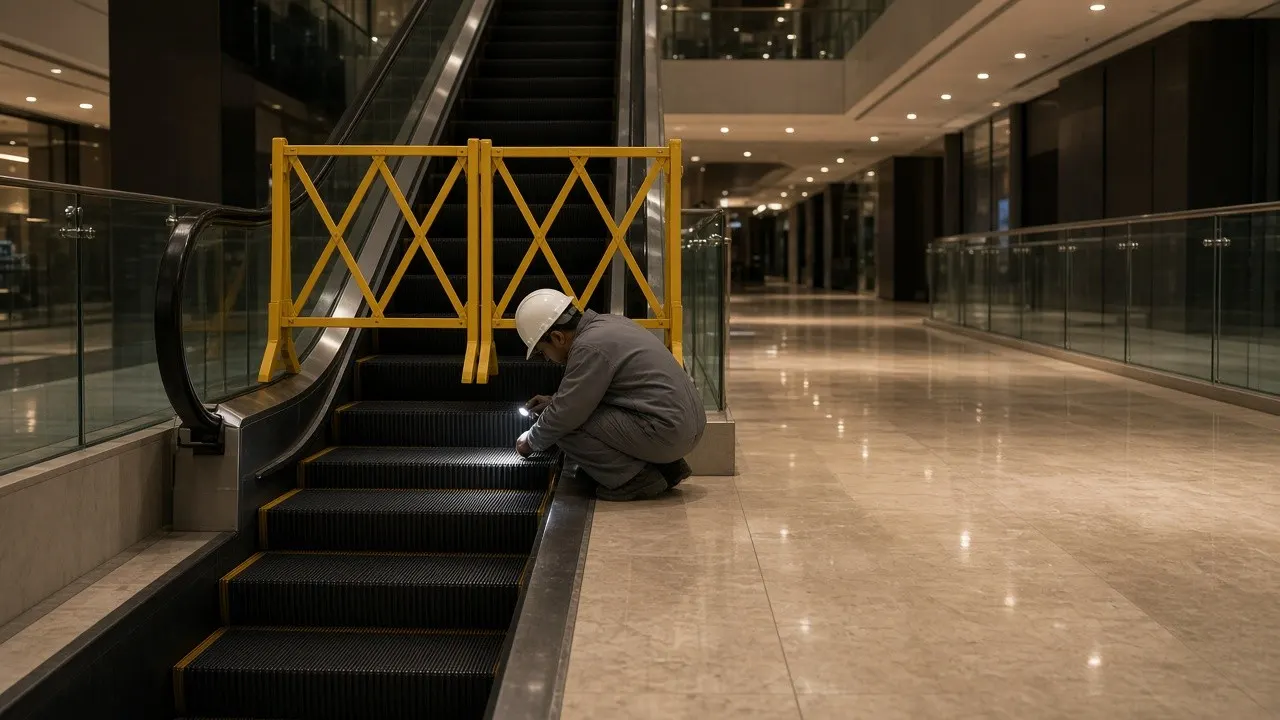
For more detail, read escalator faults and repairs in Dubai and escalator design and maintenance for UAE malls, or see our escalator maintenance and repair service.
Red flags that your lift is not being properly maintained
Watch for these signs that monthly visits are not covering what they should:
- the log book only says "service done", with no tasks or findings listed;
- visits are much shorter than the checklist above would need, or are missed without notice;
- the same fault keeps returning and is "reset" each time;
- the alarm or intercom has not been tested, or nobody answers it;
- sand and debris build up in the door sills between visits;
- the machine room is hot, dirty or used as a store;
- recommendations are made verbally but never written down or priced;
- the lift fails its third-party inspection on items that routine maintenance should have caught.
If you see several of these, it is time to review your contract or ask another company to survey the lift. Our buyer's checklist for choosing a lift company in Dubai explains what to ask for in writing.
How Elevaya handles monthly lift maintenance
Elevaya Lifts maintains villa, residential and commercial lifts and escalators across the UAE, for all lift brands, including lifts we did not install. Each planned visit follows a checklist for that lift, and the work, findings and any parts needed are recorded so the owner can see what was done and approve anything extra.
As a reference point, Elevaya's non-comprehensive AMC for a G+1 villa lift in Dubai starts from AED 2,500 a year. It includes 12 visits a year (one each month), fixes for issues found, and free 24-hour emergency callouts at no extra cost. Only replacement parts are charged, and only when they need changing. Our elevator AMC cost guide explains what that covers, and our lift maintenance service page covers buildings and portfolios. You can also review our completed projects.
Related Elevaya guides
Continue planning with these related Elevaya guides:
- Elevator AMC cost in Dubai: villa owners' guide: non-comprehensive from AED 2,500 for G+1, visits, callouts and parts rules.
- Common lift problems in Dubai: causes and fixes: stuck lifts, doors not closing, jerky rides, noise and summer heat trips, safe owner checks, trapped-passenger steps, repairs and certification.
- How to choose the best lift company in Dubai: buyer's checklist: licences, AMC terms, written response times, parts, references and red flags.
- Escalator faults and repairs in Dubai: why escalators stop, safety-device trips, handrail and step chain wear, sand and heat, repair vs modernization.
- Escalator design and maintenance for UAE malls: layout, balustrades, dust and heat, AMC and modernization.
- Lift upgrades in Dubai: what to upgrade first: rescue devices for power cuts, door light curtains, VVVF and energy saving, cabin refresh, alarms, EN 81-80, upgrade vs modernization.
- Elevator modernization in Dubai: signs, scope and standards: when to modernize, controller and door upgrades, EN 81-20/80, downtime and cost factors.
- Lift COP and LOP panels in Dubai: what is on each panel, DBC button heights, Braille and intercom rules, common faults, repair vs replacement.
- Glass villa lift in Dubai: footprint, heat and cost factors: shaft vs shaftless, laminated glass, cabin cooling, hydraulic vs MRL vs platform.
- Glass and panoramic villa lifts in Dubai: 2026 planning guide: placement, glazing, heat control, approvals and AMC care.
- Lift installation in Dubai: step-by-step process: survey, shaft, pit and headroom prep, supply and delivery, installation sequence, testing, EIAC certification and handover.
- Lift and elevator supply in the UAE: buyer's guide: supply-only vs supply and installation, what to specify, what a supply quote must include, BS EN 81 / ASME A17, EIAC certification, escalator supply and red flags.
- Lift speed by building height in Dubai towers: DBC travel-time formula, worked m/s examples, waiting times, DHA hospital and Trakhees rules.
- Elevator and escalator speeds in UAE buildings: rated lift speed by travel height and 0.5 vs 0.65 m/s escalators.
- Elevator cabin design trends in the UAE for 2026: finishes, COP/LOP panels, LED lighting and glass cabins.
- Luxury elevator interiors in the UAE: marble, bronze and wood: weight, fire performance and cleaning of premium cabin finishes.
- Lift out of service in a UAE building: who to report it to: who is responsible, the 14-day RERA route in Dubai, municipality contacts by emirate, and what owners and tenants can ask for.
- Escalator modernization in the UAE: signs, scope and compliance: when to modernize, modernize vs replace, controller and drive, steps, chain and handrail, energy features, phased mall works and the EIAC major inspection.
- Escalator installation in the UAE: step-by-step process: survey and selection, pit and truss supports, rigging, alignment, controller, safety devices, testing, EIAC inspection and handover.
Related Elevaya services and guides: Lift maintenance, Elevator AMC, Home lift maintenance, Lift maintenance contract checklist, Commercial lift and escalator maintenance, Lift repairs, Elevator spare parts, Inspection preparation.
FAQ
What should a monthly lift maintenance visit include?
A monthly visit should include a review of the fault log, a ride test, cleaning and checking of car and landing doors, a test of the alarm, intercom and car lighting, inspection of the machine, brake, ropes or belts and controller (or the hydraulic power unit), checks of the car top, pit and rescue device battery, and a written record of the work, findings and parts needed.
How often should a lift be serviced in Dubai?
Most passenger and villa lifts in Dubai are serviced once a month under an annual maintenance contract, with the detailed tasks and intervals set by the manufacturer's instructions, usage and condition. Separately, Dubai Municipality requires lifts in workplaces, hotels and other establishments to be tested and certified by an EIAC-accredited third party once every 12 months.
What is a lift maintenance log book?
It is the record of every maintenance visit, callout, repair and inspection for a specific lift. It should show the date, technician, tasks done, findings, parts replaced or recommended, the lift's status and any open actions, so the owner and the inspector can see the lift's history.
Is monthly maintenance the same as the annual lift inspection?
No. Monthly maintenance is done by your lift company to keep the lift safe and reliable. The annual inspection is an independent test and certification by an inspection body accredited by EIAC. If the lift fails, the inspection body issues a report with reasons, and the repairs must be carried out before a certificate is issued.
Do villa lifts need monthly maintenance if they are rarely used?
Yes. Lightly used villa lifts still need regular visits, because long idle periods, power cuts, heat and flat batteries cause their own faults. Elevaya's non-comprehensive AMC for a G+1 villa lift in Dubai starts from AED 2,500 a year and includes 12 monthly visits.
What should an escalator maintenance checklist cover in the UAE?
Comb plates and teeth, steps and gaps, handrail condition and speed, skirt deflectors, emergency stops and safety switches, the drive and step chain, cleaning of sand and debris, and, in Dubai, the energy features required by the Dubai Building Code, such as reduced speed when idle and photocell detectors at the landings.
Book a lift maintenance visit in the UAE with Elevaya
Want to know what your monthly lift service should cover, or need a second opinion on your current maintenance? Elevaya maintains all lift brands across the UAE. Call or WhatsApp +971 58 584 4685 or contact Elevaya to arrange a survey of your lift.