Elevaya journal
Luxury Lift Cabin Upgrade in Dubai: Rose Gold PVD, Bronze, Black Titanium, Rare Veneers, Leather, Shagreen and Gold Leaf
Upgrade an existing lift cabin in Dubai with rose gold PVD, bronze, copper, black titanium, ebony and burl veneers, leather, shagreen and gold leaf.
Published · Updated · Elevaya Lifts
Quick answer: A luxury lift cabin upgrade in Dubai usually keeps the lift's machine, rails and shaft and re-dresses the car itself: new wall panels, doors, handrails, ceiling and floor. Beyond gold, platinum and titanium, the finishes that work best on an existing lift are rose gold and champagne PVD stainless steel, brass, bronze and copper, hammered or etched metal, black titanium, Macassar ebony and burl walnut veneers, leather, shagreen and gold leaf. Each one is chosen for where it sits in the cabin, made off site to measured drawings, and checked for weight and fire performance before it goes in. Elevaya designs, supplies, installs and maintains these cabins, and our bespoke luxury villa lifts page shows the design directions many owners start from.
A lot of villas and penthouses in Dubai have a lift that runs perfectly well and looks like it came out of a catalogue. Brushed steel walls, a plain ceiling, a grey floor. The house around it has been finished in walnut, bronze and stone, and the lift is the one room that never got the same attention.
You do not have to replace the lift to change that. Most of what you see and touch in a cabin can be taken out and rebuilt in better materials, and much of the work can be done off site while the lift keeps running. The catch is that a lift car is not a wall in a living room. It moves, it carries a weight limit, and it has to meet fire and safety rules. So the finish has to be right for the cabin as well as for the house.
Elevaya has worked on lifts in the UAE since 2019, on more than 200 projects across design, supply, installation and annual maintenance contracts. Our overview of bespoke luxury home lifts in Dubai covers gold, platinum, diamonds and crystal on a new lift, and our guide to rare marble and onyx covers stone. This guide is about metals, woods and soft finishes, and about putting them into a lift you already own.
What does a luxury lift cabin upgrade involve on an existing lift?
A luxury cabin upgrade replaces the visible parts of the car, such as wall panels, ceiling, floor, handrails and often the door faces, while the machine, controller, rails and safety gear stay in place unless they are due for work anyway. It starts with a survey of the lift as it is, not with a mood board.
Before we suggest a single material, we look at:
- The lift's data. Rated load, car weight and how much the car can gain without changes elsewhere. This sets the budget for every panel that follows.
- How the car is built. Some cars have removable decorative panels on a frame; others have finishes bonded straight onto the car walls. The first is easy to re-dress. The second needs a new inner skin.
- The doors. Car and landing door faces can be re-clad in many cases, but door panels are moving parts with their own weight limits, so we treat them separately.
- What is close to its end. If the controller, door operator or drive is near the end of its life, it makes sense to plan the cabin with a lift modernization so the car is only opened up once. Our guide to lift upgrades in Dubai explains what to fix first.
With that in hand, the design can be as ambitious as the house. A cabin refurbishment can go from a simple refresh to a full bespoke interior.
Rose gold and champagne PVD: the practical precious metal
Rose gold and champagne PVD stainless steel give the warmth of gold with the toughness of steel, which is why they are often the backbone of an upgraded luxury cabin. PVD stands for physical vapour deposition: a very thin, hard, coloured layer is bonded to the steel in a vacuum chamber. The colour usually comes from a metal compound such as titanium nitride rather than from solid gold.
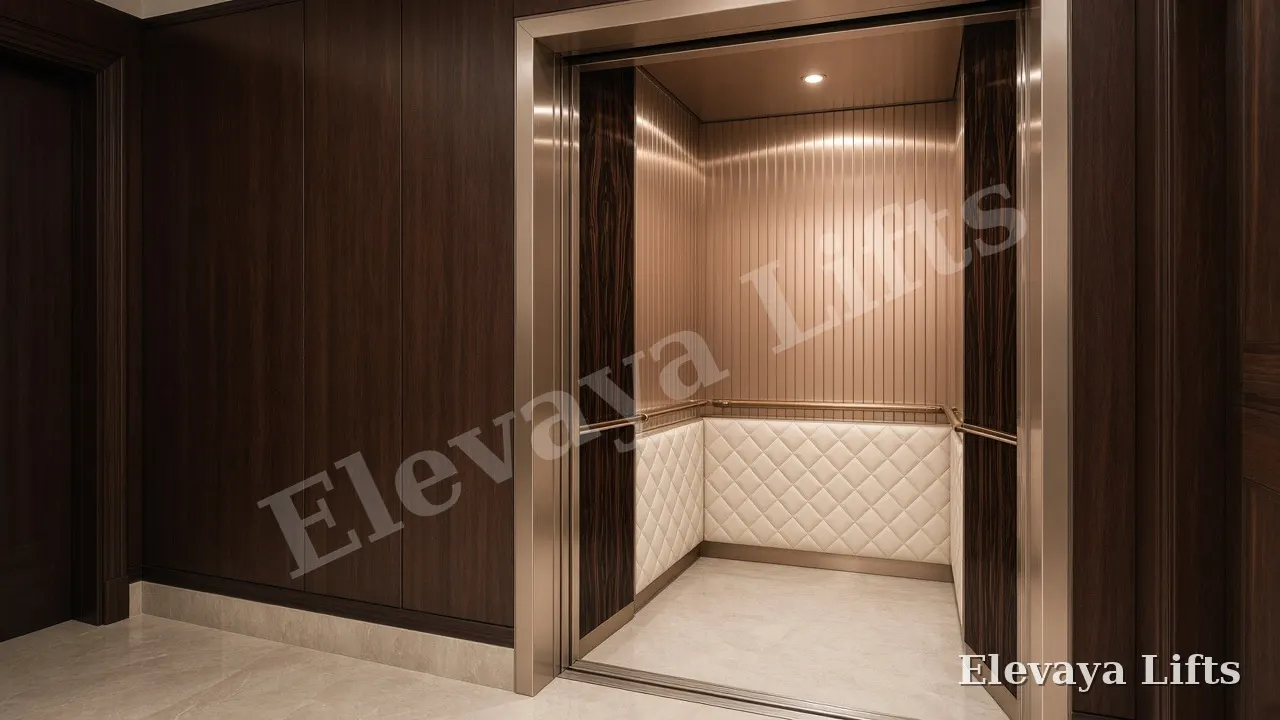
Champagne is the quieter of the two. It sits between gold and steel and works with almost any stone or wood. Rose gold is warmer and pinker, and looks best beside dark timber, ivory leather or a cream floor, as in the cabin above. Both come in mirror, brushed, satin or bead-blasted finishes, and both can be fluted, as on that rear wall, which adds depth without adding much weight.
Things we watch for with PVD:
- One batch for the whole cabin. Colour can shift slightly between coating runs. We order every panel, trim and handrail bracket together, plus a spare panel for the future.
- Brushed over mirror where hands go. Mirror PVD shows every fingerprint. Brushed or satin hides them far better, and an anti-fingerprint top coat helps more.
- No site touch-ups. A deep scratch that cuts through the coating shows the steel below, and it cannot be patched on site with a pen. The panel comes out and is recoated or replaced, which is why removable panels matter.
Brass, bronze and copper: metals that change with time
Brass, bronze and copper are "living" metals: unless they are sealed, they darken and change colour as they age, so the first decision is whether you want them to stay bright or to age. Both choices can look superb. They just need different care.
A useful thing to know before you buy: much of what is sold as architectural "bronze" is actually a brass. The US National Park Service's Metals in America's Historic Buildings notes that commercial and architectural "bronze" today usually contains zinc rather than tin, and that brass finishes are usually protected with lacquer to prevent tarnish. That is not a problem. But ask your supplier which alloy you are getting and whether it is solid metal, a cladding over another core, or a PVD colour on steel, because each ages and repairs differently.
How the three behave in a cabin:
- Brass is the bright, golden one. Lacquered, it stays that way for years with gentle cleaning. Unlacquered, it mellows to a soft, deeper gold.
- Bronze is browner and more serious. It suits dark woods, leather and black stone, and it is the classic metal for handrails and door frames in older grand buildings.
- Copper starts pink and warm and turns brown fairly quickly where it is touched. Indoors, in an air-conditioned cabin, it is far less likely to go green than copper on a roof, but fingerprints will show as darker marks if it is left unsealed.
Weight is the other point. Solid cast bronze is beautiful and heavy. On an existing lift we usually use thin sheet or cladding bonded to a light core, and keep solid metal for the parts you actually hold, like the handrail.
Hammered, etched and black titanium: texture that hides wear
Texture is one of the smartest choices in an upgraded cabin, because a hammered or etched surface hides the small marks that would ruin a mirror finish. It is also where a cabin starts to feel hand-made rather than ordered.
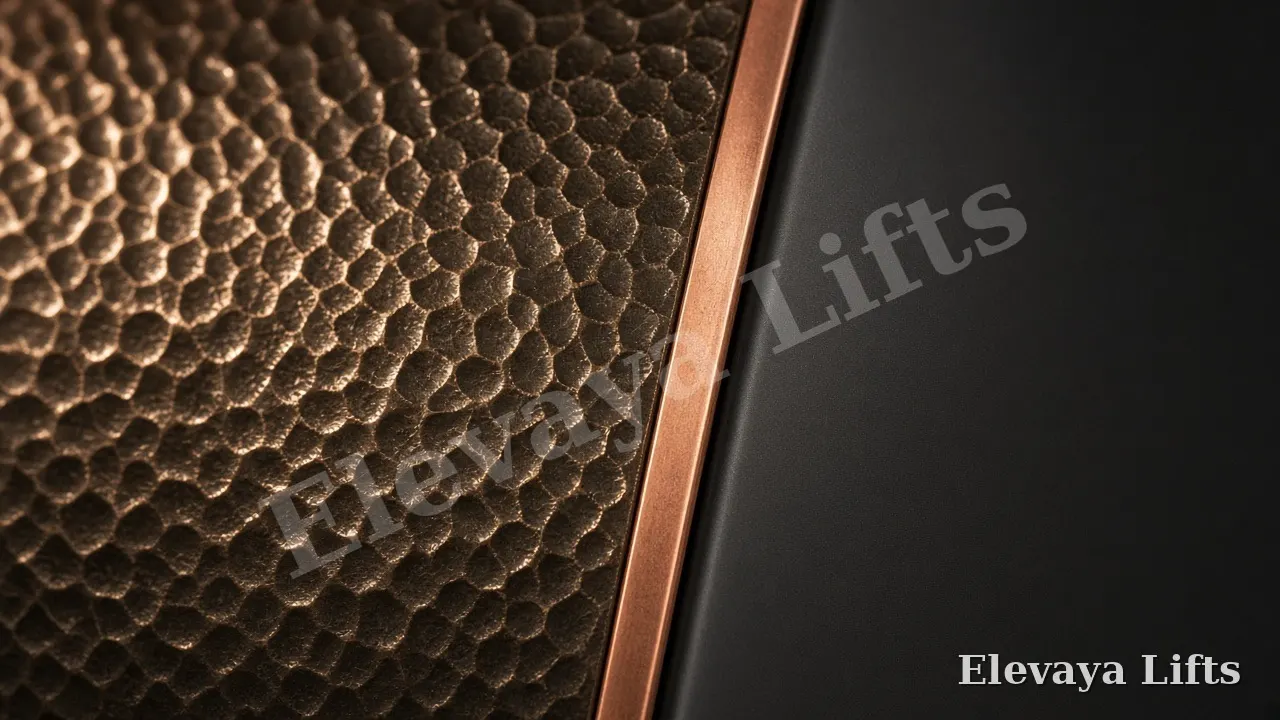
Hammered metal is beaten by hand or machine into a pattern of small facets. Each dent catches light differently, so a minor knock from a suitcase simply disappears into the surface. That makes it ideal for the lower half of the cabin, from the floor to the handrail, where most damage happens.
Etched metal has a pattern cut into the surface with acid or a laser: a geometric grid, a fine linen texture, a family motif or an Arabic pattern. Etching can be combined with PVD and with mirror and brushed areas on the same sheet, so one panel can carry two tones without any joins.
Black titanium in lift work usually means stainless steel with a black, titanium-based PVD coating, rather than solid titanium sheet. It gives a deep, almost gunmetal black that frames warmer metals beautifully, as in the close-up above, where a strip of copper separates hammered bronze from matte black. Matte black shows dust and greasy fingerprints, so it needs a regular wipe, but it hides scratches better than polished black.
Macassar ebony and burl walnut: veneers with a story
Macassar ebony and burl walnut bring the warmth of rare timber into a cabin, and in a lift they are always used as thin veneers on a stable, fire-rated core, never as solid wood. That keeps the weight down and stops the panels moving as the air changes.
Macassar ebony comes from Indonesia and is known for its stripes of black and warm brown. It is dense, dramatic and works best in long vertical panels, like the side insets in our hero image, where the stripes make a small cabin feel taller. Supply of fine ebony is limited, so we ask the supplier to document the legal origin of the veneer before it is approved.
Burl walnut is cut from the knotted growths on a walnut tree, and its swirls and "eyes" are different in every sheet. It is the timber you see in classic car dashboards and fine cabinetry. It looks rich in a lift, especially with a fine metal inlay.
What keeps a veneer looking good in a Dubai lift:
- Sequence-matched sheets. Veneer leaves cut one after another from the same log keep the figure flowing across three walls.
- Sealed on both sides. Balanced backing and a durable lacquer stop warping when the cabin cools down after a hot day.
- Protected edges. A thin metal trim at corners and at the door return stops chips where hands and bags pass.
- Out of direct sun. In a glass or panoramic lift, strong sunlight fades veneer over time, so timber usually goes on the walls that face away from the glass.
Leather, shagreen and gold leaf: the soft and fragile layer
Leather, shagreen and gold leaf are the finishes that make a cabin feel personal, and they last when they are placed with care, kept on removable panels and backed by fire test data. They are the hand-finished layer on top of the metals and woods.
Leather softens the sound and feel of a cabin. Quilted or stitched leather lower panels, like the ivory dado in our hero image, are comfortable to lean against and quiet the ride. We use upholstery leather that comes with fire performance data, fix it on panels that clip out, and choose a tone that forgives the odd scuff. If a panel is marked after a few years, it can be re-covered without touching the rest of the cabin.
Shagreen traditionally means the pebbled skin of a ray, polished and dyed, and used on fine boxes and furniture for centuries. Real shagreen is tough once finished, but it is also costly and comes in small skins, so in a lift it is used for small panels, inlays or a handrail cover. Embossed leather and resin versions imitate the look. Both can be beautiful, but you should know which one you are getting, and the supplier should be able to show where real skins came from.
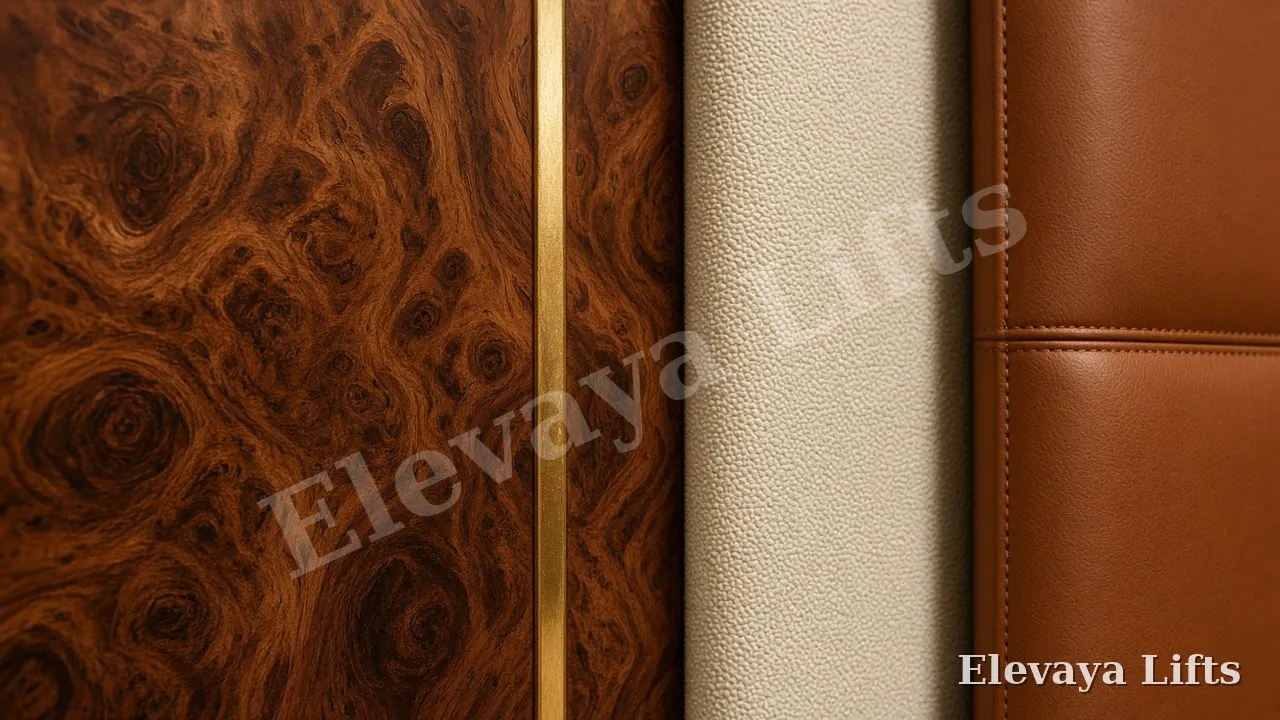
Gold leaf is gold beaten so thin it is almost translucent, laid by a gilder onto a prepared surface and then sealed. It glows in a way no paint can, especially in a crackled or antique finish. It is also the most delicate thing in this guide. In a cabin we use it where hands do not reach: the ceiling, a cornice, or a narrow inlay line in veneer, as in the burl walnut panel above. If it is damaged, a gilder can repair it locally.
Where each finish belongs in an upgraded cabin
A lift cabin has three zones, and the best upgrades put each material in the zone that suits it.
| Finish | Look | Best place in the cabin | How it wears | Care |
|---|---|---|---|---|
| Rose gold or champagne PVD | Warm gold tones on steel | Walls, door faces, trims, handrail brackets | Hard; deep scratches show steel and cannot be patched on site | Soft cloth, mild soap; no abrasive pads |
| Brass (lacquered or living) | Bright to mellow gold | Handrails, trims, door frames | Lacquer can wear where touched; living finish darkens | Lacquered: soft cloth only. Living: polish or let it age |
| Bronze | Deep brown-gold | Handrails, frames, feature panels | Darkens and develops a patina; dents if thin | Soft cloth; wax or oil if specified |
| Copper | Pink turning brown | Feature strips, inlays, ceiling panels | Shows fingerprints quickly if unsealed | Sealed: soft cloth. Unsealed: expect it to age |
| Hammered metal | Faceted, light-catching | Lower walls up to the handrail | Hides knocks and marks well | Soft cloth; avoid sprays that leave residue |
| Etched metal | Pattern in the steel | Feature walls, door faces, COP surround | Pattern hides light scratches | Soft cloth |
| Black titanium (black PVD) | Deep gunmetal black | Frames, borders, contrast panels | Matte shows dust and grease; hides fine scratches | Frequent dry wipe; mild soap |
| Macassar ebony veneer | Black and brown stripes | Upper walls, tall side insets | Edges chip if unprotected | Dry dusting; wood-safe cleaner |
| Burl walnut veneer | Swirling figure | Feature panels, inlaid sections | Fades in strong sun | Dry dusting; keep out of direct sun |
| Leather | Soft, quilted or stitched | Lower panels, rear wall | Scuffs; re-coverable | Leather cleaner and conditioner |
| Shagreen | Pebbled, matte | Small panels, inlays, handrail cover | Tough when finished; edges need framing | Soft dry cloth |
| Gold leaf | Glowing, sometimes crackled | Ceiling, cornice, inlay lines | Delicate; repairable by a gilder | Do not touch or clean with liquid |
Three simple rules come out of that table:
- Floor to handrail is the knock zone. Hammered metal, brushed PVD, leather on clip-out panels or harder stone.
- Handrail to ceiling is the display zone. Veneers, etched panels, shagreen and polished metals.
- The ceiling is for the fragile things. Gold leaf, fine inlays and anything that should be seen, not touched.
Weight, fire and the Dubai rules on an upgraded cabin
An upgraded cabin has to stay within what the lift was designed to carry, and its new linings must meet the fire and safety rules of the standard the lift was built to. This is the part of the job nobody photographs, and the part that matters most.
On weight, every panel, adhesive, frame and fixing is added up and compared with what came out. If the car ends up heavier, a lift engineer checks whether the balance and the lift's settings need adjusting. This is why we prefer veneers, thin cladding and PVD steel to solid stone and solid metal on an existing lift.
On standards, the Dubai Building Code says in D.5 that lifts are designed, installed and maintained to one suite of standards, either ASME A17 or BS EN 81, and that the two are not mixed. For villas, K.5.5.4 says lifts, where provided, conform to D.5 and D.6. Both suites have rules on the fire behaviour of car wall, floor and ceiling materials, so we ask for test data on leathers, veneers and coatings before they are approved, and keep it with the lift's records.
For a lift in a building, such as a penthouse lift in a tower, the code's accessible lift requirements in C.5.9.3.2 also shape the design. They call for handrails on the side walls at 900 mm ± 100 mm from the floor, lift doors in a colour that contrasts with the lobby walls, and lighting of at least 100 lux. A dark ebony and black titanium cabin can still meet all of that. It just has to be designed in from the start, rather than discovered at inspection. Our guide to gold lift doors and luxury lift panels covers the door, button and handrail rules in more detail.
How do you keep downtime short during a cabin upgrade?
The way to keep a lift out of service for as little time as possible is to do almost everything off site: measure the cabin precisely, build and finish every panel in the workshop, and only stop the lift when the parts are ready to fit. The actual fit-out then becomes a fast, planned sequence rather than a building project inside your lift.
The usual sequence looks like this:
- Survey and measured drawings of the car, doors and fixings, with the lift still running.
- Sample board with the real metals, veneers, leather and leaf side by side, approved under cabin lighting.
- Workshop fabrication of panels, trims, handrails and ceiling on a frame that matches the measured car.
- Fit-out, when the lift is taken out of service, old panels come out and new ones go in.
- Testing and handover, with the weight record, test data and a care sheet for each finish.
If the lift also needs mechanical or controller work, both are planned together so the household only loses the lift once. After handover, the cabin is looked after under the lift's AMC, with visits that check loose or rattling panels, door faces and handrail fixings, as well as the lift itself.
Related Elevaya guides
Continue planning with these related Elevaya guides:
- Luxury marble and onyx lift interiors in Dubai: rare stones beyond Calacatta, from Statuario, Arabescato, Nero Marquina, Emperador and Taj Mahal quartzite to blue and green onyx, malachite, lapis lazuli and backlit agate, and how each is handled for weight and wear.
- Bespoke luxury lift design process in Dubai: from brief and mood board to material samples, 3D renders, a full-scale mock-up, fabrication, installation, handover and AMC care of precious finishes.
- Gold lift doors and luxury lift panels in Dubai: gold and platinum landing doors and frames, engraved or monogrammed COP and LOP panels, jewelled push buttons, handrails, and how to make them last.
- Swarovski crystal lift cabins in Dubai: crystal, onyx and light: crystal ceilings and walls, backlit onyx, mirrors, cabin lighting levels, and how to keep crystal secure and serviceable in a moving cabin.
- Bespoke luxury home lifts in Dubai: gold, gems and rare marble: what can be customised, how gold, platinum, diamonds, crystal and rare marble are specified, weight, safety and care.
- Luxury elevator interiors in the UAE: marble, bronze and wood: weight, fire performance and cleaning of premium cabin finishes.
- Elevator cabin design trends in the UAE for 2026: finishes, COP/LOP panels, LED lighting and glass cabins.
- Lift upgrades in Dubai: what to upgrade first: rescue devices for power cuts, door light curtains, VVVF and energy saving, cabin refresh, alarms, upgrade vs modernization.
- Elevator modernization in Dubai: signs, scope and standards: when to modernize, controller and door upgrades, EN 81-20/80, downtime and cost factors.
- Lift COP and LOP panels in Dubai: what is on each panel, DBC button heights, Braille and intercom rules, common faults, repair vs replacement.
- Lift installation in Dubai: step-by-step process: survey, shaft, pit and headroom prep, supply and delivery, installation sequence, testing, EIAC certification and handover.
- Dubai villa lift permit: which NOC and authority you need: the developer NOC, which authority approves (DM, DDA or Trakhees), the steps and the documents.
- Glass and panoramic villa lifts in Dubai: 2026 planning guide: placement, glazing, heat control, approvals and AMC care.
- Glass villa lift in Dubai: footprint, heat and cost factors: shaft vs shaftless, laminated glass, cabin cooling, hydraulic vs MRL vs platform.
- Dubai annual lift inspection certificate: who issues it, 12-month and 6-month inspection rules and how to prepare.
- Elevator AMC cost in Dubai: villa owners' guide: non-comprehensive from AED 2,500 for G+1, visits, callouts and parts rules.
- Lift maintenance checklist for Dubai: monthly service visit: what each monthly visit should check on doors, ride, machine and brake, alarm, car top and pit, the log book and villa lifts.
- How to choose the best lift company in Dubai: buyer's checklist: licences, AMC terms, written response times, parts, references and red flags.
- Hydraulic lift problems in Dubai: leaks, sinking and heat: oil leaks, a car that sinks or re-levels, slow or jerky rides, summer overheating, noise and safe owner checks.
- Lift and elevator supply in the UAE: buyer's guide: supply-only vs supply and installation, what to specify, what a supply quote must include and red flags.
- Export lifts and elevator spare parts from the UAE: export documents, HS codes, certificate of origin and the steps from enquiry to shipment.
- Luxury lift modernization ideas in the UAE: pairing a modernization with smart glass, fibre-optic starry ceilings, antiqued mirror, mother-of-pearl, marquetry, Murano-style glass, mashrabiya and Arabic calligraphy, touchless, fingerprint and touchscreen controls, cabin music, scent, filtered air and near-silent doors.
- What is the best luxury home elevator brand for a Palm Jumeirah or Emirates Hills villa?: how to compare brands neutrally by drive type, local service and parts, BS EN 81 or ASME A17 compliance, warranty, AMC, design flexibility and heat suitability.
- How much does a bespoke glass panoramic villa lift cost in Dubai?: what an installed AED quote should cover, the choices that move the price, confirmed Elevaya price points and the yearly cost of ownership.
- Can you install a luxury elevator in an already built Dubai villa without a concrete shaft or deep pit?: self-supporting structures, shallow-pit and pitless options, EN 81-21 and EN 81-41, positions in finished villas, approvals and cost.
- Which is quieter and smoother for a luxury villa: screw-driven, hydraulic or gearless traction?: how each drive sounds and rides in a Dubai villa, where noise really comes from, heat effects and how to test a lift before you buy.
Related Elevaya services and guides: Bespoke luxury villa lifts, Luxury lift design, Home lifts, Lift cabin wall panels, Elevator ceiling lighting, Home lift for an existing villa, Cabin refurbishment, Lift modernization, Villa and home lift maintenance, Projects, Contact Elevaya.
FAQ
Is rose gold PVD real gold?
Usually not. Rose gold and champagne PVD are thin, hard coloured coatings bonded to stainless steel in a vacuum, and the colour normally comes from metal compounds rather than gold. That is why they are tougher than gold plating and suit a busy lift. If you want real gold, ask for it to be specified and documented separately.
Will brass, bronze or copper panels tarnish in a lift cabin?
Yes, if they are left unsealed. All three darken with handling and time, copper fastest. A clear lacquer keeps them bright with gentle cleaning, while an unsealed "living" finish ages to a deeper colour. Decide which look you want before fabrication, because the care is different.
Is shagreen practical in a lift?
Yes, in the right place. Finished shagreen is surprisingly tough, but it comes in small skins and its edges need a frame. We use it for small panels, inlays or a handrail cover above the knock zone. Embossed leather and resin versions give a similar look at lower risk, so ask which one is being offered.
Can gold leaf be used inside a lift without rubbing off?
It can, as long as nobody touches it. Gold leaf is sealed after it is laid, but it stays delicate, so we keep it to the ceiling, cornices and thin inlay lines rather than walls at hand height. It should never be cleaned with sprays or wet cloths, and a gilder can repair small damage locally.
Does my lift have to be out of service for the whole cabin upgrade?
No. Survey, drawings, sampling and fabrication all happen while the lift keeps working. It only stops for the fit-out and testing, and how long that takes depends on the scope. If mechanical or controller work is also planned, doing both together means the lift is out of service only once.
Upgrade your lift cabin with Elevaya
If your lift works well but no longer matches your home, we would be glad to help you choose the metals, woods and leathers, sample them under your cabin's light and fit them safely. Call or WhatsApp +971 58 584 4685, explore our bespoke luxury villa lifts or contact Elevaya to arrange a survey of your existing lift.