Elevaya journal
Luxury Marble and Onyx Lift Interiors in Dubai: Rare Stones Beyond Calacatta, from Statuario and Nero Marquina to Malachite, Lapis and Agate
Rare stone for a Dubai lift cabin: Statuario, Arabescato, Nero Marquina, onyx, malachite, lapis and agate, and how to handle their weight and wear.
Published · Updated · Elevaya Lifts
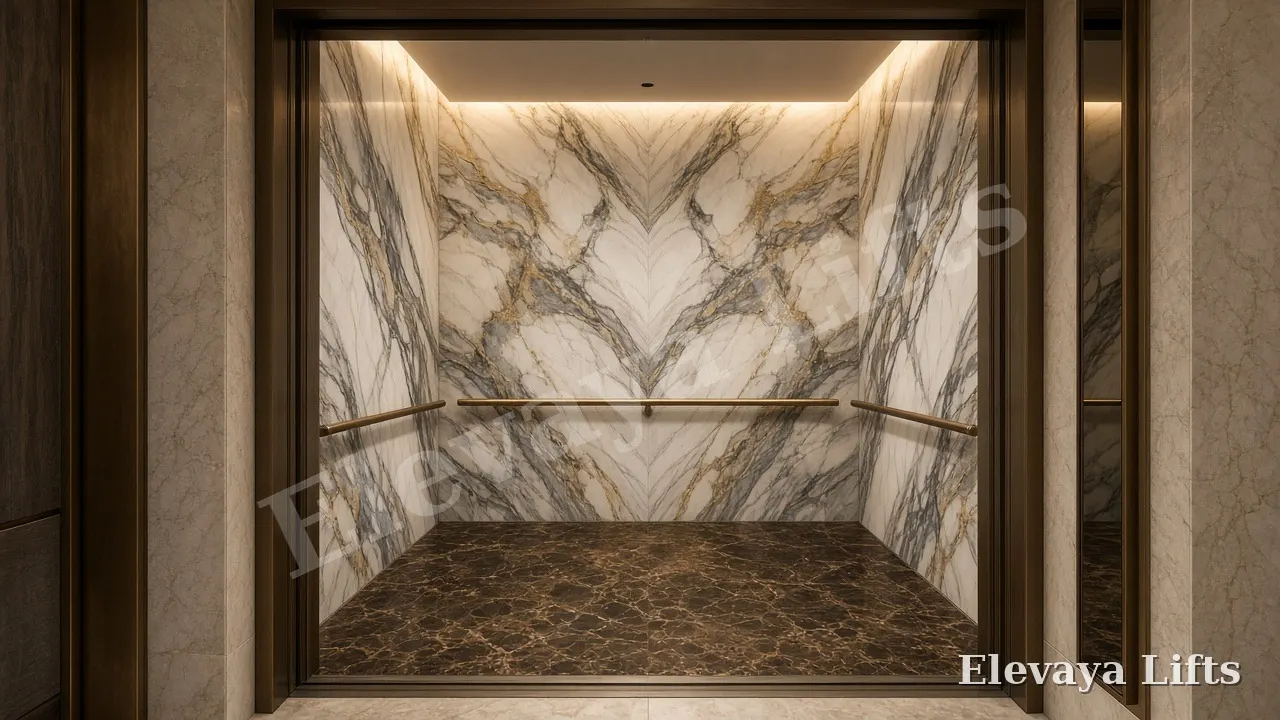
Quick answer: Luxury marble and onyx lift interiors in Dubai can go well beyond Calacatta and Carrara: Statuario and Arabescato for bright, dramatic white walls, Nero Marquina and Emperador for depth, Taj Mahal quartzite for a hard-wearing floor, and blue or green onyx, malachite, lapis lazuli or backlit agate for a feature panel. Each stone has its own weight, softness and weak points, so in a moving cabin it is chosen for where it will sit, backed and fixed to suit, and kept away from the places that take knocks. Elevaya designs, supplies, installs and maintains these cabins, and our bespoke luxury villa lifts page shows the design directions many clients start from.
Most luxury lift cabins in the Gulf begin with Calacatta. It is beautiful, and it is safe. But a palace, a villa or a penthouse often asks for something rarer: a stone with more drama, more colour or more glow, that nobody else on the street will have.
Rare stones are not interchangeable, though. A black marble, a brown marble, a quartzite and a copper mineral behave very differently on a wall that moves, vibrates and gets brushed by luggage every day. This guide takes each stone in turn: how it looks, where it belongs in a cabin, and how it should be handled for weight and wear.
Elevaya has worked on lifts in the UAE since 2019, on more than 200 projects across design, supply, installation and annual maintenance. Our overview of bespoke luxury home lifts in Dubai explains how a whole cabin is specified, and our guide to the bespoke luxury lift design process explains how a slab is sampled and approved. Here we stay with the stones themselves.
Statuario and Arabescato: the rare white marbles
Statuario and Arabescato are Italian white marbles that look richer than standard white stone: Statuario is bright white with fewer, bolder grey veins, and Arabescato carries heavier, swirling grey veining that can read as a pattern across a whole wall. Both are true marbles, so they are softer than they look and need the same care as any calcite stone.
Statuario suits a calm cabin. Its white is clean enough to sit beside platinum-tone metal or pale gold without looking yellow, and its veins are wide enough to bookmatch on a rear wall so the pattern mirrors from a centre line. It is the stone for a client who wants light and quiet rather than drama.
Arabescato is the opposite. Its veins are dense and restless, so one bookmatched panel can carry the whole cabin. Some slabs show warm, almost golden lines among the grey, which is why it pairs so well with bronze or brushed gold handrails. Too much of it on every wall can feel busy in a small space, so we often keep it to the rear and side walls and let the ceiling and door frames stay plain.
How we handle the white marbles in a cabin:
- Panels from one block, in sequence. In a cabin you see three walls at once. Slabs cut one after another from the same block keep the veins flowing; slabs from different blocks rarely match.
- Thin stone on a light backing. For walls, a thin layer of real marble bonded to a light backing panel gives the look of solid stone with far less weight. The full weight is still recorded, because it all becomes part of the car.
- Edges protected. White marble chips at its corners. Exposed edges are eased or protected with a metal trim, especially at the door return where hands and bags pass.
- Honed below, polished above. Where white marble is used on a floor, a honed or lightly textured finish hides fine scratches and feels safer underfoot than a mirror polish.
Nero Marquina, Emperador and Taj Mahal quartzite: depth and warmth
Nero Marquina and Emperador bring the darker, warmer side of rare stone into a cabin, and Taj Mahal quartzite gives a warm, pale look with more resistance to wear than marble. Each needs a different kind of care in fabrication.
Nero Marquina is a Spanish black marble with sharp white veins. It makes a striking floor, landing threshold or border, and it frames white marble beautifully. It is also honest about every mark. Polished black stone shows dust, footprints, water spots and the dull patches left by acidic cleaners far more than white stone does. Many slabs also have natural fissures that are filled and stabilised at the quarry or workshop, so we ask how a slab has been treated before it is chosen.
Emperador is a Spanish brown marble, from dark chocolate to light caramel, crossed by a fine net of paler veins. It is warm and rich under cabin lighting and suits wood, leather and bronze. That net of veins is also its weakness: Emperador is often fissured, so slabs are usually resin-filled and reinforced on the back before cutting. Thin Emperador panels need that backing, and careful handling on site, more than most marbles.
Taj Mahal quartzite is a Brazilian stone with a soft cream ground and gentle gold veining. As a quartzite it is generally harder and less sensitive to acids than marble, which makes it one of the more practical choices for a cabin floor that should still feel luxurious. It is also harder to cut and polish, so it takes more time in the workshop. Stones sold as "quartzite" vary, so we test an offcut for scratching and etching before the slab is approved.
Blue and green onyx: stone that glows, and breaks
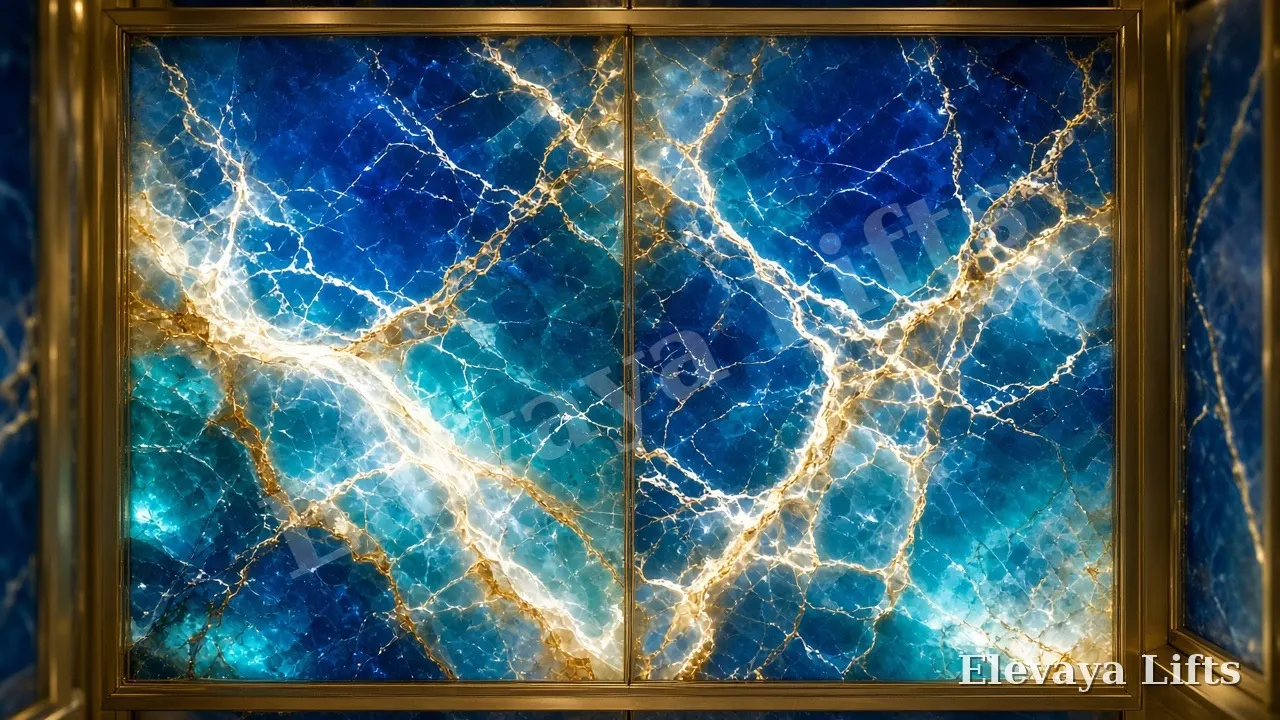
Blue and green onyx are translucent stones chosen for colour and glow, and in a lift they are always thin, backed and protected, because onyx is softer and more brittle than marble. They belong on a feature wall or ceiling panel, never on a floor.
A note on names first. The "onyx" used for walls and lighting in interiors is a banded calcite stone, sometimes called onyx marble. It is not the same as the hard, banded chalcedony that jewellers call onyx. That matters for care: interior onyx reacts to acids like marble does, and it scratches easily.
Green onyx is the better known of the two. It ranges from pale pistachio to deep emerald, often with gold or rust veining, and it turns luminous when lit from behind. Blue onyx is rarer and more theatrical. Its colour can run from teal to royal blue, with white and gold veins that look almost like light breaking through. Because strong blues are rare in natural stone, we ask the supplier to confirm in writing whether a slab's colour is natural or enhanced, and whether it has been resin-treated. Treatments are not wrong in themselves, but they change how the stone ages and how it should be cleaned.
Handling onyx for a cabin is mostly about protecting it before anyone touches it:
- Backed before it is cut. Onyx slabs are usually reinforced with resin and a mesh, or laminated to glass or a clear backing for lighting, before they are cut to panel size.
- Framed, not exposed. A slim metal frame, as in the image above, protects the edges and lets the panel be lifted out as one piece.
- Kept above the knock zone. We keep onyx above handrail height, where trolleys, suitcases and shoes cannot reach it.
- Sampled under the real light. Blue and green onyx shift colour more than honey onyx under warm or cool LEDs, so the sample is judged lit, at the colour temperature the cabin will use.
Our guide to Swarovski crystal lift cabins covers the lighting side of backlit stone in detail: even light, heat and access to the LEDs behind the panel.
Malachite, lapis lazuli and agate: the semi-precious cabin
Malachite, lapis lazuli and agate are not building stones in the usual sense; they come in small pieces, so a lift panel made from them is a crafted composite, and it is designed, fixed and cleaned like a work of art rather than a wall. Used well, they make a cabin feel like the inside of a jewellery box.
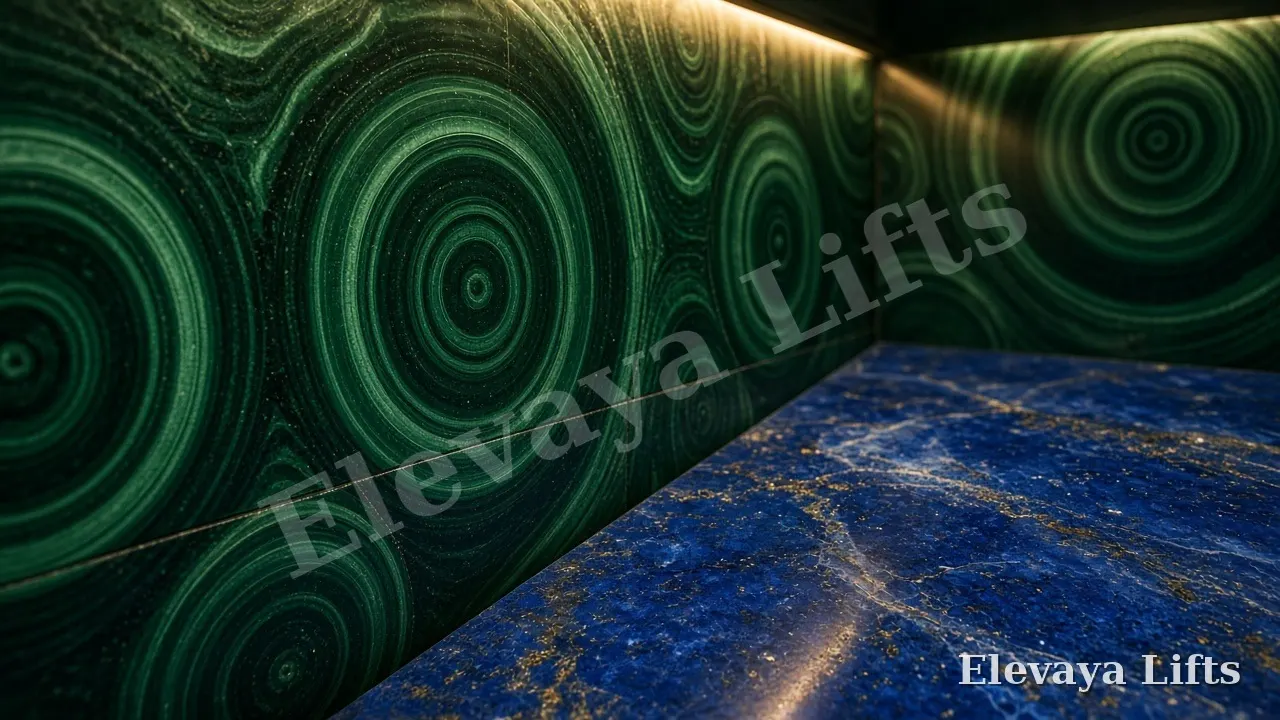
Malachite is a green copper mineral with bands and bullseye rings in every shade of green. Large flawless blocks are rare, so wall panels are usually made from thin slices, matched by hand and set on a backing so the pattern seems to flow across the surface. It is soft and sensitive to acids and heat, and it is heavier for its size than marble. On a cabin wall, we keep it to framed feature panels, protected by a metal edge, and specify the backing so the weight stays known.
Lapis lazuli is the deep blue stone of royal and religious art. The Gemological Institute of America describes lapis lazuli as a rock, an aggregate of minerals, mainly lazurite, calcite and pyrite. The pyrite gives the gold flecks; the calcite gives the white streaks. GIA lists a specific gravity of about 2.75, much like marble, so lapis is not unusually heavy. It is precious, though, and like malachite it is normally supplied as thin tiles or a veneer on a backing. A lapis floor is possible in a private villa cabin with gentle use, but we would normally set it as a central panel framed by a harder stone, and never with a slippery mirror polish.
Agate is banded chalcedony, a quartz-family material, so it is much harder than marble and resists scratching well. Its slices are small, which is why "agate panels" and other semi-precious panels, such as amethyst, rose quartz or tiger's eye, are made from many slices set in clear resin on glass or a translucent sheet. Lit from behind, the bands glow amber, white and smoky grey. The stone itself is tough; the resin around it is the softer part, so these panels sit in frames, above handrail height, with the light kept cool.
A useful reference here is GIA's study Gemstone Durability: Design to Display, published in Gems & Gemology. It notes that porous stones such as malachite and lapis lazuli may absorb cleaning solutions, which can discolour them, and it lists dye and wax as treatments for lapis. Written for jewellery, it holds just as true for a cabin panel: ask what treatment a stone has had, and clean it only as its care sheet says.
How rare stones compare in a lift cabin
The right stone for each surface depends on how it wears, how it is backed and whether it needs light behind it, so floors, lower walls and feature panels are usually given different stones. The table is a qualitative guide for planning, not a substitute for testing the actual slab.
| Stone | Look | Relative weight and handling | Wear in a cabin | Backlighting | Best place in the cabin | Care |
|---|---|---|---|---|---|---|
| Statuario | Bright white, bold grey veins | Like other marbles; thin panels on a light backing for walls | Soft; etches with acids; corners chip | No | Walls, honed floor | pH-neutral cleaner; sealed; no acids |
| Arabescato | White with dense, swirling grey and sometimes gold veins | As Statuario; cut in sequence for flowing veins | As Statuario | No | Rear and side feature walls | As Statuario |
| Nero Marquina | Black with sharp white veins | Often fissured and stabilised; handle panels flat | Shows dust, scratches and etch marks clearly | No | Floor border, landing threshold, trims | Frequent dry dusting; pH-neutral cleaner |
| Emperador | Dark to light brown with a fine net of veins | Usually resin-filled and reinforced on the back; fragile when thin | Moderate; fissures need care | No | Floor, wall panels with wood or bronze | pH-neutral cleaner; check filled fissures |
| Taj Mahal quartzite | Cream with soft gold veining | Slower to cut and polish; test the offcut | Harder and less acid-sensitive than marble | No | Floor, threshold, lower walls | Sealed; mild cleaner |
| Blue or green onyx | Translucent teal, blue or green with gold veins | Brittle; backed with mesh or glass before cutting; framed | Soft; scratches and etches | Yes | Feature wall or ceiling panel above handrail height | Soft cloth; no acids; ask about treatments |
| Malachite | Banded green rings and bullseyes | Thin slices on a backing; heavier for its size than marble | Soft; sensitive to acids and heat | No | Framed feature panel | Damp soft cloth only; no chemicals |
| Lapis lazuli | Deep blue with gold pyrite flecks | Tiles or veneer on a backing | Moderate; may be dyed or waxed | No | Feature panel, framed floor inlay | Damp soft cloth; avoid solvents and heat |
| Agate and semi-precious panels | Banded slices in amber, white, grey or pink | Slices set in resin on glass or a translucent sheet; framed | Stone is hard; resin is the softer surface | Yes | Backlit feature panel above handrail height | Soft cloth; no abrasive pads; keep light cool |
Three placement rules come out of this table:
- The floor gets the toughest stone. Taj Mahal quartzite, honed marble or a framed inlay. Sand from shoes is harder than marble and works like fine sandpaper on a polished floor.
- The knock zone gets the second toughest. The band from the floor to handrail height takes bags, trolleys and feet, so it is often finished in a harder stone, metal or timber.
- The rarest stone goes where it is seen, not touched. Onyx, malachite, lapis and agate live above the handrail, on the rear wall facing the doors, or in a ceiling panel.
Weight is planned for every option. The finished cabin, with stone, backing, adhesive, frames and fixings, is weighed on paper before anything is cut, and it has to suit the lift's design. In Dubai, the Dubai Building Code says in clause K.5.5.4 that villa elevators shall conform to sections D.5 and D.6, and the decoration is designed around those rules. For the floor, the Code's accessibility chapter (C.7.2.1.2) grades slip resistance by pendulum test value and asks the product provider to supply that data, or for the material to be tested before it is accepted. A private villa lift is not a public corridor, but it is a sensible standard to borrow for a polished stone floor.
Caring for rare stone in a Dubai lift, and adding it to an existing one
Rare stone stays beautiful in a lift when it is cleaned with the right products, kept free of sand and checked for loose panels and failing light at every service visit. A great deal of damage to stone in lifts comes from the wrong cleaner rather than from age.
A simple routine for the household or building team:
- Dry dust first. A soft dry cloth or microfibre mop removes the fine sand that scratches marble and dulls black stone.
- Use pH-neutral stone cleaner. Vinegar, lemon, bleach, many bathroom sprays and general glass cleaners can etch marble and onyx, and can stain porous malachite and lapis.
- Wipe spills quickly. Coffee, juice and perfume are acidic. On white Statuario they leave dull rings; on Nero Marquina they leave pale ones.
- Mats at the landing. A good entrance mat on the ground floor saves more stone than any sealer.
- Reseal on a schedule. Marble, onyx and quartzite are sealed after fitting and resealed as the care sheet recommends.
Under an annual maintenance contract, our technicians add the stone to each visit: panels that have moved or started to rattle, cracked or chipped edges, frames and fixings, and the LEDs behind onyx and agate. Problems found early are usually small. See our villa and home lift maintenance page for how visits work.
Rare stone can also be added to an existing lift. A rear feature panel in Arabescato, a framed onyx panel or a lapis inlay is often the upgrade that changes a cabin most for the least added weight. We survey the lift first, check the load allowance and the condition of the equipment, and then design the stone around what the lift can carry. Where the drive or doors are also due for work, the stone can be planned alongside lift modernization; where only the interior changes, it is a cabin refurbishment. Our earlier guide to luxury lift interiors in marble, bronze and wood covers the classic finishes, and the lift cabin wall panels guide explains how panels are built and fixed.
Elevaya designs and installs some of the world's most expensive bespoke home lifts, customised with diamonds, Swarovski crystals, gold, platinum and precious metals, and finished in the world's most expensive marbles. Choosing the stone is one of the most personal parts of that work, and one of the most rewarding. Explore the design directions on our bespoke luxury villa lifts page, or see how gold lift doors and luxury lift panels frame a stone cabin.
Related Elevaya guides
Continue planning with these related Elevaya guides:
- Bespoke luxury lift design process in Dubai: from brief and mood board to material samples, 3D renders, a full-scale mock-up, fabrication, installation, handover and AMC care of precious finishes.
- Gold lift doors and luxury lift panels in Dubai: gold and platinum landing doors and frames, engraved or monogrammed COP and LOP panels, jewelled push buttons, handrails, and how to make them last.
- Swarovski crystal lift cabins in Dubai: crystal, onyx and light: crystal ceilings and walls, backlit onyx, mirrors, cabin lighting levels, and how to keep crystal secure and serviceable in a moving cabin.
- Bespoke luxury home lifts in Dubai: gold, gems and rare marble: what can be customised, how gold, platinum, diamonds, crystal and rare marble are specified, weight, safety and care.
- Luxury elevator interiors in the UAE: marble, bronze and wood: weight, fire performance and cleaning of premium cabin finishes.
- Elevator cabin design trends in the UAE for 2026: finishes, COP/LOP panels, LED lighting and glass cabins.
- Lift installation in Dubai: step-by-step process: survey, shaft, pit and headroom prep, supply and delivery, installation sequence, testing, EIAC certification and handover.
- Dubai villa lift permit: which NOC and authority you need: the developer NOC, which authority approves (DM, DDA or Trakhees), the steps and the documents.
- Glass and panoramic villa lifts in Dubai: 2026 planning guide: placement, glazing, heat control, approvals and AMC care.
- Glass villa lift in Dubai: footprint, heat and cost factors: shaft vs shaftless, laminated glass, cabin cooling, hydraulic vs MRL vs platform.
- Lift COP and LOP panels in Dubai: what is on each panel, DBC button heights, Braille and intercom rules, common faults, repair vs replacement.
- Lift upgrades in Dubai: what to upgrade first: rescue devices for power cuts, door light curtains, VVVF and energy saving, cabin refresh, alarms, upgrade vs modernization.
- Elevator modernization in Dubai: signs, scope and standards: when to modernize, controller and door upgrades, EN 81-20/80, downtime and cost factors.
- Dubai annual lift inspection certificate: who issues it, 12-month and 6-month inspection rules and how to prepare.
- Elevator AMC cost in Dubai: villa owners' guide: non-comprehensive from AED 2,500 for G+1, visits, callouts and parts rules.
- Lift maintenance checklist for Dubai: monthly service visit: what each monthly visit should check on doors, ride, machine and brake, alarm, car top and pit, the log book and villa lifts.
- How to choose the best lift company in Dubai: buyer's checklist: licences, AMC terms, written response times, parts, references and red flags.
- Hydraulic lift problems in Dubai: leaks, sinking and heat: oil leaks, a car that sinks or re-levels, slow or jerky rides, summer overheating, noise and safe owner checks.
- Lift and elevator supply in the UAE: buyer's guide: supply-only vs supply and installation, what to specify, what a supply quote must include and red flags.
- Export lifts and elevator spare parts from the UAE: export documents, HS codes, certificate of origin and the steps from enquiry to shipment.
- Luxury lift cabin upgrade in Dubai: metals and finishes: re-dressing an existing lift with rose gold and champagne PVD, brass, bronze, copper, hammered and etched metal, black titanium, Macassar ebony and burl walnut veneers, leather, shagreen and gold leaf, and how weight, fire rules and downtime are handled.
- Luxury lift modernization ideas in the UAE: pairing a modernization with smart glass, fibre-optic starry ceilings, antiqued mirror, mother-of-pearl, marquetry, Murano-style glass, mashrabiya and Arabic calligraphy, touchless, fingerprint and touchscreen controls, cabin music, scent, filtered air and near-silent doors.
- What is the best luxury home elevator brand for a Palm Jumeirah or Emirates Hills villa?: how to compare brands neutrally by drive type, local service and parts, BS EN 81 or ASME A17 compliance, warranty, AMC, design flexibility and heat suitability.
- How much does a bespoke glass panoramic villa lift cost in Dubai?: what an installed AED quote should cover, the choices that move the price, confirmed Elevaya price points and the yearly cost of ownership.
- Can you install a luxury elevator in an already built Dubai villa without a concrete shaft or deep pit?: self-supporting structures, shallow-pit and pitless options, EN 81-21 and EN 81-41, positions in finished villas, approvals and cost.
- Which is quieter and smoother for a luxury villa: screw-driven, hydraulic or gearless traction?: how each drive sounds and rides in a Dubai villa, where noise really comes from, heat effects and how to test a lift before you buy.
Related Elevaya services and guides: Bespoke luxury villa lifts, Luxury lift design, Home lifts, Lift cabin wall panels, Elevator ceiling lighting, Villa lift dimensions and planning, Home lift for an existing villa, Lift installation, Cabin refurbishment, Lift modernization, Villa and home lift maintenance, Projects, Contact Elevaya.
FAQ
Which rare stone is most practical for a lift floor?
Taj Mahal quartzite is usually the most practical of the rare stones, because it is generally harder and less sensitive to acids than marble. A honed Statuario or Emperador floor also works well. Malachite, onyx and agate panels are best kept off the floor, and lapis is better as a framed inlay than a whole floor.
Are malachite and lapis lazuli too delicate for a lift cabin?
Not if they are placed and protected well. Both are softer and more porous than most building stones, so we use them as framed feature panels above handrail height, on a proper backing, and give the household a care sheet that rules out acidic and chemical cleaners.
Is blue onyx natural, and does it matter?
Some blue onyx is natural and some is colour-enhanced or resin-treated. It matters because treatments change how the stone ages and how it should be cleaned. We ask the supplier to confirm in writing what has been done to the slab before it is approved.
Can agate or semi-precious panels be backlit in a lift?
Yes. Agate and other semi-precious panels are made from slices set in clear resin on glass or a translucent sheet, which suits backlighting. The panel sits in a metal frame above handrail height, the LEDs are kept cool, and the panel or the light behind it must come out for service.
Why has my marble lift floor gone dull near the doors?
Usually sand and the wrong cleaner. Fine sand carried in on shoes scratches polished marble, and acidic cleaners etch it, and both concentrate where people step in and out. A good mat at the landing, daily dry dusting, pH-neutral cleaner and, where needed, professional honing and re-polishing bring it back.
Choose your stone with Elevaya
If you are planning a lift for a palace, villa or penthouse and want a stone that nobody else has, we would be glad to help you choose it, sample it and build it safely into the cabin. Call or WhatsApp +971 58 584 4685, explore our bespoke luxury villa lifts or contact Elevaya to arrange a private design consultation.