Elevaya journal
Glass and Panoramic Villa Lifts in Dubai: A Planning Guide for 2026
Planning a glass or panoramic villa lift in Dubai? Shaft options, glazing, heat control, approvals, costs drivers and AMC care, explained by Elevaya.
Published · Updated · Elevaya Lifts
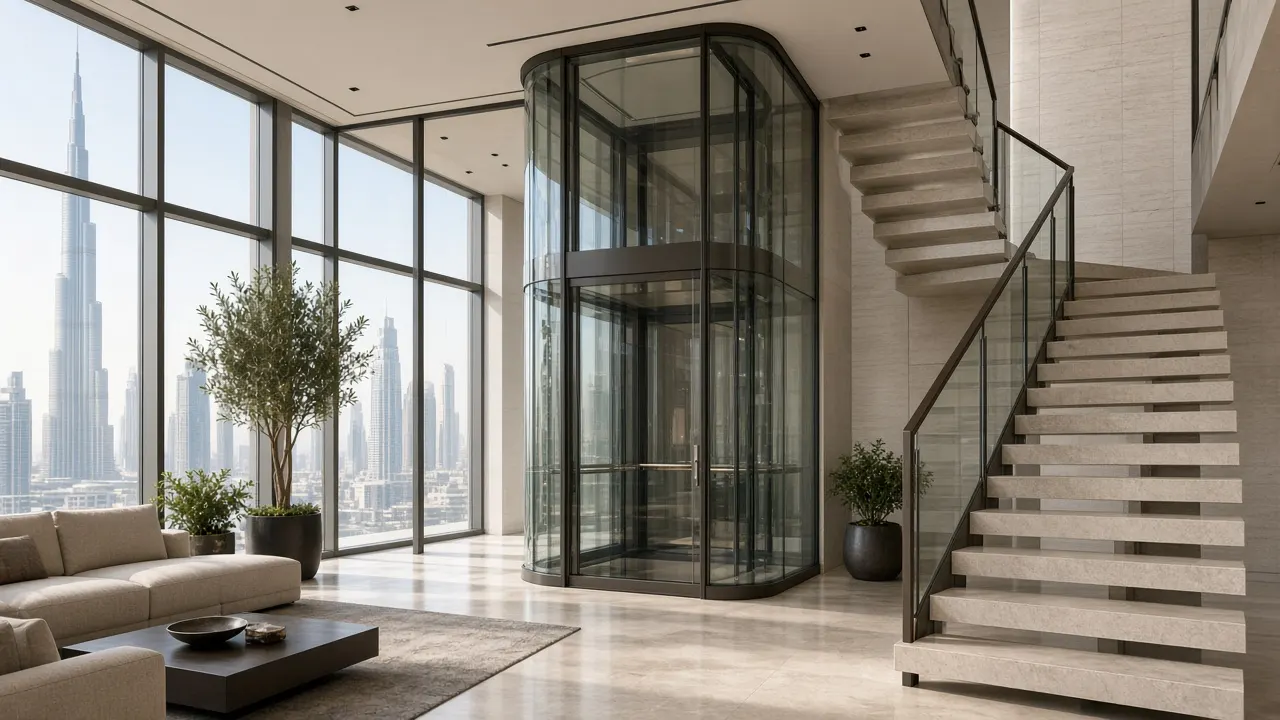
Quick answer: A panoramic (glass) villa lift in Dubai is a home lift whose cabin and often its shaft are glazed with laminated safety glass, so it becomes a visible architectural feature beside the staircase or in a double-height entrance. Getting one right depends on five things: where it sits in the plan, the shaft type (glass, partly glazed or masonry with a glass cabin), heat and sun control, the approvals your community and authority require, and a maintenance (AMC) plan that keeps glass, doors and drives clean and safe in UAE dust and heat.
Glass lifts used to be something you saw in malls and hotel atriums. In Dubai villas they are now one of the most requested features in new builds and major renovations, because they do something a closed lift cannot: they add light and movement to the house instead of hiding behind a wall.
Elevaya has designed, supplied and installed lifts in the UAE since 2019, across more than 200 projects, and maintains them under annual maintenance contracts (AMC). This guide explains how panoramic villa lifts work, what to decide early, and where owners most often get caught out. If you are still choosing between lift types, start with our panoramic lifts and home lifts pages.
What Counts as a "Panoramic" Villa Lift?
The terms get used loosely, so it helps to separate three configurations:
- Glass cabin in a glass shaft. The full panoramic look. The shaft is a steel or aluminium frame with laminated glass infill, or a near-frameless structure with minimal mullions. Everything is visible, including the counterweight or drive if it is not carefully concealed.
- Glass cabin in a partly glazed shaft. One or two shaft faces are glass (usually the side facing the staircase or living area) and the rest is masonry or panelled. This is often the best balance of view, privacy and heat control.
- Glass-fronted cabin in a closed shaft with a glass landing door. The least "panoramic", but it still brings light into the lobby and suits villas where structure or privacy rules out an open shaft.
All three can look excellent. The right one depends on the floor plan, the sun, and how much of the machinery you are happy to see.
Where to Place a Glass Lift in a Villa
Beside or inside the staircase void
The most common Dubai placement is alongside the main staircase, either next to it or in the stairwell void. The lift and stair read as one sculptural element, and the shaft footprint is absorbed into space that already exists. Check early that the void is big enough for the shaft plus clearances, and that the stair handrail and the lift entrance do not clash.
In a double-height entrance
A glass lift standing in a double-height entrance hall is a strong statement. It works best when the lift faces the main door and the ground-floor landing is approached across open floor, not tucked behind a column. Think about what you will see through the glass: a plain concrete wall behind the shaft undermines the whole effect, so plan a feature wall, stone cladding or planting.
Against an external façade
Some owners want the lift on an outside wall with views over a garden or the water. This is possible but it is the hardest case in the UAE climate. Direct summer sun on a glass shaft can push cabin temperatures well beyond comfort without shading, high-performance glass and ventilation. If the lift will be outside the building envelope, look at our outdoor lifts options rather than treating it as an indoor lift with extra glass.
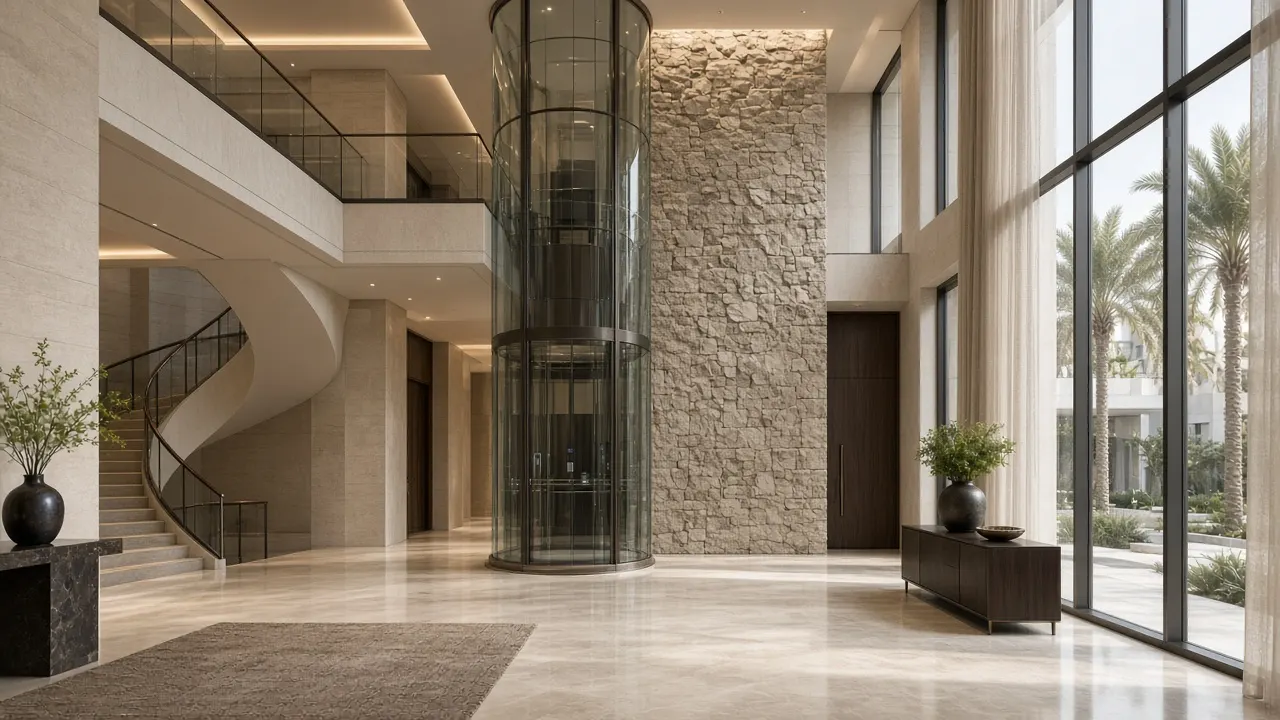
In a double-height entrance, plan what is seen behind the glass.
Drive Options for Glass Villa Lifts
The drive affects how "clean" the shaft looks, how much space you need above and below, and how quiet the ride is.
- Hydraulic drives are common in villas because the pit and headroom can be modest and the machinery sits in a small cabinet nearby. The ram can be visible in a glass shaft, so its position matters. See hydraulic lifts.
- Traction / machine-room-less (MRL) drives suit taller villas and give a very smooth ride. In a glass shaft, the ropes and counterweight need careful placement or screening. See traction and MRL lifts.
- Compact home-lift systems with reduced pit and headroom are useful in existing villas where you cannot dig deep. Our guide on adding a home lift to an existing villa covers the structural questions.
Whatever the drive, ask your designer to show you a section drawing of the shaft with every visible component drawn in. A glass shaft is honest: what is in the drawing is what you will see every day.
Glass Specification: Safety First, Then Looks
Glass in a lift is a safety component, not a decorative panel. A few principles apply to every panoramic villa lift:
- Laminated safety glass is used for cabin walls and shaft panels, so that if a pane cracks, it stays in place.
- Thickness and fixing are engineered to the panel size and the loads the glass must resist; this is not something to value-engineer.
- Low-iron (extra-clear) glass avoids the green tint of standard glass and is worth it when the glass is the main feature.
- Solar-control or tinted interlayers reduce heat gain where the shaft gets direct sun.
- Edge protection and handrails inside the cabin keep passengers away from glass edges and help children and older users.
Local requirements for building systems, including glazing and lifts, sit within the framework of the Dubai Building Code published by Dubai Municipality, alongside any master-developer or community rules. Your lift contractor and consultant should confirm which requirements apply to your plot before the design is frozen.
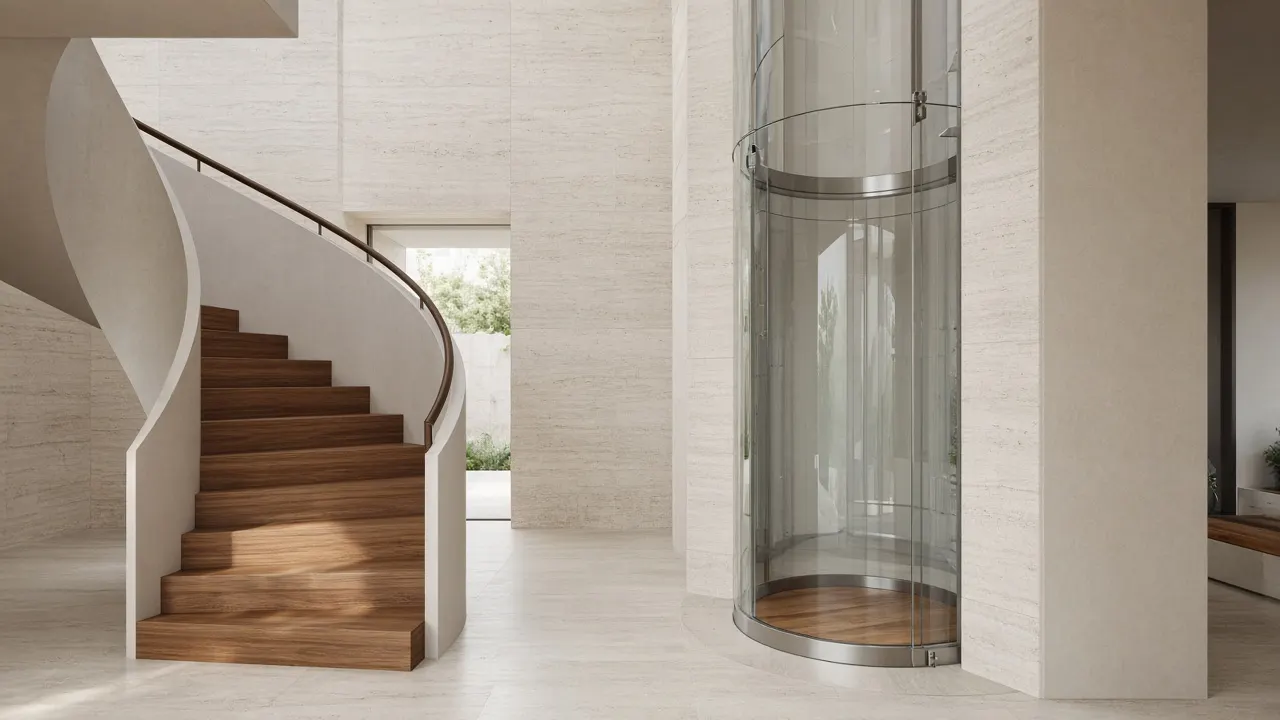
Minimal framing keeps the focus on stone, wood and light.
Designing for UAE Heat and Dust
This is where a glass lift in Dubai differs from one in Europe.
Heat
Glass lets sunlight in. In a stairwell lit by a skylight or a west-facing window, the shaft can act like a greenhouse. Good practice includes:
- Keeping the shaft inside the air-conditioned envelope whenever possible.
- Using solar-control glass on any face that sees direct sun.
- Providing cabin ventilation or a dedicated cabin fan, and making sure the drive cabinet or machine space is cooled.
- Avoiding dark cabin floors in sunny shafts, which absorb heat.
Dust
Fine dust settles on every horizontal surface and shows instantly on glass. Plan for:
- Door sills and guide shoes that can be cleaned easily.
- Shaft access for cleaning the outside of the cabin glass and the inside of the shaft glass (this is often forgotten).
- A cleaning routine in your maintenance plan, not just mechanical checks.
Cabin Interior: Let the Glass Lead
With a panoramic lift, the view is the interior. Keep the cabin itself quiet:
- A slim stainless steel or bronze-tone frame.
- A stone or engineered-stone floor that matches the landing floor, so the lift feels part of the house. Our post on luxury elevator interiors: marble, bronze and wood goes deeper into materials.
- A small, flush control panel on the one solid wall or on a glass-mounted strip.
- Soft, warm ceiling lighting that does not reflect harshly off the glass at night. The 2026 cabin design trends guide covers lighting colour temperatures in more detail.
Night-time reflections are the most common surprise. A brightly lit glass cabin in a dark stairwell turns every wall into a mirror. Dimmable lighting and some light in the surrounding space solve this.
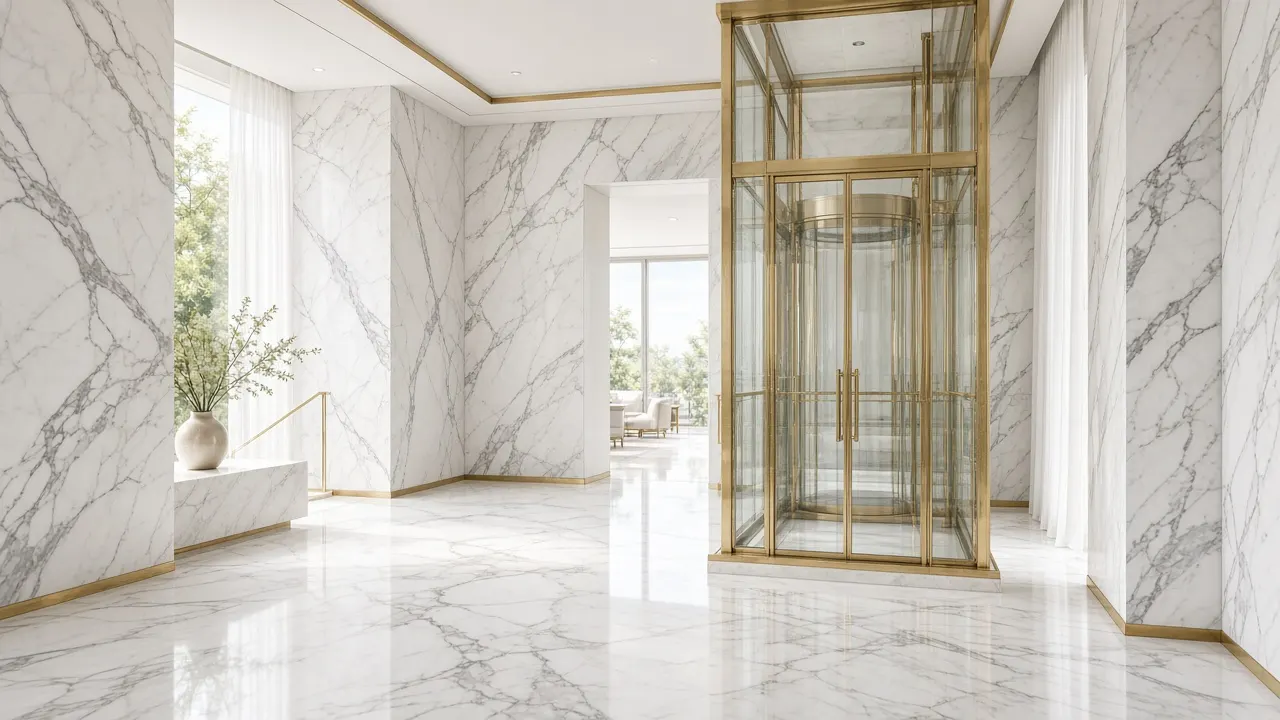
Matching the cabin floor to the landing stone makes the lift feel built-in.
Approvals and Timeline
Every project is different, but a typical villa sequence looks like this:
- Concept and feasibility: confirm space, structure and drive type; produce layout and section drawings.
- Community and authority approvals: many Dubai communities require a no-objection certificate (NOC) from the master developer before structural or façade changes, and works must follow the applicable building regulations.
- Detailed design and glass engineering.
- Manufacture and supply.
- Civil works: pit, openings, structural supports and power.
- Installation, commissioning and testing, followed by handover. Our installation service page explains how we run this stage.
- AMC start, so the lift is maintained from day one.
Glass panels have their own lead time and must be measured precisely after civil works, so build that into the programme.
What Drives the Cost of a Glass Villa Lift?
We do not publish fixed prices because every villa is different, but these factors move the budget the most:
- Glass shaft vs partly glazed vs closed shaft.
- Number of stops and travel height.
- Drive type and whether a pit can be dug.
- Glass type (low-iron, solar control, curved or very large panes).
- Cabin finishes and door type.
- Civil works in an existing villa.
For a fuller breakdown, see our home lift cost guide for the UAE.
Maintenance: Keeping a Glass Lift Looking New
A panoramic lift is judged by how it looks, so maintenance has two jobs: safety and appearance. A good home lift maintenance plan for a glass lift should include:
- Scheduled safety checks of doors, brakes, safety gear and controls.
- Inspection of glass panels and fixings for chips, cracks or loosening.
- Cleaning of door tracks and sills, which collect dust quickly in the UAE.
- Checks on cabin ventilation and the drive cabinet temperature.
- Clear call-out terms for breakdowns.
2026 update: footprint, shaftless structures and heat
Updated 21 October 2026. For a deeper look at the technical side of the decision, read our new guide, Glass villa lift in Dubai: footprint, heat, glazing and cost factors. It compares framed glass shafts with self-supporting ("shaftless") glass lifts and platform-style home lifts, lists everything that adds to the footprint (pit, headroom, door swing and landing space), explains laminated vs tempered glass and cabin cooling for UAE summers, and sets out the cost factors to compare between quotations.
Two points to add to the approvals section above. The Dubai Building Code's villa chapter (Part K) requires any villa elevator to conform to sections D.5 and D.6 of Part D, so one suite of standards, ASME A17 or BS EN 81, must be chosen for the whole project and the energy-saving provisions apply. Part C of the Code also recommends that panoramic elevators include a full-height opaque wall or corner section 800 mm wide.
Key Takeaways
- Decide early between a full glass shaft, a partly glazed shaft or a closed shaft with glass features.
- Place the lift where the view through it is worth seeing, and keep it inside the cooled envelope if you can.
- Treat glass as a safety component: laminated, properly fixed and engineered.
- Plan heat control, dust cleaning and night lighting from the start.
- Budget for approvals and glass lead times, and start an AMC at handover.
Ready to explore a panoramic lift for your villa? Contact Elevaya with your floor plans and we will advise on layout and drive options. For how glass lifts also feature in commercial spaces, read our guide to escalator design and maintenance for UAE malls.
Related Elevaya guides
Continue planning with these related Elevaya guides:
- Elevator cabin design trends in the UAE for 2026: finishes, COP/LOP panels, LED lighting and glass cabins.
- Luxury elevator interiors in the UAE: marble, bronze and wood: weight, fire performance and cleaning of premium cabin finishes.
- Escalator design and maintenance for UAE malls: layout, balustrades, dust and heat, AMC and modernization.
- Elevator and escalator speeds in UAE buildings: rated lift speed by travel height and 0.5 vs 0.65 m/s escalators.
- Elevator AMC cost in Dubai: villa owners' guide: non-comprehensive from AED 2,500 for G+1, visits, callouts and parts rules.
- How to choose the best lift company in Dubai: buyer's checklist: licences, AMC terms, written response times, parts, references and red flags.
- Elevator modernization in Dubai: signs, scope and standards: when to modernize, controller and door upgrades, EN 81-20/80, downtime and cost factors.
- Glass villa lift in Dubai: footprint, heat and cost factors: shaft vs shaftless, laminated glass, cabin cooling, hydraulic vs MRL vs platform.
- Lift speed by building height in Dubai towers: DBC travel-time formula, worked m/s examples, waiting times, DHA hospital and Trakhees rules.
- Escalator faults and repairs in Dubai: why escalators stop, safety-device trips, handrail and step chain wear, sand and heat, repair vs modernization.
- Lift installation in Dubai: step-by-step process: survey, shaft, pit and headroom prep, supply and delivery, installation sequence, testing, EIAC certification and handover.
- Lift and elevator supply in the UAE: buyer's guide: supply-only vs supply and installation, what to specify, what a supply quote must include, BS EN 81 / ASME A17, EIAC certification, escalator supply and red flags.
- Lift maintenance checklist for Dubai: monthly service visit: what each monthly visit should check on doors, ride, machine and brake, alarm, car top and pit, the log book, maintenance vs inspection, villa lifts and an escalator checklist.
- Lift COP and LOP panels in Dubai: what is on each panel, DBC button heights, Braille and intercom rules, common faults, repair vs replacement.
- Lift upgrades in Dubai: what to upgrade first: rescue devices for power cuts, door light curtains, VVVF and energy saving, cabin refresh, alarms, EN 81-80, upgrade vs modernization.
- Common lift problems in Dubai: causes and fixes: stuck lifts, doors not closing, jerky rides, noise and summer heat trips, safe owner checks, trapped-passenger steps, repairs and certification.
- Escalator modernization in the UAE: signs, scope and compliance: when to modernize, modernize vs replace, controller and drive, steps, chain and handrail, energy features, phased mall works and the EIAC major inspection.
- Escalator installation in the UAE: step-by-step process: survey and selection, pit and truss supports, rigging, alignment, controller, safety devices, testing, EIAC inspection and handover.
Related Elevaya services: Panoramic lifts, Home and villa lifts, Lift installation, Home lift maintenance.
FAQ
Can a glass lift be added to an existing villa in Dubai?
Yes, in many cases. The main questions are whether there is space in the stair void or another location for the shaft, whether a pit can be formed or a low-pit system used, and whether the community requires an NOC. A site survey and structural review come first.
Does a glass lift get hot in the UAE summer?
It can if the shaft receives direct sun. Keeping the shaft inside the air-conditioned area, using solar-control glass, and providing cabin ventilation keep temperatures comfortable.
Is a panoramic lift safe for children and elderly users?
When designed correctly, yes. Laminated safety glass, protected glass edges, handrails, door safety sensors and regular maintenance are standard measures. Supervision rules for young children apply as with any lift.
How often should a villa glass lift be serviced?
Follow the manufacturer's schedule and your AMC terms; most home lifts are serviced at regular scheduled intervals, with extra cleaning attention for glass and door sills in dusty months.
Which is better for a glass villa lift, hydraulic or traction?
Hydraulic often suits low-rise villas with limited headroom; traction or MRL suits taller villas and very smooth rides. The best choice depends on travel height, pit depth and how visible the machinery will be.