Elevaya journal
Swarovski Crystal Lift Cabins in Dubai: Crystal Ceilings, Backlit Onyx, Mirrors and Lighting
Swarovski crystal lift cabins in Dubai: crystal ceilings, backlit onyx, mirrors and lighting, and how to keep crystal secure and serviceable.
Published · Updated · Elevaya Lifts
Quick answer: A Swarovski crystal lift cabin works when the crystal, the light and the mirrors are designed as one system and the crystal is fixed for a room that moves. In Dubai villas that usually means a recessed crystal ceiling or framed crystal borders, backlit onyx or translucent stone on one or two walls, a mirror that opens up the space, and warm, glare-free LED lighting. Every crystal module should be mechanically retained rather than held by glue alone, every light source and driver should be reachable without taking the cabin apart, and the emergency lighting, ventilation, alarm and controls must keep working exactly as the lift was designed. Elevaya designs, supplies and installs these cabins for new and existing villa lifts. See our bespoke luxury villa lifts collection, especially the Crystal Signature and Platinum & Onyx directions.
A lift cabin is a strange place to put crystal. It is a small box, it moves up and down all day, its doors open and close hundreds of times a week, and people lean on its walls with shopping, luggage and children. It also has almost no natural light, so whatever you see in there is entirely down to the lighting you choose.
That is exactly why crystal can look so good in a lift. In a closed, controlled space, a well-lit crystal ceiling or a glowing onyx wall has nothing to compete with. Done badly, the same cabin feels like a mirrored disco box with a hot ceiling and a rattle you can hear on every trip.
Elevaya has worked on lifts in the UAE since 2019, on more than 200 projects across design, supply, installation and annual maintenance. Our overview of bespoke luxury home lifts in Dubai covers the full palette of gold, platinum, diamonds and rare marble. This guide goes deeper into one corner of it: crystal and light. How crystal ceilings and walls are built, how backlit onyx works, where mirrors help and where they hurt, how bright a cabin should be, and how to keep every crystal secure and serviceable for years in a cabin that never stops moving.
Why crystal and lighting have to be designed together
Crystal has no sparkle of its own. It only returns the light you give it, so the light source, its angle and its colour decide whether a crystal cabin looks rich or flat. Clients often choose the crystal first and leave lighting to the end. We do it the other way round.
A few things we settle early:
- Where the light comes from. Light grazing across faceted crystal from the side or from a narrow cove gives the most life. Light shining straight through crystal from behind tends to wash it out.
- Colour temperature. Warm white flatters gold, onyx and skin tones. Cooler white makes crystal look icy and can make honey onyx look green. Most of our crystal cabins sit in the warm range, and we confirm it on a sample under the actual LEDs.
- How many layers. A good cabin has at least two: a general light so people can see the controls and each other, and a feature light for the crystal or stone. Mixing them on one circuit makes it impossible to get both right.
- What is reflected. In a mirrored cabin every light point appears two or three times. That can be lovely, or it can put a bright LED straight into a passenger's eye from three directions.
Crystal ceilings: recessed, framed and canopy designs
For a moving cabin the safest and most striking crystal ceiling is one where the crystals sit inside a recessed tray or framed canopy, lit from the edge, rather than hanging below the ceiling line. There are three ways we usually approach it:
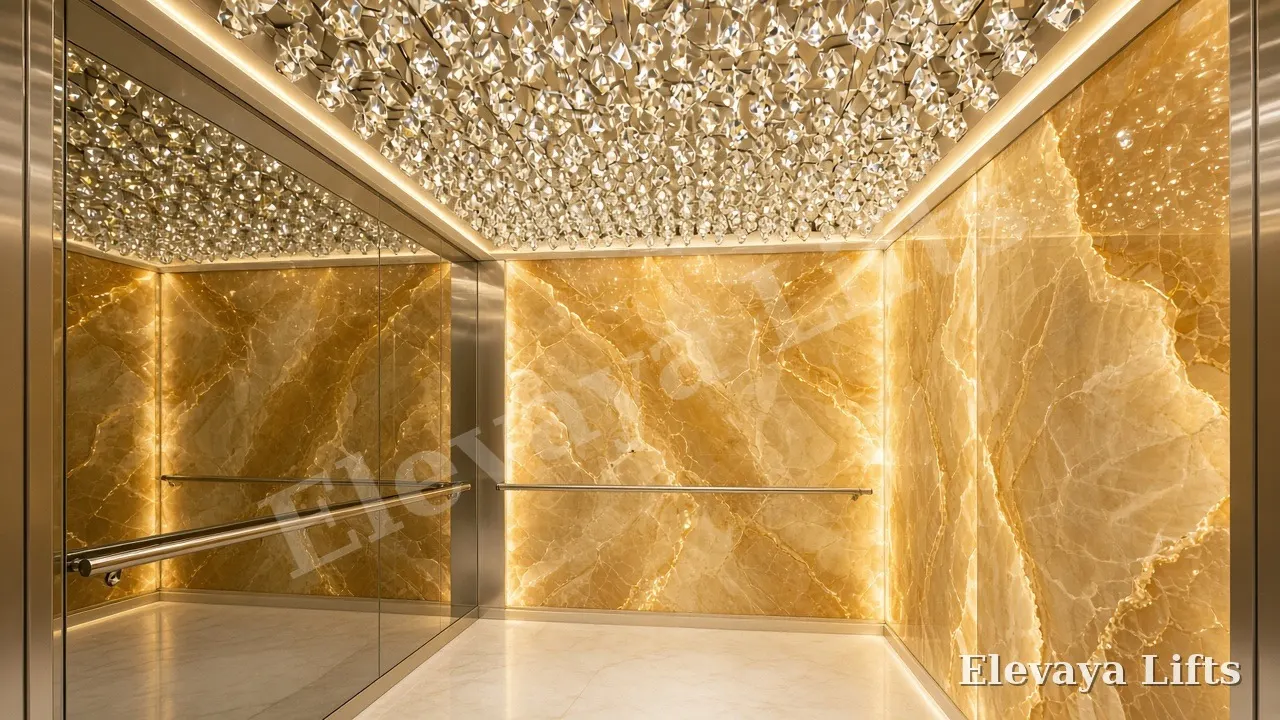
- Full recessed field. A dense field of faceted crystals set into a shallow tray across the whole ceiling, with cove lighting around the edge. It reads as one glittering surface and gives the most drama.
- Framed canopy. A round or oval crystal panel set into a plain ceiling, with a ring of light around it. Calmer, and easier to service, because the crystal is one removable module.
- Short drops within the recess. If a client loves the look of hanging crystal, drops can work when they are short, captive and kept within the depth of the ceiling recess, so they do not swing into anyone's head or eat into the cabin's height. A full chandelier, in our view, does not belong in a lift.
Whatever the style, the ceiling has jobs to do beyond looking good. Ventilation openings, the emergency light, any camera or speaker and the access to the car top all have to be planned into the design from the start, not cut in afterwards.
Crystal on walls: borders, columns and feature panels
On walls, crystal lasts longest where people cannot knock it: framing a stone panel, running in a vertical column beside a mirror, or set behind a protective edge, rather than at hip height where bags and elbows land. The common wall details are:
- Crystal borders around a backlit onyx or marble panel, which outline the stone and catch light from the panel itself.
- Vertical crystal columns in the corners or beside the mirror, where they read from the doorway and stay out of the way.
- Full crystal feature panels, which are dramatic but best kept to the rear wall above handrail height.
Where a client asks for Swarovski crystal, we record the agreed product references and the supply source in the material schedule, so there is never a question later about what was fitted or where a replacement comes from. Elevaya is not affiliated with Swarovski; we specify and fit the crystal the client chooses through an agreed supply route.
Backlit onyx and translucent stone
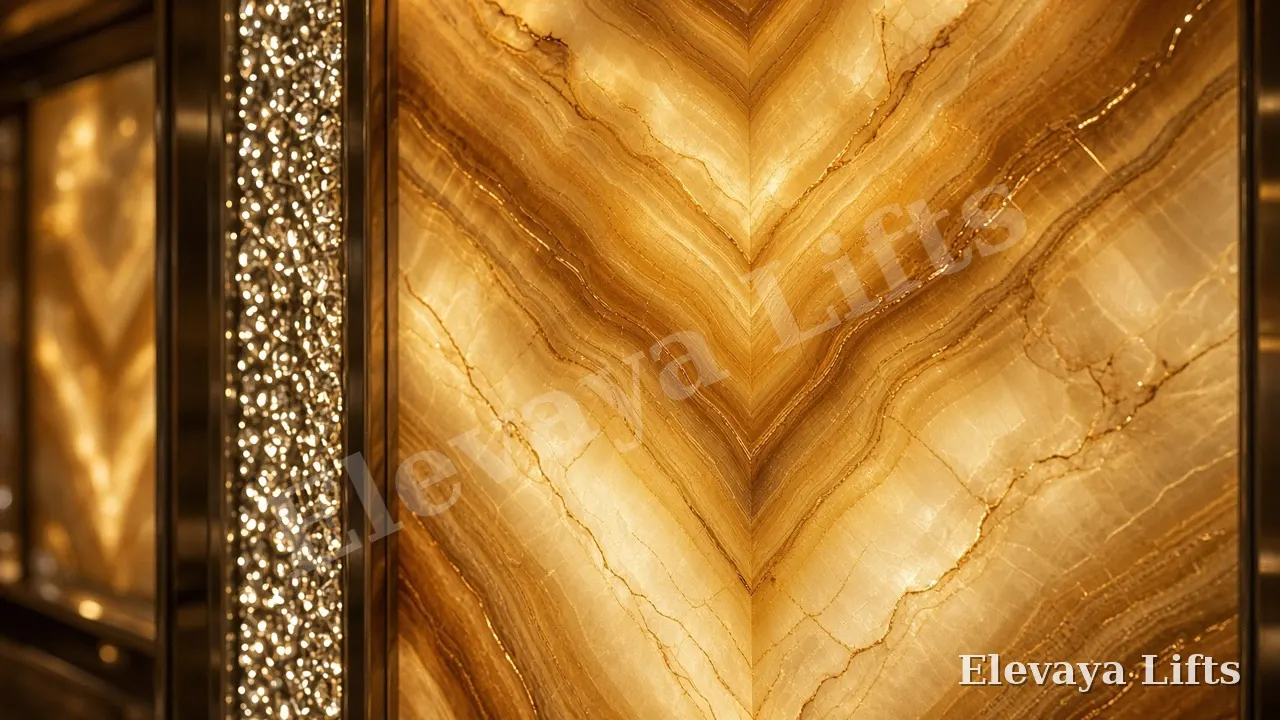
Onyx is one of the few stones that glows when lit from behind, which is why it pairs so naturally with crystal, but in a lift it has to be thin, backed, evenly lit and kept cool. It is also more fragile than most marbles, so it needs more care in the build.
What makes backlit onyx work in a cabin:
- The right slab. Honey, white, green and gold onyx all behave differently under light. We choose the actual slab, check the vein layout and, where it suits, bookmatch two pieces so the pattern mirrors across the wall.
- A reinforced, lightweight build. Translucent stone for lighting is cut thin and laminated to a clear or translucent backing, which adds strength and reduces weight. That matters, because every kilogram added to the cabin has to be part of the lift's engineering.
- Even light. An LED light panel or edge-lit diffuser behind the stone, set at a distance that avoids hot spots. Uneven light shows every LED as a bright dot.
- Low heat. LED panels run cool, but a sealed box behind stone in a Dubai summer still needs thought. The drivers sit somewhere ventilated and reachable, not buried behind the stone.
- Access. The stone panel or the light behind it must come out without damage, because LED strips and drivers eventually fail and someone will have to change them.
Green onyx with gold veining, as in a corner beside a crystal column, is a striking alternative to the familiar honey tones. It is also less forgiving of cool white light, so it is always sampled under the lighting it will live with.
Mirrors: making a small cabin feel bigger without the funhouse effect
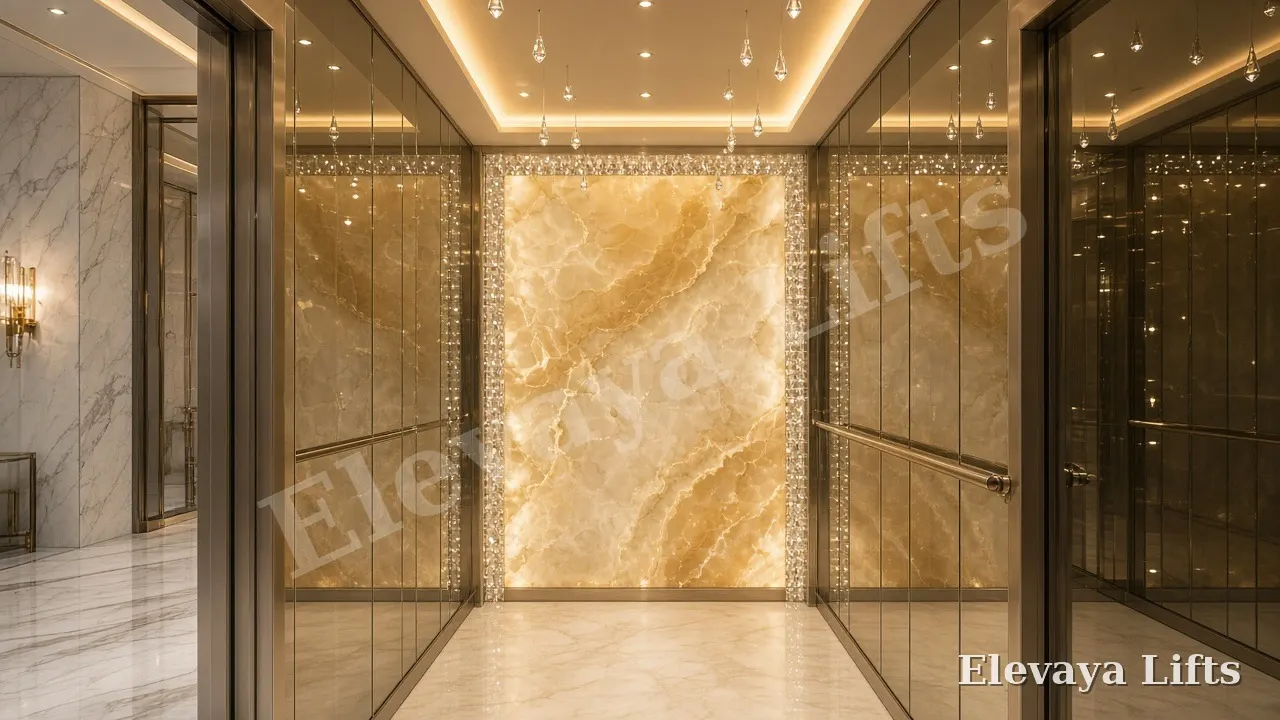
A single well-placed mirror makes a villa lift feel larger and calmer; mirrors on every wall create endless reflections, multiply glare and show every fingerprint. In most crystal cabins we use one mirrored side wall, or a rear mirror above the handrail, and keep the other surfaces in stone or metal.
Some practical points:
- Champagne or bronze-tinted mirror softens the reflection and suits warm lighting, gold and onyx. Clear silver mirror works with platinum and white stone.
- Safety first. Mirror and glass in a cabin should be a safety product, laminated or safety-backed so that if it cracks it stays in place, and fixed in a frame or channel rather than only glued.
- Placement for use, not just looks. The Dubai Building Code's accessible elevator requirements (clause C.5.9.3.2 item d) say that where a wheelchair user cannot turn around inside the lift, a mirror shall be installed to help them reverse out, with its size and position chosen to be as non-visually distracting as possible. Even in a private villa, that is a sensible way to think about where a mirror goes.
- Reflections of lights. We check, with the lighting layout, what each mirror will reflect. A crystal ceiling reflected once looks generous. A row of downlights reflected into the eyes of the person standing at the controls does not.
How bright should a crystal lift cabin be?
Bright enough that everyone can read the buttons and see their footing, with the sparkle coming from feature lighting on top of that, not instead of it. A moody cabin is tempting, but a lift is not a lounge.
The Dubai Building Code gives a useful benchmark: for accessible elevators, clause C.5.9.3.2 item t) says lights should be installed to provide a uniform illumination of a minimum of 100 lux. The same clause also asks for handrails on the side walls (item j) and buttons between 900 mm and 1,200 mm above the floor (item k). In a crystal cabin, we use those as a check on the design: is there even, general light at the controls and floor, are the handrails still there and graspable, and is the control panel left clear of crystal?
Our lighting plan usually includes:
- General light, often from a cove or a diffused ceiling, set to a comfortable level.
- Feature light on the crystal and onyx, ideally on its own circuit so it can be tuned.
- Emergency lighting, which must stay working and visible under any decorative ceiling.
- Low glare. No bare LED points visible from the standing position, and no light aimed straight into the mirror.
- Dimming or scenes, where the client wants a softer evening setting, without the general light ever dropping below what is needed to use the lift safely.
Keeping crystal secure in a moving cabin
Crystal in a lift must be retained mechanically, so that vibration, door movement, temperature changes and years of cleaning cannot loosen it. Adhesive on its own is not a plan. Heat, cleaning products and constant small movements all work on glue over time.
How we approach it:
- Modules, not loose stones. Crystals are set into metal trays, frames or channels that are built and checked off site, then fixed into the cabin as complete modules.
- Mechanical retention. Each crystal is held by a setting, clip, pin or captive frame, with any adhesive acting as a secondary measure, not the only one.
- Fixings that suit vibration. Module fixings are chosen and locked so they do not back out with the lift's movement, and every module is inspected after installation and the first weeks of use.
- Weight on the record. The weight of crystal, stone, backing, frames and lighting is calculated and checked against the lift's design before fabrication. We never let decoration eat into the rated load.
- Out of harm's way. Crystal is kept away from the door path, the handrail grip, the control panel and the edges where luggage strikes.
- Spares from day one. We agree a small stock of spare crystals and, where relevant, a spare LED driver, so a lost crystal or failed driver is a quick visit rather than a months-long wait.
Designing a crystal cabin that can still be serviced
A beautiful cabin that a technician cannot open is a problem waiting to happen, so every crystal, stone and light module is designed to come out and go back without damage. This is the part clients rarely ask about and most appreciate later.
| Element | What to decide before fabrication | How it stays serviceable |
|---|---|---|
| Crystal ceiling | Recessed tray or framed canopy; crystal reference and supplier; module size and weight | Removable modules; clear access to the car top, ventilation and emergency light |
| Crystal wall details | Border, column or feature panel; height above the handrail; setting method | Each run is a separate module that can be lifted out and re-fitted |
| Backlit onyx or stone | Actual slab; backing; LED panel type; colour temperature | Panel or light box removable; drivers placed where they can be reached and cooled |
| Mirrors | Tint; safety backing or lamination; frame or channel fixing | Replaceable without disturbing stone or crystal next to it |
| Lighting | General, feature and emergency circuits; dimming scenes; glare check | Light sources and drivers labelled and reachable for replacement |
| Controls and safety | COP and handrail kept clear; alarm, intercom and emergency light untouched | Normal maintenance and inspection access preserved |
During regular maintenance visits, the technician checks the lift's safety and ride as usual, then looks at the decorative modules: any loose or missing crystal, any panel that has started to rattle, a dark section of onyx that points to a failing LED strip, or heat marks around a driver. Catching these early is far cheaper than repairing a stone panel after a strip has been left to fail.
For cleaning, the household rules are short: dust crystal gently with a soft lint-free cloth or a soft brush, never spray anything directly onto crystal, onyx or light fittings, and use a pH-neutral cleaner on stone. The wider care of gold, marble and other finishes is covered in our bespoke luxury home lifts guide.
Dubai rules that still apply to a crystal cabin
However much crystal goes in, the lift underneath still has to be designed, maintained and inspected to the same rules as any other lift in Dubai. The decoration does not change the engineering standard.
The Dubai Building Code says in clause K.5.5.4 that if elevators are provided in a villa, their design shall conform to sections D.5 and D.6, and section D.5 sets the lift standards a project follows. The accessible elevator clauses in C.5.9.3.2, quoted above for mirrors, handrails, buttons and lighting, are a good design reference even where a private villa lift is not formally an accessible lift.
Dubai Municipality's guideline DM-HSD-GU48-ECLA2 (version 5) requires lifts and other lifting equipment to be tested and certified by a third party accredited by the Emirates International Accreditation Center (EIAC) once every 12 months (requirement 1), and the certificate of safety is issued only after any repairs have been carried out (requirement 4). If a crystal refit goes beyond decoration and changes safety devices, driving mechanisms or controls, the inspection body's rules on repair and alteration apply: EIAC-RQ-IB-002 defines repair or alteration in clause 2.6. Our guide to the Dubai annual lift inspection certificate explains the yearly cycle.
Adding crystal and backlit stone to an existing villa lift
Many existing villa lifts can take a crystal and onyx interior, but the decision starts with the lift, not the crystal. We survey the cabin size, the ceiling depth available for a recessed tray, the load allowance, the condition of the doors and controls, and how the existing lighting and emergency light are wired.
If the cabin can take it, the new interior is built as modules off site and fitted in a short shutdown. If the lift itself is tired, it is usually wiser to combine the interior with lift modernization so you are not putting a jewellery-box cabin on old equipment. Our cabin refurbishment service covers interiors on their own, and because Elevaya services all lift brands, the lift does not need to be one we installed.
Once the cabin is finished, regular care keeps it that way. In Dubai, Elevaya's non-comprehensive AMC for a G+1 villa lift starts from AED 2,500 a year, with 12 visits a year (one each month), fixes for issues and free 24-hour emergency callouts; only replacement parts are charged, and only when they need changing. Our villa and home lift maintenance page sets out the service, and the elevator AMC cost guide explains what the base plan covers.
Why villa owners trust Elevaya with crystal cabins
Because the same team designs the crystal and light, checks the engineering, installs the cabin and then looks after it. Elevaya has been working in the UAE since 2019 on more than 200 projects, covering design, supply, installation and annual maintenance contracts.
For a crystal and lighting project, that means:
- lighting and crystal sampled together, under the actual LEDs, before anything is ordered,
- crystal references, stone slabs and mirror specifications written into the material schedule,
- modules built for mechanical retention, weight and access,
- a maintenance team that knows what is behind every panel.
Explore the five design directions on our bespoke luxury villa lifts page. Crystal Signature and Platinum & Onyx are the natural starting points for this kind of cabin.
Related Elevaya guides
Continue planning with these related Elevaya guides:
- Bespoke luxury home lifts in Dubai: gold, gems and rare marble: what can be customised, how gold, platinum, diamonds, crystal and rare marble are specified, weight, safety and care.
- Luxury elevator interiors in the UAE: marble, bronze and wood: weight, fire performance and cleaning of premium cabin finishes.
- Elevator cabin design trends in the UAE for 2026: finishes, COP/LOP panels, LED lighting and glass cabins.
- Lift interior designs for UAE villas, schools and hospitals: modern, gold and bronze lift interiors and how finishes differ by building type.
- Glass and panoramic villa lifts in Dubai: 2026 planning guide: placement, glazing, heat control, approvals and AMC care.
- Glass villa lift in Dubai: footprint, heat and cost factors: shaft vs shaftless, laminated glass, cabin cooling, hydraulic vs MRL vs platform.
- Lift COP and LOP panels in Dubai: what is on each panel, DBC button heights, Braille and intercom rules, common faults, repair vs replacement.
- Lift upgrades in Dubai: what to upgrade first: rescue devices for power cuts, door light curtains, VVVF and energy saving, cabin refresh, alarms, upgrade vs modernization.
- Elevator modernization in Dubai: signs, scope and standards: when to modernize, controller and door upgrades, EN 81-20/80, downtime and cost factors.
- Dubai villa lift permit: which NOC and authority you need: the developer NOC, which authority approves (DM, DDA or Trakhees), the steps and the documents.
- Lift installation in Dubai: step-by-step process: survey, shaft, pit and headroom prep, supply and delivery, installation sequence, testing, EIAC certification and handover.
- Dubai annual lift inspection certificate: who issues it, 12-month and 6-month inspection rules and how to prepare.
- Elevator AMC cost in Dubai: villa owners' guide: non-comprehensive from AED 2,500 for G+1, visits, callouts and parts rules.
- Lift maintenance checklist for Dubai: monthly service visit: what each monthly visit should check on doors, ride, machine and brake, alarm, car top and pit, the log book and villa lifts.
- How to choose the best lift company in Dubai: buyer's checklist: licences, AMC terms, written response times, parts, references and red flags.
- Common lift problems in Dubai: causes and fixes: stuck lifts, doors not closing, jerky rides, noise and summer heat trips, safe owner checks and repairs.
- Hydraulic lift problems in Dubai: leaks, sinking and heat: oil leaks, a car that sinks or re-levels, slow or jerky rides, summer overheating, noise and safe owner checks.
- Lift and elevator supply in the UAE: buyer's guide: supply-only vs supply and installation, what to specify, what a supply quote must include and red flags.
- Export lifts and elevator spare parts from the UAE: export documents, HS codes, certificate of origin and the steps from enquiry to shipment.
- Gold lift doors and luxury lift panels in Dubai: gold and platinum landing doors and frames, engraved or monogrammed COP and LOP panels, jewelled push buttons, handrails, and how to make them last.
- Bespoke luxury lift design process in Dubai: from brief and mood board to material samples, 3D renders, a full-scale mock-up, fabrication, installation, handover and AMC care of precious finishes.
- Luxury marble and onyx lift interiors in Dubai: rare stones beyond Calacatta, from Statuario, Arabescato, Nero Marquina, Emperador and Taj Mahal quartzite to blue and green onyx, malachite, lapis lazuli and backlit agate, and how each is handled for weight and wear.
- Luxury lift cabin upgrade in Dubai: metals and finishes: re-dressing an existing lift with rose gold and champagne PVD, brass, bronze, copper, hammered and etched metal, black titanium, Macassar ebony and burl walnut veneers, leather, shagreen and gold leaf, and how weight, fire rules and downtime are handled.
- Luxury lift modernization ideas in the UAE: pairing a modernization with smart glass, fibre-optic starry ceilings, antiqued mirror, mother-of-pearl, marquetry, Murano-style glass, mashrabiya and Arabic calligraphy, touchless, fingerprint and touchscreen controls, cabin music, scent, filtered air and near-silent doors.
- What is the best luxury home elevator brand for a Palm Jumeirah or Emirates Hills villa?: how to compare brands neutrally by drive type, local service and parts, BS EN 81 or ASME A17 compliance, warranty, AMC, design flexibility and heat suitability.
- How much does a bespoke glass panoramic villa lift cost in Dubai?: what an installed AED quote should cover, the choices that move the price, confirmed Elevaya price points and the yearly cost of ownership.
- Can you install a luxury elevator in an already built Dubai villa without a concrete shaft or deep pit?: self-supporting structures, shallow-pit and pitless options, EN 81-21 and EN 81-41, positions in finished villas, approvals and cost.
- Which is quieter and smoother for a luxury villa: screw-driven, hydraulic or gearless traction?: how each drive sounds and rides in a Dubai villa, where noise really comes from, heat effects and how to test a lift before you buy.
Related Elevaya services and guides: Bespoke luxury villa lifts, Home lifts, Panoramic lifts, Cabin refurbishment, Lift modernization, Lift installation, Home lift for an existing villa, Villa and home lift maintenance, Projects, Contact Elevaya.
FAQ
Can Swarovski crystal be used in a lift cabin?
Yes, for selected decorative details such as a recessed ceiling, a crystal border around a stone panel or a vertical column beside a mirror. The material schedule records the agreed crystal product references and the supply source, and the crystal is set in modules that are mechanically retained, kept clear of the controls and handrail, and removable for maintenance.
Will crystals come loose when the lift moves?
Not if they are built for it. Crystals should sit in metal trays, frames or settings that hold them mechanically, with adhesive only as a back-up, and the modules should be fixed with fixings that will not work loose with vibration. They are checked after installation and on regular maintenance visits, and a small stock of spare crystals is kept for quick replacement.
Does backlit onyx get hot inside a lift cabin?
Modern LED backlighting runs cool, but the light box behind the stone still needs space, an even light spread and drivers placed where they can shed heat and be reached. Thin onyx laminated to a translucent backing, lit by an LED panel at the right distance, gives an even glow without hot spots.
How bright should a luxury lift cabin be?
Bright enough to read the buttons and see the floor clearly, with feature lighting for the crystal on top. The Dubai Building Code's accessible elevator clause C.5.9.3.2 item t) says lights should provide a uniform illumination of a minimum of 100 lux, which is a sensible benchmark for any cabin, and emergency lighting must stay working under a decorative ceiling.
Are mirrors safe in a lift cabin?
Yes, when the mirror is a safety product, laminated or safety-backed so it stays in place if it cracks, and fixed in a frame or channel. One well-placed mirror usually works better than mirrored walls all round, because it opens up the cabin without multiplying glare and reflections.
Who can maintain a lift with a crystal ceiling?
Any competent lift maintenance team can service the lift itself, but the decorative modules need people who know how they come out and go back. Elevaya services all lift brands and plans every crystal cabin it builds so a technician can reach the car top, the lights and the drivers without damaging the finish.
Talk to Elevaya about a crystal lift cabin
If you are picturing a crystal ceiling, a glowing onyx wall or a mirror that finally makes a small cabin feel generous, we would be glad to help you shape it into a lift that is beautiful, safe and easy to look after. Call or WhatsApp +971 58 584 4685, explore our bespoke luxury villa lifts or contact Elevaya to arrange a private design consultation.