Elevaya journal
Bespoke Luxury Home Lifts in Dubai: Gold, Diamonds, Crystal and Rare Marble
Bespoke luxury home lifts in Dubai with gold, platinum, diamonds, crystal and rare marble: what you can customise, weight, safety and care.
Published · Updated · Elevaya Lifts
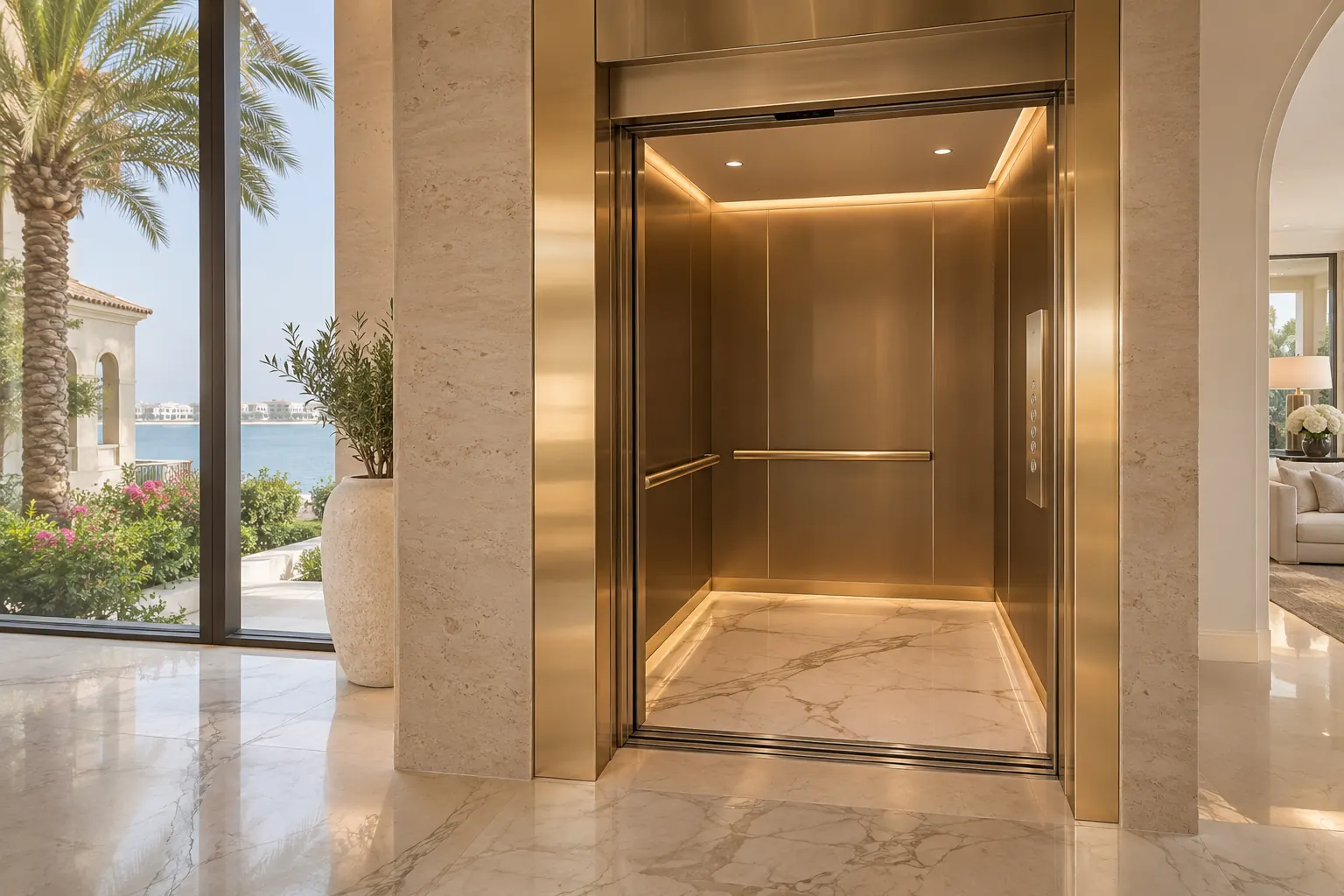
Quick answer: A bespoke luxury home lift is a villa lift whose cabin is designed from scratch around the owner's taste, using materials such as genuine gold or platinum plating, diamond detailing, Swarovski crystal and rare marble like Calacatta Gold, Statuario or Calacatta Viola. Almost every visible surface can be customised: walls, ceiling, floor, handrail, mirror, door finishes, lighting and the surround of the control panel. What cannot be traded away is the engineering underneath. Every extra kilogram of stone and metal has to be included in the lift's design, the controls must stay clear and readable, and the finished lift still has to meet the standards it was built to and pass its third-party inspection in Dubai. Elevaya designs, supplies and installs these one-off cabins for new villas and refits existing lifts. Start on our bespoke luxury villa lifts page.
Most people never think about the inside of a lift. In a villa it is different. The lift is the one room every member of the family and every guest steps into, often several times a day, and it usually opens straight onto the main hall or a formal majlis. When the rest of the house has hand-carved doors, bookmatched marble and gold leaf ceilings, a standard stainless-steel cabin looks like it belongs to someone else's building.
That is why some owners in Dubai, Abu Dhabi and across the GCC ask for something closer to jewellery than joinery: a cabin with a gold-plated geometric screen, a feature wall of backlit onyx, a narrow line of diamonds framing a marble panel, or faceted crystal set into the ceiling. Elevaya designs and installs exactly this kind of lift, and we have been working on lifts in the UAE since 2019, with more than 200 projects behind us across design, supply, installation and annual maintenance.
This guide is not a trend round-up. We have already written about luxury elevator interiors in marble, bronze and wood and cabin design trends for 2026. This one is about the top end: what goes into a truly bespoke home lift with precious materials, how those materials are specified so you get what you pay for, and what the engineering, safety rules and care routine look like when the cabin is worth more than many cars.
What makes a home lift "bespoke" rather than just upgraded?
A bespoke home lift is designed for one villa and one owner, so the cabin proportions, materials, lighting and details are developed from your brief instead of being picked from a catalogue. An upgraded lift swaps standard panels for nicer ones. A bespoke lift starts with a blank sheet and a conversation about how the house should feel.
In practice the difference shows up in three places:
- The design brief. We begin with your architecture, the interior designer's palette and the way the household uses the lift. A family that rides it daily with children and a wheelchair user needs a different cabin from a guest lift that mostly carries visitors up to a rooftop terrace.
- The materials. Instead of a finish code, you choose real things: a particular marble slab, a plating type and thickness, a stone setting, a crystal reference. Each one is recorded in a material schedule.
- The integration. The cabin, the landing doors and the surrounds on each floor are treated as one composition, so the lift reads as part of the house rather than a box dropped into it.
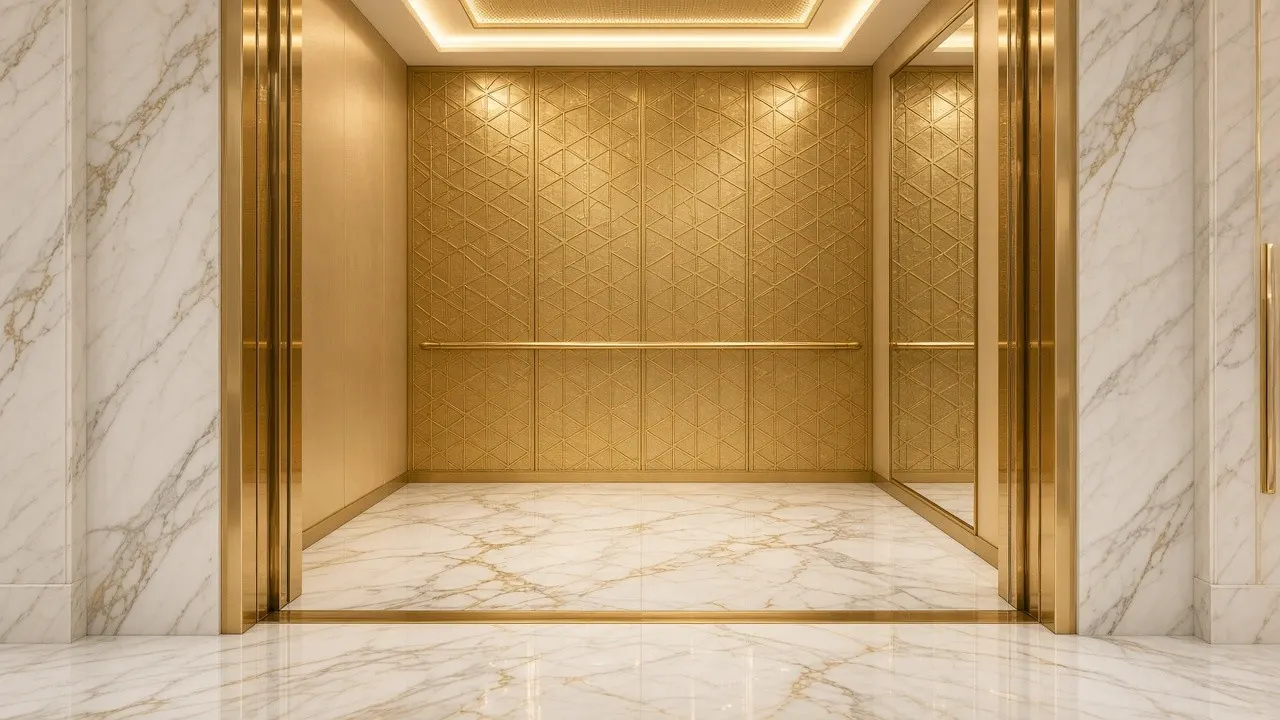
Our bespoke luxury villa lifts page shows five design directions we use as starting points: Royal Gold, Platinum and Onyx, Titanium Atelier, Diamond Detail and Crystal Signature. They are starting points, not packages. Most finished cabins borrow from more than one.
What can you customise in a luxury villa lift?
Nearly everything you can see and touch can be customised, as long as the safety-critical parts keep working the way the standards require. Here is how we usually break a cabin down with clients:
| Part of the lift | What can be customised | What stays fixed |
|---|---|---|
| Wall panels | Gold or platinum plating, titanium sheet, marble or onyx panels, engraved or relief metalwork, mirror, crystal or gem inlays | Panels must be securely fixed and removable for maintenance access |
| Ceiling | Luminous or coffered ceilings, crystal details, metal edges, concealed lighting | Ventilation, emergency lighting and headroom must not be compromised |
| Floor | Marble, inlaid borders, stone compositions laid to a vein layout | Level with the landing, suitably slip-resistant, within the weight allowance |
| Handrail | Plated, solid or titanium metal, custom profile, engraved detail | Firm, graspable and free of sharp edges or protruding stones |
| Car operating panel surround | Plated or stone surround, bespoke trim | Buttons, indicators and alarm must stay clear, legible and reachable |
| Doors and landings | Plated or clad door finishes, stone or metal surrounds on each floor | Door mechanism, clearances and locking stay as engineered |
| Lighting | Warm, layered LED lighting, backlit onyx, light that sparkles off crystal | Low heat near stone and crystal; light sources reachable for replacement |
If you are refitting an older lift rather than building new, the same list applies, but each item is checked against what the existing lift can carry and how its doors and controls are built. Our guide to lift COP and LOP panels explains what the control panels must include, which is worth reading before anyone suggests covering them in stone.
How gold, platinum and titanium finishes are specified
The single most important word in a precious-metal specification is "genuine": the quotation should state whether a surface is real gold or platinum plating, or a gold-tone or platinum-colour finish that looks similar. Both can be beautiful. They are not the same product, and a colour description alone does not tell you which one you are getting.
For metal finishes we agree, in writing:
- The base metal under the finish, usually a stainless steel or brass panel.
- The finish itself. Genuine gold plating or genuine platinum plating applied by a specialist finisher, or a gold-tone or platinum-colour PVD or coating where a harder-wearing or different specification suits the cabin better.
- Where it goes. Precious-metal plating often makes most sense on decorative surfaces that are admired rather than gripped all day. High-touch spots such as the handrail and the panel surround take more wear.
- A physical sample. You approve a real sample piece, under lighting close to the cabin's, before fabrication starts. The approved sample is the reference for what gets supplied.
- Care requirements. How the finish should be cleaned and what to avoid, written down so your household staff and our technicians follow the same routine.
Titanium works differently. It suits contemporary villas that want depth and colour without ornament. We can assess solid titanium sheet or a titanium-colour coated alternative, and the drawings set out panel thickness, backing, joints, fixings and which sections can be removed and replaced.
Diamonds and Swarovski crystal in a lift cabin
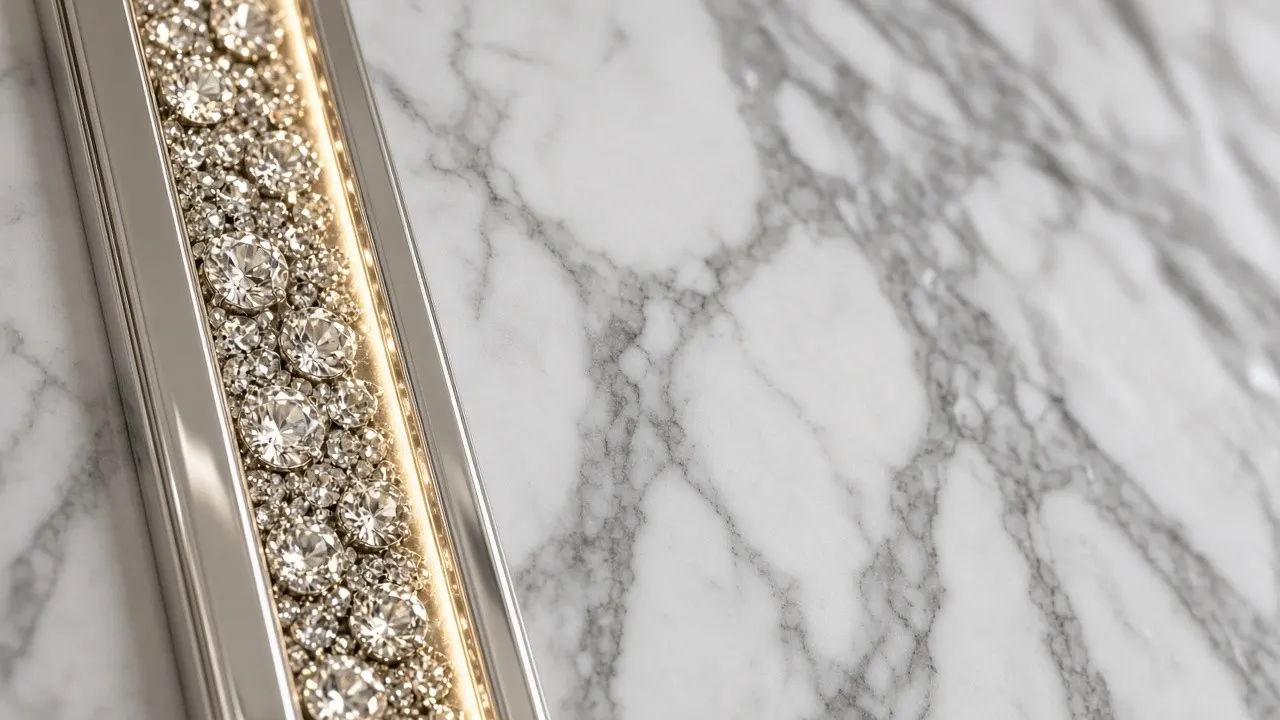
Diamonds and crystal look best in a lift when the detail is deliberate and protected: a narrow border around a stone panel, a framed feature wall or a recessed ceiling detail, rather than stones scattered on surfaces people lean against. A lift cabin is a small, busy space. Shopping bags, luggage, prams and elbows all brush the walls.
For diamond detailing, the specification records:
- whether the stones are natural or laboratory-grown,
- stone size and quantity,
- the setting method and the metal used for the settings,
- the supporting documents you want with the stones,
- where the settings sit, so they stay clear of the controls, the handrail and the door path.
For crystal, Swarovski crystal can be specified for selected decorative details. Where a client asks for it, the specification lists the agreed product references and the supply source, so there is no question later about what was fitted. Faceted crystal set into recessed wall details or a protected ceiling gives a lot of sparkle without hanging anything into the cabin's headroom. A chandelier in a lift sounds romantic, but it eats height, swings with movement and is hard to clean, so we steer clients towards recessed settings instead.
Lighting makes or breaks this kind of detail. Warm LED sources angled across the crystal create the effect people want, and they run cool enough not to cook adhesives or settings. We also plan how a technician reaches each light source to replace it without lifting out a gem-set panel.
Choosing rare marble for a lift floor and walls
Rare marble in a lift is chosen slab by slab, because colour, veining and bookmatching vary from one block to the next, and the cabin is small enough that every vein shows. The stones our clients ask about most are:
- Calacatta Gold: warm gold and grey veins on white, a natural partner for gold frames and borders.
- Statuario: bright white with grey movement, for a calm, light cabin.
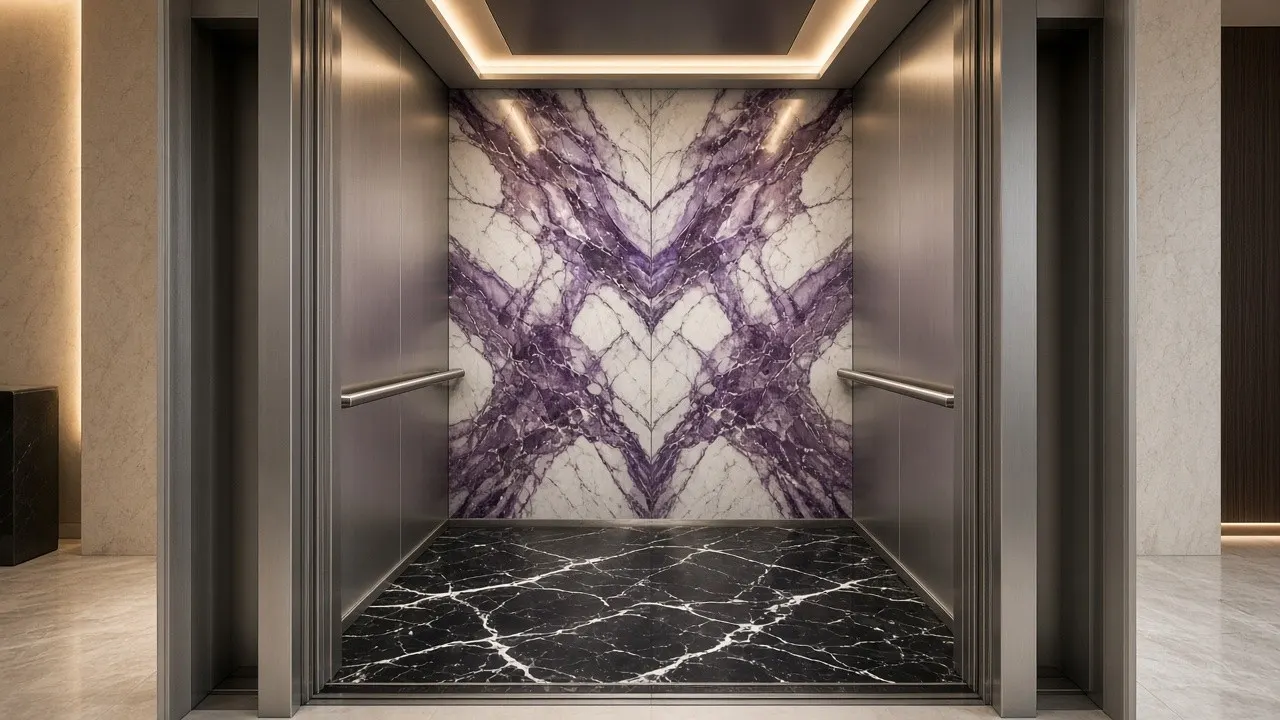
- Calacatta Viola: creamy white with bold violet and burgundy veins, striking on a rear feature wall.
- Rosso Levanto: deep red with light veins, for a dramatic panel, inlay or floor.
- Nero Marquina: black with white veins, crisp on floors and borders.
- Translucent onyx: not marble, but a favourite for backlit wall panels.
For each one we agree the actual slab, the vein layout across walls and floor, the edge details and how the floor meets each landing. Natural stone also brings practical questions. Polished marble can be slippery, so the floor finish is chosen with that in mind. Doors need clearance for the thickness of stone on the walls. Backlit onyx needs a way to reach and replace the light behind it.
Weight is the big one, which is why it gets its own section below. Where a cabin cannot take a full stone build-up, lightweight-backed stone panels (a thin layer of real stone bonded to a light backing) are one option we review.
Weight, load and engineering: the part nobody photographs
Every kilogram of marble, metal and glass added to a cabin is weight the lift moves on every trip, so the finished cabin weight has to be part of the lift's engineering from the start, not something worked out after the stone arrives.
Here is why it matters. A lift is designed around a rated load (the passengers and goods it may carry) and the weight of the car itself. Heavy decorative finishes increase the car's own weight. On a traction lift, that affects how the car and counterweight are balanced, and the load on the machine, ropes, brake and safety gear. On a hydraulic lift, it affects the pressure the system works at. In every case, it changes the numbers the lift was originally designed around.
So, before fabrication, we:
- Estimate the weight of every finish layer: stone, backing, adhesive, metal panels, fixings, gem-set frames and the ceiling.
- Check that total against the lift's design for a new lift, or against the existing lift's data and condition for a refit.
- Adjust the design if needed: thinner or lightweight-backed stone, metal instead of stone on some walls, or a lift specified from the start to carry a heavier car.
- Record the final cabin build-up so the inspection body and future technicians know what is on the car.
What we will not do is let decorative weight eat into the passenger capacity the lift is rated and labelled for. A beautiful lift that is quietly overloaded is a bad lift.
This is also why new villas are the easiest place to go all out. When we are involved early, working with your architect and interior designer, the shaft, door openings, cabin size and drive can be chosen with the finished cabin in mind. Our home lifts page covers the options, and the lift installation process guide walks through what happens from survey to handover.
Safety and compliance for luxury home lifts in Dubai
A luxury cabin is still a lift, and in Dubai a villa lift is designed, installed, tested and maintained to the same recognised standards as lifts in larger buildings. The finishes sit on top of that, never instead of it.
The Dubai Building Code is direct about villas. Clause K.5.5.4 says that if elevators are provided in a villa, their design shall conform to sections D.5 and D.6. Clause D.5 then requires vertical transportation to be designed, installed, tested, commissioned and maintained to one suite of standards, either ASME A17 or BS EN 81, and says the two are not used interchangeably. Those standards cover far more than finishes, but they include requirements on the car itself, such as how materials behave in a fire, and they are why a cabin design has to be checked by people who know the lift, not only by the interior designer.
Inspection matters too. Dubai Municipality's guideline DM-HSD-GU48-ECLA2 (version 5) requires lifts to be tested and certified by an EIAC-accredited third party every 12 months (requirement 1), and the certificate of safety is issued only after any repairs have been carried out (requirement 4). For an existing lift, the inspection body's rules are worth knowing before a heavy refit. EIAC-RQ-IB-002 defines repair or alteration to include changes to safety devices and to driving mechanisms and controls (clause 2.6), and describes a major inspection, with a proof load test, after a major repair or alteration (clause 2.22). Our guide to the Dubai annual lift inspection certificate explains the inspection cycle.
On the design side, these are the safety points we hold to in every luxury cabin:
- Controls stay readable. Buttons, floor indicators, the alarm and any intercom are never hidden, set flush with gems or made hard to read against a busy stone pattern.
- Nothing sharp at hand or shoulder height. Gem settings and crystal sit in protected, recessed details, away from the handrail and the door edges.
- Mirrors and glass are safety-rated and fixed so they stay put.
- Ventilation and emergency lighting keep working under a decorative ceiling.
- The floor is level with each landing so nobody catches a heel on the threshold.
- Every panel can come off. Technicians need to reach the car top, the panel wiring, the lights and the door equipment without damaging a finish.
If the villa is getting a lift for the first time, permits come before any of this. Our Dubai villa lift permit and NOC guide covers which authority approves the work.
The design process, from first idea to handover
A bespoke lift moves from brief to survey, then to drawings and physical samples, and only after you approve everything to a quotation, fabrication and installation. It follows the same four steps set out on our bespoke luxury villa lifts page.
- Share your vision. Tell us the villa location, the floors served and whether this is a new or existing lift. Send plans, mood images and the finishes you love.
- Survey the villa. We check the site and the lift requirements, working with your architect, interior designer or project manager where there is one.
- Approve the details. We develop drawings, the stone layout, metal samples, the lighting plan and the maintenance provisions. You see and touch real samples, not just renders.
- Commission your lift. You receive a survey-based quotation with an agreed scope, programme, installation and handover arrangements.
Precious finishes involve specialist suppliers, such as stone yards, plating houses and gem setters, so lead times are set once the material schedule is final rather than promised up front. For an existing lift, we also review its condition. If it needs work underneath, cabin refurbishment can run alongside lift modernization of the controller, drive, doors or safety systems, with the decorative and technical scope kept clearly separate. See our cabin refurbishment service for refits.
How much does a bespoke luxury home lift cost?
There is no fixed price for a bespoke luxury lift, because every cabin is a one-off and the cost depends on the lift itself plus the approved material schedule. Anyone quoting a figure before seeing your villa and agreeing the materials is guessing.
The things that move the price most are:
- the lift type, travel height, number of stops and cabin size,
- whether it is a new installation or a refit of an existing lift,
- the metal finishes and how much surface they cover,
- the quantity and type of stones and crystal, and the setting work,
- the marble chosen, the slab selection and how much of it is used,
- lighting, ceiling and door finishes on every landing,
- any engineering changes needed to carry the finished weight.
We price the surveyed lift and the approved material schedule together, including installation and the agreed service scope, so the quotation reflects what will actually be built.
Caring for precious finishes in a lift
Precious finishes last when they are cleaned gently and regularly with the right products, and when small problems such as a loose panel or a dull setting are caught early. At handover we agree a written care routine for each material. The general rules look like this:
| Finish | Everyday care | Avoid |
|---|---|---|
| Gold or platinum plating | Soft, dry or barely damp microfibre cloth; light, regular wiping of touch points | Abrasive pads, metal polish, harsh chemical sprays that can strip plating |
| Titanium and coated metals | Soft cloth and the cleaner agreed for that finish | Scouring powders and scratchy cloths |
| Marble and onyx | pH-neutral stone cleaner, prompt wiping of spills, periodic resealing as advised | Acidic or bleach cleaners, vinegar, lemon, letting drinks or perfume sit on the stone |
| Crystal and gem settings | Lint-free cloth, gentle dusting, a professional check of settings | Spraying cleaners directly onto settings, picking at stones |
| Mirrors and glass | Glass cleaner sprayed onto the cloth, not the panel | Spraying near plated edges or stone |
Two things are specific to the UAE. Fine sand is everywhere, and grit carried on shoes acts like sandpaper on a polished marble floor, so good mats at each landing door make a real difference. And because many villas are busy with staff, drivers and deliveries, make sure everyone who cleans the lift knows the routine, not just the house manager.
Mechanical care matters as much as polish. Regular maintenance is where a technician notices a panel that has started to move, a fixing that needs attention or a light that is failing behind onyx. In Dubai, Elevaya's non-comprehensive AMC for a G+1 villa lift starts from AED 2,500 a year. It includes 12 visits a year (one each month), fixes for issues and free 24-hour emergency callouts; only replacement parts are charged, and only when they need changing. Our elevator AMC cost guide explains what that covers, and our villa and home lift maintenance page sets out the service.
Why villa owners choose Elevaya for bespoke lifts
Because we treat the luxury cabin and the lift engineering as one project, and we stay with the lift after handover. Elevaya has worked in the UAE since 2019 on more than 200 projects, covering design, supply, installation and annual maintenance contracts. We service all lift brands, so an existing villa lift does not have to be one we installed for us to refit and maintain it.
What that means for a bespoke project:
- one team for the design, the engineering review, the specialist finishes, installation and aftercare,
- materials specified in writing, with physical samples you approve,
- weight, safety and access worked out before anything is fabricated,
- a lift that still has to pass its inspection, and a service team that knows what is behind every panel.
We also take on projects outside Dubai, across the UAE and the wider GCC.
Related Elevaya guides
Continue planning with these related Elevaya guides:
- Luxury elevator interiors in the UAE: marble, bronze and wood: weight, fire performance and cleaning of premium cabin finishes.
- Elevator cabin design trends in the UAE for 2026: finishes, COP/LOP panels, LED lighting and glass cabins.
- Lift interior designs for UAE villas, schools and hospitals: modern, gold and bronze lift interiors and how finishes differ by building type.
- Glass and panoramic villa lifts in Dubai: 2026 planning guide: placement, glazing, heat control, approvals and AMC care.
- Glass villa lift in Dubai: footprint, heat and cost factors: shaft vs shaftless, laminated glass, cabin cooling, hydraulic vs MRL vs platform.
- Lift COP and LOP panels in Dubai: what is on each panel, DBC button heights, Braille and intercom rules, common faults, repair vs replacement.
- Dubai villa lift permit: which NOC and authority you need: the developer NOC, which authority approves (DM, DDA or Trakhees), the steps and the documents.
- Lift installation in Dubai: step-by-step process: survey, shaft, pit and headroom prep, supply and delivery, installation sequence, testing, EIAC certification and handover.
- Lift upgrades in Dubai: what to upgrade first: rescue devices for power cuts, door light curtains, VVVF and energy saving, cabin refresh, alarms, upgrade vs modernization.
- Elevator modernization in Dubai: signs, scope and standards: when to modernize, controller and door upgrades, EN 81-20/80, downtime and cost factors.
- Dubai annual lift inspection certificate: who issues it, 12-month and 6-month inspection rules and how to prepare.
- Elevator AMC cost in Dubai: villa owners' guide: non-comprehensive from AED 2,500 for G+1, visits, callouts and parts rules.
- Lift maintenance checklist for Dubai: monthly service visit: what each monthly visit should check on doors, ride, machine and brake, alarm, car top and pit, the log book and villa lifts.
- How to choose the best lift company in Dubai: buyer's checklist: licences, AMC terms, written response times, parts, references and red flags.
- Hydraulic lift problems in Dubai: leaks, sinking and heat: oil leaks, a car that sinks or re-levels, slow or jerky rides, summer overheating, noise, emergency lowering, safe owner checks and repairs.
- Common lift problems in Dubai: causes and fixes: stuck lifts, doors not closing, jerky rides, noise and summer heat trips, safe owner checks and repairs.
- Lift and elevator supply in the UAE: buyer's guide: supply-only vs supply and installation, what to specify, what a supply quote must include, BS EN 81 / ASME A17, EIAC certification and red flags.
- Export lifts and elevator spare parts from the UAE: export documents, HS codes, certificate of origin and the steps from enquiry to shipment.
- Swarovski crystal lift cabins in Dubai: crystal, onyx and light: crystal ceilings and walls, backlit onyx, mirrors, cabin lighting levels, and how to keep crystal secure and serviceable in a moving cabin.
- Gold lift doors and luxury lift panels in Dubai: gold and platinum landing doors and frames, engraved or monogrammed COP and LOP panels, jewelled push buttons, handrails, and how to make them last.
- Bespoke luxury lift design process in Dubai: from brief and mood board to material samples, 3D renders, a full-scale mock-up, fabrication, installation, handover and AMC care of precious finishes.
- Luxury marble and onyx lift interiors in Dubai: rare stones beyond Calacatta, from Statuario, Arabescato, Nero Marquina, Emperador and Taj Mahal quartzite to blue and green onyx, malachite, lapis lazuli and backlit agate, and how each is handled for weight and wear.
- Luxury lift cabin upgrade in Dubai: metals and finishes: re-dressing an existing lift with rose gold and champagne PVD, brass, bronze, copper, hammered and etched metal, black titanium, Macassar ebony and burl walnut veneers, leather, shagreen and gold leaf, and how weight, fire rules and downtime are handled.
- Luxury lift modernization ideas in the UAE: pairing a modernization with smart glass, fibre-optic starry ceilings, antiqued mirror, mother-of-pearl, marquetry, Murano-style glass, mashrabiya and Arabic calligraphy, touchless, fingerprint and touchscreen controls, cabin music, scent, filtered air and near-silent doors.
- What is the best luxury home elevator brand for a Palm Jumeirah or Emirates Hills villa?: how to compare brands neutrally by drive type, local service and parts, BS EN 81 or ASME A17 compliance, warranty, AMC, design flexibility and heat suitability.
- How much does a bespoke glass panoramic villa lift cost in Dubai?: what an installed AED quote should cover, the choices that move the price, confirmed Elevaya price points and the yearly cost of ownership.
- Can you install a luxury elevator in an already built Dubai villa without a concrete shaft or deep pit?: self-supporting structures, shallow-pit and pitless options, EN 81-21 and EN 81-41, positions in finished villas, approvals and cost.
- Which is quieter and smoother for a luxury villa: screw-driven, hydraulic or gearless traction?: how each drive sounds and rides in a Dubai villa, where noise really comes from, heat effects and how to test a lift before you buy.
Related Elevaya services and guides: Bespoke luxury villa lifts, Home lifts, Panoramic lifts, Cabin refurbishment, Lift modernization, Lift installation, Home lift for an existing villa, Villa and home lift maintenance, Projects, Contact Elevaya.
FAQ
What is a bespoke luxury home lift?
A bespoke luxury home lift is a villa lift whose cabin is designed for one home and one owner. Walls, ceiling, floor, handrail, door finishes and lighting are developed from your brief, using materials such as genuine gold or platinum plating, titanium, diamond detailing, Swarovski crystal and rare marble, while the lift's engineering and safety stay to the standards it is built to.
Can a home lift really have gold, platinum and diamonds?
Yes, as a custom decorative specification. The quotation states the base metal, whether the finish is genuine gold or platinum plating or a gold-tone or platinum-colour finish, and the approved sample. For diamonds, it records whether the stones are natural or laboratory-grown, their size and quantity, the setting method and the documents you want with them.
Is a marble floor too heavy for a villa lift?
Not if the weight is planned. Marble, backing, adhesive and fixings all add to the car's weight, so the total is checked against the lift's design before fabrication. Where a full stone build-up is too heavy, lightweight-backed stone panels or a mix of stone and metal are options, and on a new villa the lift can be specified to suit the finished cabin from the start.
Can I add luxury finishes to my existing villa lift?
Often, yes. We first assess the cabin, door openings, headroom, load allowance and the condition of the equipment. Added decorative weight goes into the engineering review, and if the lift needs work underneath, cabin refurbishment can be combined with modernization. Larger alterations may also bring an inspection by the third-party inspection body before the lift returns to use.
How do you clean gold-plated and marble lift interiors?
Use a soft microfibre cloth on plated metal and avoid abrasive pads, metal polish and harsh sprays. Clean marble with a pH-neutral stone cleaner, wipe spills quickly and avoid acidic cleaners. Keep good mats at each landing so sand does not scratch a polished floor, and have crystal and gem settings checked during maintenance visits.
Does Elevaya build bespoke lifts outside Dubai?
Yes. Elevaya works across all seven Emirates and welcomes bespoke design, supply and installation enquiries across the GCC. Every quotation follows a technical site survey.
Start your bespoke lift with Elevaya
Planning a new villa, or ready to turn an ordinary lift into the most memorable room in the house? Tell us about your home, your floors and the materials you love, and we will shape them into one coherent design. Elevaya has worked on more than 200 projects in the UAE since 2019. Call or WhatsApp +971 58 584 4685, explore our bespoke luxury villa lifts or contact Elevaya to arrange a private design consultation.