Elevaya journal
Glass Villa Lift in Dubai: Footprint, Heat, Glazing and Cost Factors
Compare glass and enclosed villa lifts in Dubai: usable space, solar heat, glazing, privacy, cleaning and installation scope. Plan a technical survey.
Published · Updated · Elevaya Lifts
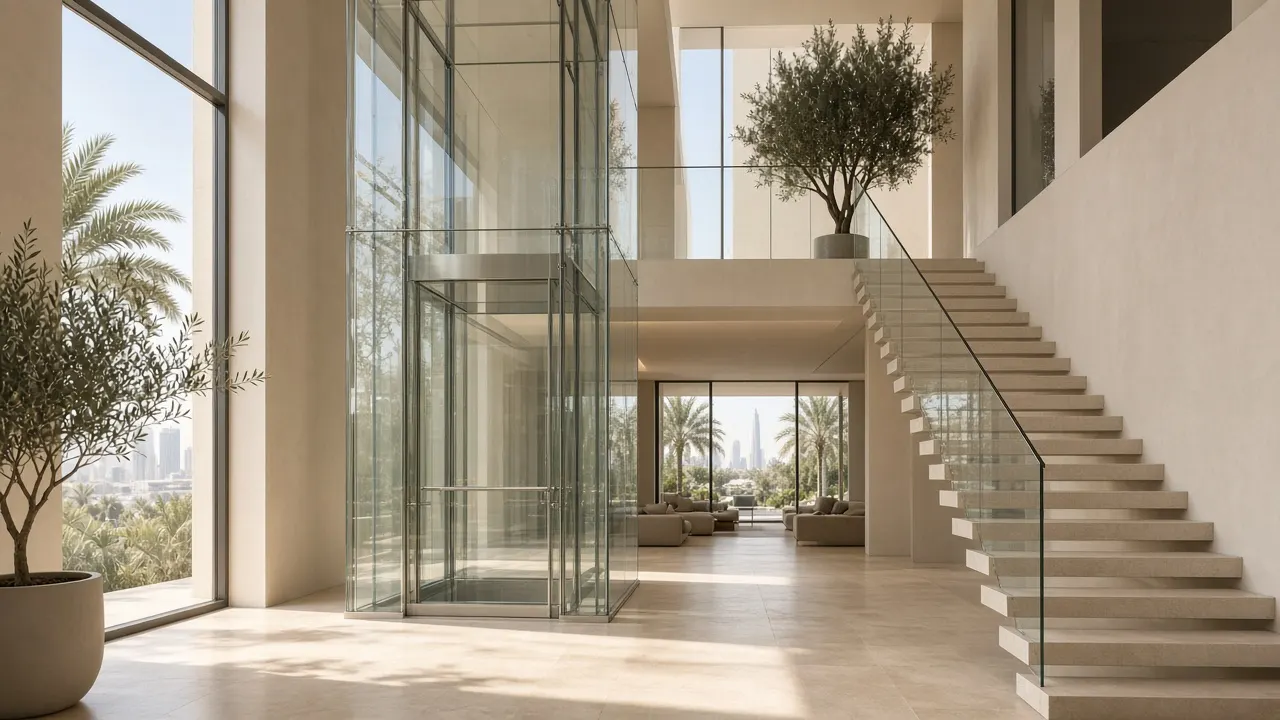
Quick answer: A glass villa lift in Dubai is a home lift with a glazed cabin and, usually, a glass shaft or a self-supporting glass structure that stands in an atrium, a stair void or against the façade. The decisions that shape cost and comfort are the structure (built shaft, framed glass shaft or self-supporting "shaftless" unit), the drive (hydraulic, machine-room-less traction or a platform lift), the space you can give it including pit and headroom, and how you manage solar heat through glass in a UAE summer. In Dubai, any villa lift must follow one suite of standards, ASME A17 or BS EN 81, under the Dubai Building Code. A site survey should come before any price.
A glass lift is the one piece of equipment in a villa that people actually look at. That is the attraction, and also the reason it needs more planning than a closed lift: every frame, rope, ram and cable you choose is on display, and every square metre of glass faces the sun.
This guide focuses on the practical questions owners and architects ask us once they have decided they want a glass villa lift in Dubai: how much floor space it really takes, how hot it gets, which glass to use, whether "shaftless" is a real option, and what moves the budget. For placement ideas and interior styling, read our companion piece, Glass and panoramic villa lifts in Dubai: a planning guide for 2026. Elevaya Lifts has worked in the UAE since 2019 on more than 200 projects, covering lift design, supply, installation and annual maintenance contracts (AMC).
Which type of glass villa lift fits your home?
There are four common ways to build a glass home lift, and they differ more in structure than in looks. Choose the structure first; the finish comes later.
| Configuration | How it is built | Typically suits |
|---|---|---|
| Glass cabin in a framed glass shaft | Steel or aluminium frame with laminated glass panels forming the shaft, cabin travels inside | Atriums and double-height halls where the lift is the feature |
| Self-supporting glass lift ("shaftless" look) | A factory-made structure that carries its own guide rails and glazing, fixed to the floor slabs | Existing villas where building a masonry shaft is impractical |
| Glazed cabin in a built shaft with glass openings | Concrete or block shaft with one glazed face or glass landing doors | Villas that want light and a view without full exposure to the sun |
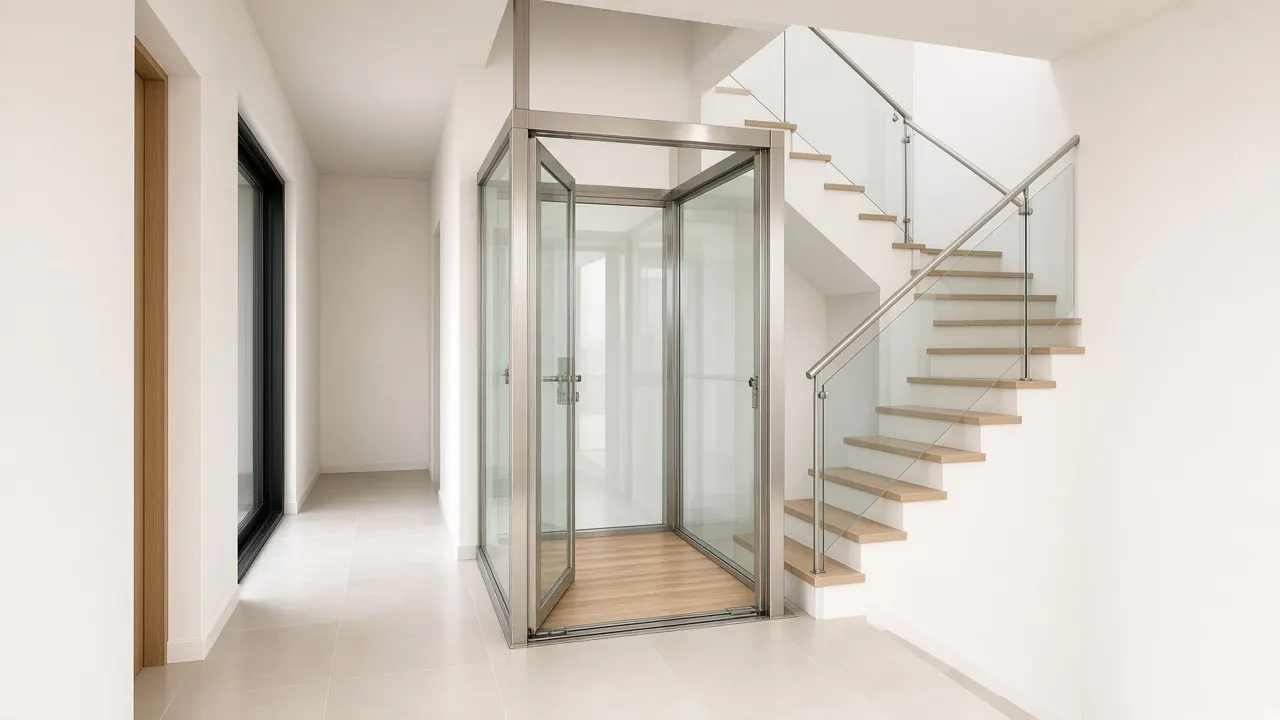
| Glass platform-style home lift | Compact enclosed platform with glazed panels and hinged doors, usually slower | Short travel in a stair void or a retrofit with little pit depth |
All four can be beautiful. They behave very differently in heat, cost and maintenance, which is what the rest of this guide is about.
Shaft vs shaftless glass lift for a villa: what is the real difference?
A "shaftless" glass lift still has an enclosure. The difference is that the structure arrives as part of the lift instead of being built by the contractor. True open platforms with no enclosure are not what most Dubai villa owners mean by the term.
- Built or framed shaft. The civil contractor or a steel fabricator builds the shaft, and the lift is installed into it. You get more freedom over glass sizes, frame colour and how the shaft meets the floors, but more trades to coordinate.
- Self-supporting structure. The lift supplier provides the frame, rails and glazing as one engineered package. It is often quicker on site and easier to retrofit, but the module sizes are set by the manufacturer, and the slab openings, fixings and pit (if any) still need structural checks.
Either way, ask for a section drawing that shows every visible component: rails, brackets, ropes or ram, cables and the machine or controller cabinet. In a glass shaft, the drawing is the view.
How much space does a glass villa lift need?
The glass lift footprint in a villa is more than the cabin. Plan for these elements together, then confirm them on the manufacturer's drawings for the exact model:
- Cabin size, set by how many people you want to carry and whether a wheelchair or stroller must fit.
- Structure and glazing depth on every side of the cabin, which is larger for framed shafts than for slim self-supporting units.
- Door type and swing. Hinged doors common on platform lifts need clear space to open; sliding doors take space inside the structure instead.
- Landing space in front of each door so people can approach and turn. For lift platforms in buildings other than private homes, Part C of the Dubai Building Code asks for a 1,500 mm by 1,500 mm landing kept free of obstacles, which is a useful benchmark for comfortable villa design too.
- Pit depth below the lowest floor and headroom above the top stop, which depend on the drive.
- Machine or controller space, either a small cabinet nearby or equipment inside the shaft.
Stair voids are the most common location because they reuse space that already exists. Measure the void after the stair is built, not from the architect's early plans, since balustrades and finishes often take more room than drawn. If you are adding a lift to an occupied home, our guide to installing a home lift in an existing villa covers the structural survey.
Heat and glazing: designing a glass lift for a UAE summer
Glass admits solar heat, so a glass cabin in direct sun will overheat unless the design deals with orientation, glass specification, shading and ventilation together. This is the biggest difference between a glass lift in Dubai and one in a cooler climate.
Solar gain and orientation
Before choosing glass, map the sun. East and especially west faces receive low-angle sun that passes deep into a glazed shaft. A lift inside the air-conditioned envelope, lit by a skylight, can still trap heat at the top of the shaft. Ask your consultant to look at summer sun paths, and consider opaque or shaded faces on the hottest side.
Laminated vs tempered safety glass
Both are safety glass, but they fail differently:
- Tempered (toughened) glass is several times stronger than ordinary glass and breaks into small, blunt pieces. Once broken, a single tempered pane no longer stays in place.
- Laminated glass bonds two or more panes with a plastic interlayer. If it cracks, the fragments stay attached to the interlayer and the panel keeps acting as a barrier.
That is why lift cabins and shafts use laminated glass, often made from toughened or heat-strengthened plies for strength. EN 81-20, the European safety standard for new passenger lifts, requires glass in car walls to be laminated, and the panel thickness and fixing must be engineered for the loads it carries. This is not a place to value-engineer.
Coatings, tints and interlayers
Solar-control coatings and tinted or solar-control interlayers reduce the heat that passes through the glass, while low-iron glass keeps the view clear. There is a trade-off: stronger solar control usually means a darker or more reflective look. Request glass samples and the glass supplier's performance data, and view the samples in daylight on site.
Ventilation and cooling of glass cabins
A lift car needs ventilation in all cases. In a sunny Dubai shaft, plan for a cabin fan at minimum and consider a dedicated cabin air-conditioning unit where the shaft sees direct sun or sits outdoors. Do not forget the equipment: drive cabinets, controllers and hydraulic power units also need to stay within their operating temperature, so give them a cooled or well-ventilated space.
Indoor vs outdoor glass lifts in a Dubai villa
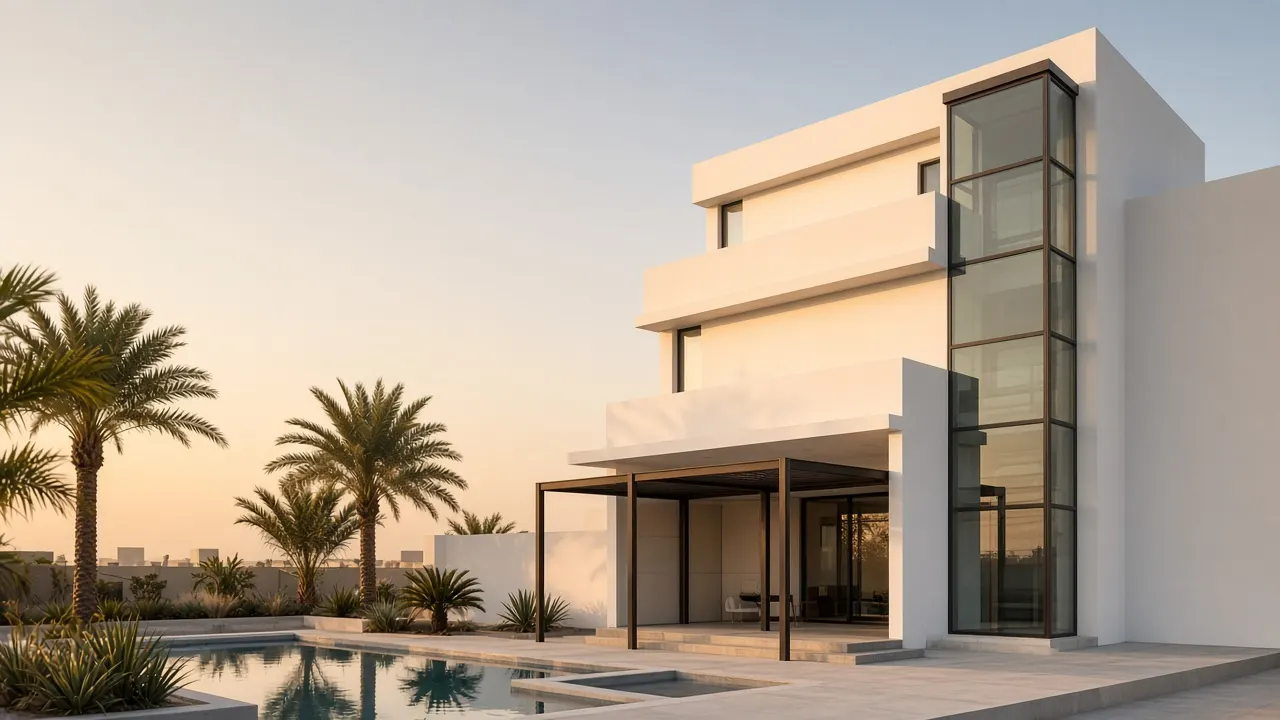
An indoor glass lift is easier to keep comfortable; an outdoor glass lift gives the best views but must be specified as outdoor equipment from the start. Treat an external lift as its own product, not an indoor lift with extra glass.
An outdoor glass lift in the UAE needs:
- Sealing against sand and wind-blown dust, with door tracks and sills that can be cleaned easily.
- Water management for the rare heavy rain, including a drained pit and weather-protected landing doors.
- Components rated for outdoor use, including electrical enclosures, lighting and door equipment, and seals that resist UV.
- Cabin cooling, because an external glazed box in summer sun gains heat quickly.
- Security at ground level, so the external landing cannot be used to enter the house.
Our outdoor lifts page explains the options for gardens, terraces and external façades.
Hydraulic vs MRL traction vs platform: which drive for a glass villa lift?
For most G+1 and G+2 villas the real choice is between hydraulic, machine-room-less (MRL) traction and a platform-style home lift, and the answer depends on travel height, pit depth, ride quality and what you are willing to see through the glass.
| Drive | Pit and headroom | What you see in a glass shaft | Ride and speed | Typical fit |
|---|---|---|---|---|
| Hydraulic | Modest pit; machinery in a small nearby cabinet | The ram or jack beside the cabin, unless concealed | Smooth, suited to low rise | Low-rise villas with a convenient spot for the power unit |
| MRL traction | Needs pit and top clearance to suit the model | Ropes, counterweight and machine within the shaft, so placement matters | Very smooth; suits taller villas | G+2 and above, or owners who want a passenger-lift ride |
| Platform-style home lift | Shallow pit or none, low headroom | Compact drive within the structure | Slow; vertical lifting platforms to EN 81-41 are limited to 0.15 m/s | Short travel, retrofits, accessibility-led projects |
Two Dubai Building Code details are worth knowing here. Part D requires traction lifts in new buildings to use variable voltage variable frequency (VVVF) drives and energy-efficient cabin lighting that switches off after a period of inactivity. And whatever the drive, the lift must stay within the single standards suite chosen for the project.
What drives the cost of a glass home lift in Dubai?
We do not publish installation prices for glass lifts, because the same brochure model can differ widely in cost depending on the house. These are the factors that move a glass home lift cost in Dubai the most:
- Structure: framed glass shaft, self-supporting unit, or built shaft with glazed openings.
- Drive type and the number of stops and travel height.
- Glass specification: low-iron, solar-control, large single panes, curved glass or frameless details.
- Cabin and doors: automatic sliding vs hinged doors, cabin size and interior finishes.
- Climate measures: cabin air conditioning, shading and outdoor-rated components.
- Civil and structural works: pit, slab openings, steel supports, power supply and making good finishes.
- Approvals: design submissions, master-developer NOC and third-party inspection.
- Access during installation: finished marble floors, narrow stairs and occupied homes all add time.
For a broader view, see our home lift cost guide for the UAE. Compare quotations against the same specification; a lower figure that drops cabin cooling or uses a thinner glass specification is not the same lift.
Approvals, standards and inspection for villa lifts in Dubai
The Dubai Building Code's villa chapter (Part K) states that if elevators are provided, their design shall conform to sections D.5 and D.6. In plain terms:
- D.5, safety and reliability: the lift must be designed, installed, tested, commissioned and maintained to one suite of standards, either ASME A17 or BS EN 81, and the two may not be mixed on one project.
- D.6, energy conservation: controls to conserve energy, including VVVF drives on traction lifts, efficient lighting with automatic switch-off and a standby mode.
Part C of the Code also recommends that panoramic elevators include a full-height opaque wall or corner section 800 mm wide, a sensible design touch for passengers who are uneasy with heights. You can read all of these in the Dubai Building Code 2021 published by Dubai Municipality.
On testing, Dubai Municipality's technical guideline for the examination and certification of lifts and other lifting equipment (DM-HSD-GU48, version 5) applies to establishments in Dubai where lifts are used and requires lifts in workplaces such as hotels to be tested and certified by an EIAC-accredited third party every 12 months. For a private villa, ask your installer how testing and commissioning will be documented at handover, and check what your master developer requires before work starts; many communities ask for a no-objection certificate for structural or façade changes. Our elevator inspection and testing guide explains the process.
Keeping a glass lift clear, cool and safe
A glass lift needs the same safety maintenance as any lift, plus attention to glass, seals and cooling. A good home lift maintenance plan should cover door equipment and sills, brakes, safety gear and controls, and also inspect glass panels and fixings for chips or loosening, clean door tracks that collect dust, and check cabin fans or air conditioning before summer.
Elevaya's non-comprehensive AMC for a G+1 villa lift in Dubai starts from AED 2,500 a year and includes 12 visits (one each month), fixes for issues found and free 24-hour emergency callouts; replacement parts are charged only when they need changing. Our elevator AMC cost guide explains what is included. Elevaya services all lift brands, including lifts we did not install, so an existing glass lift from another supplier can join the same contract.
A short planning checklist for a glass villa lift
- Decide the structure: framed glass shaft, self-supporting unit, built shaft with glass, or platform lift.
- Map the sun and decide indoor or outdoor before choosing glass.
- Confirm the footprint, pit and headroom on the manufacturer's drawings.
- Choose the drive that suits travel height and what you are willing to see.
- Specify laminated safety glass, solar control and cabin ventilation or cooling.
- Agree the standards suite, approvals, NOC and handover testing.
- Start an AMC from handover. If you are still comparing contractors, use our buyer's checklist for lift companies in Dubai.
Related Elevaya guides
Continue planning with these related Elevaya guides:
- Glass and panoramic villa lifts in Dubai: 2026 planning guide: placement, glazing, heat control, approvals and AMC care.
- Elevator cabin design trends in the UAE for 2026: finishes, COP/LOP panels, LED lighting and glass cabins.
- Luxury elevator interiors in the UAE: marble, bronze and wood: weight, fire performance and cleaning of premium cabin finishes.
- Elevator AMC cost in Dubai: villa owners' guide: non-comprehensive from AED 2,500 for G+1, visits, callouts and parts rules.
- How to choose the best lift company in Dubai: buyer's checklist: licences, AMC terms, written response times, parts, references and red flags.
- Elevator modernization in Dubai: signs, scope and standards: when to modernize, controller and door upgrades, EN 81-20/80, downtime and cost factors.
- Elevator and escalator speeds in UAE buildings: rated lift speed by travel height and 0.5 vs 0.65 m/s escalators.
- Lift speed by building height in Dubai towers: DBC travel-time formula, worked m/s examples, waiting times, DHA hospital and Trakhees rules.
- Escalator design and maintenance for UAE malls: layout, balustrades, dust and heat, AMC and modernization.
- Escalator faults and repairs in Dubai: why escalators stop, safety-device trips, handrail and step chain wear, sand and heat, repair vs modernization.
- Lift installation in Dubai: step-by-step process: survey, shaft, pit and headroom prep, supply and delivery, installation sequence, testing, EIAC certification and handover.
- Lift and elevator supply in the UAE: buyer's guide: supply-only vs supply and installation, what to specify, what a supply quote must include, BS EN 81 / ASME A17, EIAC certification, escalator supply and red flags.
- Lift maintenance checklist for Dubai: monthly service visit: what each monthly visit should check on doors, ride, machine and brake, alarm, car top and pit, the log book, maintenance vs inspection, villa lifts and an escalator checklist.
- Lift COP and LOP panels in Dubai: what is on each panel, DBC button heights, Braille and intercom rules, common faults, repair vs replacement.
- Lift upgrades in Dubai: what to upgrade first: rescue devices for power cuts, door light curtains, VVVF and energy saving, cabin refresh, alarms, EN 81-80, upgrade vs modernization.
- Common lift problems in Dubai: causes and fixes: stuck lifts, doors not closing, jerky rides, noise and summer heat trips, safe owner checks, trapped-passenger steps, repairs and certification.
- Escalator modernization in the UAE: signs, scope and compliance: when to modernize, modernize vs replace, controller and drive, steps, chain and handrail, energy features, phased mall works and the EIAC major inspection.
- Escalator installation in the UAE: step-by-step process: survey and selection, pit and truss supports, rigging, alignment, controller, safety devices, testing, EIAC inspection and handover.
Related Elevaya services: Panoramic lifts, Home and villa lifts, Outdoor lifts, Lift installation, Home lift maintenance.
FAQ
What is a shaftless glass lift for a villa?
It is a glass home lift whose structure, guide rails and glazing come as one self-supporting unit fixed to the floors, so no masonry shaft has to be built. It still has an enclosure; the difference is that the lift supplier provides it instead of the civil contractor.
Does a glass lift get too hot in a Dubai summer?
It can if glass faces direct sun without control. Keeping the lift inside the cooled envelope where possible, using solar-control laminated glass, shading the hottest faces and fitting a cabin fan or cabin air conditioning keep it comfortable.
Is tempered or laminated glass used for glass lifts?
Lift cabins and shafts use laminated safety glass, often made from toughened plies. Laminated glass holds together if it cracks, while a single tempered pane falls out in small pieces once broken. EN 81-20 requires laminated glass for car walls.
Which drive is best for a glass villa lift: hydraulic, MRL traction or platform?
Hydraulic suits low-rise villas with space for a nearby power unit, MRL traction suits taller villas and the smoothest ride, and platform-style lifts suit short travel and shallow pits. The right choice depends on travel height, pit depth and what you are happy to see through the glass.
What affects the cost of a glass home lift in Dubai?
The structure type, drive, number of stops, glass specification, door type, cabin cooling, outdoor-rated components, civil and structural works, approvals and site access. A reliable price follows a site survey and a written specification.
Which rules apply to a villa lift in Dubai?
The Dubai Building Code requires villa elevators to conform to its safety and energy provisions in sections D.5 and D.6, including the use of one suite of standards, ASME A17 or BS EN 81. Many communities also require a master-developer NOC before structural or façade work.
Plan your glass villa lift with Elevaya
Thinking about a glass lift for your villa, indoors or out? Send us your floor plans or book a site visit and Elevaya will advise on structure, drive, glazing and cooling, then give you a written, itemised proposal. Call or WhatsApp +971 58 584 4685 or contact Elevaya.
Glass lift or enclosed cabin: what changes in daily use?
A glass lift can preserve sightlines through an atrium or stairwell. An enclosed cabin offers more privacy and a wider range of opaque wall finishes. The choice should follow the position in the home, the selected system and how the family uses the space, rather than appearance alone.
| Decision | Glass design | Enclosed design |
|---|---|---|
| Daylight and view | Keeps views open; check reflections and exposure | More visual separation from the surrounding space |
| Solar exposure | Assess glazing specification, shading and the enclosure’s heat conditions | Assess the full shaft and cabin environment, not only the wall finish |
| Cleaning | Plan safe access to both faces of the glazing | Compare fingerprints, joints and finish-specific cleaning |
| Space | Include enclosure, door, shaft and structural requirements | Include the same dimensions; a cabin photograph does not show the whole footprint |
| Privacy | Review views from adjacent rooms and landings | Often easier to screen the cabin from surrounding rooms |
For an outdoor location, coordinate weather protection, water drainage and corrosion exposure with the supplier and building team. Do not infer a temperature rating or a universal glass thickness from a photograph. Compare the specified glazing and equipment documentation for the actual location.
See the home-lift cost guide for budget scope, the villa dimensions guide for the measurements to request, and the Dubai villa permit and NOC guide before structural work. Home lift maintenance should cover the equipment as well as care of the visible finishes.