Elevaya journal
Lift COP and LOP Panels in Dubai: Buttons, Code Rules, Faults and Upgrades
Lift COP and LOP panels in Dubai: what is on each panel, DBC button heights and Braille rules, common faults, and repair vs replacement options.
Published · Updated · Elevaya Lifts
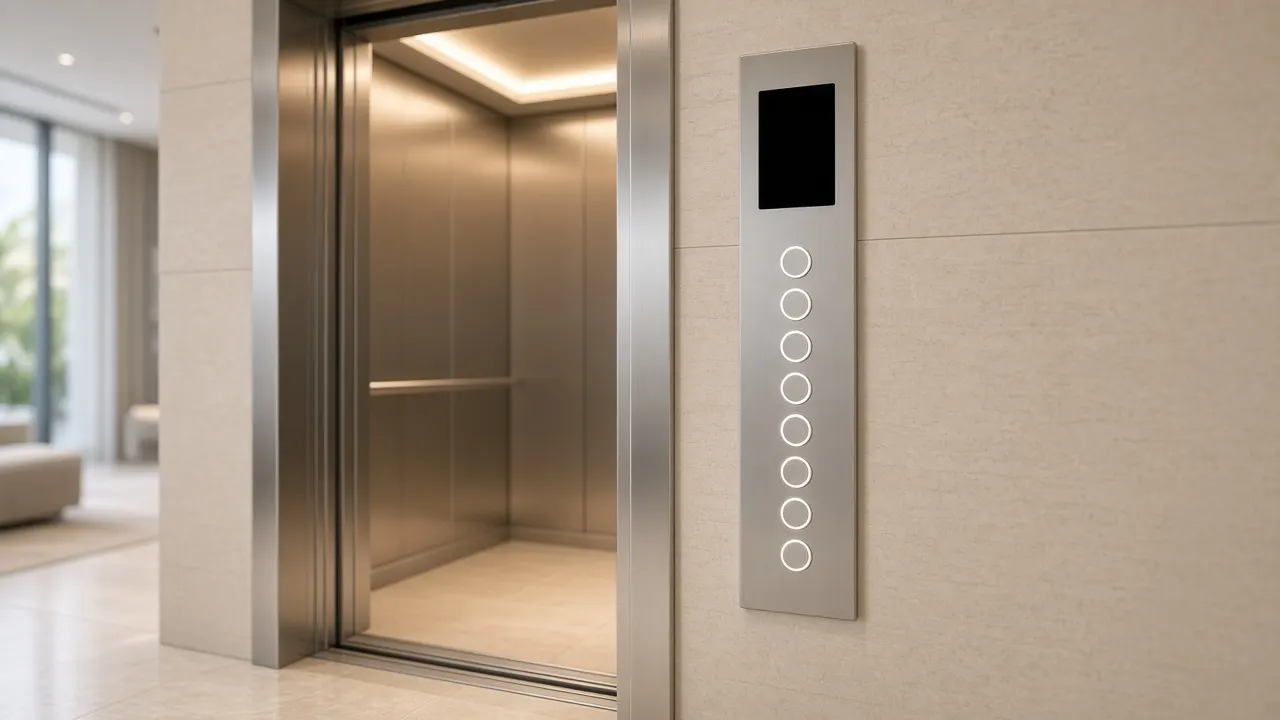
Quick answer: On a lift, the car operating panel (COP) is the button panel inside the cabin and the landing operating panel (LOP) is the call station outside the lift on each floor. A COP normally carries the floor buttons, door open and close buttons, an alarm button, a hands-free emergency intercom, a position indicator and key switches for authorised modes; an LOP carries the up and down call buttons and often an indicator or arrival lantern. Neither is the lift's main control panel (the controller), which sits in the machine room or a cabinet and runs the lift. In Dubai, clause C.5.9.3.2 of the Dubai Building Code sets the accessible-lift rules for panels: buttons between 900 mm and 1,200 mm above the floor, embossed numerals with Braille, a raised and green-ringed exit-floor button, a tactile fallback for touch screens, a hands-free two-way intercom and audible floor announcements. Most COP and LOP faults in UAE buildings trace back to worn buttons, failed indicator supplies, heat, dust, moisture or the emergency communication line, and many can be fixed without replacing the whole panel.
Most people only notice a lift's buttons when one stops working. A floor button that needs three presses, a landing call that lights but brings no lift, a blank floor indicator, or an alarm button that rings nowhere are some of the most common complaints facility managers and villa owners raise with a lift company. They are also some of the most misunderstood, because the panel you press is often not where the fault is.
This guide explains lift COP and LOP panels in Dubai in practical terms: what each panel is, what should be on it, what the Dubai Building Code asks for, how to choose materials for a villa or a tower, which faults are typical in the UAE climate, and when repair, refurbishment or replacement makes sense. For a short overview of the components themselves, see our elevator COP, LOP, buttons and indicators guide. For what an upgrade project involves, see elevator control-panel upgrades.
Elevaya Lifts has worked in the UAE since 2019 on more than 200 projects, covering design, supply, installation and annual maintenance contracts (AMC). We service all lift brands, including lifts we did not install, so the advice below applies whichever manufacturer's panels you have.
What are COP and LOP panels on a lift?
COP and LOP panels are the passenger interface of a lift: the COP sits inside the car and the LOP sits at each landing, and together they send calls to the controller and show passengers what the lift is doing. They are often supplied as a matched set of "fixtures" with the same finish, button style and display type.
| Component | Where it is | What it does |
|---|---|---|
| Car operating panel (COP) | Inside the lift car, usually on a side wall or front return beside the door | Floor selection, door control, alarm and intercom, indicators, key switches |
| Landing operating panel (LOP), also called a hall call station | Beside the landing door on every served floor | Up and down calls, sometimes a position indicator or key switch |
| Position indicator and hall lantern | Above the landing door, inside the car or built into the COP/LOP | Shows the current floor, direction of travel and which lift is arriving |
| Main controller ("control panel") | Machine room, or a cabinet at the top landing or in the shaft on MRL lifts | Runs the drive, doors, calls and safety circuits |
| Firefighter's or fire service panel | Normally at the designated main landing of the relevant lift | Lets the fire service take control of the lift during an emergency |
| Emergency communication unit | Built into the COP, with a link to a manned alarm centre | Two-way voice contact between trapped passengers and a rescue service |
In a group of lifts, there may be one shared LOP between two cars, and in buildings with destination control the landing buttons are replaced by a keypad or touch screen where passengers enter their floor before boarding.
COP vs LOP vs the lift controller: which "control panel" do you mean?
When someone says "the lift control panel" they may mean the buttons in the car, the buttons on the landing, or the controller cabinet that drives the lift, and getting this right early avoids quoting the wrong job. These are three different pieces of equipment with different costs, lead times and compatibility questions.
- The COP and LOP are input and display devices. They register calls and show information, but they do not decide how the lift moves.
- The controller is the lift's brain. It receives calls from the COP and LOP, controls the motor drive and doors, monitors the safety circuit and decides which car answers which call.
- The link between them is either parallel wiring (one or more wires per button) or a serial communication bus, where many buttons share a few conductors and an electronic board in each panel encodes the signals.
This matters because a fault that looks like a "button problem" can sit anywhere along that chain. A landing call that lights up but never brings the lift may be a controller or communication fault, not a faulty button. A dead indicator on every floor at once points to a shared supply or bus problem, not ten broken displays. Our lift problems and troubleshooting guide covers how symptoms map to systems more broadly.
It also matters when you plan an upgrade. Replacing the COP and LOP fixtures is a smaller job than replacing the controller, but new fixtures must speak the same "language" as the existing controller. If the controller is being replaced, as in a full elevator modernization, the fixtures are normally replaced with it so the whole system is matched.
What is on a car operating panel (COP)?
A modern COP carries the controls passengers need to choose a floor and get help, plus a few locked controls for authorised staff. The exact list depends on the building, the standards suite chosen for the project and the specification, but a typical COP in a Dubai building includes:
- Floor buttons for every served level, with clear floor designations such as B2, B1, G, M, 1, 2 and R that match the building's floor naming.
- Door open and door close buttons, with recognisable symbols.
- An alarm button, which activates the emergency alarm and the voice link.
- A hands-free emergency intercom with a speaker and microphone grille, so a trapped passenger can talk to a rescue service without lifting a handset.
- Indicators showing the current floor and direction, plus visual confirmation that the alarm has been registered and that help is on the way, where the system provides it.
- Overload indication, a light, symbol or voice message when the car is overloaded.
- Key switches or card readers behind a locked service cabinet or on the face of the panel for independent service, inspection, out-of-service or floor-lockout functions.
- Access-control interface in residential towers and offices, where a card or fob is needed before certain floors can be selected.
- Car lighting and fan controls in a locked section, on some lifts.
The COP should also carry the information panel or plaque with the rated load and passenger capacity, and, where required, the sign showing the alarm centre's telephone number next to the intercom.
In villas, the COP is often simpler: fewer floors, no access control and sometimes a combined panel that houses the floor buttons, alarm and a small display in one slim column. Private homes can still benefit from the same accessibility features used in public buildings, especially where an elderly family member or a wheelchair user will use the lift.
What is on a landing operating panel (LOP)?
An LOP is the call station at each landing; on most floors it has an up and a down button, while the top and bottom floors have only one. Around it, the landing usually has a position indicator or hall lantern that shows where the lift is, which way it is travelling and, in a group, which car is about to arrive.
A typical LOP or landing set in a Dubai building includes:
- Up and down call buttons, illuminated when a call is registered.
- A position indicator above the door or built into the LOP, showing the floor and direction.
- Hall lanterns and an arrival gong or chime in groups of lifts, so passengers know which car to walk to.
- A key switch at the main landing on some lifts, for parking or out-of-service functions.
- The firefighter's switch at the designated landing for lifts that have a firefighting or fire service mode, usually behind a glass-fronted cover.
- Out-of-service or fire messages on the display where the controller supports them.
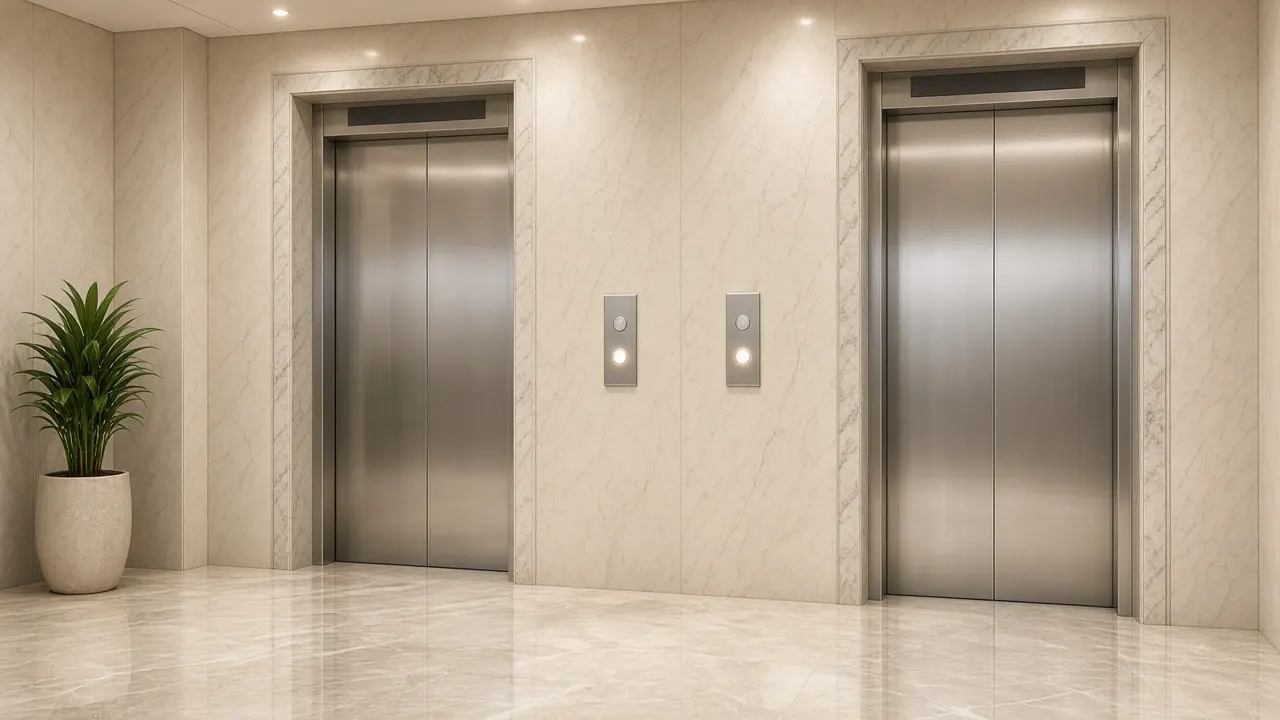
The landing is also where accessibility starts. Clause C.5.9.3.2 of the Dubai Building Code requires a clear manoeuvring space of at least 1,500 mm by 1,500 mm in front of the lift door and in front of the hall call button, so the LOP has to be positioned where a wheelchair user can actually reach it, not tucked into a corner or behind a planter.
What does the Dubai Building Code require for lift buttons and panels?
The Dubai Building Code sets panel requirements for accessible lifts in Part C (Accessibility), clause C.5.9.3.2, and requires every lift to be designed and maintained to one recognised standards suite under Part D, clause D.5. The Dubai Building Code 2021 says that, as part of the overall elevator provision, at least one accessible elevator (or a lift platform) must be provided in every building with more than one floor, with listed exemptions.
For accessible elevators, clause C.5.9.3.2 includes these requirements and recommendations that directly affect COP and LOP design:
| DBC C.5.9.3.2 item | What it says about panels and signals |
|---|---|
| h) | A clear manoeuvring space of at least 1,500 mm × 1,500 mm in front of the lift door and the hall call button |
| i) | Floor indicators located 1,800 mm to 2,000 mm above the floor |
| k) | Buttons between 900 mm and 1,200 mm above the floor, with high-embossed numerals and Braille numerals on the left lower side of each button |
| l) | For lifts serving many floors, the keypad should be at a maximum height of 1,200 mm so every floor can be called |
| m) | The exit-floor button (usually ground) should be raised at least 3 mm above the others and circled with a green line at least 2 mm wide |
| n) | Landing call buttons may use tactile icons instead of digits, colour-contrasted against the background |
| o) | Where touch screens or buttons are installed, a tactile button must be included to activate an alternative interface for blind or visually impaired passengers, such as an audible floor count |
| p) | Braille and tactile signage on the door jamb at a height of 1,500 mm |
| q) | A hands-free intercom allowing two-way communication between passengers and a rescue service, with a graphic and tactile sign showing the alarm centre's phone number |
| r) | Audible signals or voice announcements at each floor; visual signals should be provided in public use buildings for people with hearing impairment |
| s) | For passengers with hearing impairment, either an audio and visual intercom or a means of sending and receiving emergency SMS text messages from inside the car |
Two practical points follow from that table. First, touch-screen or glass "touch" COPs are not ruled out, but they must have a tactile fallback that opens an alternative interface. Second, the emergency communication requirement goes beyond a voice intercom: in buildings where the accessible lift rules apply, the design must also give a hearing-impaired passenger a way to communicate, either visually or by text.
For vertical lift platforms, which are often used to solve small level changes in existing buildings, clause C.5.9.4 asks for control buttons between 900 mm and 1,200 mm that use continuous pressure operation and can be operated with an elbow or a closed fist. Our platform and accessibility lifts page explains where these are used.
Which standards sit behind the panels?
Clause D.5 of the Code requires vertical transportation to be designed, installed, tested, commissioned and maintained to either the ASME A17 suite or the BS EN 81 suite, with one suite selected per project. The Code's reference list for Part D includes several BS EN 81 parts that are directly relevant to operating panels:
- BS EN 81-70: accessibility to lifts for persons including persons with disability, which covers button design, positions and signals.
- BS EN 81-28: remote alarm on passenger and goods passenger lifts, which covers the emergency alarm and communication link.
- BS EN 81-71: vandal resistant lifts, relevant to robust fixtures in car parks, transit-type and heavily used public buildings.
- BS EN 81-72 and BS EN 81-73: firefighters lifts and the behaviour of lifts in the event of fire, which shape the fire service controls.
- BS EN 81-82: rules for improving the accessibility of existing lifts, a useful reference when an older lift's panels are being upgraded.
For lifts required for firefighting, clause D.5 also says they must conform to the relevant sections of the UAE Fire and Life Safety Code in addition to the chosen standards suite. The firefighter's switch, its location and the fire service operating modes are therefore a fire-safety matter as well as a lift matter, and should be coordinated with the building's fire consultant.
Do villas have to follow the accessible-lift rules?
For villas, clause K.5.5.4 of the Code says that if elevators are provided, their design shall conform to D.5 and D.6, so the standards-suite rule applies. Whether every Part C accessibility item applies to a private home depends on the project and the approving authority, so confirm it with your consultant. Even where it is not mandatory, the C.5.9.3.2 list is a sensible design brief for a family lift: well-placed buttons, a clear exit-floor button, audible floor announcements and a reliable emergency intercom make a lift easier and safer for everyone in the house.
How do firefighter's switches and key switches work?
Key switches and the firefighter's switch let authorised people take a lift out of normal service, and they should be clearly labelled, kept locked and tested as part of routine maintenance. Passengers should never be able to activate them by accident.
Common authorised functions include:
- Fire service or firefighter's operation: activated at the designated landing, usually behind a break-glass or key-operated cover. Depending on the lift type and the fire design, the lift returns to that landing and then only responds to controls used by the fire service.
- Independent service: a key switch in the COP that takes the car out of group service so it responds only to car calls, used for moving furniture or VIP use.
- Inspection or out-of-service: switches that let technicians or building staff park the lift safely during cleaning or maintenance.
- Floor lockout and access control: key, card or fob controls that restrict which floors can be selected, common in residential towers and hotels.
The building's fire alarm interface usually also sends the lift to a designated floor when the alarm activates. That interface sits in the controller, not the panel, but the COP and LOP displays are where passengers see the result. When testing fire operation, check what the panels show as well as where the car goes.
Which materials and finishes suit villas vs towers?
In villas, panel choices are mostly about appearance and matching the interior; in towers, malls and car parks they are about durability, vandal resistance and cleaning, with appearance second. In both cases, the finish has to cope with heat, humidity, sand and frequent cleaning.
| Factor | Villa lifts | Residential towers, hotels and offices | Car parks, labour accommodation and high-traffic public buildings |
|---|---|---|---|
| Faceplate | Hairline or mirror stainless steel, PVD-coloured stainless (gold, bronze, black), glass, sometimes matched to cabin panels | Hairline stainless steel or PVD finishes, sometimes glass on premium projects | Thick stainless steel faceplates with tamper-resistant fixings |
| Buttons | Slim micro-stroke metal buttons or flush capacitive touch with a tactile fallback | Micro-stroke buttons with Braille and clear illumination | Robust vandal-resistant push buttons |
| Displays | Small TFT or LCD screens, sometimes showing the time or messages | Dot-matrix, LCD or TFT indicators, hall lanterns in groups | Simple, bright, high-contrast indicators |
| Extras | Discreet design, mirrored or hidden service cabinet | Access-control readers, destination control keypads in some towers | Protective covers and sturdy intercom grilles |
| Main risks | Fingerprints and scratches on mirror finishes, sun on outdoor or glass lifts | Constant use, cleaning chemicals, access-control integration | Impact damage, dust and harsh cleaning |
A few specification tips apply in every building type. Contrast matters more than shine: a black-on-mirror button may look elegant but be hard to read for older users. Illumination should be visible in daylight, especially on LOPs near glass façades or in outdoor lobbies. Fixings and sealing matter on outdoor landings and in car parks, where sand and wash-down water can reach the panel. Our cabin renovation guide and the post on luxury elevator interiors cover how panels fit into a wider interior refresh.
What are the most common COP and LOP faults in UAE buildings?
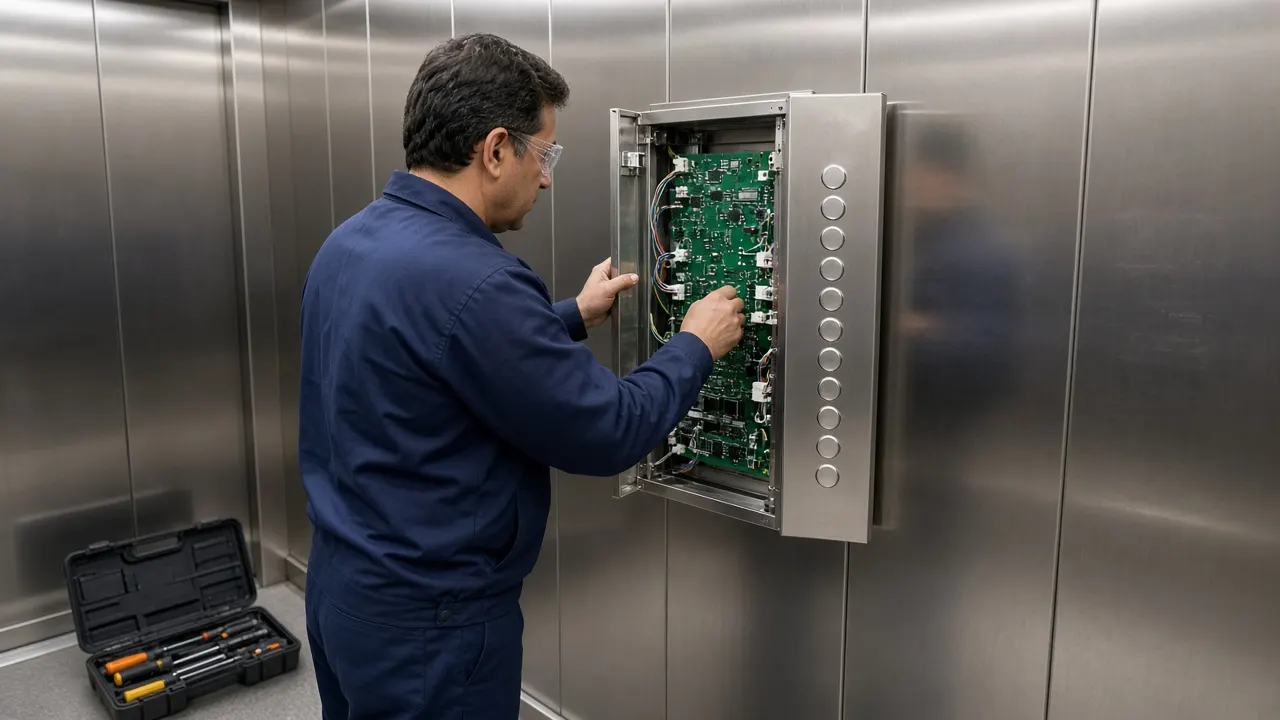
The most common panel faults are stuck or unresponsive buttons, buttons that light but do not register a call, dead or flickering indicators, and emergency intercoms that do not connect, and the climate makes several of them more likely. The table below lists typical symptoms, what usually causes them and what a technician should check.
| Symptom | Likely causes | What to check |
|---|---|---|
| Button stuck in or needs several presses | Worn micro-switch, dust or sand in the button, cleaning fluid ingress, heat-aged plastic parts | Button mechanism and seal, then replace the button module with a compatible part |
| Button lights but the lift does not respond | Call registered at the panel but not reaching the controller, communication or wiring fault, controller in a special mode | Controller fault log, bus or wiring continuity, active key switches or fire mode |
| Button never lights | Failed lamp or LED, failed button board, loose connector | Button and board supply, connectors |
| One indicator dead or flickering | Failed display, LED driver or local board | Display module and its connection |
| Indicators dead on every floor | Shared power supply, fuse or communication bus failure | Fixture power supply and bus from the controller |
| Garbled or wrong floor shown | Position or encoding fault, display configuration after work on the lift | Controller position signals and display settings |
| Alarm button rings nowhere or intercom silent | Failed telephone line or SIM, expired service plan, low backup battery, failed speaker or microphone | End-to-end test call to the alarm centre, battery, line status |
| Panel warm to touch or discoloured | Sun exposure on outdoor or glass lifts, poor ventilation behind the faceplate | Shading, ventilation, component temperature ratings |
| Moisture or corrosion behind the faceplate | Condensation from air conditioning, wash-down water, unsealed outdoor LOPs | Seals, gaskets, drainage, IP-rated replacements where needed |
Three UAE-specific patterns are worth calling out. Sand and fine dust work their way into mechanical buttons, especially on ground-floor and car-park landings near open doors. Heat and sun age plastics, adhesives and displays faster on outdoor landings and in glass lifts, which our glass villa lift guide discusses. Emergency communication often fails silently: the alarm button looks fine, but the line, SIM or battery behind it has stopped working, which only a regular end-to-end test call will reveal.
A good rule is to record the symptom, not the assumed cause: which button, which floor, all the time or only sometimes, and what the display showed. That information lets a technician go straight to the right part of the system, and it avoids replacing a perfectly good panel when the real problem is in the controller. Our lift repairs service works this way.
Should you repair, refurbish or replace COP and LOP panels?
Repair individual buttons and displays when the panels are sound and parts are available; refurbish or replace the fixtures when parts are obsolete, faults keep returning or you need accessibility features the old panels cannot provide; and replace them with the controller when you modernize the lift. The right option depends on the condition of the panels, the controller they connect to and what you want to achieve.
| Option | When it fits | Watch out for |
|---|---|---|
| Like-for-like repair | A few worn buttons or one failed display, with compatible parts available | Confirm the part matches the panel and controller, not just the look |
| Faceplate refurbishment | Panels work but look tired, scratched or out of style | Button positions, Braille and contrast must still meet the brief |
| New fixtures on the existing controller | Panels obsolete or failing, controller still sound and supported | Interface compatibility (parallel or serial), configuration and testing |
| New fixtures with a controller modernization | Controller obsolete, recurring faults, wider upgrade planned | Plan downtime, testing and certification as a full project |
| Accessibility upgrade | Adding Braille, audible announcements, hearing-impaired communication or better button heights | Use BS EN 81-82 or the project's chosen standard as a reference |
Compatibility is the key question. A new COP from a different supplier can be fitted to an existing controller, but only when someone has confirmed how the controller expects to receive calls and send display information, and whether an interface board is needed. A survey should record the lift make and model, controller type, panel photographs, fault history and available drawings before anyone quotes. Our spare parts guide explains how compatibility is confirmed.
Can panels be replaced on a lift from a different brand?
Yes, in many cases. Because Elevaya services all lift brands, including lifts we did not install, we regularly look at panels on equipment from different manufacturers and generations. Whether a like-for-like part, a compatible replacement or a new fixture set is the right answer depends on the controller and the parts available, which is why the survey comes first. Our guide to multi-brand lift maintenance explains how this works.
What happens after the panels are changed?
After panel work, the lift should be tested end to end: every car and landing call, door open and close, indicators on every floor, alarm and intercom, overload signal, key switches and fire service operation. Dubai Municipality guideline DM-HSD-GU48-ECLA2 requires lifts to be tested and certified by a third party accredited by the Emirates International Accreditation Centre (EIAC) once every 12 months, and says the certificate of safety is issued after examination and test and only after any repairs have been carried out. Where panel work is part of a wider modernization, plan the inspection with the project, and keep the updated certificate on site. Our inspection preparation service helps buildings get ready.
COP and LOP specification checklist
Use this checklist when specifying new panels, reviewing a quotation or planning a refurbishment. It works for villas and for multi-storey buildings.
- Scope: list every component in scope: COP, LOPs on each floor, indicators, hall lanterns, intercom, key switches, access-control readers and the firefighter's switch, and say what stays and what changes.
- Compatibility: confirm the controller type, the interface (parallel or serial) and whether an interface board is needed.
- Floor naming: agree floor designations (B, G, M, R and so on) that match the building signage and the indicators.
- Accessibility: button heights, embossed numerals, Braille, the raised and green-ringed exit-floor button, audible announcements, visual signals and the hearing-impaired communication option, checked against C.5.9.3.2 where it applies.
- Touch interfaces: if you choose touch or glass panels, confirm the tactile fallback and how cleaning will affect them.
- Emergency communication: confirm who answers the alarm, how the line works, the backup battery and how often the connection will be tested.
- Fire and special modes: coordinate the firefighter's switch, fire alarm interface and key switches with the fire consultant.
- Environment: specify sealing and protection for outdoor, car-park or sun-exposed landings.
- Finishes: choose faceplate finishes that resist fingerprints and cleaning chemicals, with enough contrast for easy reading.
- Spares and support: ask which spare buttons and displays will be kept available and who supports the software settings.
- Testing and handover: ask for a written test list, updated wiring drawings and the inspection certificate after the work.
How does an AMC look after COP and LOP panels?
Under an annual maintenance contract, panels should be checked on every routine visit, not only when something breaks. A practical routine covers every floor button and landing call, door buttons, indicators, lanterns and chimes, the alarm button with a live test call, overload signalling, key switches and the fire service function, plus a visual check for loose faceplates, damage, moisture and heat stress.
In Dubai, Elevaya's non-comprehensive AMC for a G+1 villa lift starts from AED 2,500 a year. It includes 12 visits a year (one each month), fixes for issues found and free 24-hour emergency callouts at no extra cost; only replacement parts are charged, and only when they need changing. The elevator AMC cost guide explains what that covers, and lift maintenance and AMC sets out the service for larger buildings.
Related Elevaya guides
Continue planning with these related Elevaya guides:
- Elevator modernization in Dubai: signs, scope and standards: when to modernize, controller and door upgrades, EN 81-20/80, downtime and cost factors.
- Elevator AMC cost in Dubai: villa owners' guide: non-comprehensive from AED 2,500 for G+1, visits, callouts and parts rules.
- Lift installation in Dubai: step-by-step process: survey, shaft, pit and headroom prep, supply and delivery, installation sequence, testing, EIAC certification and handover.
- Lift and elevator supply in the UAE: buyer's guide: supply-only vs supply and installation, what to specify, what a supply quote must include, BS EN 81 / ASME A17, EIAC certification, escalator supply and red flags.
- Lift maintenance checklist for Dubai: monthly service visit: what each monthly visit should check on doors, ride, machine and brake, alarm, car top and pit, the log book, maintenance vs inspection, villa lifts and an escalator checklist.
- How to choose the best lift company in Dubai: buyer's checklist: licences, AMC terms, written response times, parts, references and red flags.
- Elevator cabin design trends in the UAE for 2026: finishes, COP/LOP panels, LED lighting and glass cabins.
- Luxury elevator interiors in the UAE: marble, bronze and wood: weight, fire performance and cleaning of premium cabin finishes.
- Glass villa lift in Dubai: footprint, heat and cost factors: shaft vs shaftless, laminated glass, cabin cooling, hydraulic vs MRL vs platform.
- Glass and panoramic villa lifts in Dubai: 2026 planning guide: placement, glazing, heat control, approvals and AMC care.
- Lift speed by building height in Dubai towers: DBC travel-time formula, worked m/s examples, waiting times, DHA hospital and Trakhees rules.
- Elevator and escalator speeds in UAE buildings: rated lift speed by travel height and 0.5 vs 0.65 m/s escalators.
- Escalator design and maintenance for UAE malls: layout, balustrades, dust and heat, AMC and modernization.
- Escalator faults and repairs in Dubai: why escalators stop, safety-device trips, handrail and step chain wear, sand and heat, repair vs modernization.
- Lift upgrades in Dubai: what to upgrade first: rescue devices for power cuts, door light curtains, VVVF and energy saving, cabin refresh, alarms, EN 81-80, upgrade vs modernization.
- Common lift problems in Dubai: causes and fixes: stuck lifts, doors not closing, jerky rides, noise and summer heat trips, safe owner checks, trapped-passenger steps, repairs and certification.
- Escalator modernization in the UAE: signs, scope and compliance: when to modernize, modernize vs replace, controller and drive, steps, chain and handrail, energy features, phased mall works and the EIAC major inspection.
- Escalator installation in the UAE: step-by-step process: survey and selection, pit and truss supports, rigging, alignment, controller, safety devices, testing, EIAC inspection and handover.
Related Elevaya services and guides: Control-panel upgrades, Lift modernization, Lift repairs, Lift maintenance and AMC, Elevator spare parts, COP, LOP, buttons and indicators.
FAQ
What is the difference between a COP and an LOP in a lift?
The COP (car operating panel) is the button panel inside the lift car, with floor buttons, door buttons, alarm, intercom and indicators. The LOP (landing operating panel) is the call station outside the lift on each floor, with up and down buttons and often an indicator.
Is the lift control panel the same as the COP?
No. The COP is only the passenger panel inside the car. The lift's main control panel, or controller, sits in the machine room or a cabinet and runs the drive, doors, calls and safety circuits. The COP and LOP send calls to it.
What height should lift buttons be in Dubai?
For accessible lifts, Dubai Building Code clause C.5.9.3.2 requires buttons between 900 mm and 1,200 mm above the floor, with high-embossed numerals and Braille. Floor indicators go between 1,800 mm and 2,000 mm, and multi-floor keypads should be no higher than 1,200 mm.
Can I install touch-screen lift buttons in Dubai?
Yes, but the Dubai Building Code requires a tactile button that activates an alternative interface for blind or visually impaired passengers, such as an audible floor count, wherever touch screens or touch buttons are installed. Check compatibility with the controller first.
Why does a lift button light up but the lift does not come?
The panel has registered the call, but the call may not be reaching the controller, or the lift may be in a special mode such as independent service, inspection or fire operation. A technician should check the controller fault log, the wiring or bus and any active key switches.
Can COP and LOP panels be replaced without modernizing the whole lift?
Often, yes. If the controller is sound and supported, new fixtures can be fitted after the interface is confirmed. If the controller is obsolete or faults keep returning, replacing panels as part of a modernization is usually the better long-term option.
Get your lift panels checked in Dubai
Whether a single button has stopped working, your indicators have gone dark or you are planning new panels as part of a refurbishment or modernization, Elevaya can survey the lift, confirm compatibility and repair, refurbish or replace the COP and LOP panels on any brand. Call or WhatsApp +971 58 584 4685 or contact Elevaya to arrange a visit anywhere in the UAE.