Elevaya journal
Lift Installation in Dubai: The Step-by-Step Process from Survey to Handover
Lift installation process in Dubai, step by step: survey, shaft, pit and headroom prep, supply, installation, testing, EIAC certification and handover.
Published · Updated · Elevaya Lifts
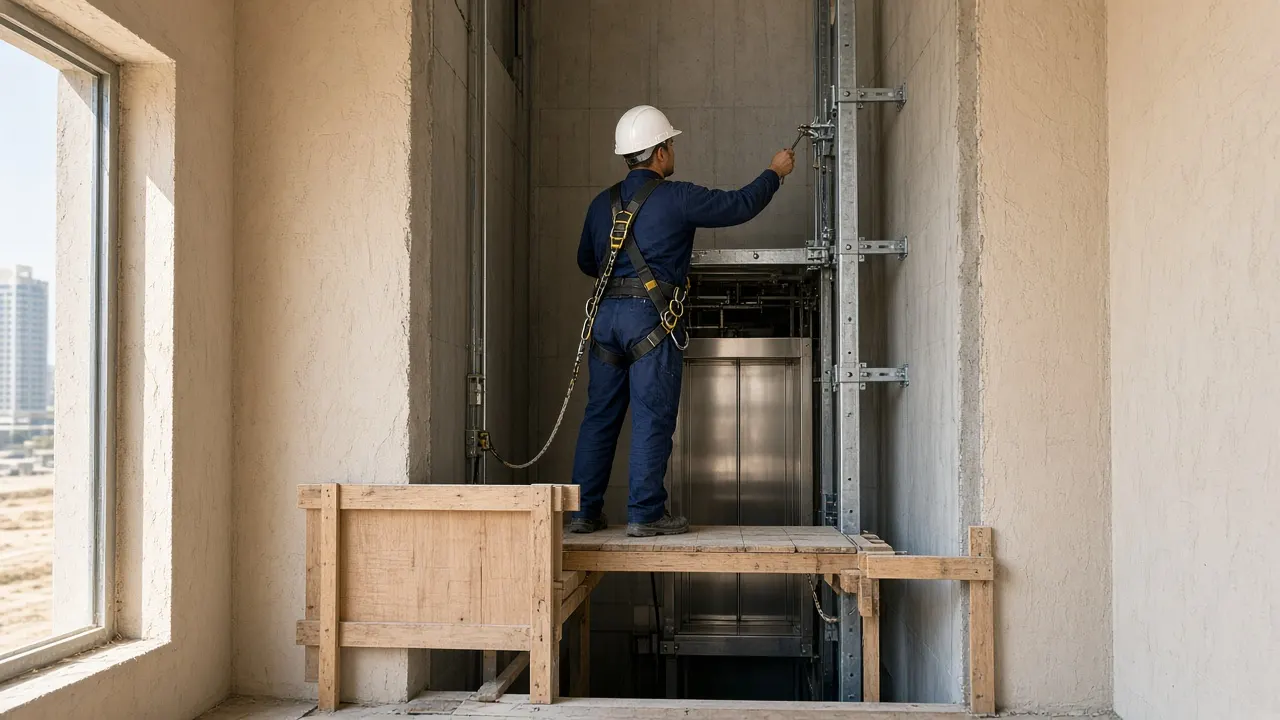
Quick answer: The lift installation process in Dubai runs in a fixed order: a site survey and lift type selection, civil preparation of the shaft, pit, headroom and (if needed) machine room, a dedicated power supply and other builder's works, supply of the equipment to the site, installation of rails, doors, car, machine, controller and wiring, then testing and commissioning by the installer. Before the lift goes into service, an inspection body accredited by the Emirates International Accreditation Centre (EIAC) inspects and certifies it, in line with Dubai Municipality guideline DM-HSD-GU48. Handover should include the certificate, drawings, manuals, keys and a maintenance plan, usually an annual maintenance contract (AMC). How long it takes depends on the lift type, the number of floors, manufacturing lead time and whether the shaft is ready when the equipment arrives.
Most delays on a lift project are not caused by the lift. They come from a shaft that is a few centimetres out of plumb, a pit that was poured too shallow, a power supply that was never brought to the machine position, or equipment that arrives before the building is ready to receive it. The lift itself is usually the most predictable part of the job.
This guide walks through the lift installation process in Dubai in the order it actually happens on site, from the first survey to the day the keys and certificate are handed over. It is written for villa owners, developers, consultants and main contractors who want to know what has to be ready at each stage, who is responsible for it, and which documents to ask for at the end. If you are still choosing a lift, start with the home lift planning checklist. If you are adding a lift to a villa you already live in, read the guide to a home lift for an existing villa alongside this one. For what Elevaya includes in an installation contract, see lift installation.
Elevaya Lifts has worked in the UAE since 2019 on more than 200 projects, covering design, supply, installation and annual maintenance contracts (AMC). We also service all major lift brands, including lifts we did not install, so the process below is described in a way that applies whichever manufacturer you choose.
What are the main stages of lift installation in Dubai?
A lift installation in Dubai has nine stages, and each one depends on the one before it being finished properly. The sequence is the same for a two-stop villa lift and a tower lift; what changes is the scale, the number of parties involved and the time each stage takes.
| Stage | What happens | Who usually leads it |
|---|---|---|
| 1. Site survey and lift selection | Measure the building, confirm use, stops, load and drive type, agree the standards suite | Lift company with the owner or consultant |
| 2. Design and approved drawings | Lift layout drawings with shaft, pit, headroom, loads and openings | Lift company, checked by consultant and structural engineer |
| 3. Civil and builder's works | Shaft, pit, headroom, machine room or MRL space, openings, lifting hook, waterproofing | Main contractor or owner's builder |
| 4. Power and services | Dedicated supply to the controller position, lighting and sockets in the shaft and pit, earthing | MEP contractor |
| 5. Supply and delivery | Ordering, manufacture, shipping, delivery and secure storage on site | Lift company |
| 6. Installation | Rails, landing doors, car, machine, controller, ropes or hydraulics, wiring | Lift company |
| 7. Testing and commissioning | Safety-gear, brake, overspeed, door and load tests, ride adjustment | Lift company |
| 8. Third-party inspection and certification | Inspection by an EIAC-accredited inspection body; certificate issued | Owner appoints; lift company supports |
| 9. Handover and maintenance | Documents, training, keys, AMC start | Lift company and owner |
Two things are worth taking from the table. First, stages 3 and 4 are rarely done by the lift company, but they decide whether stage 6 can start. Second, stage 8 is carried out by an independent party, not by the installer, so it needs to be planned and booked rather than assumed.
How does the site survey shape the whole lift project?
The site survey turns a wish ("we want a lift") into a buildable specification, and almost every later problem can be traced back to something the survey missed. A good survey records the building as it is, not as the drawings say it is.
For a new building, the survey is often a drawing review plus a site visit once the structure is up. For an existing villa or building, it is a full measured visit. Either way, the surveyor should confirm:
- Use and passengers: who will use the lift, whether a wheelchair, stretcher or goods need to fit, and how many people at a time. This drives the car size and rated load.
- Stops and travel: the number of floors served, including roof or basement, and the floor-to-floor heights.
- Lift type and drive: machine-room-less (MRL) traction, traction with a machine room, hydraulic, or a platform-type home lift. Our lift types and selection guide compares them.
- Available space: the shaft footprint, the depth that can be dug for a pit, the clear height available above the top floor, and where a controller can sit.
- Structure: what the shaft walls are made of and whether they can take rail bracket fixings, or whether a steel structure is needed.
- Access: how equipment will be brought into the building and stored, which matters a great deal in finished villas and tight urban plots.
At this stage the project also chooses its standards suite. Clause D.5 of the Dubai Building Code 2021 requires vertical transportation to be designed, installed, tested, commissioned and maintained to either the ASME A17 suite or the BS EN 81 suite of standards, and says one suite shall be selected for a project and the two shall not be used interchangeably. For villas, clause K.5.5.4 of the same Code says that if elevators are provided, their design shall conform to D.5 and D.6. Choosing the suite early matters because it fixes the safety clearances the shaft, pit and headroom have to provide.
What civil works does a lift shaft, pit and headroom need?
The builder has to deliver a shaft that is the right size, plumb, structurally ready for the rail fixings, with a dry pit of the right depth and enough headroom above the top landing, exactly as shown on the lift company's approved layout drawing. The dimensions themselves come from the chosen lift model and standards suite, so there is no single "Dubai size"; the drawing is the reference. Our guide to elevator shaft, MRL and structure planning explains how those dimensions are set. Here we focus on what has to be physically ready before installation can start.
Lift shaft preparation checklist:
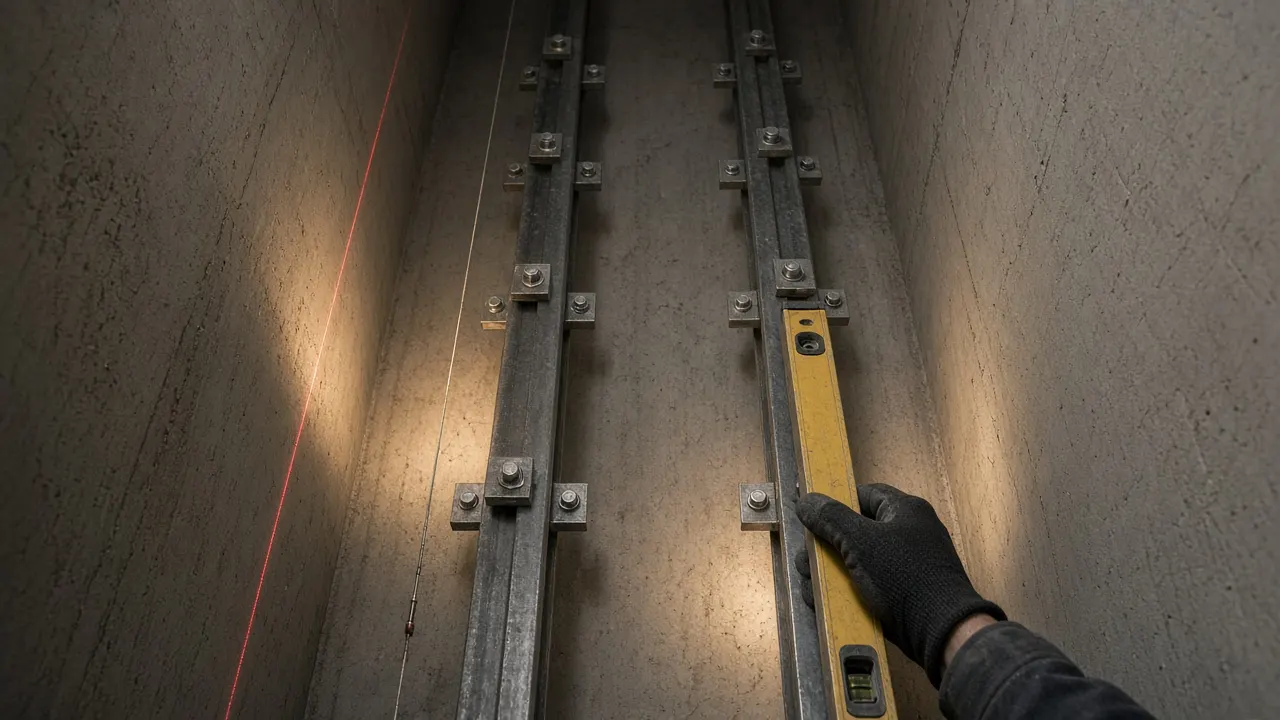
- Internal dimensions and plumb: the clear width and depth must match the drawing over the full height. A shaft that narrows at one floor, or drifts out of vertical, can force a smaller car or costly corrective works.
- Wall construction for fixings: rail brackets are fixed into the shaft walls or into embedded plates and steel members at set intervals. Blockwork may need reinforced bands, beams or steel framing at the fixing points; the structural engineer should confirm.
- Landing openings: openings at each floor, at the agreed width, height and position, with finished floor levels marked so landing sills can be set correctly.
- Pit: a pit of the depth on the drawing, with a level, structurally adequate base, waterproofing and no water ingress. A wet pit is a common reason installers refuse to start.
- Headroom: the clear height from the top landing floor to the underside of the shaft ceiling, again as per the drawing. Too little headroom is one of the most expensive mistakes to fix after the slab is cast.
- Lifting hook or beam: a rated hook or beam at the top of the shaft, if the lift design calls for one, for hoisting equipment during installation.
- Ventilation and safety: shaft ventilation where required, temporary barriers at open landings, and clear, lit access.
For buildings covered by Part B of the Dubai Building Code, clause B.6.6.4 adds a fire requirement: shafts for elevator hoistways passing through several floors must achieve the same fire resistance rating as the floors they pass through, as set by the UAE Fire and Life Safety Code. Firefighting lifts carry further shaft requirements under the same Code, which your fire consultant should cover.
Machine room or machine-room-less (MRL)?
With a machine room, the builder also provides a room, usually above the shaft, with the size, access door, lifting point, ventilation or cooling and lighting the lift company specifies. With an MRL lift, the machine sits inside the shaft and the controller usually goes in a cabinet at the top landing or in a nearby space. MRL saves a room, but it makes the shaft and headroom details even more important and needs proper cooling for the controller in the UAE heat. A hydraulic lift needs space for its power unit and tank, usually close to the bottom of the shaft. Whatever the choice, it should be fixed before the civil drawings are frozen.
What power supply and builder's works must be ready before installation?
Before the lift company can install and test, the building must provide a dedicated electrical supply to the controller position and the other "builder's works in connection" listed in the lift contract. These items are often in the main contractor's or MEP contractor's scope, and they are the most common cause of a finished lift that cannot be commissioned.
A typical builder's works list includes:
- Main power supply to the lift controller location, with its own isolator, sized to the lift company's load data, and the correct earthing.
- Lighting and sockets in the shaft, pit and machine room, as specified.
- Permanent power before testing. Lifts can be installed on temporary power, but final testing and commissioning normally need the permanent supply.
- Fire alarm interface where the building has a fire alarm system, so the lift returns to the designated floor on alarm.
- Intercom, CCTV or building management system connections, if specified.
- Finishes around the lift: architrave walls, landing floor finishes at the correct levels, and the cut-outs for landing call buttons and indicators.
- Waterproofing and drainage at the pit and, for outdoor or rooftop lifts, protection from rain and dust.
Clause D.6.1 of the Dubai Building Code also requires traction lifts in new buildings to include energy-conserving controls: VVVF drives on non-hydraulic lifts, energy-efficient lighting that switches off after a maximum of 5 minutes of inactivity, and a standby condition for off-peak periods. These come with the equipment, but they should be on the specification so they are checked at commissioning.
How do lift supply, lead time and delivery work?
Supply covers ordering, manufacturing, shipping and delivering the lift to site, and the lead time depends on the lift type, the level of customisation and the manufacturer's schedule, so it should be agreed in writing at order stage rather than assumed. "Supply and installation of lifts" in Dubai is usually one contract, but the supply part runs on its own clock.
The main factors that lengthen or shorten supply lead time are:
- Standard or custom: standard car sizes and finishes come faster than bespoke cabins, special glass, stone or metal finishes, or non-standard door sizes.
- Lift type: home lifts, standard passenger lifts, panoramic lifts, freight lifts and bed lifts each have different production paths.
- Approved drawings and final measurements: most manufacturers will not start production until the layout is approved and the shaft has been re-measured on site.
- Shipping and customs clearance, which vary with origin and season.
- Finish selections: late decisions on the cabin interior, buttons or landing doors hold up the order.
Delivery should be timed to site readiness. Equipment that arrives months before the shaft is ready sits in a corner of the site exposed to dust, humidity, heat and accidental damage. Agree a secure, dry, shaded storage area close to the shaft, keep packing intact until installation, and record the delivery against the packing list so missing items are flagged early. For villas that are already occupied, plan the delivery route through the house in advance.
What is the lift installation sequence on site?
On site, a lift is built from the bottom of the shaft up and from the structure inwards: guide rails first, then landing doors, then the car and counterweight, then the machine and controller, and finally the wiring that ties everything together. The exact order varies by manufacturer and lift type, but a traction lift typically goes in like this:
- Shaft check and setting out. The installer re-measures the shaft, hangs plumb lines or sets laser references, and confirms the shaft matches the approved drawing before anything is fixed.
- Guide rails and brackets. Brackets are fixed to the shaft walls and the car and counterweight guide rails are erected, aligned and joined. Rail alignment largely decides ride quality, so this is not a step to rush.
- Pit equipment. Buffers and pit fittings are installed.
- Landing doors. Sills, door frames and landing doors are fitted at each floor and aligned to the rails and finished floor levels.
- Car and counterweight. The car frame (sling), platform, safety gear, car walls, ceiling and car door are assembled; the counterweight frame is installed and filled.
- Machine and suspension. In an MRL lift the machine is mounted in the shaft; with a machine room it sits in the room. Ropes or belts are then installed and tensioned. In a hydraulic lift the cylinder, power unit and piping take this place.
- Controller and wiring. The controller is installed, and the travelling cable, shaft wiring, door operators, landing call stations, car operating panel and safety circuits are connected.
- First run. The lift is run slowly under inspection control, so clearances can be checked along the full travel.
For an existing villa, our guide to a home lift for an existing villa covers how to protect an occupied home during this stage. In any building, open landings must stay protected until the landing doors are installed and locked.
How are lifts tested and commissioned before handover?
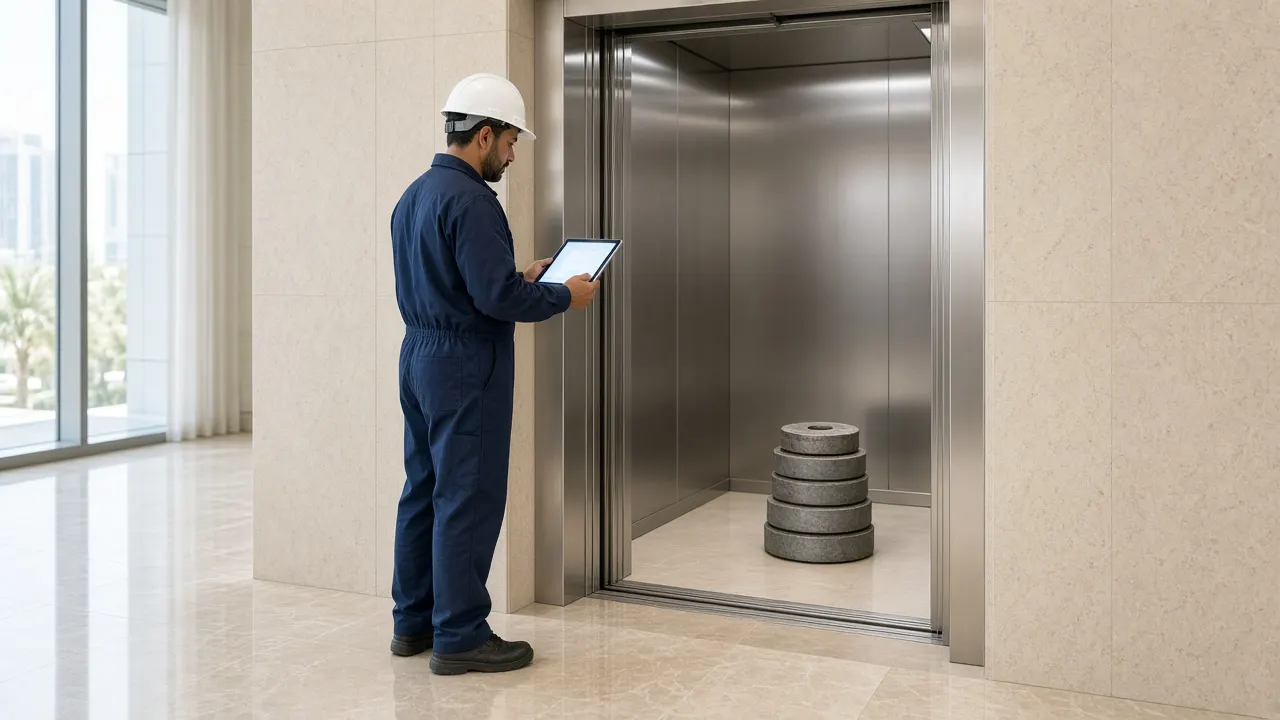
Testing and commissioning is the installer proving, step by step, that every safety function works and that the lift rides correctly, before an independent inspector is invited to verify it. It follows the test procedures of the standards suite chosen at the start (ASME A17 or BS EN 81) and the manufacturer's instructions.
Commissioning typically covers:
- Safety gear and overspeed governor: the governor trips at its set speed and the safety gear stops and holds the car.
- Brake and load tests: the brake holds the specified test load and the lift performs within its rated load.
- Door safety: door locks, door contacts, the door protective device (light curtain or edge) and door closing force.
- Limit and terminal switches, buffers and final limits.
- Emergency features: alarm button, intercom, emergency lighting, rescue operation and, where fitted, automatic rescue to the nearest floor on power failure.
- Fire service functions linked to the fire alarm interface, where the building has one.
- Levelling and ride quality: accurate stopping at each floor, smooth acceleration and quiet running.
- Energy features: VVVF drive, lighting switch-off and standby, as required by DBC clause D.6.1 for traction lifts in new buildings.
How is a new lift inspected and certified in Dubai?
In Dubai, a lift must be examined, tested and certified by a third party accredited by EIAC, and the certificate must be kept on site; the first inspection takes place when the new lift is commissioned and the inspections then repeat periodically. Two official documents set this out.
Dubai Municipality's DM-HSD-GU48-ECLA2 technical guideline (version 5.0, January 2025) applies to lifts and other lifting equipment in the Emirate of Dubai. It requires lifts to be tested and certified by an EIAC-accredited third party once every 12 months, says only persons qualified by EIAC may examine, test and certify the equipment, requires the certificate of safety to be issued only after any repairs have been carried out, and requires the compliance certificate to be kept at the site.
EIAC's requirements for lifting-equipment inspection bodies (EIAC-RQ-IB-002) describe what those inspections include:
- An initial inspection is defined as an inspection after production "for commissioning purpose", and an initial approval certificate is issued after a design review, inspection of the manufacturing process and the initial inspection (clauses 2.20 and 5.3.1).
- The inspection body may need to witness some installation steps, and critical stages of the installation may require inspector verification (clause 2.21).
- Inspectors verify that the installation complies with the reviewed design, and that an elevator's attachment to the structure has been adequately verified (clauses 5.4.2 and 5.4.3).
- For the Emirate of Dubai, Annex B lists elevators under lifting equipment used for lifting persons, with a proof load test during the initial inspection and periodic inspection every six months.
The practical lesson: book the inspection body early, give them the approved drawings and technical file, and ask whether they want to witness any installation stage. Our elevator inspection and testing guide covers how to prepare the document pack. The intervals above come from the documents as published; confirm the current interval for your lift with your inspection body.
What documents should you receive at lift handover?
At handover, the owner should receive everything needed to operate, maintain, inspect and later modernise the lift, not just the keys. Make this list part of the contract so "complete" means the same thing to everyone. A good handover pack includes:
- Third-party inspection certificate from the EIAC-accredited inspection body, and a copy for display or storage on site.
- As-built drawings: the final layout, wiring diagrams and controller schematics.
- Commissioning and test records from the installer.
- Operation and maintenance manuals, including the rescue procedure.
- Equipment list: model, serial numbers, rated load, rated speed, drive and controller type, and the standards suite.
- Warranty terms in writing, including what is covered and for how long. Our elevator warranty guide explains what to check.
- Keys and tools: controller, landing door release and machine room or cabinet keys.
- Owner training: how to use the lift safely, what to do if someone is trapped, and who to call.
- Spare parts guidance: which wear parts to keep in stock and where to source them.
How long does lift installation take in Dubai?
There is no honest single number: the time depends on the scope, so ask for a programme broken into stages instead of one headline figure. The total period from order to handover is driven mostly by supply lead time and civil readiness, not by the on-site installation itself.
The factors that most affect how long lift installation takes in Dubai are:
- Number of stops and travel height: more floors means more rails, landing doors and wiring.
- Lift type and customisation: a standard MRL passenger lift and a bespoke glass villa lift are very different jobs.
- Supply lead time from approval to delivery, as described above.
- Civil readiness: whether the shaft, pit, headroom, power and openings are complete and correct when the installers arrive.
- Site access and working hours, especially in occupied villas and buildings.
- Inspection booking: how quickly the third-party inspection can be scheduled after commissioning, and whether any findings need correcting.
- Finishes: cabin interiors and landing finishes that are installed last or by others.
Ask your lift company for a programme that shows each of the nine stages, which ones depend on the builder, and what the critical dates are for drawing approval, site readiness and delivery.
Villa lift installation steps: what is different in a home?
Villa lift installation follows the same stages, but space, structure and the fact that people may be living in the house change how each stage is handled. The most common differences we see in Dubai villas are:
- Shaft options: a built masonry or concrete shaft, a steel or glass shaft structure, or a self-supporting platform lift with its own enclosure. Each changes the civil works. See our posts on the glass villa lift in Dubai and panoramic villa lifts.
- Pit and headroom limits in existing villas, where digging a pit or raising a roof slab may be difficult. Some home lift designs need a shallower pit or less headroom; the survey decides what is feasible.
- Delivery and handling through doors, stairs and finished interiors.
- Protection of the home: dust control, floor protection and safe working while the family is present.
- Heat for outdoor and glass lifts, which affects controller cooling and cabin ventilation.
For a G+1 villa lift, Elevaya's non-comprehensive AMC in Dubai starts from AED 2,500 a year, including 12 visits (one per month), fixes for issues and free 24-hour emergency callouts, with replacement parts charged only when they need changing. Our elevator AMC cost guide explains what that covers.
What happens after handover: why does the AMC start on day one?
A new lift starts wearing from its first trip, so maintenance should begin at handover rather than after the warranty or the first breakdown. An AMC keeps the safety devices tested, the doors adjusted, the controller clean and cool, and the records ready for each periodic inspection. It also gives the owner one responsible party for callouts.
Two points are worth agreeing before handover:
- Who maintains the lift during the warranty period, and whether warranty depends on maintenance by a particular company.
- How periodic inspections will be prepared for and booked, given the intervals set out by Dubai Municipality and EIAC.
Because Elevaya services all lift brands, including ones we did not install, owners can keep the same maintenance provider if they later modernise or add lifts from another manufacturer. See lift maintenance and AMC for details, and our checklist for choosing the best lift company in Dubai before you sign either an installation or a maintenance contract.
Related Elevaya guides
Continue planning with these related Elevaya guides:
- Glass villa lift in Dubai: footprint, heat and cost factors: shaft vs shaftless, laminated glass, cabin cooling, hydraulic vs MRL vs platform.
- Glass and panoramic villa lifts in Dubai: 2026 planning guide: placement, glazing, heat control, approvals and AMC care.
- How to choose the best lift company in Dubai: buyer's checklist: licences, AMC terms, written response times, parts, references and red flags.
- Elevator AMC cost in Dubai: villa owners' guide: non-comprehensive from AED 2,500 for G+1, visits, callouts and parts rules.
- Lift speed by building height in Dubai towers: DBC travel-time formula, worked m/s examples, waiting times, DHA hospital and Trakhees rules.
- Elevator and escalator speeds in UAE buildings: rated lift speed by travel height and 0.5 vs 0.65 m/s escalators.
- Elevator modernization in Dubai: signs, scope and standards: when to modernize, controller and door upgrades, EN 81-20/80, downtime and cost factors.
- Elevator cabin design trends in the UAE for 2026: finishes, COP/LOP panels, LED lighting and glass cabins.
- Luxury elevator interiors in the UAE: marble, bronze and wood: weight, fire performance and cleaning of premium cabin finishes.
- Escalator design and maintenance for UAE malls: layout, balustrades, dust and heat, AMC and modernization.
- Escalator faults and repairs in Dubai: why escalators stop, safety-device trips, handrail and step chain wear, sand and heat, repair vs modernization.
- Lift COP and LOP panels in Dubai: what is on each panel, DBC button heights, Braille and intercom rules, common faults, repair vs replacement.
- Lift upgrades in Dubai: what to upgrade first: rescue devices for power cuts, door light curtains, VVVF and energy saving, cabin refresh, alarms, EN 81-80, upgrade vs modernization.
- Common lift problems in Dubai: causes and fixes: stuck lifts, doors not closing, jerky rides, noise and summer heat trips, safe owner checks, trapped-passenger steps, repairs and certification.
- Lift and elevator supply in the UAE: buyer's guide: supply-only vs supply and installation, what to specify, what a supply quote must include, BS EN 81 / ASME A17, EIAC certification, escalator supply and red flags.
- Lift maintenance checklist for Dubai: monthly service visit: what each monthly visit should check on doors, ride, machine and brake, alarm, car top and pit, the log book, maintenance vs inspection, villa lifts and an escalator checklist.
- Export lifts and elevator spare parts from the UAE: export documents, HS codes 8428 and 8431.31, Dubai Chambers certificate of origin fees and the steps from enquiry to shipment.
- Escalator modernization in the UAE: signs, scope and compliance: when to modernize, modernize vs replace, controller and drive, steps, chain and handrail, energy features, phased mall works and the EIAC major inspection.
- Escalator installation in the UAE: step-by-step process: survey and selection, pit and truss supports, rigging, alignment, controller, safety devices, testing, EIAC inspection and handover.
Related Elevaya services and guides: Lift installation, Home and villa lifts, Traction and MRL lifts, Inspection preparation, Lift maintenance and AMC, Elevator shaft and MRL planning.
FAQ
What are the steps of lift installation in Dubai?
Site survey and lift selection, approved layout drawings, civil works for the shaft, pit and headroom, power supply and builder's works, supply and delivery, installation of rails, doors, car, machine and controller, testing and commissioning, inspection and certification by an EIAC-accredited body, then handover and an AMC.
How long does lift installation take in Dubai?
It depends on the scope: the number of stops, the lift type and customisation, supply lead time, whether the shaft and power are ready, site access and how quickly the third-party inspection is booked. Ask for a staged programme rather than a single figure.
What must be ready before a lift can be installed?
A shaft built to the approved drawing, plumb and ready for rail fixings, landing openings at the right levels, a dry pit of the correct depth, the required headroom, a machine room or controller space if needed, a dedicated power supply with isolator and earthing, and safe, clear site access.
Who inspects and certifies a new lift in Dubai?
An inspection body accredited by the Emirates International Accreditation Centre (EIAC). Dubai Municipality guideline DM-HSD-GU48-ECLA2 requires lifts to be tested and certified by an EIAC-accredited third party, with the certificate kept on site, and EIAC's rules cover initial and periodic inspections.
What documents should I get when a new lift is handed over?
The third-party inspection certificate, as-built and wiring drawings, commissioning and test records, operation and maintenance manuals with the rescue procedure, an equipment list with serial numbers, written warranty terms, keys and tools, owner training, and spare parts guidance.
Does a new lift need an AMC straight away?
It is strongly advisable. Maintenance from day one keeps safety devices tested and records ready for periodic inspections. In Dubai, Elevaya's non-comprehensive AMC for a G+1 villa lift starts from AED 2,500 a year with 12 visits and free 24-hour emergency callouts.
Plan your lift installation in Dubai
Whether you are building a new villa, adding a lift to an existing home or delivering a building project, Elevaya can survey the site, prepare the layout and builder's works list, supply and install the lift, coordinate commissioning and inspection, and maintain it afterwards. Call or WhatsApp +971 58 584 4685 or contact Elevaya to plan supply and installation of lifts in Dubai and across the UAE.