Describe the location before the component.
Start with the property, exact escalator, direction, floor connection and operating status. Malls, hotels, airports, stations and public buildings have different traffic, access windows and passenger-diversion needs. If the unit is stopped or barricaded, keep it secured under the building’s procedures and do not remove covers or enter restricted areas to photograph a label.
Recognise the visible passenger-zone parts.
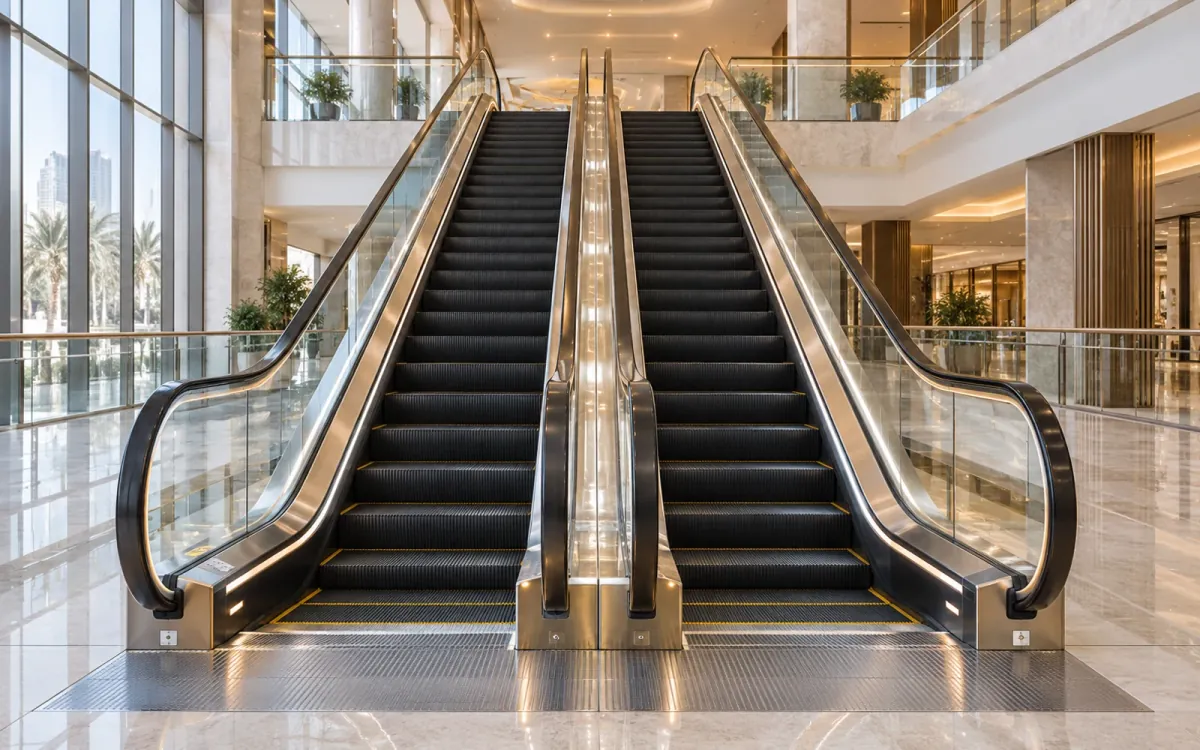
The steps or pallets, handrail belt, balustrade, skirt panels, comb plate, landing plate and entrance area are the parts most users see. Lighting and finish options may change appearance, but visibility and safe use take priority. Report a damaged step, loose landing plate, unusual handrail behaviour or foreign object immediately through the site’s established safety process rather than continuing operation.
Understand the concealed systems.
Inside the truss are drive, chain, track, braking, tensioning, lubrication, control and monitoring components. Their condition cannot be diagnosed from a public-area photograph. Noise, vibration, reversal, irregular step movement or repeated stoppage are observations—not proof of one failed part. A competent survey should record fault history and examine the relevant system safely.
Treat every protective device as equipment-specific.
Escalators can include monitoring for comb areas, step or pallet condition, chain behaviour, handrail entrances, unintended reversal and other conditions. Names and arrangements vary by model and applicable project criteria. A safety switch is not bypassed to restore service, and a generic catalogue list is not used as a substitute for the installed documentation and test procedure.
Build a parts request that can be verified.
Provide the manufacturer, model, serial or asset number, site, reported symptom, fault code if safely visible, service history and clear photographs taken from public areas. The replacement route must confirm part reference, revision, dimensions, electrical or mechanical compatibility and any associated adjustment or testing. Elevaya reviews OEM or suitable equivalent options only after equipment identification and inspection.
- Equipment identification and exact site asset
- Observed symptom, date and operating status
- Available manual, previous report and fault history
- Part reference and revision where verified
- Installation, adjustment, testing and return-to-service scope
Separate repair, refurbishment and modernization.
A damaged handrail or worn component may lead to a bounded repair. Repeated faults, obsolete controls, widespread wear or unavailable parts can justify a broader condition review. Modernization may retain some serviceable structures while replacing other systems, but the decision follows survey evidence, downtime planning and a written scope.
Questions, answered.
Can escalator parts be identified from a photo?
A photo can help prepare the visit, but it rarely confirms the exact part, revision, compatibility or underlying cause. Equipment records and inspection are still required.
Does Elevaya provide escalator maintenance and parts across the UAE?
Elevaya accepts escalator maintenance, repair and modernization enquiries across all seven Emirates. Equipment acceptance, attendance, parts and contract scope are confirmed per site.
Can an escalator safety switch be bypassed to keep it running?
No instruction on bypassing protective devices is provided. Secure the equipment under the site’s procedures and arrange competent assessment.
Elevaya develops every project around the surveyed equipment, building and agreed service scope.