Elevaya journal
Can an Elevator Cabin Be Customized With Bookmatched Marble, Brushed Brass, Bronze or Leather Panels?
Yes, a lift cabin can take bookmatched marble, brushed brass, bronze or leather. How slabs are matched, weight vs load, fire rules, care and lead times.
Published · Updated · Elevaya Lifts
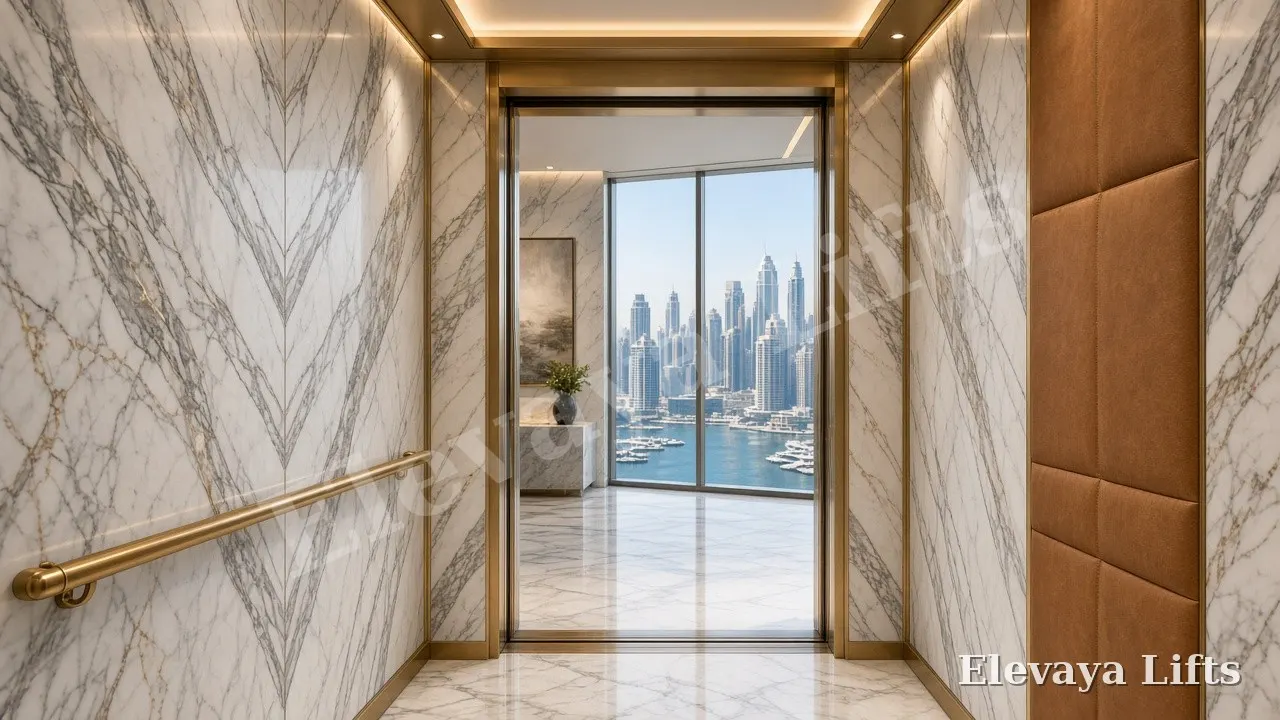
Quick answer: Yes. A lift cabin can be lined with bookmatched marble, brushed brass, bronze or leather, in new and existing lifts. What makes it work is engineering, not taste: the finishes have to fit the lift's weight allowance, pass the fire rules of the standard the lift is built to, be fixed mechanically and stay cleanable in Dubai's humidity.
We get this question in two forms. Some clients send a photo of a hotel lift with mirrored marble walls and ask whether a bookmatched marble lift cabin can be done at home. Others already have a lift and want to know whether the plain steel car can become something special. The answer to both is yes, but the route is different, and the details decide whether the result still looks right in five years.
Elevaya Lifts designs, supplies, installs and maintains lifts across all seven Emirates from Al Barsha 1, Dubai. We have worked in the UAE since 2019, our team of 40+ has completed more than 200 projects, and we design bespoke cabins in stone, metal and leather for luxury villas and penthouses. This guide is the practical side of that work. For the stones themselves, see our guide to rare marble and onyx lift interiors; for metals and leather on an existing car, see the luxury lift cabin upgrade guide.
What does bookmatched marble mean in a lift cabin?
Bookmatching means cutting two or more slabs one after another from the same block and opening them like the pages of a book, so the veins mirror each other across the joint. In a lift cabin, it usually means the rear wall shows one symmetrical pattern, with the joint running down the centre line of the car.
Getting it right in a cabin is harder than on a bathroom wall, for three reasons:
- The panels are small and interrupted. A cabin wall is broken by the handrail, the car operating panel, ventilation openings and the door returns. Each cut-out has to be placed so it does not slice through the most striking part of the vein.
- The sequence matters. Slabs are numbered as they come off the block. If one breaks during cutting or polishing, the next slab in the sequence is the only true match. That is why we reserve the whole run plus spares, not just the number of panels on the drawing.
- It is seen from very close. In a car you stand a step away from the wall under bright downlights. Small mismatches that would disappear in a lobby are obvious.
There are a few common patterns. A simple two-panel bookmatch on the rear wall is the classic. A four-way match (book and end matched) creates a centred, almost kaleidoscopic figure, and suits a tall car with a single feature wall. A continuous vein that wraps from the side walls into the rear needs every panel cut from the same sequence and set out together.
How do we plan the matching before any stone is cut?
By laying out the cabin on the actual slabs, not on a catalogue photo. Our usual sequence:
- Measure the car and draw every wall as a flat elevation with the handrail, panel, light and vent positions marked.
- Photograph the reserved slabs at the stone yard, front and back, with their sequence numbers.
- Overlay the cabin drawings on the slab photos and move them until the joints, the cut-outs and the best part of the vein line up. You approve this layout, not a sample tile.
- Cut, polish and dry-lay the panels in the workshop in their final arrangement, under light similar to the cabin's, before anything goes to site.
- Back and edge the panels for the lift. Thin stone is often bonded to a light backing such as an aluminium honeycomb panel to save weight and add strength.
Step 4 is the one we never skip. Seeing the full set flat on a table is the last cheap moment to change your mind.
How heavy can a marble, brass and leather cabin get?
Heavier than most people expect, and this is where a beautiful idea can fail. Natural marble weighs roughly 2.7 tonnes per cubic metre, so every square metre of solid 20 mm stone adds about 54 kg. Line three walls and a floor of an ordinary villa cabin and the stone alone can approach the weight of several passengers.
The decoration goes into the weight of the car itself, not into the passenger allowance. But the drive, brake, suspension, safety gear and buffers were all sized for a certain car weight plus the rated load. On a traction lift, the counterweight is normally set to the car's weight plus a share of the rated load, so a much heavier car has to be rebalanced and checked. On a hydraulic lift, more car weight means more pressure in the system. On a light platform lift, the limit arrives quickly.
That is why we work to a weight budget from the first sketch:
- Stone: thinner, backed panels where full thickness is not needed; solid stone kept for the floor, where it is supported.
- Metals: brass or bronze sheet over a light core, or PVD-coated stainless steel in a brass or bronze tone where touch and weight matter.
- Leather: upholstered onto light boards, which adds very little.
On a new lift, the drive and car are sized for the finished weight. On an existing lift, a lift engineer compares the new linings with what comes out and checks whether the balance and settings must change.
Which fire and material rules apply to cabin finishes in Dubai?
The rules of whichever standard the lift is built to. The Dubai Building Code requires vertical transportation to be designed, installed and maintained to one suite of standards, ASME A17 or BS EN 81, without mixing them (D.5), and its villa section says elevators, where provided, conform to D.5 and D.6 (K.5.5.4).
For a lift to the BS EN 81 suite, EN 81-20 sets fire-behaviour requirements for the materials of the car walls, floor and ceiling, tested against the European fire classification EN 13501-1, which the Dubai Building Code also lists in its references. In practice:
- Marble, brass and bronze are not combustible, so the questions are mostly about weight, fixing and edges.
- Leather, timber veneers, adhesives and some coatings can burn. We ask the supplier for fire test or classification data for the exact product, and keep it with the lift's records.
- Glass used in car walls must be laminated under EN 81-20, so check the build-up of any glass or mirror panel with the supplier.
If a material's acceptability for your building is unclear, ask your consultant, and confirm it with Dubai Civil Defence or the approving authority, before ordering. Lifts in buildings, such as a penthouse lift in a tower, also have accessible-lift requirements in DBC C.5.9.3 that shape handrails, contrast and lighting; our gold lift doors and luxury lift panels guide covers those.
How are the panels fixed, and what about ventilation?
Mechanically, with the panels removable. Adhesive alone is not enough for stone in a car that starts and stops thousands of times a year and sits in summer heat. Panels hang on concealed brackets or cleats fixed to the car shell, with a small gap for movement, and the heavy ones get a positive mechanical stop.
Removable matters for service. Technicians need to reach the car operating panel wiring, lights, the intercom and sometimes the car door equipment. A cabin where every panel is glued shut turns a simple repair into a refurbishment.
Ventilation is the other thing that cannot be designed out. The standard requires ventilation openings in the car, and they must stay clear behind and around the new linings. We usually hide them in shadow gaps at the top and bottom of the walls or in the ceiling detail, so the stone reads as continuous. In a Dubai villa where the lift runs all day, that airflow also stops the cabin feeling stuffy in August.
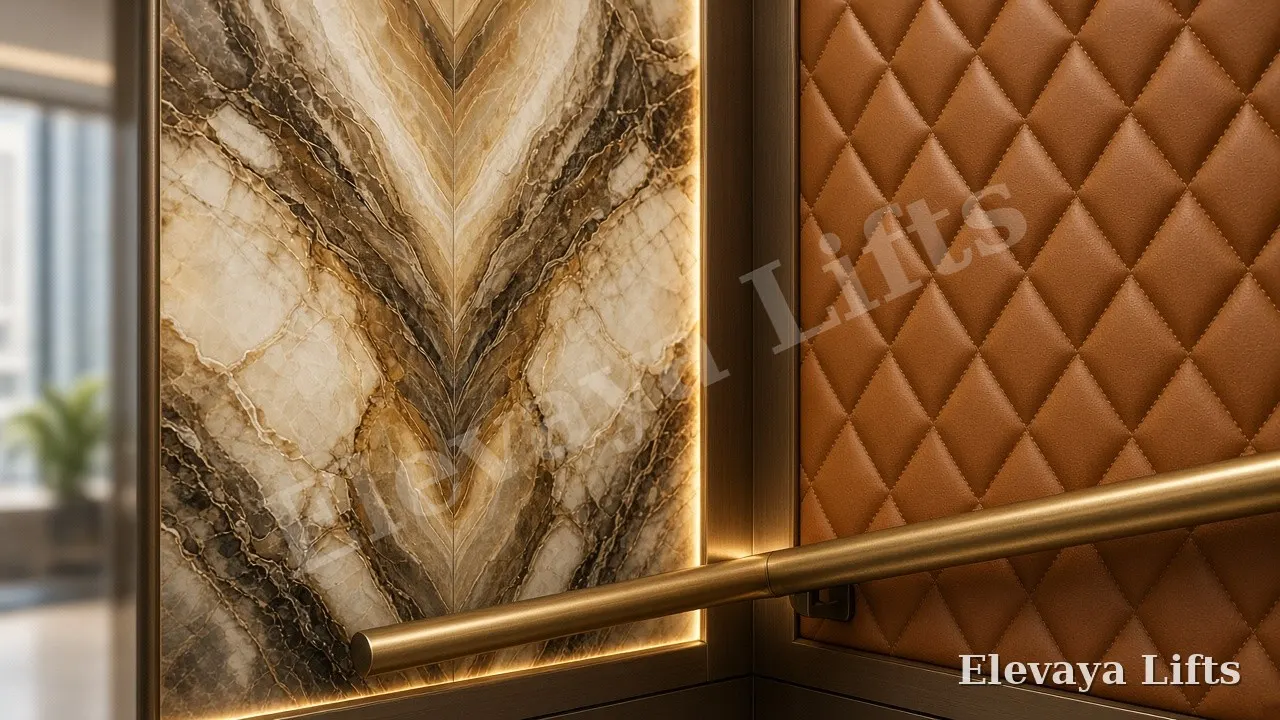
Brushed brass, bronze or leather: which suits which part of the cabin?
Each material has a natural place, and knowing where it ages well saves money later.
| Material | Where it works best | What Dubai does to it | How to keep it |
|---|---|---|---|
| Bookmatched marble | Rear feature wall, floor | Fine sand scratches the floor; acidic spills etch | Dry dust, pH-neutral stone cleaner, reseal as recommended |
| Brushed brass | Trims, handrail, door frames, ceiling details | Humidity and hands tarnish unlacquered brass quickly | Lacquered or PVD finish in high-touch areas; dry microfibre cloth |
| Bronze | Frames, panels, kick plates | Darkens and develops a patina | Accept the patina or seal it; no abrasive pads |
| Leather | Upper wall panels between metal frames | Dry air-conditioning cracks it; damp closed houses invite mould | Conditioner as the maker advises; keep away from door edges and luggage height |
Two notes from experience. Lacquered brass keeps its colour but a deep scratch shows; a "living" unlacquered finish hides scratches inside its patina but changes colour, especially near the coast on Palm Jumeirah or Jumeirah Bay. And leather is best kept above the handrail, framed in metal, where luggage, trolleys and shopping bags do not reach it.
How do you clean a stone, metal and leather cabin in Dubai's humidity?
Little and often, with the right product for each surface. The detailed stone routine is in our marble and onyx lift interiors guide. For a mixed cabin, the short version is:
- A soft dry cloth or microfibre for everything, daily if the lift is busy. Sand is the main enemy.
- No vinegar, lemon, bleach or general bathroom sprays on marble or brass. They etch stone and strip lacquer.
- Glass cleaner only on glass and mirrors, sprayed onto the cloth, not onto the wall, so it does not run onto stone or leather.
- Keep the villa's air-conditioning reaching the lift landing. Cabins in houses closed up for the summer suffer most from humidity.
Under an AMC, our technicians also check panels that have shifted or started to rattle, loose trims and failing lights at each visit.
How long does a bespoke stone and metal cabin take?
Longer than a standard car, and the timeline depends more on the materials than on the lift. The things that set the programme are:
- finding and reserving the right slab run, especially for a rare stone;
- approving the slab layout and the metal and leather samples;
- workshop cutting, backing and dry-laying;
- finishing metals and upholstering leather;
- for an existing lift, scheduling the fit-out so the lift is out of service as briefly as possible.
We give you a programme after the survey, once the stone and finishes are chosen. The cabin upgrade guide explains how the downtime is kept short by building almost everything off site.
Is it easier with a new lift or a retrofit?
In a new villa or a new lift
Easier, because the car, drive and structure are designed around the finished weight from day one. If you know you want a full stone cabin, say so before the lift type is chosen; it can change the drive. Our comparison of Cibes, Nibav, Aritco and custom Italian traction villa lifts explains why heavy cabins usually point to traction.
In an existing lift
Possible, with a lighter hand. We survey the lift, weigh what comes out, check the load allowance and the condition of the equipment, then choose thinner stone, framed panels and PVD metals where needed. A single bookmatched rear wall in brass frames often changes a cabin more than lining every surface. If the drive or doors are also due for work, plan the cabin with a lift modernization; otherwise it is a cabin refurbishment. After the work, have the lift checked and tested before it returns to service.
What does a bespoke cabin cost with Elevaya?
Bespoke cabins are priced after a site survey, because the stone, metals and lift type vary so much. For context, some of our bespoke luxury lifts, with handcrafted Italian marbles and precious metals such as gold, cost AED 2 million to 5 million, and a few AED 20 million to 25 million. At the other end, our basic home lifts are from AED 69,999, and some basic models start as low as AED 60,000. Our non-comprehensive AMC for a G+1 Dubai villa lift starts from AED 2,500 a year, including 12 visits, fixes, free 24-hour emergency callouts and parts charged only when needed.
Elevaya designs bookmatched stone, brass, bronze and leather cabins for villas and penthouses across the UAE, and maintains lifts of all brands, including Otis, KONE and Schindler, and lifts we did not install. See bespoke luxury villa lifts and our marble and onyx lift collection for design directions.
Related Elevaya guides
Continue planning with these related Elevaya guides:
- What is the difference between Cibes, Nibav, Aritco and custom Italian traction villa lifts in Dubai?: drive types, EN 81-41 versus EN 81-20/50, published speeds, pit and headroom, cabin sizes, customisation and service.
- Luxury marble and onyx lift interiors in Dubai: Statuario, Nero Marquina, onyx, malachite and lapis in lift cabins, with care and retrofit notes.
- Luxury lift cabin upgrade in Dubai: rose gold PVD, bronze, black titanium, rare veneers, leather and gold leaf on an existing lift, and how downtime is kept short.
- Luxury elevator interiors in the UAE: marble, bronze and wood: how to specify classic luxury finishes for a lift cabin.
- Gold lift doors and luxury lift panels in Dubai: doors, buttons, handrails and the accessibility rules that frame them.
- Can you install a luxury elevator in an already built Dubai villa without a concrete shaft or deep pit?: self-supporting structures, shallow-pit and pitless options, EN 81-21 and EN 81-41, positions in finished villas, approvals and cost.
- Which is quieter and smoother for a luxury villa: screw-driven, hydraulic or gearless traction?: how each drive sounds and rides in a Dubai villa, where noise really comes from, heat effects and how to test a lift before you buy.
- Bespoke luxury lift design process in Dubai: from brief and survey to drawings, samples, manufacture and installation.
- Bespoke luxury home lifts in Dubai: gold, gems and rare marble: what can be customised, how precious finishes are specified, weight, safety and care.
- How do I install a private lift inside a duplex penthouse in Downtown Dubai or Dubai Marina?: building and master developer NOCs, slab openings in towers, near-pitless lift types, delivery through service lifts, heat and cost drivers.
- What is the smallest footprint possible for a luxury townhouse lift in Dubai Hills Estate or Arabian Ranches?: published compact lift sizes, under-stair and void positions, pit and headroom, EN 81-41 versus EN 81-20 and Emaar community NOCs.
- Are panoramic outdoor glass elevators safe against Dubai summer heat, UV and coastal humidity?: cabin heat and cooling, UV and seals, salt air on coastal villas, condensation, standards and maintenance for outdoor glass lifts.
- What glass specification (laminated, tempered, smoked or smart switchable glass) is best for villa lifts?: laminated vs tempered vs heat-strengthened plies, PVB and ionoplast interlayers, heat soaking, tints, smart glass and Dubai safety glazing rules.
- How much noise in decibels does a luxury gearless villa elevator make inside a bedroom-adjacent shaft?: bedroom decibel targets from WHO and DIN 8989, Dubai Building Code noise rules, airborne and structure-borne paths, shaft isolation and how to measure.
- Can a luxury home lift integrate with KNX, Lutron or Control4 smart home lighting and access systems?: what a villa lift can share with a smart home, relays vs gateways, access control, what stays in the lift controller, cybersecurity and Dubai rules.
Related Elevaya services and guides: Bespoke luxury villa lifts, Marble and onyx lifts, Gold lifts, For designers, Lift cabin wall panels, Lift cabin renovation, Luxury lift design, Lift refurbishment, Lift modernization, Contact Elevaya.
FAQ
Can bookmatched marble be used on all cabin walls?
Yes, if the lift is designed for the weight and the slab sequence is long enough to cover every panel. Many clients choose one bookmatched feature wall and quieter stone or metal on the sides, which saves weight and money.
Is leather allowed inside a lift cabin?
It can be, if the specific leather and its backing meet the fire requirements of the standard the lift is built to. Ask for fire test data for the exact product, and confirm with your consultant or the authority if unsure.
Will brushed brass tarnish in Dubai?
Unlacquered brass will darken, faster near the coast and where it is touched often. Lacquered brass or brass-tone PVD on stainless steel keeps its colour longer and suits handrails and door frames.
Does a heavy marble cabin reduce how many people the lift can carry?
The rated load stays the same, but the extra car weight must be within what the drive, brake, suspension and safety gear were designed for. On an existing lift, an engineer checks this and may rebalance the lift.
Can an existing villa lift get a bookmatched marble cabin?
Often, yes, with lighter backed stone and a careful weight check. A single bookmatched rear wall is the usual starting point. A survey shows what your lift can carry.
Plan your cabin with Elevaya
Send us a photo of the look you love and a few details of your lift or plans. We will survey, check the weight and rules, and show you a slab layout before anything is cut. Call or WhatsApp +971 58 584 4685, explore bespoke luxury villa lifts, or contact Elevaya.