Elevaya journal
What Glass Specification (Laminated, Tempered, Smoked or Smart Switchable Glass) Is Best for Villa Lifts?
Laminated, tempered, smoked or smart glass for a villa lift? Plies, PVB vs ionoplast, heat soaking, tints and Dubai safety glazing rules explained.
Published · Updated · Elevaya Lifts
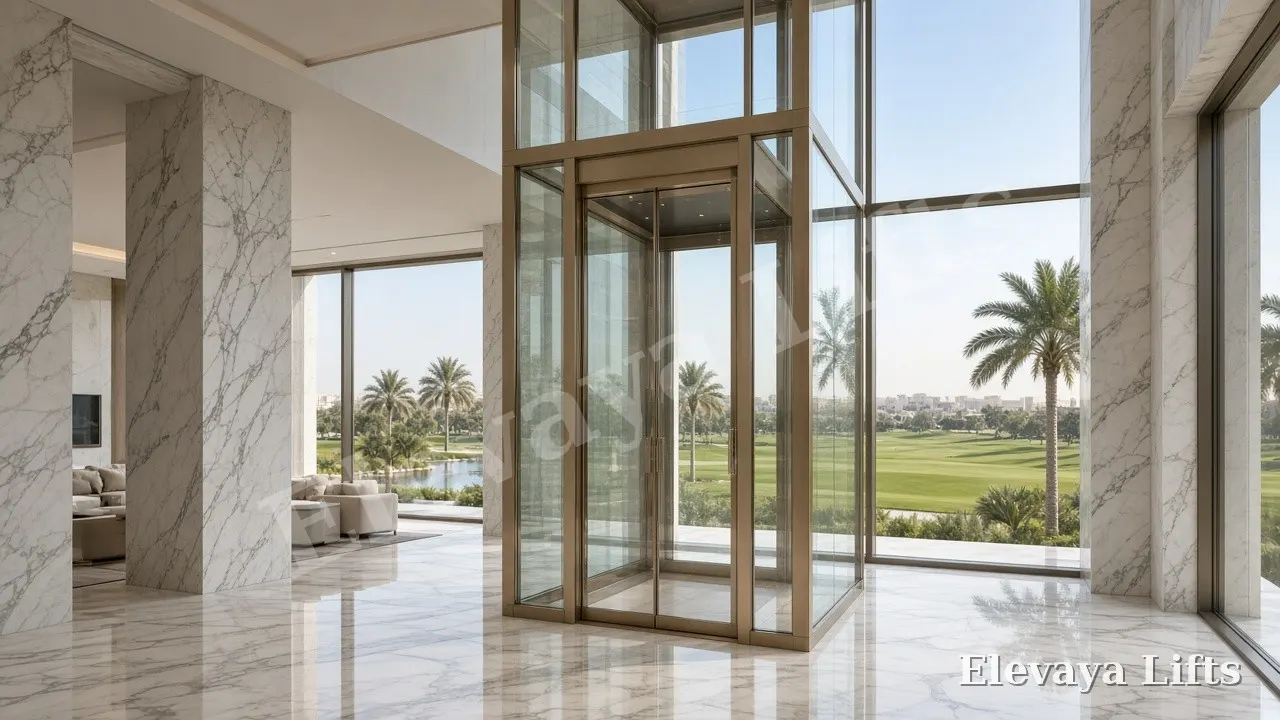
Quick answer: For a villa lift, the best glass is laminated safety glass built from toughened or heat-strengthened plies, ideally heat soaked. Tempered glass on its own is not enough for cabin or shaft walls. Smoked, low-iron or solar-control glass is a choice of look and heat, and smart switchable glass suits laminated panels where privacy really matters.
"Laminated, tempered, smoked or smart?" sounds like four options to pick from. It is not. Two of those words describe how the glass is made safe, one describes its colour and one describes a film inside it. A good villa lift panel often combines three of them.
So the useful question is a little different: what goes into each panel, and why. This guide takes the panel apart layer by layer, then shows where Dubai's rules come in. If your lift will stand outside, read it together with our guide on whether outdoor glass elevators are safe against Dubai heat, UV and coastal humidity, which covers seals, steel, cooling and maintenance.
Elevaya Lifts designs, supplies, installs and maintains home and bespoke luxury villa lifts from its office in Al Barsha 1, Dubai. Since 2019 our team of 40+ has completed more than 200 projects across all seven Emirates.
Which glass goes where in a villa lift?
Different parts of the lift do different jobs, so they do not all get the same glass. As a starting point:
| Part of the lift | What the glass has to do | Usual make-up |
|---|---|---|
| Cabin walls | Carry people leaning on them, stay in place if broken | Laminated, from toughened or heat-strengthened plies |
| Shaft or enclosure walls | Protect people outside the lift from moving parts, resist impact | Laminated safety glass |
| Glass landing and cabin doors | Take repeated use and impact, meet the door tests of the lift standard | Laminated glass tested as part of the door |
| Roof or overhead glass on the shaft | Stay up after breakage | Laminated, with post-breakage containment |
| Glass balustrade beside the lift landing | Protect a drop | Laminated glass that holds in place if shattered |
Notice what is missing: a single pane of tempered glass. That is the one choice we never make for a lift wall.
Laminated, tempered or heat-strengthened: what is the difference?
They are different answers to different problems:
- Tempered (toughened) glass is heated and quenched so it is several times stronger than ordinary glass. When it breaks, it breaks into small, blunt pieces. Strong and safe to fall on, but once broken, a single tempered pane no longer stands up.
- Heat-strengthened glass goes through a gentler version of the same process. It is about twice as strong as ordinary glass and breaks into larger pieces that tend to stay in the frame. It is also much less prone to spontaneous breakage than fully tempered glass.
- Laminated glass is two or more panes bonded together with a plastic interlayer. If a pane cracks, the pieces stick to the interlayer and the panel keeps acting as a wall.
For a lift, laminated is the requirement and tempered or heat-strengthened is the ingredient. EN 81-20, the European standard for passenger lifts, expects glass in car walls to be laminated, and the glass panel has to pass its impact tests as fixed. A laminate of two toughened plies is very strong but can sag after both plies break; a laminate of two heat-strengthened plies, or one of each, holds its shape better after breakage. Which one is right depends on the panel size and how it is fixed, and that is an engineering decision for the glass supplier and the lift designer together.
Why is tempered glass alone not enough for a lift?
Because a lift wall has to stay a wall after something goes wrong. A child's scooter, a dropped suitcase, a stone thrown up by a garden machine: once a single tempered pane breaks, the opening is open. With laminated glass, the cracked panel stays in place until it is replaced, and the lift is taken out of service in the meantime. That is the whole point of a glass lift being safe.
Which interlayer should villa lift glass use: PVB, ionoplast or EVA?
The interlayer is the part most buyers never ask about, and it decides how the glass ages.
- PVB is the standard interlayer for laminated safety glass. It is proven and economical, and it filters most UV. Its weak point is the edge: if a PVB edge is left exposed to moisture for years, it can cloud or start to delaminate. Indoors, with edges sealed in a frame, it is usually the right choice.
- Ionoplast interlayers are much stiffer and stronger. They keep a broken panel rigid, allow thinner or larger panels, and cope better with exposed edges. They suit frameless-looking cabins, large panels and outdoor shafts. They cost more.
- EVA is used mostly for decorative laminates, such as fabric, mesh or printed layers, and in some smart glass. Check that any decorative laminate is still tested as safety glass.
Ask which interlayer is in the quotation and how thick it is. "Laminated" with no further detail is not a specification.
Should villa lift glass be heat soaked?
Yes, for any toughened ply. Toughened glass carries a small risk of breaking on its own years later because of tiny nickel sulphide inclusions from manufacture. A heat soak test deliberately heats the toughened glass after manufacture, so most panels with a critical inclusion break in the oven rather than in your hall.
The European standard for heat soaked toughened glass, EN 14179-1, is honest that the risk is reduced, not removed. In a laminated lift panel, a spontaneous break of one ply is an inconvenience rather than a danger, but heat soaking makes it much rarer. On a bespoke lift with large, made-to-measure glass that takes weeks to replace, it is worth it.
Smoked, tinted, low-iron or coated: what changes?
The look and the heat, not the safety. Safety comes from the laminate; colour and coatings are layered on top.
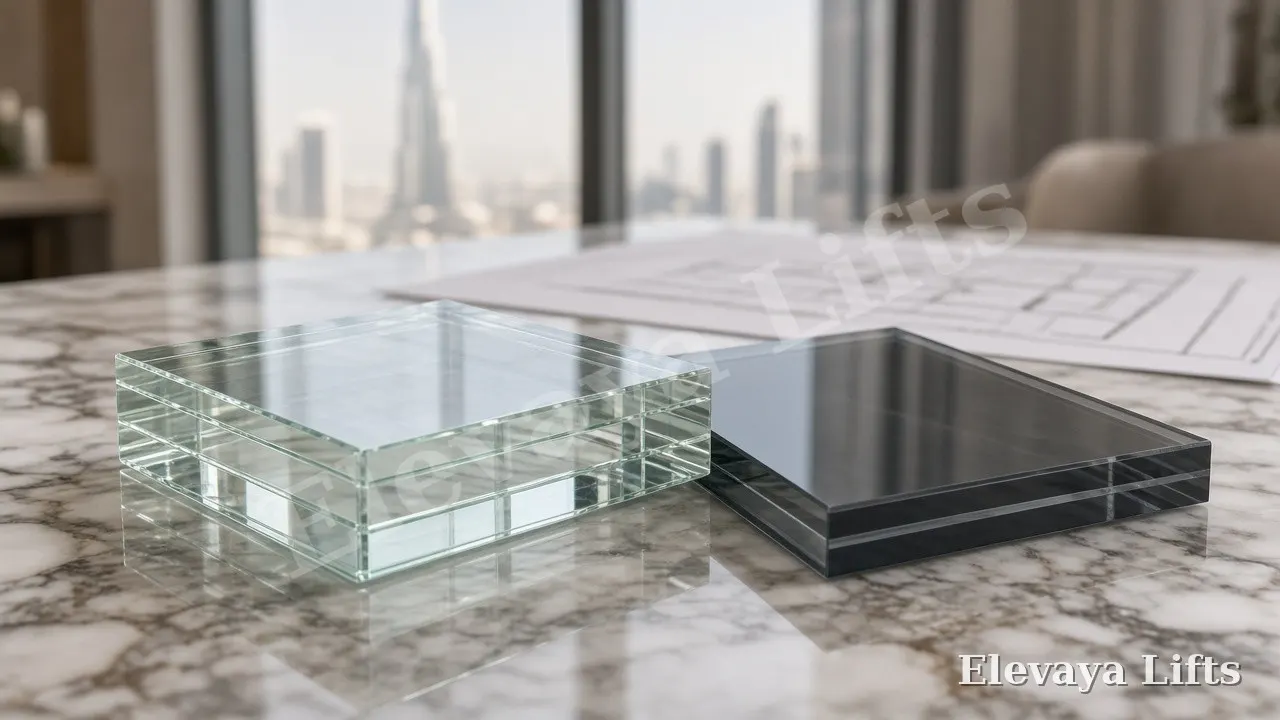
- Smoked or tinted glass is either body-tinted glass or a clear glass with a tinted interlayer. Grey and bronze tints suit dark marble and bronze frames. They reduce glare and some heat, and they give a bit of privacy by day.
- Low-iron (extra-clear) glass removes the green edge tint of ordinary glass. In a thick laminate the difference is obvious, and it is the usual choice when the view or the interior is the point of the lift.
- Solar-control and low-e coatings cut the heat that comes through. Many need to sit inside the laminate or inside a sealed unit, not on an exposed face. Stronger coatings look more reflective from outside.
- Acid-etched or frosted panels give privacy at chosen heights without power.
Two practical notes. Tinted glass shows the cabin lights at night much more than by day, so privacy disappears after dark. And always look at a full-size sample in daylight at the lift position before you sign off.
If the glass forms part of the villa's air-conditioned envelope, for example a glass shaft on an outside wall that opens into the house, your consultant may have to show that the glazing also meets the Dubai Building Code's villa envelope criteria for shading coefficient and light transmittance (Table K.13). Confirm with the consultant and the authority how they treat a lift shaft.
Is smart switchable glass a good idea in a villa lift?
Sometimes, for a few panels, not usually for the whole lift. Smart switchable glass uses a liquid crystal film laminated between glass. Powered, it is clear; switched off, it turns milky white. In a villa lift it is useful where a glass shaft passes a bedroom or a guest suite and the owner wants the view most of the time and privacy some of the time.
What to check before you choose it:
- It must still be laminated safety glass. The smart film sits inside a laminate that has to meet the same safety requirements as any other lift panel.
- Power has to reach the cabin. Cabin panels need power through the lift's travelling cable and a controller. Shaft panels are easier because they do not move. The laminated glass standard EN 14449 itself notes that glass with electrical wiring or connections can fall under other electrical rules as well.
- Heat and UV. Smart film has temperature and UV limits. On a sun-facing outdoor shaft in Dubai, ask the manufacturer for its rated range and warranty in writing.
- What it looks like off. Switched off, the panel is white, not tinted. Decide what you want the lift to look like during a power cut.
- Replacement. A failed smart panel means replacing the glass, and bespoke sizes take time. Ask about lead times for spares.
For many villas, a fixed frosted band at the right height, or tinted glass, gives enough privacy at a fraction of the complexity.
What do Dubai's rules say about glass in a villa lift?
The lift glass follows the lift standard, and the glass around the lift follows the building code. The Dubai Building Code requires lifts to be designed, installed, tested, commissioned and maintained to one suite of standards, ASME A17 or BS EN 81 (D.5), and applies that to villa lifts (K.5.5.4). Home lifting platforms are built to EN 81-41, now in its 2024 edition, and passenger lifts to EN 81-20. The glass in the lift should be the glass that was tested and certified with the lift, not a local substitute.
For the villa around the lift, Part K of the code says:
- Safety glazing is required in critical locations in doors, side panels and low-level glazing, classified to BS EN 12600 or the American equivalents (K.7.6.1).
- Containment is needed for glazing below 800 mm that protects a drop of more than 760 mm (K.7.6.2).
- Overhead glazing shall be laminated, with a post-breakage containment system (K.7.6.3), which covers glass roofs over a shaft or a lift lobby.
- Glass in balconies and guardrails shall be laminated glass that holds in place if shattered.
The code's accessibility section also recommends that panoramic elevators include a full-height opaque section (C.5.9.3.2). It sits in the accessible elevator requirements, so ask your consultant whether it applies to your private lift. Fire separation for the shaft is a matter for Dubai Civil Defence under the UAE Fire and Life Safety Code; confirm it with them through your consultant. Approvals start with your master developer's NOC and the building permit; our villa lift permit and NOC guide explains the steps.
How thick should villa lift glass be?
As thick as the engineering says, and no thinner. Thickness depends on panel size, how it is fixed (four-sided frame, two sides, point fixings), the loads it carries, the interlayer and the test results for that panel. We do not quote a standard thickness because there is not one. Ask for the glass calculation or the test evidence for your actual panels, and for a marking or certificate that identifies the glass make-up.
What would we usually specify for a Dubai villa lift?
Every villa is different, but this is where we start the conversation:
- Indoor glass lift in a stair void or atrium: low-iron laminated glass from heat-strengthened or heat-soaked toughened plies, PVB interlayer with edges protected by the frame.
- Outdoor or sun-facing glass shaft, especially by the sea: laminated glass with an ionoplast interlayer, solar-control coating or tinted interlayer, and edge detailing designed for weather, plus everything in our outdoor glass lift guide.
- Privacy at bedroom levels: a fixed frosted or tinted band first; smart switchable panels where the owner really wants clear and private on demand.
- Statement lifts: curved laminated glass, tinted interlayers to match bronze or gold frames, or decorative laminates, all tested as safety glass.
How does the glass affect the price?
A lot, on a bespoke glass lift. Low-iron glass, thicker laminates, ionoplast interlayers, heat soaking, curved panels, coatings and smart film each add cost and lead time, and large panels need more careful delivery and lifting on site. Bespoke lifts are priced after a site survey. Some of our bespoke luxury lifts cost AED 2 million to 5 million, with handcrafted Italian marbles and precious metals such as gold, and a few cost AED 20 million to 25 million. Our guide to what a bespoke glass panoramic villa lift costs in Dubai explains the other cost drivers.
For standard lifts, Elevaya's basic home lifts are shown from AED 69,999, and some basic models start as low as AED 60,000. After handover, our non-comprehensive AMC for a G+1 Dubai villa lift starts from AED 2,500 a year: 12 visits, fixes, free 24-hour emergency callouts, and parts charged only when needed.
Related Elevaya guides
- Are panoramic outdoor glass elevators safe against Dubai summer heat, UV and coastal humidity?: cabin heat, UV and seals, salt air, condensation, standards and maintenance for outdoor glass lifts.
- How much does a bespoke glass panoramic villa lift cost in Dubai in AED, including installation?: what moves the price of a glass lift and what a full quote covers.
- Glass villa lift in Dubai: footprint, heat, glazing and cost factors: structures, drives and space for glass home lifts.
- Glass and panoramic villa lifts in Dubai: a planning guide: placement and styling ideas for glass lifts.
- Can an elevator cabin be customized with bookmatched marble, brushed brass, bronze or leather panels?: heavy finishes, weight and fire rules for bespoke cabins.
- Emirates Hills bespoke lifts: plan the home before the finish: local notes for Emirates Hills villas.
- How much noise in decibels does a luxury gearless villa elevator make inside a bedroom-adjacent shaft?: bedroom decibel targets from WHO and DIN 8989, Dubai Building Code noise rules, airborne and structure-borne paths, shaft isolation and how to measure.
- Can a luxury home lift integrate with KNX, Lutron or Control4 smart home lighting and access systems?: what a villa lift can share with a smart home, relays vs gateways, access control, what stays in the lift controller, cybersecurity and Dubai rules.
Related Elevaya services and guides: Bespoke luxury villa lifts, Panoramic lifts, Lift design, Home lifts, Villa lift prices, Home lift maintenance, Contact Elevaya.
FAQ
Is tempered glass enough for a villa lift?
No. A single tempered pane loses its strength completely once broken. Lift cabin and shaft walls use laminated safety glass, usually made from tempered or heat-strengthened plies.
What is the best glass for a glass villa lift?
Laminated safety glass from heat-strengthened or heat-soaked toughened plies, with a PVB interlayer indoors or an ionoplast interlayer for large panels and outdoor shafts, and low-iron glass where clarity matters.
Can I use smoked or tinted glass in a home lift?
Yes. Tint comes from body-tinted glass or a tinted interlayer inside the laminate, so the panel stays safety glass. It cuts glare by day but gives little privacy at night when the cabin is lit.
Does smart switchable glass work in a lift?
It can, as a laminated panel. Cabin panels need power through the travelling cable, and the film has heat and UV limits, so check the manufacturer's rating for Dubai conditions.
Do Dubai rules require laminated glass for lifts?
The lift's chosen standard governs the lift glass, and EN 81-20 expects laminated glass in car walls. The Dubai Building Code also requires overhead glazing and glass balustrades in villas to be laminated.
Choose the right glass with Elevaya
Bring us your design references and the lift position, and we will show you real samples and a written glass specification for each panel. Call or WhatsApp +971 58 584 4685, explore bespoke luxury villa lifts, or contact Elevaya.