Elevaya journal
Are Panoramic Outdoor Glass Elevators Safe Against Dubai Summer Heat, UV and Coastal Humidity?
Are outdoor glass lifts safe in Dubai heat, UV and sea air? What really ages them: cabin heat, seals, salt corrosion, condensation and upkeep.
Published · Updated · Elevaya Lifts
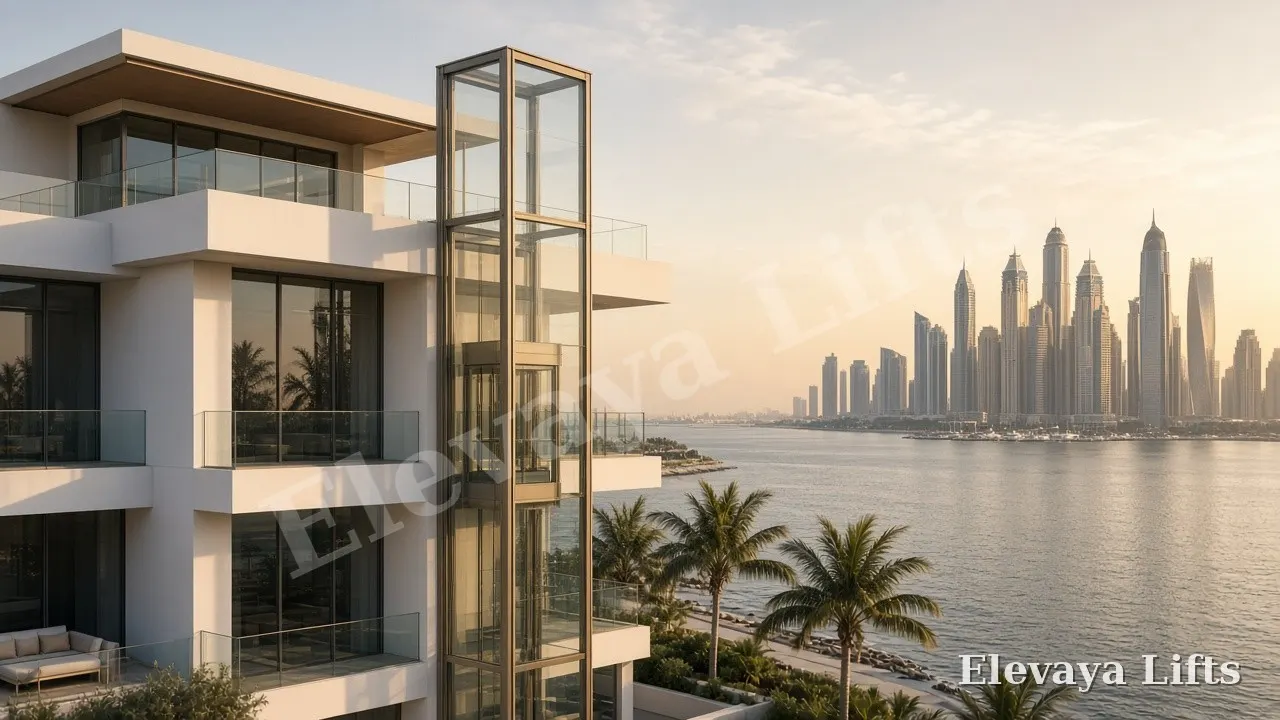
Quick answer: Yes, when it is designed for the site. Properly specified laminated safety glass does not fail because of Dubai heat or UV. The real risks sit around the glass: an overheated cabin, electronics working near their limit, perished seals, and steel or fixings corroding in salt air. Shading, cabin cooling, marine-grade materials and monthly maintenance deal with all four.
People who ask us this have usually seen the render already. A glass lift running up the outside of a Palm Jumeirah villa, sea on one side, skyline on the other. Then someone at a dinner party tells them the glass will cook in August, or that the sea air will eat the lift in five years, and the doubt sets in.
Both worries are reasonable, and neither is a reason to give up the idea. An outdoor glass elevator in Dubai is a normal project when it is treated as an outdoor machine, not as an indoor lift that happens to be outside. This article is about that difference: what the climate actually does to an outdoor panoramic lift, and what keeps it safe and comfortable. Choosing the glass itself (laminated, tempered, tinted or smart) has its own guide: what glass specification is best for villa lifts.
Elevaya Lifts is a UAE lift company with its office in Al Barsha 1, Dubai. Since 2019 our team of 40+ has completed more than 200 projects across all seven Emirates, covering lift design, supply, installation and annual maintenance, including glass and bespoke luxury villa lifts.
Is an outdoor glass lift safe in a Dubai summer?
Structurally, yes. The question people really mean is usually comfort and reliability, and those are where the design work goes.
Separate three things when you judge an outdoor glass lift:
- Passenger safety. Will the glass hold, will the doors and safety gear work, can someone be rescued if the power fails? These are governed by the lift standard and the glazing rules, and heat does not change them if the lift is built to them.
- Comfort. How hot is the cabin after the lift has stood in the sun for an hour? This is the problem owners notice first, and it is a design problem, not a safety one.
- Durability. How fast do the seals, finishes, steel and electronics age outside? This decides whether the lift still looks and runs like new in year eight.
An outdoor glass elevator that gets the first point right and ignores the other two will be safe and miserable. The rest of this guide is mostly about the other two.
What does the climate actually do to an outdoor glass lift?
Each part of the Dubai climate attacks a different part of the lift. This is how we break it down on a survey:
| Exposure | What it affects | What we look for in the design |
|---|---|---|
| Summer heat (air in the high 40s °C) | Cabin temperature, controller and drive electronics, hydraulic oil if used | Shading, cabin cooling, equipment rated for the ambient, machine space away from direct sun |
| Direct sun on glass | Heat gain inside the cabin, thermal stress in the glass, fading of finishes | Orientation, solar-control glass, toughened or heat-strengthened plies, UV-stable materials |
| UV | Sealants, gaskets, exposed interlayer edges, powder coat, cabin leather or timber | UV-rated silicones and gaskets, protected glass edges, outdoor-grade coatings |
| Salt air near the coast | Steel frame, fixings, guide rails, door tracks, ropes | Galvanised and painted steel to a marine system, stainless fixings of a suitable grade, isolated dissimilar metals |
| Humidity and dew | Condensation on cooled glass, moisture in electrics | Sealed and ventilated equipment, drainage, dew-point thinking in the cooling design |
| Dust and sand | Door sills and tracks, sensors, glass clarity | Sill design, regular cleaning, covered or sheltered landings where possible |
How hot does a glass lift cabin get, and how is it kept cool?
Hot enough that it has to be designed for. Glass lets in solar heat and traps it, so a glass cabin parked in afternoon sun behaves like a parked car. The glass itself does not mind; the people inside do.
Four things keep a panoramic cabin usable in July and August:
- Orientation and shading. A shaft on a north or east face, or one tucked under a roof overhang or pergola, has an easier life than one on a bare west elevation. If the position is fixed by the view, the shading has to work harder.
- Solar-control glass. Tinted or coated glass, or a solar-control interlayer, cuts the heat that gets through. It changes the colour and reflection, so see samples in daylight. Our glass specification guide compares the options.
- Cabin cooling. A small cabin air-conditioning unit on the car roof, sized for a glass cabin rather than a closed one, plus ventilation for the shaft. On short travel lifts some owners prefer a cooled shaft enclosure instead.
- Where the lift waits. Lifts can usually be set to return to a chosen floor when idle. Park it at the shaded level, and it starts every trip cooler.
What we avoid is a sealed glass box with no cooling plan. That is the lift that gets used twice and then ignored.
Can direct sun crack the glass?
It can crack the wrong glass, which is one reason lift glass is not ordinary glass. When part of a pane sits in hot sun and part in shadow, or the edge stays cool behind a frame while the middle heats up, the temperature difference creates stress. Plain annealed glass can crack from that. Toughened (tempered) and heat-strengthened glass resist thermal stress far better, which is why lift laminates are built from those plies.
The Dubai Building Code also expects the whole building envelope to cope with temperature swings: section E.4.1.5 says the envelope has to accommodate thermal movement "without any reduction in its performance". For a glass shaft that means the frame, gaskets and fixings must let the glass expand without being pinched. Ask your supplier how the glass is held and how much movement the fixing allows.
Does UV damage an outdoor glass lift?
Not the glass. UV ages the softer materials around it. Laminated glass already filters out most UV, so the cabin interior is better protected than the outside of the lift. On the outside, the weak points are:
- Sealants and gaskets. Use UV-rated structural or weather silicones and EPDM-type gaskets made for exterior use, and expect to inspect them.
- Exposed glass edges. The edge of a laminated panel is where moisture and heat can get into the interlayer over the years. Edges should be protected by the frame or sealed, or the interlayer chosen for exposed edges.
- Coatings. Powder coat and paint must be an exterior, UV-stable system, or the colour chalks and fades.
- Cabin finishes. Leather, timber and some plastics fade near glass, even behind laminated panels. Pick finishes with that in mind or keep them away from the sunniest faces.
What does salt air do to a lift on Palm Jumeirah or Jumeirah Bay?
It goes after the steel and the small parts. On frond villas on Palm Jumeirah, on Jumeirah Bay Island and on other beachfront plots, salt-laden air settles on everything, and corrosion starts at cut edges, fixings and anywhere two different metals touch.
What we specify for coastal sites:
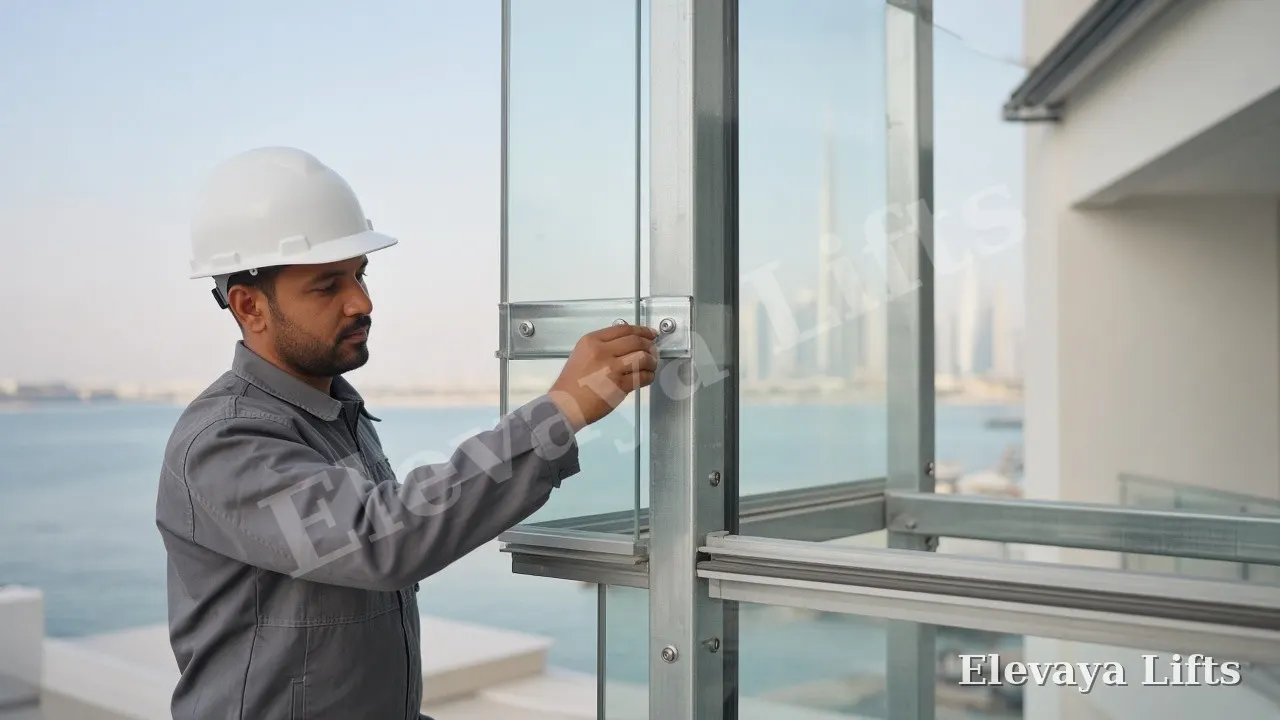
- Steel frame hot-dip galvanised and then painted with a system meant for marine exposure, with site welds and cut ends treated, not just touched up.
- Fixings in stainless steel of a grade suited to a marine atmosphere, kept apart from aluminium with isolating washers or sleeves to stop galvanic corrosion.
- Guide rails, door tracks and ropes protected and cleaned on a schedule; a little salt and sand in a door track is the most common cause of door faults on outdoor lifts.
- Electrical equipment in enclosures suited to the exposure, with cable entries sealed.
The Dubai Building Code is blunt about this for façades: fixings "shall be corrosion-resistant and of a material type appropriate for the local environment and exposure conditions" (E.4.1.1). An outdoor glass lift shaft fixed to a villa wall should be designed to the same thinking.
Why does an outdoor glass lift fog up, and is humidity a problem?
Because cold glass meets humid air. On humid late-summer evenings in Dubai, a cabin cooled to a comfortable temperature can make its own glass colder than the dew point of the air outside, and the outside face mists over. It is a nuisance, not a hazard, and it is managed by not over-cooling, by cooling the shaft as well as the cabin on some designs, and by keeping air moving across the glass.
The bigger humidity issue is electrical. The Dubai Building Code's electrical section lists the conditions that equipment has to operate in, including a maximum ambient air temperature of 48 °C and relative humidity up to 100% (Table G.3 in G.4.6). Lift controllers, drives, door operators and landing buttons on an outdoor lift sit right in those conditions. Ask for the supplier's rated operating temperature and humidity, and where the controller will live. A shaded, ventilated or cooled cabinet is far better than a steel box on a sunny wall.
Do not forget water. Dubai does get heavy downpours now and then, and an outdoor lift needs a drained pit or base, falls away from landing door sills, and sealed cable routes so rainwater does not run into the electrics.
Which standards and approvals apply to an outdoor glass lift in Dubai?
The same lift rules as an indoor villa lift, with more questions about the structure and the façade. The Dubai Building Code requires lifts to be designed, installed, tested, commissioned and maintained to one suite of standards, ASME A17 or BS EN 81, without mixing them (D.5), and applies that to villas where a lift is provided (K.5.5.4).
For EN 81 lifts, EN 81-20 covers passenger lifts, and its own scope says supplementary requirements have to be considered in special cases, including "extreme climate conditions". That is the line to put in front of a supplier who offers an indoor lift for an outdoor position. Slower home lifting platforms fall under EN 81-41, now in its 2024 edition, and the manufacturer should confirm in writing that the model is approved for outdoor installation.
On approvals, expect a master developer NOC first (Nakheel on Palm Jumeirah, Emaar in Emirates Hills, and so on), then the building permit from the authority for your plot, which is Dubai Municipality for most villas and Trakhees or another authority in some areas. An external shaft changes the elevation of the villa, so community design guidelines matter more than for an indoor lift. Confirm the exact requirements with your consultant and the authority for your plot before you commit. Our villa lift permit and NOC guide walks through the steps.
What maintenance does an outdoor glass lift need?
More than an indoor one, and on a fixed rhythm. Monthly visits are the baseline. On an outdoor glass lift we add checks that an indoor lift rarely needs: seals and gaskets, glass edges and fixings, corrosion at welds and fixings, drainage at the pit and landings, sand in door sills and tracks, and the cabin cooling unit and its drain.
Elevaya's non-comprehensive AMC for a G+1 Dubai villa lift starts from AED 2,500 a year, with 12 visits, fixes for issues found and free 24-hour emergency callouts; parts are charged only when needed. Larger or more exposed lifts are quoted after we see them. We maintain lifts of all brands, including Otis, KONE and Schindler, and lifts we did not install, so an existing outdoor lift can be taken on after an inspection. See our home lift maintenance service for what a visit covers.
Glass cleaning is separate from lift maintenance on most villas. Near the sea, salt film and dust build up quickly, so agree who cleans the outside of the shaft, how often, and how they reach it safely.
What does designing for the climate add to the cost?
It adds to the budget, but it is cheaper than fixing a lift that was not designed for outdoors. The main cost drivers are the steel and its coating system, the glass specification, cabin cooling, shading or canopies, drainage and waterproofing, and access for installation and cleaning. Bespoke glass lifts are priced after a site survey. For the full picture of what moves the price, read how much a bespoke glass panoramic villa lift costs in Dubai.
How do we plan an outdoor glass lift for a Dubai villa?
We start with the sun and the sea, then the lift. On a survey we:
- Track the sun on the proposed elevation at different times of day and check what shade exists or can be added.
- Check the exposure to sea air and wind, and the distance from the waterline.
- Look at the structure the shaft will fix to, and the route for bringing glass in.
- Plan the equipment space for the controller and drive away from direct sun.
- Agree the cabin cooling and the parking floor.
- Map the approvals with the master developer and the authority.
Then we put it in writing: glass make-up, steel and coating system, cooling, drainage and the maintenance plan. You can compare that against other proposals line by line. For placement and styling ideas, our panoramic lifts page and glass villa lift guide are useful starting points.
Related Elevaya guides
- What glass specification (laminated, tempered, smoked or smart switchable glass) is best for villa lifts?: plies, interlayers, heat soaking, tints, smart glass and Dubai safety glazing rules.
- How much does a bespoke glass panoramic villa lift cost in Dubai in AED, including installation?: what moves the price of a glass lift and what a full quote covers.
- Glass villa lift in Dubai: footprint, heat, glazing and cost factors: structures, drives and space for glass home lifts.
- Glass and panoramic villa lifts in Dubai: a planning guide: placement and styling ideas for glass lifts.
- Palm Jumeirah villa lifts: glass, privacy and upkeep: local notes for Palm Jumeirah homes.
- Can you install a luxury elevator in an already built Dubai villa without a concrete shaft or deep pit?: self-supporting structures and shallow-pit options.
- How much noise in decibels does a luxury gearless villa elevator make inside a bedroom-adjacent shaft?: bedroom decibel targets from WHO and DIN 8989, Dubai Building Code noise rules, airborne and structure-borne paths, shaft isolation and how to measure.
- Can a luxury home lift integrate with KNX, Lutron or Control4 smart home lighting and access systems?: what a villa lift can share with a smart home, relays vs gateways, access control, what stays in the lift controller, cybersecurity and Dubai rules.
Related Elevaya services and guides: Bespoke luxury villa lifts, Panoramic lifts, Home lifts, Lift design, Home lift maintenance, Emirates Hills villa lifts, Contact Elevaya.
FAQ
Can an outdoor glass lift work in Dubai's summer heat?
Yes, if it is designed for it. That means shading or solar-control glass, a cabin cooling unit, electronics rated for the ambient temperature and a controller kept out of direct sun.
Will Dubai sun crack the glass of a panoramic lift?
Lift glass is laminated from toughened or heat-strengthened plies, which resist the thermal stress that can crack ordinary glass in part sun and part shade. The frame must also allow the glass to expand.
Is an outdoor glass lift safe near the sea on Palm Jumeirah?
Yes, with marine-grade detailing: galvanised and painted steel, suitable stainless fixings isolated from aluminium, sealed electrics, and regular cleaning of door tracks and rails.
Why does my glass lift fog up in the evening?
The cooled glass is colder than the dew point of the humid air outside, so moisture condenses on it. Less aggressive cooling and air movement across the glass usually solve it.
How often should an outdoor glass lift be serviced?
Monthly, with extra checks for seals, corrosion, drainage and sand in the door tracks. Elevaya's AMC for a G+1 villa lift starts from AED 2,500 a year with 12 visits.
Plan an outdoor glass lift with Elevaya
If you are thinking about a glass lift on the outside of a villa in Palm Jumeirah, Emirates Hills, Jumeirah Bay or anywhere else in the UAE, start with a site survey. Call or WhatsApp +971 58 584 4685, explore our bespoke luxury villa lifts, or contact Elevaya.