
Elevaya journal
How Much Noise in Decibels Does a Luxury Gearless Villa Elevator Make Inside a Bedroom-Adjacent Shaft?
How many decibels should a gearless villa lift make next to a bedroom? WHO and DIN 8989 targets, Dubai Building Code rules, isolation and testing.
Published · Elevaya Lifts
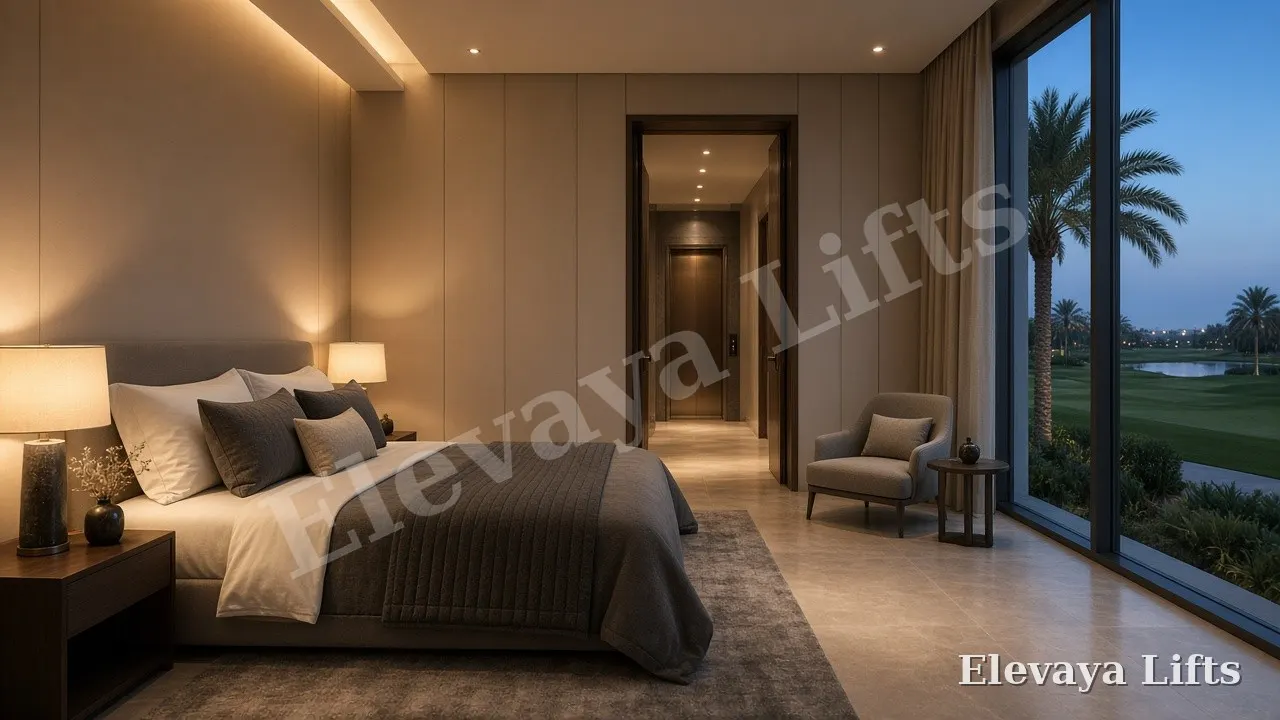
Quick answer: No standard gives one decibel figure for a villa lift, and a brochure number means little until you know where it was measured. In the bedroom itself, a sensible target is about 30 dB(A) maximum while the lift runs. That matches the German lift-noise standard for bedrooms and sits close to WHO's bedroom guideline.
We get this question in two forms. Before the build, an architect asks how many decibels the lift will make, because the master bedroom shares a wall with the shaft. After the build, an owner asks why they can hear the lift at 2 a.m. when the brochure said it was silent.
Both questions have the same answer underneath. The number that matters is not what the machine produces at one metre in a factory. It is what reaches your pillow, through your wall, with your bedroom door closed. A quiet gearless machine can still be heard next door if it is bolted to the wrong wall, and an ordinary lift can be inaudible if the shaft is built well.
This guide is about villa lift noise at that bedroom number: which decibel targets actually come from a standard, what the Dubai Building Code says, how sound gets from a shaft into a bedroom, and how to measure the result. If you are still choosing between drive types, start with our comparison of which villa lift is quietest: screw, hydraulic or gearless traction and come back here once you have chosen.
Elevaya Lifts is a UAE lift company with its office in Al Barsha 1, Dubai. Since 2019 our team of 40+ has completed more than 200 projects across all seven Emirates, covering lift design, supply, installation and maintenance, including bespoke luxury villa lifts.
Why is there no single decibel figure for a villa lift?
Because "how loud is the lift" can mean four different measurements, and they can be 20 dB or more apart.
- Inside the cabin while it travels. This is what a ride-quality test measures. It tells you how the ride feels, not what the bedroom hears.
- At the landing, in front of the doors. Door motors, locks and air movement dominate here.
- Near the machine or controller. Useful for a factory test sheet, useless for a bedroom.
- In the room next to the shaft. The only number that matters for sleep, and the one most suppliers never quote.
The units matter too. A figure in dB(A) is weighted to match human hearing. An average level over a trip (LAeq) can look low even when the lift makes one sharp clunk at every stop. A maximum level (LAFmax, measured with the meter on its "fast" setting) catches that clunk. For a bedroom, ask for the maximum, not just the average.
So when a supplier says a lift runs at a certain number of decibels, ask three follow-up questions: measured where, measured how, and was it the average or the maximum?
Which decibel targets actually come from a standard?
None of them is written specifically for a private villa in Dubai. These are the reference points we use, and what each one really says:
| Source | What it says | How we use it |
|---|---|---|
| WHO Guidelines for Community Noise | Inside bedrooms at night: 30 dB LAeq for continuous noise and 45 dB LAmax for single sound events, to avoid sleep disturbance | A health-based ceiling for the bedroom as a whole, lift included |
| DIN 8989 (German lift-noise standard) | Planning rules for shaft walls and lift equipment so that lift noise in protected rooms of homes stays below 30 dB LAF,max,n, the minimum set by DIN 4109-1 | The clearest lift-specific number we know of; a good contract target for a bedroom |
| Dubai Building Code D.7.2.1 and H.10 | Noise from elevator hoistways "shall not be heard in adjacent accommodation"; residential acoustics follow Approved Document E and BS 8233; services noise must be free of tonality and impulsiveness | The local design intent; no decibel figure of its own for lifts |
| ISO 8100-34:2021 | How to measure and report lift ride quality, including A-weighted sound in the car | The method for cabin sound; it sets no pass or fail limit |
Two honest caveats. DIN 4109-1 protects rooms in other dwellings, not rooms inside your own home, so in a private villa 30 dB(A) is a target you choose, not a legal duty. And WHO's 30 dB is for all noise in the room combined, so the lift should sit below it, not at it.
Our own rule of thumb for a bedroom wall: aim for no more than 30 dB(A) LAFmax in the bedroom with the door closed during a lift run, and no clicks or tones that stand out. That is quiet. In most bedrooms it is softer than the air conditioning.
What does a few decibels of difference actually mean?
More than it looks. The decibel scale is logarithmic, so small numbers hide big changes:
- 3 dB is a doubling of sound energy, and roughly the smallest change most people notice.
- 10 dB sounds about twice as loud. A lift that reaches 40 dB(A) in a bedroom will seem twice as loud as one that reaches 30.
- A short, sharp sound is more noticeable than a steady one at the same level. A door lock clicking at 32 dB(A) can wake someone who sleeps through a 32 dB(A) air-conditioning hum.
That last point is why the Dubai Building Code asks for building services noise to be free from "attention-catching effects, tonality and impulsiveness" (H.10.3.2). For a lift beside a bedroom, the clicks matter as much as the level.
How does lift noise get from the shaft into a bedroom?
By two routes, and they need different fixes.
Airborne sound travels through the air and then through the wall. The door operator, the controller's cooling fan, air pushed ahead of the car in a tight shaft, and voices in the cabin all reach the bedroom this way. Mass stops it: a dense, well-sealed wall works far better than a light one with gaps around pipes and sockets.
Structure-borne sound travels through the building itself. On a gearless machine-room-less lift, the machine usually sits at the top of the shaft on the rails or a bedplate, and the rails are bracketed to the shaft walls every few metres. Every vibration from the machine, the brake and the guide shoes rolling over rail joints goes into those brackets. If the brackets are on the bedroom wall, the wall becomes a loudspeaker. Mass helps less here; isolation and careful fixing help more.
In a gearless lift, these are the usual sources in a bedroom-adjacent shaft:
| Source | Type | Typical cause of complaints |
|---|---|---|
| Machine and sheave | Structure-borne, sometimes tonal | Machine fixed rigidly to the structure, worn or unisolated mounts |
| Brake | Impulsive click at start and stop | Brake adjustment, no damping, bedroom right beside the machine position |
| Drive (VVVF inverter) | Tonal whine | Switching frequency, inverter mounted on a bedroom wall |
| Controller cabinet fan | Airborne, continuous | Controller in a cupboard against the bedroom |
| Guide shoes and rails | Structure-borne rumble or thump | Rail joints not aligned, dry or worn guide shoes |
| Car and landing doors | Airborne and impulsive | Door speed and adjustment, locks closing hard |
| Air movement | Airborne whistle | Fast car in a tight shaft, gaps at landing doors |
Notice that the gearless machine is only one line in that table. That is why a quiet drive is necessary but not enough.
How do you build a quiet lift shaft next to a bedroom in a Dubai villa?
Mostly by decisions made on the drawings, long before anyone installs a lift. In new villas in Dubai Hills Estate, Tilal Al Ghaf or Emirates Hills, this is the checklist we work through with the architect:
- Don't put the bedroom against the shaft if you can help it. A wardrobe, bathroom or corridor between the two is the cheapest acoustic treatment there is.
- Fix the rails to the wall that is not the bedroom. Where the layout allows, the rail brackets go on the corridor or stair side. This one detail removes much of the structure-borne path.
- Give the shaft wall mass. Solid blockwork or concrete, plastered and sealed, on the bedroom side. Seal every penetration. A light partition with a gap at the slab edge will let sound straight through.
- Isolate the machine. Ask how the machine and its bedplate are mounted and whether resilient pads or isolators are part of the supply. On an MRL lift, ask where the machine sits relative to the top-floor bedroom.
- Keep the controller and drive off bedroom walls. A landing-side cabinet or a small plant space away from sleeping areas is better than a cupboard against the bed head.
- Choose the doors with care. Well-adjusted automatic sliding doors are quiet. Ask whether the door speed can be reduced at night.
- Tune the ride on site. Start and stop profiles, brake timing and door closing are set during commissioning. A rushed handover is where many noise complaints begin.
The code backs this up. D.7.2.1 asks that hoistway noise is not heard in adjacent accommodation, and H.10.3.3 reminds designers that on-site sound insulation is always lower than laboratory figures because of workmanship and flanking paths. Treat a manufacturer's wall rating as a best case.
Does a Dubai villa hear lift noise differently?
In one useful way, yes: the air conditioning. In most Dubai bedrooms the AC runs through the night for much of the year, and its steady sound acts as a background mask. A lift that stays a few decibels under that background is effectively unheard.
The catch comes in the cooler months. On a December night in a villa in Arabian Ranches or Al Barari, the AC may be off and the windows closed. The bedroom becomes much quieter, and a lift that nobody noticed in July is suddenly audible. So when you test, test with the AC off as well as on. Design for the quiet night, not the noisy one.
Two other local points:
- Retrofit structures. Many lifts in existing villas run in self-supporting steel or glass structures fixed to the slabs. These carry vibration differently from a concrete shaft, so the fixings to each floor deserve the same isolation thinking. Our guide to installing a luxury elevator in an existing villa without a concrete shaft or deep pit explains those structures.
- Townhouses. In compact layouts the lift often ends up beside a bedroom by necessity. See the smallest footprint for a luxury townhouse lift for how placement options compare.
How should lift noise be measured before handover?
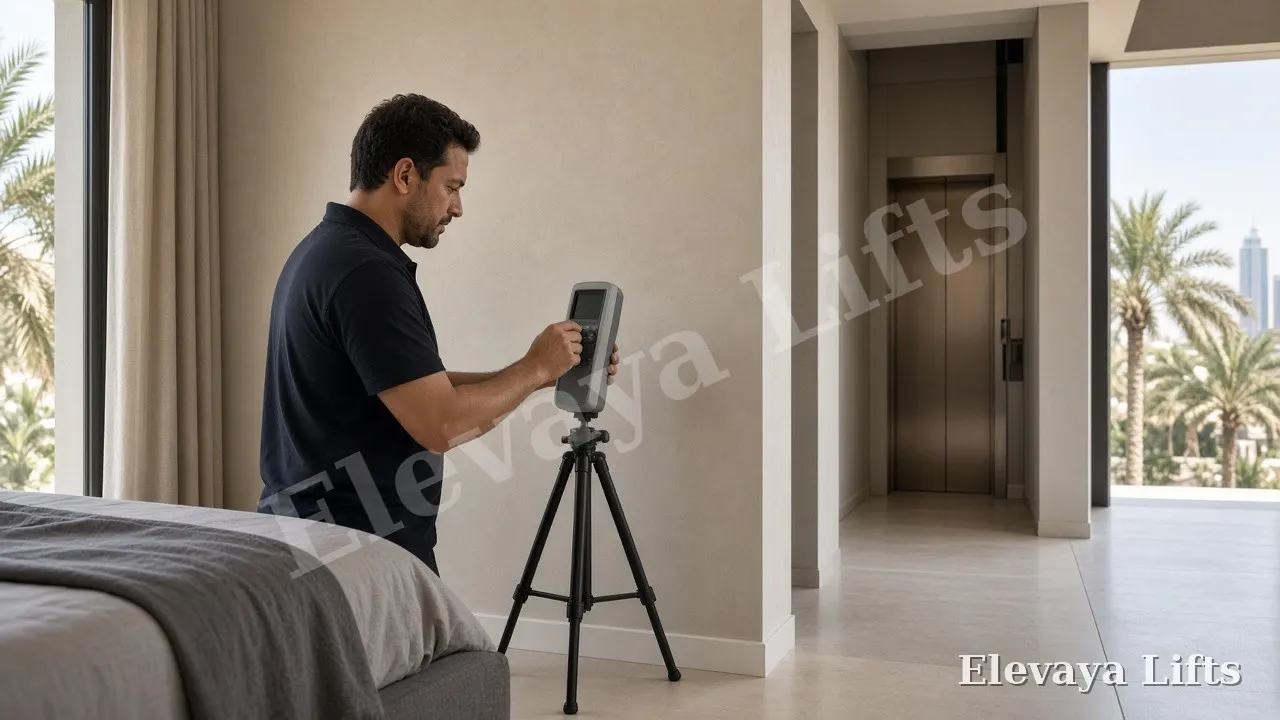
Properly, or not at all. A phone app gives you a rough idea, but the microphones are not calibrated and the readings vary from phone to phone. For a contract figure, use a sound level meter that meets IEC 61672 (Class 1 for a formal test), or have an acoustic consultant do it. The Dubai Building Code points to an acoustic consultant's guidance whenever values tighter or looser than the reference standards are used (H.10.3.1).
A simple, fair bedroom test looks like this:
- Close the bedroom door and windows. Measure with the AC off, then again with it on.
- Measure the background first, with the lift idle, for at least a minute.
- Run the lift through its full travel several times, up and down, including a stop at the bedroom floor, and record LAFmax for each run.
- Note the clicks and tones. Write down anything that stands out even if the number is low.
- Compare against what was agreed in the contract, for example "LAFmax not more than 30 dB(A) in Bedroom 1 with the door closed".
For the cabin, ISO 8100-34 sets out how ride quality and in-car sound are measured and reported, so results from different lifts can be compared fairly. Ask for that report if ride comfort was part of the specification.
What can be done if your existing villa lift is already noisy?
Most noise problems in existing lifts are adjustment and wear, not the drive. Before anyone suggests replacing the lift, we check:
- door operators, rollers and locks, which cause most night-time complaints
- guide shoes, rail joints and lubrication
- brake adjustment and the start and stop profile
- controller and drive fans, and where the cabinet sits
- loose rail brackets or a machine mount that has lost its isolation
Many of these are fixed on a single visit. Some, like a controller cabinet on the wrong wall or rails fixed to the bedroom side, need a small project. If your lift is hydraulic rather than gearless, the pump unit is the usual culprit, and our guide to hydraulic lift problems in Dubai villas covers it. For other symptoms, see common lift problems in Dubai.
Regular maintenance is what keeps a quiet lift quiet. Elevaya's non-comprehensive AMC for a G+1 Dubai villa lift starts from AED 2,500 a year. It includes 12 visits, fixes for issues found and free 24-hour emergency callouts, and parts are charged only when needed. We service lifts of all brands, including Otis, KONE and Schindler, and lifts we did not install. See our home lift maintenance service.
Does designing for low noise add to the cost?
A little, and far less when it is planned early. The cost drivers are the shaft wall build-up, isolation mounts, where the controller can go, door specification, extra commissioning time and an acoustic test at handover. Moving a bedroom wall after the shaft is built costs far more than any of these. Bespoke villa lifts are priced after a site survey, so we fold the acoustic requirements into the quote rather than adding them later. Our traction and MRL lifts page and the elevator shaft and MRL planning guide cover the space side of that planning.
If the lift is part of a wider smart home, the controller location and wiring for that also belong in the same early drawings. Our guide on integrating a luxury home lift with KNX, Lutron or Control4 explains what to plan.
Related Elevaya guides
- Which is quieter and smoother for a luxury villa: screw-driven, hydraulic or gearless traction?: drive types compared for noise and ride, and where noise comes from.
- Can a luxury home lift integrate with KNX, Lutron or Control4 smart home lighting and access systems?: what a villa lift can share with a smart home and what stays in the lift controller.
- Can you install a luxury elevator in an already built Dubai villa without a concrete shaft or deep pit?: self-supporting structures and shallow-pit options.
- What is the smallest footprint possible for a luxury townhouse lift in Dubai Hills Estate or Arabian Ranches?: compact lift sizes and positions.
- Hydraulic lift problems in Dubai villas: leaks, slow rides, heat and pump noise.
- Common lift problems in Dubai: doors, jerky rides, noise and who fixes them.
Related Elevaya services and guides: Bespoke luxury villa lifts, Traction and MRL lifts, Home lifts, Lift design, Home lift maintenance, Villa lift permits and NOCs, Contact Elevaya.
FAQ
How many decibels should a villa lift make in a bedroom?
There is no villa-specific legal limit in Dubai. A good target is about 30 dB(A) maximum in the bedroom with the door closed during a lift run, which is the level DIN 8989 uses for bedrooms and living rooms in neighbouring homes.
Is a gearless lift silent next to a bedroom?
Not automatically. The gearless machine is quiet, but brake clicks, doors, the controller fan and rails fixed to the bedroom wall can still be heard. Shaft design and isolation decide the result.
What does the Dubai Building Code say about lift noise?
Section D.7.2.1 says noise from elevator hoistways shall not be heard in adjacent accommodation, in accordance with H.10. It sets no decibel figure for lifts, so agree one with your consultant.
Can I measure lift noise with a phone app?
Only roughly. Phone microphones are not calibrated. For a contract check, use a Class 1 sound level meter or an acoustic consultant, measure LAFmax during several runs, and test with the AC off.
Why is my villa lift louder in winter?
Usually it is not louder; the room is quieter. With the air conditioning off on cool nights, there is less background sound to mask the lift, so clicks and hums become noticeable.
Plan a quiet villa lift with Elevaya
If your lift shaft will share a wall with a bedroom in Emirates Hills, Dubai Hills Estate, Palm Jumeirah or anywhere else in the UAE, bring us in while the walls are still on paper. Call or WhatsApp +971 58 584 4685, see our bespoke luxury villa lifts, or contact Elevaya to book a site survey.